
AI Personal Trainer Apps - 2026 Developer Blueprint
A technical and strategic guide for building high-performance, motion-aware fitness applications in the current market.

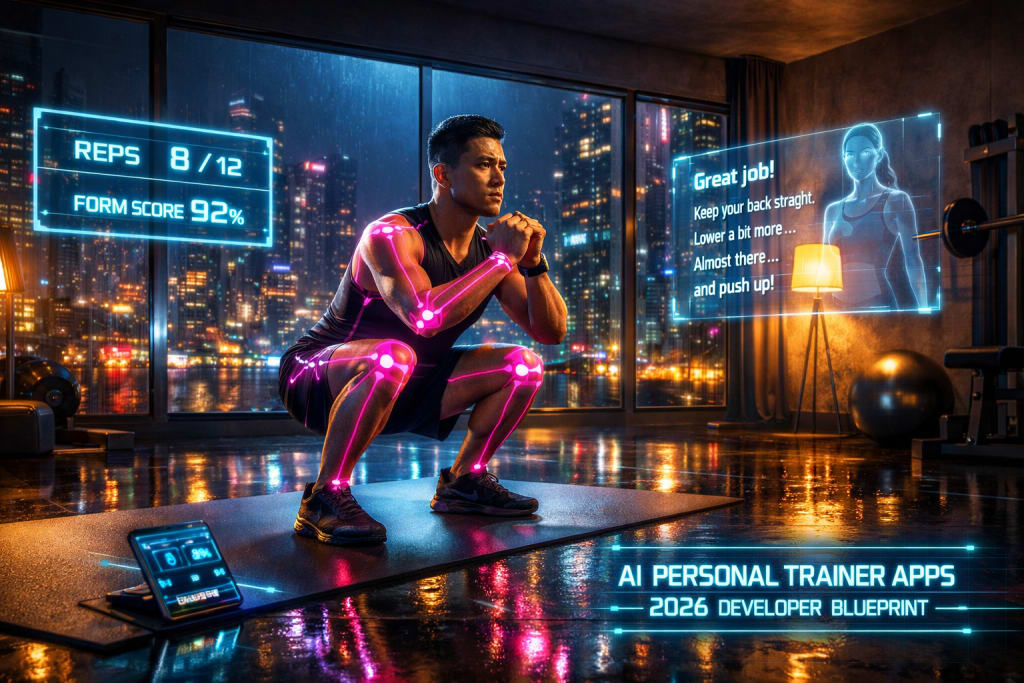
The fitness industry has seen a massive shift recently. Static video libraries are now a thing of the past. Users now demand interactive and real-time coaching. The AI Personal Trainer Apps - 2026 Developer Blueprint sets new standards. Modern apps require more than just a simple rep counter. They demand high-fidelity motion analysis. They also require empathetic feedback driven by Large Language Models (LLMs). Developers must move beyond basic API wrappers. They must build sophisticated edge-computing architectures. These systems must respect user privacy. They must also provide professional-grade athletic guidance.
This blueprint helps product owners and lead engineers. It guides the transition to autonomous AI coaches. We will examine critical infrastructure like Pose Estimation (PE) frameworks. We also cover Retrieval-Augmented Generation (RAG) pipelines. RAG helps the AI "brain" access specific fitness knowledge.
The 2026 State of AI Fitness Technology
The current landscape features the democratization of computer vision. In 2025, mobile hardware reached a major tipping point. Complex spatial transforms once required desktop GPUs. Now, they run natively on mobile neural engines. These engines are specialized chips for AI tasks. This change eliminated old latency and delay issues. Live feedback features now work instantly.
The challenge in 2026 is not just detecting a squat. The challenge is correcting the nuance of the movement. Users expect devices to identify specific form errors. One example is "butt wink," or rounding the lower back. Another is "flared elbows" during a bench press. Apps must have the accuracy of a human kinesiologist. A kinesiologist is an expert in human body movement. Developer focus has shifted toward biomechanical soundness.
Core Framework: The Three Pillars of a Modern AI Coach
Building a competitive app requires three distinct layers. These layers must work together in total synergy.
- The Computer Vision Layer (The Eyes): This layer uses frameworks like MediaPipe or ARKit. It maps 33 or more skeletal landmarks in 3D space.
- The Reasoning Engine (The Brain): This is a localized or hybrid LLM. It interprets movement data for the user. It converts data into natural language coaching cues.
- The Bio-Data Layer (The Pulse): This involves deep integration with wearable devices. It correlates movement quality with heart rate variability (HRV). It also tracks the total metabolic load on the body.
Navigating these layers requires a significant investment. It takes time and deep engineering expertise. You must calculate the financial overhead of these features. Understanding what does a fitness app actually cost to build in 2026 is vital. This knowledge helps you create a realistic project roadmap.
Real-World Implementation: Beyond the Rep Counter
Consider the "Autonomous Corrective Loop" to see this blueprint. In this scenario, the app does more than count reps. It analyzes the velocity of every single movement.
The Workflow:
- Frame Capture: The device camera captures 60 frames per second.
- Landmark Analysis: The AI identifies the user's range of motion (ROM).
- Detection: The AI sees if ROM decreased on the seventh rep.
- Inference: The LLM interprets this as fatigue-induced form breakdown.
- Audio Intervention: The app speaks to the user.
- Coaching: "Your hips are tightening up right now."
- Advice: "Slow down the eccentric, or lowering, phase next time."
This level of sophistication is no longer optional. Apps need these features for a high star rating. Some teams seek localized expertise for these interfaces. Partnering with Mobile App Development in Georgia can help. They provide talent to optimize these heavy-compute features. This ensures the app works across diverse device ecosystems.
Technical Challenges: Edge vs. Cloud Processing
A recurring debate exists in the 2026 developer blueprint. Engineers must decide where the inference, or processing, happens.
Local (Edge) Processing
- Pros: This offers zero latency and works offline.
- Pros: It provides maximum privacy for the user.
- Pros: Video data never leaves the personal device.
- Cons: This causes higher battery drain on the phone.
- Cons: It is limited by the device's Neural Processing Unit.
- 2026 Verdict: This is mandatory for real-time form correction.
Cloud Processing
- Pros: It allows access to massive, powerful models.
- Pros: This is great for long-term workout planning.
- Cons: Latency makes real-time coaching impossible to do.
- Cons: High server costs can hurt the bottom line.
- 2026 Verdict: Use this for weekly summaries and nutrition.
AI Tools and Resources
MediaPipe Holistic — This is Google’s cross-platform tracking framework.
- Best for: Real-time skeletal mapping and form analysis.
- Why it matters: It provides very low latency on mobile NPUs.
- Who should skip it: Developers building simple apps without video.
- 2026 status: It is stable and supports latest mobile chipsets.
PyTorch Mobile — An end-to-end workflow for deploying ML models.
- Best for: Custom-trained biomechanical models for specific sports.
- Why it matters: It lets developers port research models to mobile.
- Who should skip it: Teams using basic, off-the-shelf tracking APIs.
- 2026 status: This is the standard for bespoke fitness AI.
OpenAI Whisper (Localized) — High-accuracy speech-to-text for commands.
- Best for: Hands-free UI control during a workout set.
- Why it matters: Users do not need to touch sweaty screens.
- Who should skip it: Minimalist apps where voice is not core.
- 2026 status: Small, quantized versions now run efficiently on-device.
Risks, Trade-offs, and Limitations
Even the best tools can fail during implementation. Failure often happens at the human-AI interface level.
When the Solution Fails: The "Feedback Loop of Death"
In this scenario, the AI provides too many corrections. This completely overwhelms the person exercising.
- Warning signs: You see high user churn after three workouts. Users report that audio cues are very annoying.
- Why it happens: The algorithm is accurate but lacks teaching skill. It identifies five errors and reports them all.
- Alternative approach: Implement a "Hierarchy of Correction" system. Address the most dangerous error, like a rounded back. Move to minor optimizations only after safety is met.
Key Takeaways
- Privacy is the Product: Users do not want cloud video processing. Use on-device inference to build strong user trust.
- Context is King: A simple rep counter is now common. Great coaches use wearable data to adjust intensity.
- Hardware Diversity: Ensure your AI models can scale properly. Apps must run well on mid-range devices globally.
- Pedagogy over Tech: Successful apps prioritize the psychology of coaching. Better coaching beats complex code every single time.
About the Creator
Keep reading
More stories from Devin Rosario and writers in 01 and other communities.
What Does a Fitness App Actually Cost to Build in 2026
Calculating what a fitness app actually cost to build in 2026 is complex. You must look beyond simple hourly rates. The fitness technology landscape has shifted significantly recently. Basic tracking is no longer enough for users. Apps now require hyper-personalized, AI-driven coaching. They also need immersive and engaging experiences. For entrepreneurs, the investment is no longer just about coding. It is about building a data-secure ecosystem. You must also focus on high-retention systems.
By Devin Rosarioabout 4 hours ago in 01
Top Education Software Development Companies in the USA (Complete Guide)
The education industry has rapidly shifted toward digital transformation, driven by remote learning, AI-powered education tools, and mobile-first learning platforms. Businesses, universities, startups, and training organizations are increasingly partnering with Education Software Development Companies to build scalable Learning Management Systems (LMS), virtual classrooms, and intelligent eLearning applications.
By keith laurance7 days ago in 01
Creating Scroll-Stopping Experiences with Short Video App Development
In today’s fast-moving digital world, attention spans are shrinking while content consumption is skyrocketing. Users scroll endlessly through feeds, stopping only when something truly captures their interest. This behavioral shift has fueled the explosive growth of short-form video platforms. From entertainment and education to marketing and e-commerce, short videos dominate screen time. Behind every seamless swipe and instant playback lies powerful short video app development that transforms simple ideas into addictive digital experiences.
By Nayel Basim Al Shehhi3 days ago in 01



Comments
There are no comments for this story
Be the first to respond and start the conversation.