
Bablos and Freedom
The Political Economy of Will in Victor Pelevin’s Empire V

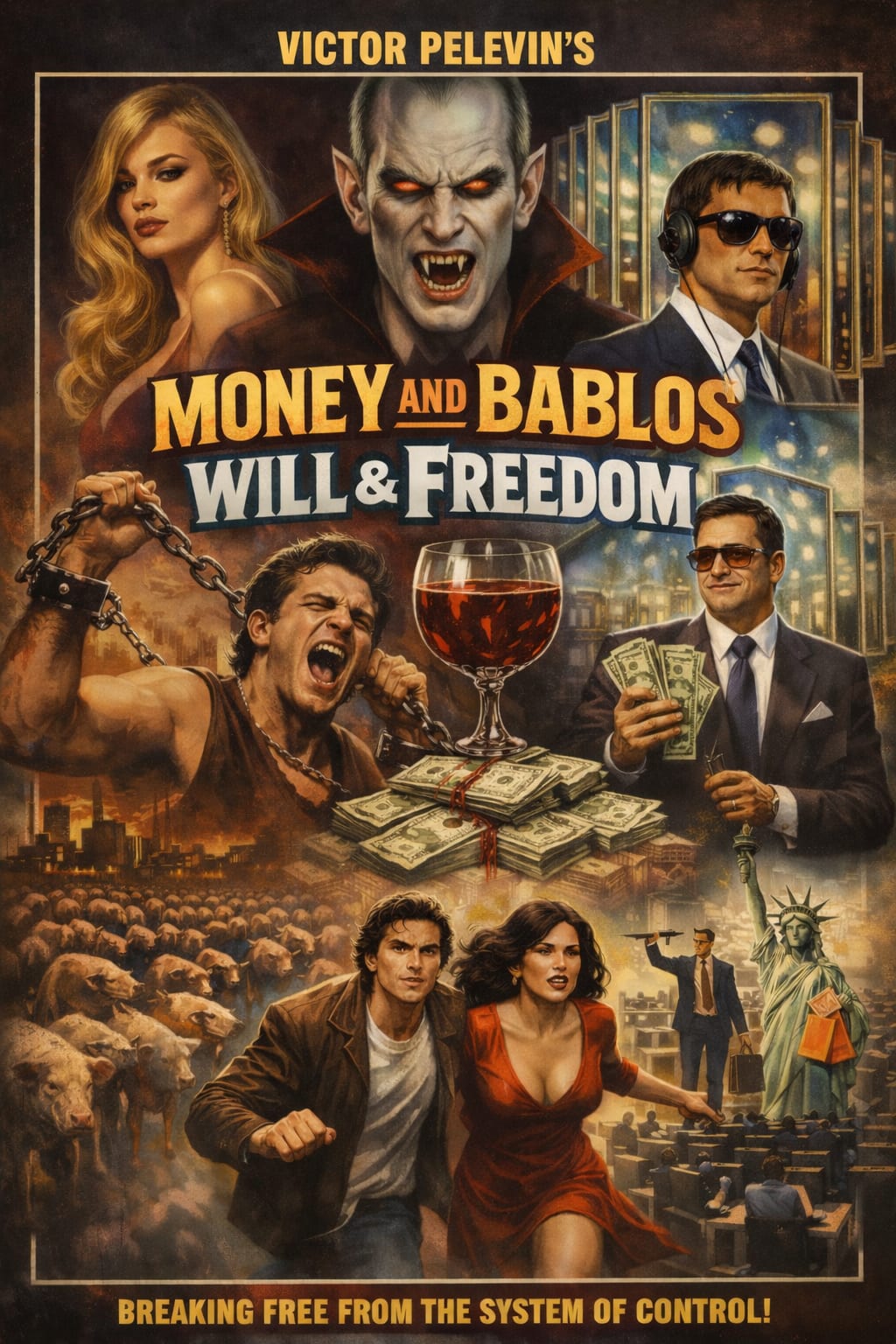
Bablos and Freedom: The Political Economy of Will in Victor Pelevin’s Empire V
In the English translation of Victor Pelevin’s novel Empire V by Andrew Bromfield, several key philosophical terms become central to understanding the strange political economy that structures the world of the vampires. Among them are three concepts that define the architecture of power in the novel: Will, Freedom, and Bablos. These terms are not merely linguistic curiosities or problems of translation; they form the philosophical backbone of Pelevin’s satire of modern capitalism. By transforming street slang and everyday political vocabulary into metaphysical categories, Pelevin constructs a disturbing vision of contemporary society in which money becomes a condensed form of human life and freedom becomes the mechanism through which that life is extracted.
At the centre of this vision lies a subtle linguistic problem. In Russian, the word volya carries a deep cultural and philosophical resonance that is difficult to reproduce in English. It refers not only to personal determination or strength of spirit but also to a state of radical openness: the endless steppe, the wild space beyond law and civilisation. Historically, volya signified the condition of being unbound by authority or structure. It is the freedom of the wilderness, the absence of constraint rather than the presence of rights.
In Bromfield’s translation, this concept becomes Will. The translation is accurate in a philosophical sense, because the term echoes the metaphysical tradition of Arthur Schopenhauer’s The World as Will and Representation. In this sense, Will is not merely a psychological trait but a primordial force: a blind, chaotic energy that drives life itself. It has no purpose beyond its own continuation and therefore cannot easily be integrated into economic systems or political institutions.
Freedom, by contrast, appears in the novel as a very different concept. It corresponds not to wild autonomy but to the liberal notion of civil liberty: the ability to choose between alternatives. The modern subject is told that freedom means having options — choosing a career, selecting products, voting for politicians, defining personal identity. Yet Pelevin reveals that these choices are carefully structured in advance. Freedom becomes the managed environment within which individuals believe they act independently while actually participating in a system designed to extract value from them.
The famous passage spoken by the vampire Enlil Maratovich expresses this paradox with brutal clarity. Addressing new members of the vampire elite, he explains that humans cannot truly be allowed to live in a state of will. They must instead be granted freedom. The difference is decisive: will is unpredictable and unproductive, whereas freedom stimulates economic activity. The more freedom humans possess, the more money they produce.
In this inversion lies Pelevin’s most provocative idea. Freedom is not the opposite of control but its most efficient instrument. By giving people the illusion that they are choosing their own paths, the system motivates them to work harder, consume more, and generate ever greater economic output. In other words, freedom becomes the mechanism through which energy is extracted from human life.
This energy appears in the novel under the strange term bablos.
In Russian slang, bablos simply means money — cash, bundles of banknotes, financial resources. Yet Pelevin insists that the word cannot be translated merely as money because in the cosmology of Empire V it refers to something much more fundamental. Bablos is the substance produced by human existence itself. It is the distilled essence of human effort, suffering, joy, and desire.
The vampires who rule Pelevin’s world do not feed on blood in the traditional Gothic sense. Instead, they feed on this economic energy generated by human civilisation. When people work, compete, consume, or pursue success, they produce bablos. The global economy therefore functions as a vast metabolic system that converts human life into energy for an invisible elite.
This metaphor turns the structure of capitalism into a biological process. Humanity becomes the digestive system of a higher species.
One of the most striking statements by Enlil Maratovich describes humans as an external part of the vampires’ peristalsis. The metaphor is intentionally grotesque. Peristalsis refers to the muscular contractions that move food through the digestive tract. By describing human society as part of this process, Pelevin suggests that the entire economic system functions as a mechanism for transforming reality into consumable energy.
Money, in this context, is not simply a symbol of value. It is the physical trace of the life-force extracted from humanity.
This is why bablos cannot be translated as ordinary currency. It represents a metaphysical substance that flows through the financial system. Every act of labour, every moment of ambition, every anxiety about status contributes to its production. The stock market, advertising industry, corporate hierarchies, and political institutions all serve as channels through which bablos circulates.
Yet the generation of this energy requires a very specific psychological condition. Humans must believe they are free.
If people possessed true will — if they experienced the wild autonomy implied by volya — they might withdraw from the system altogether. They might refuse to work endlessly for abstract rewards or decline to participate in the rituals of consumer society. In such a world, the production of bablos would collapse.
Freedom therefore functions as the psychological technology that keeps humans active. By presenting life as a field of limitless possibilities, the system encourages individuals to pursue success with relentless intensity. They compete with one another, seek recognition, and chase material symbols of achievement. All of this activity generates economic output, which ultimately becomes bablos.
Freedom is thus the long leash that allows the herd to roam while ensuring it remains productive.
Pelevin reinforces this mechanism through two additional concepts that structure the world of Empire V: glamour and discourse.
Glamour operates on the level of images. The word originally comes from Scottish folklore, where it referred to a magical spell that altered perception, making objects appear more beautiful or desirable than they actually were. In the modern world, glamour survives in advertising, fashion, and celebrity culture.
In Pelevin’s novel, glamour is a technology of visual hypnosis. It produces images that trigger desire while remaining fundamentally unattainable. The luxurious lifestyle displayed in media representations becomes a symbolic horizon that individuals constantly pursue but never fully reach.
This endless pursuit generates economic movement. People buy products, upgrade their possessions, and reshape their identities in an attempt to approach the glamorous ideal. Yet each purchase only resets the cycle, because glamour continually shifts the standard of desirability.
Discourse functions as the intellectual counterpart to glamour. While glamour controls what people feel, discourse controls how they think.
Borrowed from the vocabulary of Michel Foucault, the term discourse refers to the systems of language through which societies interpret reality. In Empire V, discourse is removed from its academic setting and placed directly within everyday life. It becomes the endless stream of commentary, ideology, expert opinion, and political analysis that explains the world to individuals.
Discourse transforms the pursuit of glamour into a rational narrative. It tells people that success is the result of merit, that consumption expresses individuality, and that economic competition is a natural feature of human life. By providing these explanations, discourse converts emotional impulses into coherent stories.
The combined effect of glamour and discourse is profound. Glamour generates desire, while discourse legitimises it. Together they create a mental environment in which humans willingly participate in the production of bablos.
Behind this system lies another of Pelevin’s metaphors: the dual structure of the human mind known as Mind A and Mind B.
Mind A perceives the external world. It processes images, advertisements, and social signals. Mind B generates internal fantasies and desires in response to these stimuli. When the two interact, they create the illusion of a stable self making choices in a meaningful world.
Pelevin compares this interaction to two mirrors facing each other. Each mirror reflects the other endlessly, creating an infinite corridor of images. Yet there is no solid object at the centre of the reflection.
This metaphor echoes Buddhist philosophy, particularly the concept of emptiness and the idea of Indra’s Net, where every jewel reflects every other jewel in an infinite web of reflections. In such a system, reality consists not of independent substances but of relationships and reflections.
Within the social world of Empire V, this endless mirroring produces the modern subject. Individuals become processes of reflection rather than stable beings. They see images of success, imagine themselves within those images, and adjust their behaviour accordingly.
The result is a perpetual cycle of aspiration and dissatisfaction that fuels the economy.
At this point the relationship between will, freedom, and bablos becomes clear. Will represents a state beyond the mirror system — a raw, unstructured form of existence that cannot easily be integrated into social or economic frameworks. Freedom, however, functions inside the mirror system. It gives individuals the impression that they control their own reflections while ensuring they continue to participate in the production of value.
Bablos is the energy produced by this participation.
In this sense, Pelevin’s novel offers a dark reinterpretation of modern liberal society. The promise of freedom, often celebrated as the foundation of democratic civilisation, appears instead as a sophisticated mechanism of control. By allowing individuals to choose among countless possibilities, the system transforms their aspirations into economic fuel.
Money becomes the visible sign of an invisible metabolism.
The brilliance of Empire V lies in the way it combines philosophical reflection with satirical exaggeration. Vampires serve as a metaphor for the structures of power that remain hidden within modern economic life. Their feeding is not literal but symbolic, representing the extraction of value from human existence.
Yet the metaphor is unsettling precisely because it feels plausible. The global economy already operates as a vast network that converts time, attention, and creativity into financial value. In this sense, bablos may not be as fictional as it initially appears.
By juxtaposing will and freedom, Pelevin exposes the paradox at the heart of contemporary society. Humans celebrate freedom as the highest political achievement, yet this freedom often takes the form of endless activity within systems that demand constant productivity.
The more freedom individuals possess, the more intensely they participate in the production of money.
The tragedy of this situation is that the original meaning of will — the wild autonomy once associated with the open steppe — gradually disappears from cultural memory. People no longer imagine a life beyond the structures of consumption and competition. Instead, they define themselves through the choices offered by the system.
Freedom becomes the pasture on which humanity grazes.
Pelevin’s vampires understand this perfectly. They do not need to enslave humanity openly because humans willingly produce the energy required to sustain the system. All that is necessary is the promise of freedom and the endless circulation of glamorous images.
In such a world, money is no longer merely a medium of exchange. It is the condensed form of human life itself.
Bablos, therefore, is not simply cash or wealth. It is the invisible substance created whenever individuals chase dreams that were never truly their own.
About the Creator
Peter Ayolov
Peter Ayolov’s key contribution to media theory is the development of the "Propaganda 2.0" or the "manufacture of dissent" model, which he details in his 2024 book, The Economic Policy of Online Media: Manufacture of Dissent.
Keep reading
More stories from Peter Ayolov and writers in BookClub and other communities.
Reflexivity at the Edge of Exhaustion
Book Review: Reflexivity at the Edge of Exhaustion There are books that describe a condition, and there are books that diagnose a structure. The Reflexivity Trap: Language, Prophecy, and the Perils of the Open Society belongs to the latter category. It does not merely comment on the political turbulence of the present or the volatility of digital media. It proposes that a single mechanism — reflexivity — has shifted from an explanatory insight into a governing script, and that this shift marks a civilisational threshold. The result is a philosophical intervention into debates on openness, media, prophecy and power that is at once systematic and unsettling.
By Peter Ayolov3 days ago in BookClub
Rachel Reviews: Lakefront Wolves by Joseph Deegan
Meet Finn. He's an 18 year old kid who has potential. He's bright with great school scores and he's also an athlete, a footballer of some prowess. He has it all going for him, it would seem, and yet, he's determined to send what could be a well-planned, stable existence firmly off the rails. He drinks, he smokes, he takes drugs, he has violent tendencies and he's in danger of losing not only his mind but all that he holds dear.
By Rachel Deeming4 days ago in BookClub
The Silent Patient: The Mind-Blowing Thriller That Left Me Questioning Sanity, Secrets, and the Truth We Hide
When I first picked up The Silent Patient, I expected a typical psychological thriller. A shocking twist or two, some suspenseful scenes, and an entertaining read. What I didn’t anticipate was how deeply it would unsettle me, how it would keep me guessing until the very last page, and how it would make me reflect on the very nature of truth, perception, and silence.
By Lukáš Hrdlička4 days ago in BookClub
Flower Bloom 369
FLOWER Bloom 2/25/26 Wednesday By Mariann Carroll Karen had been with Tony for 7 years. Tony started acting strangely after her surgery. He would mow the lawn in the rain and be on his cellphone. He started pushing Karen away. Tony came clean about seeing someone. Karen moved out two months later. Karen moved in with a friend. She felt betrayed.
By Mariann Carroll7 days ago in Fiction


Comments
There are no comments for this story
Be the first to respond and start the conversation.