

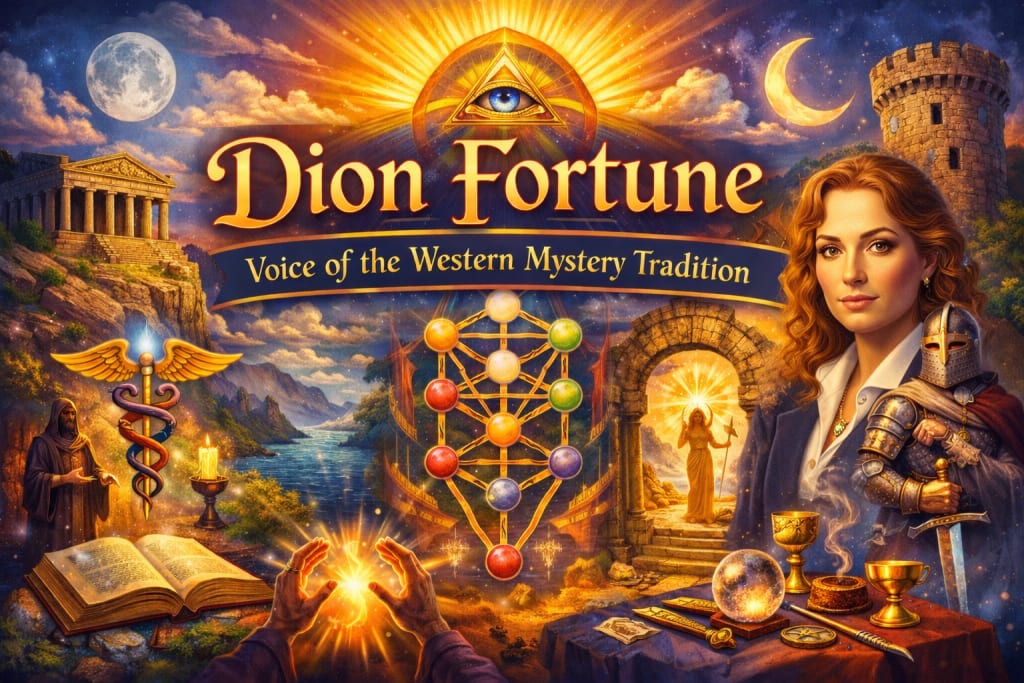
A Voice Within the Occult Revival
The early twentieth century witnessed a resurgence of interest in esoteric philosophy, ritual magic, and comparative mysticism across Britain and Europe. Within that climate of spiritual experimentation and intellectual crosscurrents, Dion Fortune emerged as one of the most articulate and disciplined exponents of the Western Mystery Tradition. Born Violet Mary Firth in 1890 in Llandudno, Wales, and later raised in England, Fortune brought together trained psychological insight, ceremonial practice, and a distinctly literary imagination at a time when occultism often struggled for intellectual credibility.
Early professional training in psychology shaped Fortune’s later esoteric formulations. Studies in psychoanalysis and work within therapeutic settings informed a view of the unconscious that paralleled mystical concepts of subtle planes and archetypal forces. Rather than separating psychology from magic, Fortune interpreted both as complementary sciences of the soul. Inner states, symbols, and ritual action were understood as mechanisms for transformation rooted in both psyche and spirit. Such integration distinguished Fortune from many contemporaries whose writings leaned either toward abstraction or theatricality.
Initiation into esoteric circles deepened this synthesis. Membership in the Hermetic Order of the Golden Dawn lineage through successor groups exposed Fortune to structured ceremonial magic, Qabalistic study, and disciplined ritual training. Subsequent involvement with the Theosophical Society broadened intellectual horizons, introducing comparative religion and Eastern metaphysics into an already complex framework. From these influences emerged an independent current of thought that emphasized the Western esoteric corpus, particularly the Hermetic Qabalah, as a living spiritual path suited to modern seekers.
In 1924, Fortune founded the Society of the Inner Light in London. This organization formalized teachings that united mystical Christianity, Qabalistic cosmology, and ceremonial discipline into a coherent initiatory structure. Written works such as The Mystical Qabalah articulated a systematic interpretation of the Tree of Life as both cosmic diagram and psychological map. Fictional works including The Sea Priestess and Moon Magic translated complex doctrine into symbolic narrative, presenting ritual and inner development through mythic storytelling. Through these texts, esoteric philosophy reached audiences beyond lodge walls and private study groups.
Intellectual seriousness characterized Fortune’s contribution. Discussions of psychic attack, group consciousness, polarity, and magical ethics were framed with analytical clarity rather than sensationalism. Engagement with questions of spiritual authority, gender polarity in ritual, and national mysticism placed Fortune within broader cultural debates of interwar Britain. Admirers regarded this synthesis as visionary. Critics questioned certain metaphysical assumptions and the blending of nationalism with esoteric symbolism. Yet even disagreement affirmed the significance of Fortune’s presence within the occult revival.
By the time of death in 1946, a distinct voice had taken shape within Western esotericism. That voice combined disciplined study, ritual practice, psychological awareness, and narrative craft into a cohesive body of work. Influence extended beyond immediate students, informing later currents within modern witchcraft, magical orders, and contemporary Qabalistic study. Within the landscape of twentieth century occult thought, Dion Fortune remains a figure whose intellectual rigor and imaginative reach secured a lasting place in the Western Mystery Tradition.
Psychology, Initiation, and Break with Orthodoxy
Violet Mary Firth entered the world in 1890 in Llandudno, North Wales, into a family shaped by Christian Science and intellectual curiosity. Education in England followed, including studies in agriculture and later psychology. Professional work during the First World War and its aftermath brought experience in therapeutic settings influenced by emerging psychoanalytic thought. Engagement with concepts of repression, trauma, and subconscious imagery would later inform an esoteric system that treated ritual as a disciplined method of psychological and spiritual integration.
Interest in mysticism did not arise in isolation. Britain during the late nineteenth and early twentieth centuries sustained an active occult revival shaped by ceremonial orders, Theosophy, psychical research, and spiritualist practice. Within this milieu, Firth encountered members of the Hermetic Order of the Golden Dawn tradition. In 1919 initiation took place within the Alpha et Omega branch, a successor body led by figures connected to the original order. Adoption of the magical name Dion Fortune derived from the Latin phrase Deo non Fortuna, translated as by God and not by chance, signaling a conviction that spiritual vocation proceeds from divine purpose rather than accident.
Training within Alpha et Omega provided structured exposure to ritual magic, Qabalistic symbolism, astrological correspondences, and graded initiation. Study of the Hermetic Qabalah, the symbolism of the Tree of Life, and the use of ceremonial implements formed the backbone of early magical discipline. At the same time, involvement with the Theosophical Society expanded awareness of comparative religion, reincarnation doctrine, and the concept of spiritual hierarchies often described as Masters or Adepts. Fortune later wrote of contact with guiding intelligences, including an exalted being identified as the Master Jesus. Such claims reflected common currents within Theosophical and occult circles of the period, where mediumship and clairvoyant communication were widely discussed.
Tensions eventually surfaced between Fortune and lodge leadership. Publication of material that interpreted and in certain respects revealed elements of Golden Dawn teaching drew criticism from superiors who regarded such disclosure as a breach of initiatory trust. Disagreements over doctrine and authority intensified the rupture. By the early 1920s separation from Alpha et Omega became definitive. The break marked not retreat but consolidation of an independent vision of Western esotericism.
In 1924, together with associates, Fortune established the Fraternity of the Inner Light in London, an organization later renamed the Society of the Inner Light. This body became the principal vehicle for teaching, ritual practice, and correspondence instruction. Curriculum drew upon Golden Dawn structure while reshaping symbolism to emphasize mystical Christianity, the Hermetic Qabalah, and a disciplined approach to psychic development. Training combined written lessons with ceremonial initiations, reflecting a belief that intellectual study must be reinforced by embodied ritual experience.
The Society of the Inner Light cultivated a model of esoteric development grounded in both inner transformation and practical technique. Meditation, pathworking upon the Tree of Life, group ritual, and ethical instruction formed an integrated path. Psychological insight informed magical work, while magical symbolism offered a framework for understanding the depths of the human psyche. Through this synthesis, the foundations of a distinct Western Mystery current took durable form in interwar Britain.
Architecture of the Inner Path: Doctrine, Discipline, and Spiritual Psychology
The body of teaching developed by Dion Fortune rests upon a structured synthesis of ceremonial practice, Qabalistic philosophy, psychic theory, and initiatory psychology. Intellectual coherence and ritual precision distinguish this system from the looser spiritual currents circulating in Britain during the interwar period. Each core element functions not as isolated doctrine but as part of an integrated map of consciousness and spiritual ascent.
Ceremonial Magic
Ceremonial magic formed the operational foundation of Fortune’s work. Training inherited from the Hermetic Order of the Golden Dawn provided graded initiation, symbolic regalia, and carefully constructed ritual scripts. Invocation served as a means of aligning consciousness with archetypal or divine forces. Evocation, more cautiously framed, concerned the controlled engagement of specific intelligences within protected ritual space.
Ritual was not treated as theatrical display. Each gesture, color, vibration of divine name, and placement of symbol corresponded to a cosmological structure rooted in the Hermetic Qabalah. Magic operated according to the principle that consciousness and symbol interact lawfully. Through disciplined repetition and ethical intention, ceremonial work refined perception, strengthened will, and integrated unconscious material into conscious awareness.
Fortune’s adaptation of Golden Dawn forms included greater emphasis on devotional elements drawn from mystical Christianity. Christ symbolism, angelic hierarchies, and sacramental language were interwoven with Hermetic correspondences. This synthesis reflected a conviction that Western esotericism possessed its own sacred lineage independent of imported Eastern systems.
Qabalistic Framework
The Qabalistic Tree of Life stands at the intellectual center of Fortune’s system. In The Mystical Qabalah, published in 1935, each sephirah is presented as both cosmic principle and psychological state. Kether represents divine unity beyond form. Tiphareth embodies spiritual harmony and the solar center of consciousness. Malkuth anchors spirit within material existence.
Rather than treating the Tree solely as abstract diagram, Fortune interpreted it as a working map of inner development. Paths between the sephiroth symbolized stages of transformation. Mythological imagery and scriptural references illustrated states of awareness encountered during meditation and ritual ascent. Dense metaphysical ideas were translated into accessible language without abandoning technical precision.
Psychological insight shaped this interpretation. Archetypal energies described in Qabalistic language corresponded to latent potentials within the human psyche. Spiritual imbalance, in this framework, arose from disproportion among these forces. Magical and contemplative practice aimed at restoring equilibrium. The Tree of Life thus functioned simultaneously as cosmology, theology, and depth psychology.
Psychic Self Defense
Publication of Psychic Self Defence in 1930 established Fortune as a practical authority within occult circles. The text addressed phenomena described as psychic attack, obsession, vampirism, and astral disturbance. Rather than sensational speculation, the work offered structured analysis grounded in both occult theory and psychological observation.
Protective methods included strengthening personal boundaries through visualization, prayer, disciplined thought, and ethical living. Ritual banishing, invocation of protective forces, and cultivation of emotional balance were presented as safeguards against suggestibility and hysteria. The tone combined caution with rational assessment. Pathological conditions were distinguished from genuine occult disturbance, reflecting awareness of psychological vulnerability.
Discussion of group consciousness and the dynamics of collective emotion anticipated later explorations in social psychology. Energetic contagion within crowds, religious movements, or political gatherings was framed as a subtle but lawful process. In this context, self defense extended beyond individual protection toward responsible participation in communal life.
Initiation as Transformation
Initiation occupies a central place in Fortune’s philosophy. Spiritual progress was not viewed as accumulation of information but as sequential expansion of consciousness. Formal lodge initiation within the Society of the Inner Light marked stages of disciplined advancement. Each grade corresponded to Qabalistic symbolism and required ethical maturity as well as intellectual comprehension.
Fiction served this initiatory vision. Novels such as The Sea Priestess and Moon Magic presented characters undergoing psychological and spiritual awakening through ritual experience. Symbolic narrative operated as indirect instruction. Readers encountering mythic drama were invited into imaginative participation that paralleled lodge work. Literature became an initiatory instrument capable of awakening dormant faculties through symbol and atmosphere.
Within this architecture of teaching, ceremonial action, Qabalistic structure, psychic awareness, and initiatory progression converge. The result is a coherent Western esoteric system grounded in disciplined study, ethical responsibility, and transformative ritual practice.
Fiction as Initiation: Myth, Magic, and Cultural Reach
The literary output of Dion Fortune occupies a distinctive place within twentieth century esoteric writing. Rather than separating doctrine from storytelling, Fortune treated fiction as a vehicle for initiatory experience. Novels became ritual spaces in narrative form, constructed to awaken symbolic awareness and guide readers through psychological and spiritual thresholds.
Among the most discussed works stands The Sea Priestess published in 1938. The novel presents a drama of lunar symbolism, priestess archetype, and ritual reconstruction of ancient mystery traditions within a modern English setting. Its sequel, Moon Magic, continued this exploration of polarity, sacred sexuality in symbolic form, and the reanimation of pre Christian mythic currents. These texts articulated themes that would later surface prominently in modern Pagan and Goddess oriented movements.
Earlier novels reveal similar integration of occult philosophy with character development. The Demon Lover examines psychic entanglement, obsession, and karmic consequence through the lens of ceremonial magic and reincarnational theory. The Winged Bull situates esoteric struggle within the charged political atmosphere preceding the Second World War, portraying magical conflict as both spiritual and national in dimension. The Goat Foot God blends classical pagan imagery with psychological transformation, presenting Pan not as caricature but as symbol of instinctual vitality seeking integration rather than repression.
Symbolism within these narratives draws heavily upon the Hermetic Qabalah, the graded initiatory system of the Golden Dawn tradition, and the ritual practices developed within the Society of the Inner Light. Characters undergo ordeals that parallel formal lodge initiation. Encounters with priestess figures, adepts, and unseen forces mirror structured pathworking upon the Tree of Life. Fictional dialogue often encodes technical instruction beneath dramatic exchange.
This method achieved two significant outcomes. Esoteric knowledge that traditionally circulated within private lodges reached a broader literate public without reducing complexity to spectacle. At the same time, narrative softened the austerity of technical manuals. Psychological realism anchored metaphysical claims in recognizable human experience. Emotional conflict, doubt, attraction, and moral choice grounded ritual symbolism in lived reality.
Influence extended beyond immediate readership. Later writers within the emerging Pagan revival encountered in these novels a model for integrating ceremonial magic with nature centered spirituality. The portrayal of priestess authority, lunar devotion, and sacralized polarity contributed to conceptual foundations later echoed in strands of modern witchcraft and Goddess spirituality. Although direct lines of transmission vary among traditions, thematic resonance is evident in subsequent twentieth century occult literature.
Fortune’s fictional corpus also advanced an argument about the power of imagination itself. Myth was not presented as antiquarian curiosity but as living structure of consciousness. Through story, archetypal forces could be engaged safely and profoundly. Literature thus became both sanctuary and laboratory, inviting disciplined reflection while preserving the mystery at the heart of esoteric pursuit.
In combining psychological acuity with ritual symbolism and narrative craft, Dion Fortune forged a literary path that expanded the reach of Western esotericism. The novels remain documents of an era in which magic, myth, and modernity converged within the written word.
Intellectual Currents Behind the Vision
The system articulated by Dion Fortune did not arise in isolation. Formation occurred within a rich network of late nineteenth and early twentieth century spiritual experimentation. Several intellectual and initiatory streams converged to shape the distinctive tone and structure of later work.
Theosophy and Spiritualist Milieus
The climate created by the Theosophical Society played a formative role in widening esoteric horizons across Britain. Theosophy promoted comparative religion, karma, reincarnation, and the concept of spiritual hierarchies guiding human evolution. Such ideas entered mainstream discussion through lectures, study groups, and publications that circulated well beyond lodge walls.
Parallel to Theosophy, spiritualist movements fostered investigation of trance mediumship, psychical research, and survival of consciousness after death. Public séances and private circles normalized discussion of clairvoyance and communication with discarnate intelligences. Within this environment, exploration of altered states carried both fascination and controversy. Exposure to these currents encouraged a view of mystical experience as a subject worthy of disciplined inquiry rather than superstition.
From Theosophy came a cosmological breadth and a vocabulary of planes, initiates, and evolutionary ascent. From spiritualist practice came familiarity with trance phenomena and psychic sensitivity. Later synthesis would temper these influences with greater structural rigor drawn from ceremonial magic.
Golden Dawn Lineage and Alpha et Omega Training
Initiation into the Alpha et Omega branch of the Hermetic Order of the Golden Dawn supplied technical scaffolding. The Golden Dawn system offered graded progression, symbolic correspondences, ritual choreography, and a detailed Hermetic Qabalistic framework. Hebrew divine names, angelic hierarchies, astrological attributions, and elemental symbolism were integrated into a cohesive initiatory ladder.
This structured environment encouraged discipline and method. Magical practice was not left to inspiration alone but anchored in tested forms and ceremonial safeguards. Later independent work retained the Tree of Life as organizing diagram while modifying ritual emphasis to include stronger devotional and psychological elements. The Golden Dawn lineage therefore provided architecture, even where reinterpretation followed.
Depth Psychology and the Unconscious
Emerging psychological theory exerted a quieter yet profound influence. Although formal discipleship under any specific analyst did not occur, familiarity with psychoanalytic thought shaped interpretation of magical experience. The writings of Carl Jung, particularly concepts of archetype and collective unconscious, offered a language capable of bridging mysticism and psychology.
Archetypal imagery within ritual and myth could be understood as expressions of deep psychic structures rather than literal external entities alone. Symbolic figures encountered in meditation might represent both transpersonal forces and interior dimensions of consciousness. This dual reading allowed esoteric practice to be framed as a disciplined engagement with the unconscious. Ritual became a method for integrating shadow elements, balancing psychic polarities, and awakening latent potential.
Such integration distinguished this approach from purely spiritist models. Psychological literacy acted as counterbalance to credulity, encouraging discernment between genuine symbolic insight and projection.
Mythology and Pre Christian Symbolism
Classical mythology and ancient religious imagery permeate later fiction and ritual writing. Greek deities, Egyptian god forms, and seasonal pagan motifs appear not as antiquarian decoration but as living symbolic languages. The figure of Pan in The Goat Foot God, lunar priestess imagery in The Sea Priestess, and temple symbolism rooted in Egyptian archetypes reflect sustained engagement with pre Christian mythic structures.
Interest in these traditions corresponded with a broader early twentieth century fascination with archaeology, anthropology, and revived pagan symbolism. Within this context, ancient myth served as a reservoir of archetypal power capable of revitalizing modern spiritual life. Symbolic polarity between masculine and feminine principles, solar and lunar forces, instinct and intellect, drew heavily upon classical sources.
These mythological elements were reframed through Hermetic Qabalah and psychological interpretation. Ancient gods became expressions of cosmic principles mapped upon the Tree of Life and mirrored within the human psyche. The result was neither simple revivalism nor academic reconstruction, but creative reanimation within a modern esoteric framework.
Through convergence of Theosophy, spiritualist experimentation, Golden Dawn structure, depth psychology, and mythological scholarship, a distinctive Western Mystery synthesis took shape. Each influence contributed vocabulary, structure, or symbolic depth. The integration of these currents produced a system at once traditional in lineage and modern in psychological awareness.
Core Ideas That Shaped Dion Fortune’s Magical Philosophy
Serious study of the Western esoteric tradition often leads to the writings and teachings of Dion Fortune. Work produced during the early twentieth century blended ceremonial magic, psychology, mythology, and spiritual philosophy into a coherent framework that influenced several later occult traditions. The following concepts stand among the most important ideas associated with Fortune’s teachings and provide essential context for understanding contributions to modern esoteric thought.
The Inner Planes
Central to Fortune’s philosophy stood the idea that reality includes multiple layers beyond the visible physical world. These subtle dimensions were described as the Inner Planes, a term widely used in Western occult literature during the early twentieth century. According to Fortune’s interpretation, human consciousness functions simultaneously within physical existence and within these subtler levels of awareness.
Within this framework, the Inner Planes contain symbolic structures, archetypal forces, and spiritual intelligences that influence human thought and culture. Meditation, ritual practice, and disciplined imagination were viewed as methods for developing awareness of these deeper layers of reality. Fortune emphasized careful training and ethical responsibility when exploring such realms, warning that psychological stability and intellectual grounding remain essential for meaningful spiritual work.
Many teachings developed within the Society of the Inner Light incorporated exercises designed to strengthen concentration and symbolic perception. Visualization, ritual symbolism, and mythic imagery served as tools for establishing contact with deeper levels of consciousness believed to exist within the Inner Planes. Fortune regarded such exploration not as fantasy but as a structured psychological discipline capable of expanding human understanding.
The Group Mind and Magical Orders
Fortune frequently emphasized the importance of collective work within structured spiritual communities. Magical orders, study groups, and ritual lodges functioned as environments where disciplined practice could unfold under guidance and mutual support. Such communities were believed to generate what Fortune described as a group mind, a shared field of intention created through focused collaboration.
Ritual activities conducted within these groups aimed to align participants around common symbolic goals. Repeated ceremonies, meditation practices, and shared study gradually strengthened collective concentration. According to Fortune’s writings, a cohesive group mind allowed spiritual symbolism to operate with greater clarity and stability than isolated individual effort.
Historical experience within organizations such as the Alpha et Omega branch of the Golden Dawn tradition informed Fortune’s views regarding the importance of structured training. Later development of the Society of the Inner Light reflected similar principles. Members engaged in regular study of mythology, philosophy, psychology, and ceremonial practice in order to cultivate balanced intellectual and spiritual development.
The Magical Use of Symbolism
Symbolism formed the foundation of Fortune’s magical philosophy. Mythological images, sacred geometry, ritual gestures, and symbolic language functioned as bridges between ordinary awareness and deeper psychological layers. Rather than treating symbolism as decorative or metaphorical, Fortune described symbolic systems as practical tools capable of shaping consciousness.
Ceremonial traditions inherited from the Hermetic Order of the Golden Dawn provided an extensive symbolic vocabulary. Planetary correspondences, elemental imagery, and Qabalistic diagrams allowed practitioners to organize spiritual concepts into coherent structures. Fortune’s writings explored ways in which symbolic meditation could awaken intuitive insight and emotional resonance.
Greek, Egyptian, and Celtic mythological themes frequently appeared within Fortune’s work. Deities, sacred landscapes, and legendary narratives served as archetypal representations of universal psychological forces. Ritual engagement with such imagery was believed to stimulate deeper layers of imagination and unlock creative spiritual perception.
The concept of symbolic participation also influenced Fortune’s fiction. Novels such as The Sea Priestess and Moon Magic integrated mythological themes into narrative form, presenting esoteric ideas through storytelling. Fiction allowed readers to encounter magical symbolism within emotional and imaginative contexts rather than purely intellectual discussion.
Psychic Self Defense
Concern with psychological boundaries and energetic protection led Fortune to develop extensive teachings on psychic self defense. Experiences reported by students of spiritualism, ceremonial magic, and trance mediumship occasionally involved emotional instability or disturbing psychological impressions. Fortune approached such issues through a combination of occult theory and practical psychological advice.
Training within the Society of the Inner Light emphasized emotional balance, ethical responsibility, and disciplined imagination. Fortune taught that uncontrolled fear, obsession, and suggestibility could produce psychological experiences mistaken for supernatural attack. Careful self observation, grounded reasoning, and stable daily habits were therefore regarded as essential safeguards.
Protective visualization and symbolic ritual were also discussed as tools for strengthening personal boundaries. Fortune encouraged students to develop mental clarity and calm concentration rather than reliance upon dramatic or sensational interpretations of psychic phenomena. Responsible spiritual practice required intellectual honesty and emotional maturity.
The well known book Psychic Self Defense explored numerous case studies illustrating how psychological suggestion, interpersonal influence, and cultural expectations could shape unusual experiences. Discussion combined skepticism with openness, presenting a framework that encouraged careful evaluation rather than unquestioning belief.
Archetypes and the Influence of Depth Psychology
Intellectual engagement with emerging psychological theories played a significant role in Fortune’s work. Particular interest developed around ideas associated with depth psychology, including concepts explored by Carl Jung concerning archetypes and the collective unconscious.
Fortune recognized striking parallels between Jungian archetypes and mythological figures encountered within ceremonial magic. Deities, symbolic guardians, and mythic narratives could be interpreted as expressions of deep psychological patterns shared across cultures. Ritual work involving archetypal imagery therefore became a method of engaging the subconscious mind in structured and creative ways.
This psychological perspective helped bridge the gap between occult philosophy and modern intellectual thought. Rather than presenting magical symbolism as literal supernatural entities, Fortune frequently discussed such imagery as manifestations of profound psychological forces operating within human consciousness.
Integration of psychology with esoteric philosophy represented an important step in the development of twentieth century magical thought. Later writers within Western occult traditions continued exploring this relationship between symbolism, myth, and the inner life of the human mind.
The Qabalistic Tree of Life as a Map of Consciousness
The Qabalistic Tree of Life formed one of the most influential structural frameworks within Fortune’s teachings. Derived from Jewish mystical traditions and adapted by Western ceremonial magic, the diagram presents ten interconnected spheres known as sephiroth, each representing aspects of divine expression and human experience.
Fortune described the Tree of Life as both a philosophical map of the universe and a diagram of human psychological development. Each sephirah corresponded to specific qualities such as wisdom, understanding, beauty, strength, and foundation. Meditation upon these symbolic spheres provided a method for contemplating the structure of existence and the stages of spiritual growth.
Training materials used within the Society of the Inner Light included extensive study of the Tree of Life. Students explored relationships between the sephiroth, planetary symbolism, mythological correspondences, and psychological states. Structured contemplation of these relationships encouraged gradual expansion of spiritual understanding.
Fortune’s book The Mystical Qabalah remains one of the most widely read introductions to the subject within modern Western occult literature. The work presented complex philosophical material in a clear and accessible manner while preserving the symbolic richness of the tradition.
Magic as a Discipline of Consciousness
Throughout Fortune’s writings, magic was consistently described as a disciplined method for directing consciousness. Ritual, meditation, symbolic study, and ethical self development formed interconnected aspects of this process. Magical practice therefore required intellectual effort, emotional maturity, and long term dedication.
Fortune rejected sensational portrayals of occultism as a path toward power or spectacle. True magical work involved careful study, balanced psychological development, and respectful engagement with symbolic traditions accumulated over centuries. Training within magical orders aimed to cultivate responsibility, self knowledge, and thoughtful exploration of spiritual ideas.
Such an approach helped shape the character of modern Western esoteric study. Fortune’s emphasis on intellectual seriousness and psychological insight encouraged many later practitioners to approach occult traditions as fields of disciplined inquiry rather than escapist fantasy.
Within the broader landscape of twentieth century spiritual thought, these concepts illustrate the distinctive contribution made by Dion Fortune. Integration of mythology, psychology, ceremonial symbolism, and philosophical reflection created a body of work that continues to influence students of Western esotericism today.
Ritual and Resolve: The Magical Battle of Britain
The approach of the Second World War cast a long shadow across Europe. Political instability, the expansion of Nazi power, and the collapse of earlier diplomatic hopes created a climate of deep unease throughout Britain. Air raid preparations, military mobilization, and public uncertainty became part of daily life after 1939. Cities prepared for bombardment while families faced the constant possibility of loss and displacement. Within this tense atmosphere, spiritual communities sought ways to maintain morale and inner stability.
Among those communities stood the circle gathered around Dion Fortune within the Society of the Inner Light. Members of this organization had long practiced ceremonial meditation, symbolic visualization, and disciplined study of the Hermetic Qabalah. Wartime conditions prompted the group to consider how such practices might serve a broader purpose beyond personal development. Spiritual effort was interpreted as a possible contribution to national resilience during a period of extreme uncertainty.
Beginning in the early months of the war, structured meditative work was organized among members of the Inner Light community. Participants gathered regularly in ritual settings or participated privately through synchronized meditation. Concentration centered upon themes of protection, endurance, and the preservation of cultural values associated with Britain. Symbolic forms drawn from ceremonial magic guided these contemplative exercises. Many of these ritual structures derived from traditions connected with the Hermetic Order of the Golden Dawn, although Fortune’s teachings introduced additional symbolic interpretations shaped by psychological insight and mythological study.
Ritual meditation often incorporated archetypal imagery connected with the land and history of Britain. Sacred landscapes, legendary guardians, and historical figures were contemplated as expressions of collective memory. Symbolic figures drawn from Arthurian legend, classical mythology, and ancient religious imagery served as focal points for meditation. Within such symbolic frameworks, the land itself was envisioned as part of a living spiritual tradition extending across centuries. Through ritual visualization, participants attempted to reinforce courage, unity, and moral determination during the darkest phases of the conflict.
Underlying these practices was a philosophical conviction that disciplined imagination could influence emotional atmosphere and collective consciousness. Ceremonial magic within the Western esoteric tradition had long regarded symbolism as a method for shaping inner states of awareness. Fortune believed that fear, despair, and psychological disorientation posed real dangers during wartime. Ritual meditation therefore focused upon cultivating steadiness of mind and clarity of purpose. Spiritual work was presented as an act of service directed toward strengthening moral resolve rather than replacing practical military effort.
Communication among members of the Inner Light community occurred through a series of letters and essays circulated privately during the war years. These writings encouraged calm reflection and emotional discipline at a time when newspapers carried daily reports of bombing raids and military setbacks. Spiritual development was described as inseparable from responsibility toward society. Meditation and ritual were framed as methods for maintaining hope, courage, and ethical clarity during periods when uncertainty threatened to overwhelm public confidence.
Later commentators began referring to these activities as the Magical Battle of Britain. The phrase reflects an interpretation of conflict that extends beyond physical warfare. According to this view, battles are fought not only through armies and machines but also within the realms of morale, imagination, and collective belief. Fortune regarded symbolic ritual as a way to align spiritual intention with the defense of cultural and moral ideals associated with Britain’s survival.
Historical interpretation of these practices remains varied. Some historians emphasize the psychological dimension of the work, noting the importance of communal support during wartime stress. Group meditation, shared symbolism, and disciplined reflection could strengthen emotional resilience in the face of constant threat. Other interpreters place the activities within a longer tradition of ceremonial magic that treats collective symbolism as capable of influencing subtle dimensions of experience. Both perspectives recognize the sincerity and dedication present within the community gathered around Fortune.
Material written during the war years was eventually gathered and published under the title The Magical Battle of Britain. The essays offer a rare glimpse into the mindset of an esoteric community confronting the realities of global conflict. Rather than withdrawing from public life, Fortune sought to interpret spiritual philosophy as a force capable of supporting courage and perseverance during crisis. The writings reveal a perspective in which mystical symbolism and historical circumstance became deeply intertwined.
Within the wider legacy of Dion Fortune, the Magical Battle of Britain stands as an unusual intersection of esoteric thought and world history. Ritual practice, philosophical conviction, and national crisis converged within a small but determined spiritual community. The episode demonstrates how ideas explored within books and ceremonial lodges were understood as living principles capable of responding to real events. For students of Western esoteric traditions, this chapter of Fortune’s life offers a compelling example of how spiritual belief can shape responses to the challenges of an uncertain age.
Debate, Disagreement, and Historical Reassessment
Public reputation of Dion Fortune developed within a lively and often contentious environment. The early twentieth century occult revival fostered intense debate concerning authority, authenticity, and the proper transmission of esoteric knowledge. Within such a landscape, strong personalities and competing interpretations of magical tradition frequently produced friction. Fortune’s writings and public statements inevitably attracted both admiration and criticism.
One recurring point of contention involved descriptions of communication with spiritual intelligences sometimes described as Masters or Inner Plane Adepts. References to guidance received through visionary experience or trance communication were not unusual within esoteric circles influenced by the Theosophical Society and related movements. Nevertheless, many practitioners within the ceremonial magic community approached such claims cautiously. Skeptics argued that visionary experiences might reflect psychological projection rather than objective contact with independent entities. Supporters countered that mystical traditions across cultures describe encounters with guiding intelligences encountered in states of deep contemplation. Debate over the nature of such experiences continues within modern esoteric scholarship.
Tension also emerged in relation to the heritage of the Hermetic Order of the Golden Dawn. The Golden Dawn tradition had already fractured into several successor groups by the early twentieth century. Disagreements over ritual authority, publication of private teachings, and interpretation of magical doctrine produced rival claims of legitimacy. Fortune’s early writings addressed certain practices within occult circles and occasionally criticized figures connected with these traditions. Such critiques were not always received favorably.
One notable exchange involved the magician and scholar Israel Regardie, who later became widely known for publishing extensive Golden Dawn material. Regardie objected to what was perceived as inaccurate representation of individuals and teachings within the magical community. Correspondence and commentary from the period reveal an atmosphere of intellectual rivalry combined with sincere concern for the preservation of initiatory integrity. These disputes reflected broader tensions surrounding secrecy, authority, and the role of publication in an initiatory tradition historically transmitted through private lodges.
Critical reassessment by modern readers has also addressed certain social assumptions present within early twentieth century occult literature. Fortune’s writings frequently emphasize polarity between masculine and feminine forces within ritual symbolism. Such concepts were framed within a metaphysical system in which spiritual balance required interaction between complementary principles. Contemporary audiences sometimes question the cultural framework underlying these ideas, particularly where discussions of gender roles appear closely tied to the social conventions of interwar Britain.
Other passages engage themes of national mysticism and collective identity that mirror intellectual currents circulating in Europe during the period between the world wars. These themes reflected widespread interest in folklore, mythic ancestry, and spiritual interpretations of national character. Modern historical scholarship approaches such material with careful contextual awareness, recognizing both cultural significance and potential limitations shaped by the era in which the work emerged.
Critical engagement does not diminish the importance of Fortune’s contribution to Western esoteric thought. Instead, examination of disagreement, debate, and historical context allows a fuller understanding of the environment in which ideas developed. Occult traditions have always evolved through discussion, reinterpretation, and sometimes vigorous dispute. Within that process, the legacy of Dion Fortune remains part of a broader conversation concerning the meaning, responsibility, and future of the Western Mystery Tradition.
Reading Recommendations: #commissionearned
Priestess: The Life and Magic of Dion Fortune by Alan Richardson
A vivid portrait of the life of Dion Fortune emerges through careful historical reconstruction in this widely respected biography. Alan Richardson examines the transformation of Violet Mary Firth from a Welsh born student of psychology into a central figure within twentieth century Western esotericism. Archival research, letters, and testimony from members of the Society of the Inner Light provide valuable insight into the daily workings of Fortune’s magical community. The narrative situates Fortune within the wider landscape of the British occult revival, including connections with traditions linked to the Hermetic Order of the Golden Dawn. Richardson also investigates Fortune’s literary output, ritual experimentation, and influence upon later magical and Pagan traditions. Attention to historical context allows readers to understand the cultural climate that shaped Fortune’s philosophy and public reputation. Rich detail and balanced interpretation make the volume particularly valuable for readers seeking deeper understanding of the ideas explored throughout this article.
The Story Of Dion Fortune by Charles Fielding and Carr Collins
Historical recollection rather than distant academic analysis characterizes this early narrative of Fortune’s life and work. Charles Fielding and Carr Collins present a concise but engaging account of the journey from the early life of Violet Firth to the emergence of Dion Fortune as a prominent voice within the Western Mystery Tradition. Description of the formation and activities of the Fraternity of the Inner Light provides valuable insight into the practical side of Fortune’s teachings. Ritual training, correspondence instruction, and group meditation form part of the picture offered by the authors. The book also captures the atmosphere of British esoteric circles during the decades between the world wars. Personal observations and institutional history combine to illuminate the environment in which Fortune’s teachings developed. Readers exploring the themes of psychology, ceremonial magic, and Qabalistic symbolism discussed in this blog will find useful historical perspective in this account.
Dion Fortune and the Inner Light by Gareth Knight
Interpretation of Fortune’s magical philosophy receives thoughtful treatment in this study by Gareth Knight, a respected teacher within the Western esoteric tradition. Knight explores the symbolic structure of the Hermetic Qabalah that formed the backbone of Fortune’s system. Detailed discussion of the Tree of Life reveals how spiritual cosmology, ritual symbolism, and psychological insight were woven into a single framework. Attention also falls upon the training structure used within the Society of the Inner Light, including meditation practices and ceremonial work derived from earlier Golden Dawn material. Knight’s familiarity with the living tradition allows explanation of technical ideas that can appear obscure in Fortune’s own writings. Connections between mythology, archetypal symbolism, and magical practice receive particular emphasis. For readers seeking a deeper grasp of the teachings described throughout this article, Knight’s work offers a clear and informed guide.
Few texts within twentieth century occult literature have generated as much lasting discussion as Psychic Self Defence, first published in 1930. Fortune addressed the subject of psychic disturbance with unusual seriousness, combining occult theory with observations drawn from psychological experience. Case studies and explanatory passages examine topics such as suggestion, emotional contagion, obsession, and deliberate psychic manipulation. Practical instruction encourages disciplined thought, emotional stability, and spiritual clarity as the strongest forms of protection. Techniques described include visualization, prayer, ritual purification, and careful cultivation of ethical character. Rather than presenting paranormal threat as sensational spectacle, the work frames psychic influence within a broader theory of human consciousness and interpersonal energy. Themes explored in the book reflect many ideas discussed throughout this blog, particularly the integration of psychology and ceremonial magic that defines Fortune’s approach to the Western Mystery Tradition.
Dion Fortune: Psychology, Magic, and the Western Mysteries by Ancient Wisdom Institute
A modern analytical perspective shapes this exploration of Fortune’s intellectual legacy. The study examines how developments in psychology during the early twentieth century influenced interpretation of magical symbolism and mystical experience. Fortune’s writings are approached as part of an attempt to reconcile esoteric philosophy with emerging theories of the human psyche. Particular attention falls upon the Tree of Life as both spiritual cosmology and psychological map. Archetypal imagery, ritual drama, and symbolic narrative are discussed as methods for engaging deeper levels of consciousness. The book also explores the lasting influence of Fortune’s ideas on later occult traditions and modern Pagan spirituality. Consideration of cultural context helps illuminate why Fortune’s synthesis of magic and psychology proved so compelling to readers. Readers interested in the philosophical foundations behind the teachings described in this blog will discover valuable insight within this interpretive work.
The intersection between occult practice and world history forms the central theme of this modern biography. Exploration of the Second World War period receives particular emphasis, including accounts of ritual meditation conducted by members of the Society of the Inner Light during the national crisis faced by Britain. These efforts later became associated with the idea sometimes described as the Magical Battle of Britain. Discussion also considers the influence of depth psychology, especially ideas linked with Carl Jung, upon interpretation of myth and symbolic imagery in Fortune’s work. Historical narrative combines with exploration of magical philosophy, creating a portrait of an occult thinker engaged with the anxieties and hopes of a turbulent era. The book provides readers with an example of how esoteric belief intersected with cultural and political realities during the twentieth century.
The Cosmic Doctrine by Dion Fortune
Cosmology rather than biography defines the focus of this challenging and fascinating text. Material within The Cosmic Doctrine presents a visionary model of the universe based upon dynamic patterns of energy and consciousness. Fortune described the content as arising through trance communication with advanced intelligences encountered during meditative states. Complex symbolic diagrams illustrate cycles of manifestation, polarity, and cosmic equilibrium. The book attempts to describe how universes emerge, evolve, and dissolve through rhythmic interaction of spiritual forces. Language often reaches into abstraction, reflecting the difficulty of expressing metaphysical ideas beyond ordinary sensory experience. Beneath the complexity lies a philosophical framework that informs much of Fortune’s later writing on ritual and psychology. Readers exploring the ideas discussed throughout this article will discover in this work the deeper cosmological vision that shaped Fortune’s understanding of magic, symbolism, and spiritual evolution.
Study, Discernment, and the Living Tradition
The legacy of Dion Fortune occupies a distinctive place within the modern history of Western esotericism. Work produced during the early decades of the twentieth century continues to influence discussion of ceremonial magic, mystical psychology, and symbolic philosophy. Careful readers encounter a body of writing that combines disciplined ritual practice with philosophical reflection and imaginative literary expression. Through books such as The Mystical Qabalah, Psychic Self Defence, and several symbolic novels, Fortune helped articulate a vision of the Western Mystery Tradition that continues to attract serious students of spiritual symbolism and inner development.
A lasting contribution lies in the effort to unite mystical experience with intellectual clarity. Ceremonial symbolism drawn from the Hermetic Qabalah, mythological imagery rooted in classical traditions, and insights related to psychology were woven into a single interpretive framework. This synthesis offered readers a way to approach esoteric subjects without abandoning reasoned inquiry. Spiritual exploration was presented as disciplined study rather than passive belief. Such an approach helped shape modern understanding of magical practice as a structured path of ethical and psychological development.
Historical distance invites both appreciation and thoughtful critique. Certain passages within Fortune’s writings reflect the cultural assumptions of early twentieth century Britain. Readers approaching the material today benefit from awareness of historical context alongside careful examination of philosophical content. Engagement with primary texts and scholarly commentary allows deeper understanding of both the achievements and limitations present within the work. Mature study of esoteric traditions requires openness to insight as well as willingness to question inherited interpretations.
Serious exploration of these ideas benefits greatly from direct reading rather than reliance upon secondhand summaries. Public libraries remain one of the most valuable resources available to students of intellectual history and spirituality. Many libraries maintain extensive collections on religion, mythology, philosophy, and the history of occult movements. Interlibrary loan programs often provide access to specialized titles that may not appear on local shelves. Quiet reading rooms, knowledgeable librarians, and curated collections offer an environment well suited for careful research.
Responsible scholarship also requires discernment when consulting material found online. Digital archives and academic databases can provide valuable access to historical texts and scholarly articles. At the same time, the internet contains large quantities of unverified commentary, incomplete excerpts, and material presented without historical context. Free online resources can serve as useful starting points, yet careful comparison with reputable editions and established scholarship remains essential. Thoughtful evaluation of authorship, publication history, and editorial reliability protects the integrity of research.
The study of Western esotericism rewards patience, curiosity, and disciplined reading. Exploration of original writings by Dion Fortune alongside biographies, historical studies, and broader works on Hermetic philosophy gradually reveals the intellectual landscape in which these teachings developed. Each carefully chosen book becomes part of a larger conversation that spans centuries of mystical thought.
Curiosity, guided by careful research and thoughtful reflection, remains the most reliable companion in such exploration. Through steady reading and informed inquiry, the ideas associated with the Western Mystery Tradition continue to unfold with depth and clarity for each new generation of readers.
About the Creator
Marcus Hedare
Hello, I am Marcus Hedare, host of The Metaphysical Emporium, a YouTube channel that talks about metaphysical, occult and esoteric topics.
https://linktr.ee/metaphysicalemporium
Keep reading
More stories from Marcus Hedare and writers in BookClub and other communities.
Trance Mediumship
The Living Voice in Altered States Trance mediumship holds a distinctive place within Western esoteric tradition. Unlike intuitive divination or clairvoyant perception, trance mediumship is defined by an altered state of consciousness in which speech, posture, facial expression, and temperament appear to shift under the influence of a perceived external intelligence. Observers have documented changes in tone, vocabulary, accent, and manner. Adherents interpret these manifestations as communication from discarnate beings. Psychical researchers have examined the same phenomena through frameworks of dissociation, subconscious cognition, and culturally conditioned religious experience. Occult practitioners have regarded trance as a disciplined method for accessing unseen dimensions of reality.
By Marcus Hedare3 days ago in BookClub
Rachel Reviews: Lakefront Wolves by Joseph Deegan
Meet Finn. He's an 18 year old kid who has potential. He's bright with great school scores and he's also an athlete, a footballer of some prowess. He has it all going for him, it would seem, and yet, he's determined to send what could be a well-planned, stable existence firmly off the rails. He drinks, he smokes, he takes drugs, he has violent tendencies and he's in danger of losing not only his mind but all that he holds dear.
By Rachel Deeming6 days ago in BookClub
I Will Teach You to Be Rich: The Step-by-Step Guide That Completely Changed How I Think About Money, Freedom, and Life
When I first picked up I Will Teach You to Be Rich, I expected a typical personal finance guide—lists of dos and don’ts, budgeting tips, and generic advice about saving and spending. What I didn’t anticipate was how practical, engaging, and life-changing this book would be. Ramit Sethi doesn’t just give financial advice; he rewires your mindset about money, empowering readers to take control of their finances in a strategic, confident way.
By Lukáš Hrdlička6 days ago in BookClub


Comments
There are no comments for this story
Be the first to respond and start the conversation.