
Julius Evola
Radical Traditionalism and the Revolt Against the Modern World

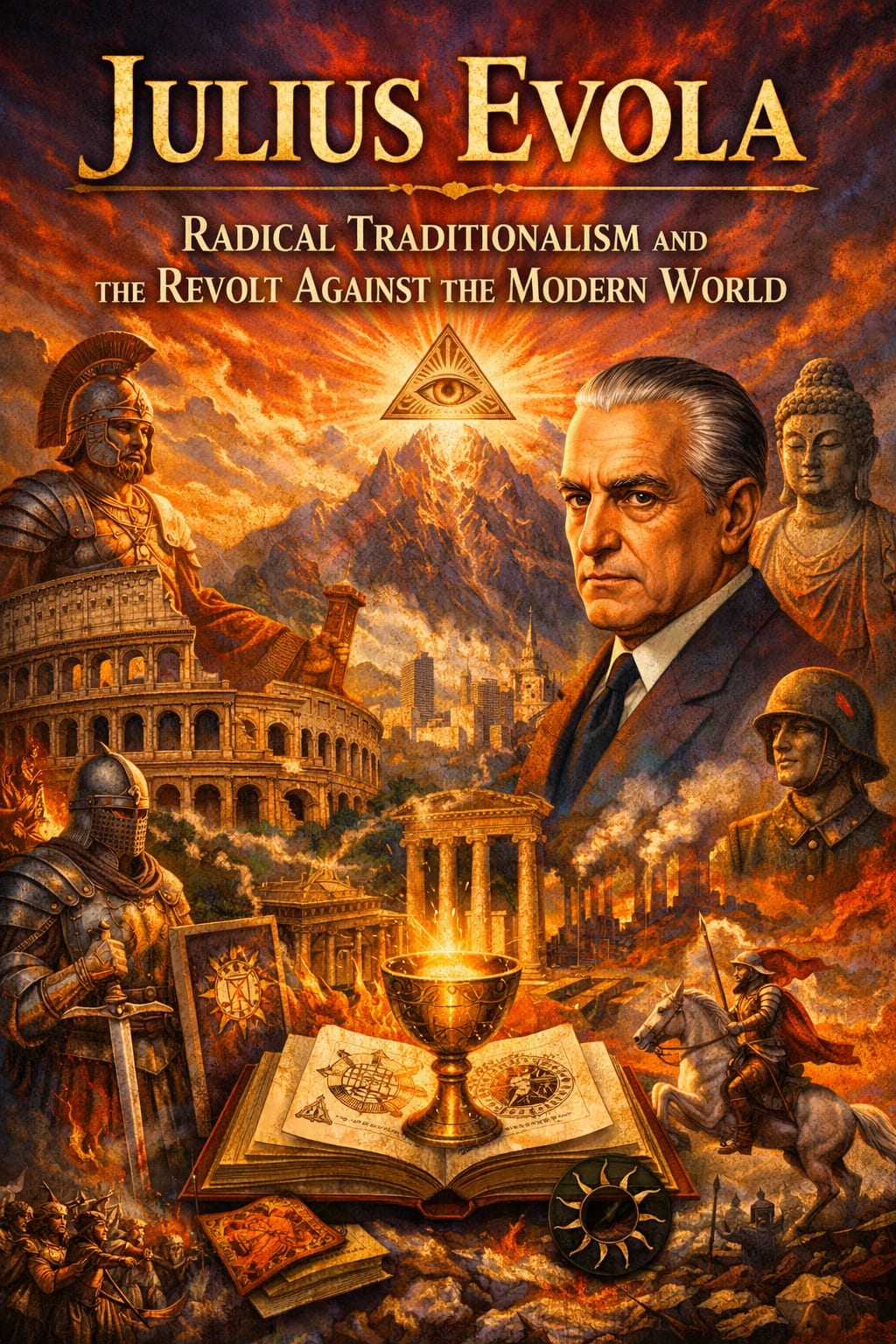
The Enigmatic Mind of Julius Evola
Twentieth century intellectual history contains a number of figures whose writings continue to provoke debate long after the surrounding political and cultural conditions have faded into the past. Among the most unusual and controversial of these figures stands Julius Evola, an Italian thinker whose work moves across an extraordinary range of intellectual territory. Philosophical reflection, esoteric speculation, cultural criticism, political theory, and comparative religion appear side by side throughout a body of work that resists easy classification.
Birth name Giulio Cesare Andrea Evola. Birth took place on 19 May 1898 in Rome, the historic capital of Italy and a city whose classical heritage formed part of the symbolic landscape that later appeared in Evola’s writing. Family background included aristocratic connections and a cultural environment shaped by the final decades of the Italian monarchy. Formal education began with technical and scientific training, including studies in engineering, though academic study soon gave way to independent intellectual exploration and artistic experimentation.
Early adulthood unfolded during a period of upheaval across Europe. Military service during the First World War exposed a generation of young Europeans to violence, instability, and the collapse of political certainties that had defined the nineteenth century. In the years that followed the war, Evola became involved in avant garde artistic circles in Rome and other Italian cultural centers. Painting and poetry associated with Futurism and Dada became part of early creative activity, reflecting the experimental spirit that marked European artistic life during the early twentieth century.
Gradual movement away from avant garde art led toward philosophy and the study of esoteric traditions. Intellectual curiosity turned toward spiritual systems that appeared to offer insight into questions of metaphysics, authority, and the structure of reality. Engagement with Western esotericism, Hermeticism, and the symbolism of ancient religious traditions began to shape a distinctive philosophical outlook. Evola also developed a serious interest in Asian religious traditions, including aspects of Hindu philosophy and certain schools of Buddhist thought, which appeared in several later studies.
Academic discussion often describes Evola as a radical traditionalist philosopher connected with the broader intellectual current known as Traditionalism. Within this framework, traditional societies were understood as cultures organized around sacred principles, hierarchical order, and metaphysical authority. Evola argued that many ancient civilizations expressed a vision of reality grounded in spiritual transcendence and symbolic cosmology. Sacred kingship, ritual authority, and aristocratic ideals appeared in this interpretation as reflections of a deeper metaphysical order.
A central theme within Evola’s writings concerns the claim that modern civilization gradually abandoned this sacred framework. Industrialization, mass politics, technological progress, and social leveling were interpreted as symptoms of a long cultural decline. Modern societies, in this analysis, increasingly emphasized material prosperity, social equality, and collective identity while losing contact with transcendent principles that once structured religious and political life. Such criticism appeared in a number of major works produced between the 1920s and the decades following the Second World War.
The political reputation attached to Evola remains one of the most debated aspects of the intellectual legacy. Historical scholarship frequently situates Evola within circles connected to Fascist Italy during the interwar period. Articles and essays addressed themes of authority, hierarchy, and the spiritual foundations of political order. At the same time, criticism directed toward fascism itself appears in several writings, particularly when modern political movements were judged to lack authentic spiritual foundations or genuine aristocratic principles.
The later decades of the twentieth century witnessed renewed scholarly interest in Evola’s ideas. Historians of religion, students of Western esotericism, and scholars of political philosophy have examined the unusual combination of mythology, metaphysics, and cultural critique that characterizes the work. Interpretations vary widely. Some readers view Evola primarily as a reactionary cultural critic of modernity, while others approach the writings as part of a broader history of esoteric thought in Europe.
Within the wider landscape of twentieth century intellectual life, the figure of Julius Evola occupies a singular position. Painter, philosopher, mountaineer, translator, and prolific essayist, Evola produced a body of work that attempts to reinterpret the spiritual foundations of civilization through myth, symbolism, and metaphysical reflection. Debate surrounding the meaning and significance of these writings has continued for decades, ensuring that the name Julius Evola remains a subject of fascination, criticism, and sustained scholarly attention.
Aristocratic Roots and the Turbulence of Early Twentieth Century Europe
Birth took place in Rome on 19 May 1898 under the name Giulio Cesare Andrea Evola. Family background traced to minor Sicilian nobility, a lineage associated with regional aristocratic traditions that remained influential within Italian cultural life during the late nineteenth century. Household environment reflected the values of a society that still maintained visible social hierarchies rooted in monarchy, landholding families, and inherited status. Such surroundings left a lasting imprint on intellectual development and later philosophical interest in aristocratic ideals, authority, and hierarchy.
Rome at the end of the nineteenth century stood at the crossroads of ancient legacy and modern transformation. The recently unified Kingdom of Italy had declared Rome the national capital only a few decades earlier. Political institutions continued to evolve while industrialization and urban expansion reshaped the physical and social character of the city. Public monuments celebrating imperial Rome and Renaissance grandeur stood alongside new boulevards, railway stations, and government ministries that symbolized the ambitions of a modern nation.
Education during childhood reflected the expectations placed upon upper class families of the period. Instruction included classical subjects such as Latin literature, history, and philosophy, disciplines regarded as essential foundations for intellectual formation. Study gradually expanded toward mathematics, science, engineering, and literature. Exposure to both classical and technical learning created an unusual intellectual mixture that later appeared in Evola’s writing, where references to ancient symbolism and metaphysical speculation often coexist with analytical discussion of philosophy and cultural theory.
European society during the early twentieth century experienced intense cultural and political upheaval. Industrial development accelerated across the continent, drawing rural populations into rapidly growing cities. Nationalist movements gained strength, socialist and revolutionary ideologies spread through industrial centers, and intellectual circles debated the meaning of modern civilization. Questions concerning the future of monarchy, religion, and social hierarchy occupied political discourse in universities, cafés, and literary salons.
Amid this atmosphere of rapid change, many young intellectuals felt drawn toward experimentation and cultural rebellion. Artistic movements challenged academic tradition, established forms of literature, and inherited social values. Early fascination with avant garde art developed during this cultural ferment. Rome, Milan, and other European capitals witnessed exhibitions, literary gatherings, and philosophical debates that attempted to redefine the role of art in a world increasingly shaped by machines, industry, and political upheaval.
War, Crisis, and the Search for Meaning
The outbreak of the First World War in 1914 transformed European society on an unprecedented scale. Italy entered the conflict in 1915, and military mobilization soon drew thousands of young men into service. Evola served as an artillery officer in the Italian army, a role that required technical training and placed soldiers close to the destructive power of modern weapons.
The conflict introduced an entire generation to mechanized warfare, trench combat, and the immense human cost of industrialized battle. European empires that had dominated global politics for centuries collapsed in the aftermath. The Austro Hungarian Empire, the German Empire, the Ottoman Empire, and the Russian Empire all disintegrated within a few years. Political revolutions, economic instability, and social unrest spread across much of the continent.
The years following the war created an atmosphere of profound uncertainty. Many intellectuals experienced disillusionment with the ideals of progress and rationality that had characterized nineteenth century optimism. Cultural life reflected this mood of skepticism and experimentation. Radical artistic movements emerged in several European cities, rejecting traditional aesthetics and embracing provocative forms of expression.
Within this climate Evola became involved with avant garde circles associated with Futurism and later with the international movement known as Dada. Dada artists sought to challenge conventional ideas of beauty, logic, and artistic order. Paintings, manifestos, and experimental poetry produced during this period often embraced paradox, absurdity, and symbolic disruption. Evola contributed paintings and literary works that reflected the restless spirit of early twentieth century modernism.
Artistic success within these circles did not bring lasting satisfaction. Growing dissatisfaction with the cultural direction of modern Europe led to a gradual withdrawal from avant garde experimentation. Increasing attention turned toward philosophical and spiritual inquiry rather than artistic rebellion.
Biographical accounts describe a period of intense personal crisis during the years following the war. The collapse of familiar cultural structures and the perceived emptiness of modern artistic movements produced a profound intellectual turning point. Study of Buddhist texts, particularly teachings connected with early forms of Buddhist philosophy, introduced a radically different approach to questions of suffering, detachment, and spiritual discipline.
This encounter with Eastern religious thought left a lasting influence on intellectual development. Themes drawn from Asian philosophical traditions later appeared within several major works devoted to comparative religion, metaphysics, and the spiritual symbolism of ancient civilizations. The search for transcendent meaning gradually replaced the earlier fascination with artistic experimentation, marking the beginning of a long intellectual journey that would define the philosophical path of Julius Evola.
From Artistic Revolt to Metaphysical Inquiry
The Dadaist Experiment
The years following the First World War witnessed a wave of artistic experimentation across Europe. Disillusionment with established cultural institutions encouraged many young artists to reject academic tradition and conventional aesthetics. Avant garde movements emerged in major cities such as Zurich, Berlin, Paris, and Rome. Futurism, Dada, and other experimental currents attempted to redefine the meaning of art in a world transformed by technological change and social upheaval.
Julius Evola entered this artistic environment during the early years of the 1920s. Early creative activity included abstract painting and experimental poetry that reflected the restless intellectual atmosphere of postwar Europe. Participation in avant garde exhibitions and artistic circles placed Evola among a generation of creators who believed that art could challenge inherited ideas about reason, culture, and identity.
Dadaism exerted a particular influence during this phase. The movement began during the war years in neutral Switzerland before spreading throughout Europe. Dada artists rejected the rational order that nineteenth century society had celebrated as a source of progress and civilization. The unprecedented destruction of the war appeared to demonstrate that faith in reason and technological advancement had produced catastrophic results. In response, Dada embraced provocation, contradiction, and symbolic disruption.
Artistic production associated with Evola during this period included abstract compositions that abandoned traditional representation. Geometric structures, fragmented forms, and dynamic spatial arrangements replaced conventional landscapes or portraits. Such works attempted to express psychological tension and spiritual unrest rather than visible reality. The paintings also revealed an emerging interest in symbolic imagery and inner experience, themes that later reappeared within philosophical writing.
Exhibitions held in Rome and other Italian cultural centers introduced these works to the public. Critics often regarded such experiments with confusion or skepticism, yet avant garde circles viewed artistic disruption as a necessary response to cultural stagnation. The purpose of art, according to many participants in these movements, involved breaking intellectual habits that confined perception and imagination.
Despite participation in this vibrant artistic world, dissatisfaction soon emerged. Artistic rebellion against tradition did not provide answers to deeper philosophical questions concerning meaning, order, and spiritual authority. The collapse of older European institutions had created a cultural vacuum that artistic experimentation alone could not fill. Gradual withdrawal from painting followed as intellectual attention shifted toward philosophy and metaphysical inquiry.
The Turn Toward Esoteric and Philosophical Study
The early 1920s marked a decisive transformation in Evola’s intellectual direction. Artistic experimentation gave way to intensive philosophical reading and study of religious traditions. Intellectual curiosity expanded toward subjects rarely addressed within mainstream academic life. Western esoteric traditions, Hermetic philosophy, mystical theology, and ancient symbolic systems became central areas of investigation.
Interest in these traditions reflected a broader cultural phenomenon within Europe during the late nineteenth and early twentieth centuries. Writers, philosophers, and scholars began to reexamine neglected spiritual traditions that had existed alongside formal religious institutions. Hermetic writings attributed to late antiquity, medieval alchemical texts, and Renaissance philosophical works inspired renewed discussion concerning hidden dimensions of spiritual knowledge.
Eastern religious traditions also attracted attention during this period. Sanskrit literature, Buddhist philosophy, and classical Hindu metaphysics became increasingly available through translations and scholarly studies. Such traditions offered philosophical perspectives that differed sharply from the materialist and rationalist outlook associated with modern Western thought. Doctrines concerning liberation, spiritual discipline, and transcendence provided an intellectual framework that appealed to seekers dissatisfied with purely secular explanations of human existence.
Within Italy, participation in small esoteric circles created opportunities for collective study and experimentation. One of the most notable initiatives associated with Evola involved the formation of the UR Group during the second half of the 1920s. This circle brought together several writers and scholars interested in ritual practice, symbolic philosophy, and forms of Western magical tradition. Articles and essays produced by members of this group appeared in specialized publications devoted to esoteric research and spiritual discipline.
Philosophical ideas developed during this period gradually formed the foundation of a distinctive system sometimes described as magical idealism. This concept proposed that reality could not be understood solely through material processes or external observation. Conscious awareness and disciplined will were regarded as active forces capable of shaping experience and transforming perception.
Within this framework, spiritual training assumed central importance. Ritual practice, meditation, symbolic study, and intellectual discipline were understood as methods for strengthening awareness and cultivating inner autonomy. Human existence, according to this interpretation, contained the potential for a higher state of consciousness that transcended ordinary limitations.
The transition from avant garde art to philosophical investigation did not represent a rejection of creativity but rather a redirection of intellectual energy. Questions concerning symbolism, imagination, and inner transformation continued to occupy a central place in later writings. Artistic rebellion had challenged cultural assumptions. Philosophical inquiry now sought deeper answers concerning the nature of reality, the structure of spiritual authority, and the possibility of transcendence within human life.
Tradition as Sacred Order
The Metaphysical Meaning of Tradition
A central pillar of Julius Evola’s philosophical system rests upon the concept of Tradition, a term given a meaning far deeper than ordinary cultural usage. In everyday language the word tradition usually refers to inherited customs, social practices, or local cultural habits transmitted from one generation to another. Evola employed the term in a radically different sense. Tradition, in this philosophical framework, signifies a primordial body of sacred knowledge that once shaped the spiritual and social structure of ancient civilizations.
This understanding of Tradition draws upon a broad range of religious and philosophical sources. Ancient Indo European cultures, classical Mediterranean civilizations, early Asian religious traditions, and medieval spiritual orders all appeared within Evola’s interpretation as expressions of a shared metaphysical heritage. Sacred symbolism, ritual authority, and hierarchical social organization represented outward manifestations of an underlying cosmic order that linked human society with transcendent principles.
In this view the political and religious institutions of earlier civilizations possessed spiritual significance that extended beyond administrative function. Kingship, priesthood, and aristocratic authority symbolized a connection between earthly governance and higher metaphysical realities. Traditional societies organized social life around this sacred structure. Religion, law, art, and political power operated within a framework that acknowledged a hierarchy extending from the divine realm through the spiritual elite and into the ordinary social order.
Evola described this system as a form of sacred civilization in which knowledge of transcendent truth guided collective life. Symbols, myths, and rituals preserved this knowledge in forms accessible to different levels of society. Religious initiates and spiritual elites served as guardians of deeper metaphysical insight, while social institutions reflected the same cosmic principles through visible hierarchy and ceremonial order.
Within this perspective, the disappearance of sacred authority represented a fundamental rupture in the continuity of civilization. The gradual rise of secular institutions, scientific materialism, and mass political participation signaled the erosion of an older worldview in which metaphysical truth once guided both individual conduct and collective organization.
Cycles of Time and the Age of Decline
Evola’s interpretation of historical development incorporated ideas drawn from ancient cosmological traditions, particularly concepts preserved within Hindu religious philosophy. Classical Indian texts describe the unfolding of cosmic time through recurring cycles known as yugas. Each cycle represents a gradual movement from spiritual clarity toward increasing fragmentation and moral decline.
The earliest phase of the cycle, often described as the Golden Age or Satya Yuga, symbolizes a state of harmony between human society and cosmic law. Spiritual authority functions openly, sacred knowledge remains widely recognized, and social order reflects metaphysical principles. Subsequent phases of the cycle mark a progressive weakening of this original unity. Ethical standards deteriorate, spiritual awareness declines, and social institutions lose connection with transcendent foundations.
The final phase of the cycle is known as the Kali Yuga, a term frequently translated as the dark age. Ancient descriptions portray this era as a time characterized by confusion, moral inversion, and the disappearance of genuine spiritual authority. Material ambition replaces sacred duty, social hierarchies dissolve, and political life becomes dominated by power struggles among competing factions.
Evola interpreted the conditions of modern civilization as a clear expression of this final stage. Industrial expansion, technological progress, and the rise of mass political movements appeared within this analysis not as signs of cultural advancement but as symptoms of a deeper spiritual exhaustion. Rapid urbanization, consumer culture, and the growth of mass communication reinforced the dominance of collective opinion over aristocratic authority and intellectual discipline.
The cyclical model of history therefore rejected the modern belief in continuous progress. Technological achievement and economic development could coexist with profound spiritual decline. According to this interpretation, external prosperity often concealed the erosion of deeper cultural foundations that once provided meaning and orientation for human life.
Recognition of the dark age carried a specific philosophical implication. Periods of civilizational decline demanded inner resistance rather than passive acceptance. Preservation of higher values, spiritual discipline, and intellectual independence represented forms of cultural survival within a deteriorating historical environment.
A Radical Critique of Modern Civilization
Rejection of Modern Ideological Foundations
The philosophical system associated with Evola developed into a sweeping critique of the political and cultural structures that emerged in Europe during the modern era. Liberal democracy, egalitarian political theory, and secular social institutions became primary targets of analysis. Such movements appeared within Evola’s interpretation as expressions of a worldview that denied transcendence and replaced spiritual authority with collective opinion.
Liberal democratic systems emphasized popular sovereignty and legal equality among citizens. From the perspective of radical traditionalism, this political model dissolved the hierarchical structure that once connected authority with spiritual responsibility. Governance based on numerical majority replaced the older concept of leadership rooted in aristocratic virtue, symbolic legitimacy, and sacred duty.
Egalitarian philosophy also represented a central object of criticism. Modern political thought often celebrates equality as a universal principle of justice and human dignity. Evola regarded such ideas as evidence of a cultural shift away from recognition of natural and spiritual hierarchy. Traditional societies acknowledged differences in spiritual capacity, intellectual discipline, and moral character. Hierarchy emerged not merely from social privilege but from the belief that individuals possessed varying degrees of inner development.
Modern economic culture formed another aspect of this critique. Industrial production, commercial expansion, and consumer markets gradually reshaped everyday life throughout the twentieth century. Mass consumption and economic competition encouraged an emphasis on comfort, wealth, and material accumulation. According to Evola’s interpretation, such priorities reduced human aspiration to purely external achievements while neglecting inner cultivation and spiritual discipline.
Secularization also transformed the relationship between religion and public life. Political institutions increasingly separated governance from theological authority. Scientific explanation replaced symbolic cosmology as the dominant framework for understanding the universe. Within Evola’s philosophy, this transformation represented the final stage of a long process in which sacred knowledge gradually disappeared from the cultural center of Western civilization.
For this reason many scholars describe Evola’s intellectual position as one of the most uncompromising critiques of modern egalitarian society produced during the twentieth century. Radical traditionalism challenged not only specific political systems but the entire philosophical foundation of modernity. Concepts such as progress, equality, and secular rationality appeared within this worldview as symptoms of a civilization that had lost contact with the sacred dimension that once guided human culture.
Spiritual Authority and the Ideal of the Warrior Aristocracy
A central social ideal within the philosophical framework developed by Julius Evola involves the concept of a warrior aristocracy. This idea reflects a vision of society organized around spiritual authority, discipline, and hierarchical order rather than political equality or economic competition. Leadership, in this interpretation, belongs to a cultivated elite whose authority arises from inner development, ethical strength, and metaphysical knowledge.
Such an elite was not understood simply as a class defined by wealth or inherited privilege. Evola described a spiritual aristocracy composed of individuals trained in self mastery, courage, and intellectual clarity. Authority emerged from character and discipline rather than popular approval. Political power, in this framework, carried symbolic and sacred meaning connected with a higher order of existence.
The model for this form of leadership appeared in several historical traditions that Evola regarded as expressions of aristocratic civilization. Indo European warrior cultures provided one of the earliest examples. Ancient societies associated with Indo European heritage often organized political authority around a tripartite structure that included priestly figures, warrior nobles, and productive social classes. Within such systems, the warrior aristocracy occupied a central role as guardians of social order and defenders of sacred law.
Roman civilization offered another historical reference point. The Roman imperial structure combined military discipline, aristocratic governance, and a strong sense of civic duty. The Roman ideal of virtus emphasized courage, honor, loyalty, and devotion to the state. Within this tradition, the ruling elite embodied both military leadership and cultural authority. Roman symbolism, architecture, and ritual life reflected a sense of connection between political order and cosmic hierarchy.
Medieval Europe also provided examples that appealed to Evola’s interpretation of tradition. Chivalric orders such as the Knights Templar and the Knights Hospitaller cultivated a combination of martial training and religious commitment. The knightly code of conduct emphasized honor, loyalty, discipline, and service to a higher spiritual purpose. Medieval chivalry therefore represented, in Evola’s view, an attempt to unite spiritual aspiration with warrior ethos.
In this model society functions through a hierarchy of roles shaped by spiritual and moral development rather than economic status or electoral power. Each level of society fulfills a distinct function, and authority flows from those who possess the highest degree of discipline and awareness. Governance by numerical majority appeared within this framework as a distortion of natural order, because collective opinion does not necessarily reflect wisdom or spiritual maturity.
The warrior aristocracy therefore symbolizes more than political leadership. The figure represents an ideal of inner sovereignty, self control, and dedication to principles that transcend personal ambition. In this vision of civilization, political authority and spiritual discipline form two aspects of the same structure of order.
Political Controversy and Historical Context
Intellectual Activity During the Fascist Era
The political dimension of Julius Evola’s career remains one of the most debated aspects of the intellectual legacy. Activity during the interwar decades placed Evola within the complex political landscape of Fascist Italy, a period characterized by authoritarian government, intense ideological conflict, and competing visions of national identity.
During the 1920s and 1930s Evola published essays and articles addressing themes such as aristocratic leadership, the nature of race, the symbolism of empire, and the spiritual foundations of political authority. Several writings appeared in journals connected with intellectual circles operating under the Fascist regime. These publications discussed the possibility of creating a political order inspired by traditional hierarchies rather than modern democratic institutions.
Historical analysis frequently identifies ideological overlap between aspects of Evola’s thought and elements of fascist political doctrine. Both perspectives emphasized authority, hierarchy, and opposition to liberal democracy. At the same time important differences also appear. Evola repeatedly criticized fascism for relying upon mass mobilization, nationalist sentiment, and modern propaganda techniques. From the standpoint of radical traditionalism, such methods reflected the same modern political mentality that characterized democratic movements.
Evola therefore described the philosophical position as transcending the ideological boundaries of contemporary political movements. Expressions such as beyond fascism or super fascist appeared in certain writings to indicate a system rooted not in nationalism or party politics but in spiritual aristocracy. The emphasis remained on the restoration of a hierarchical order guided by metaphysical principles rather than political activism alone.
Contacts with German intellectual institutions occurred during the later years of the Second World War. Research activity included studies of symbolism, myth, and secret societies associated with European history. Interest in esoteric traditions and comparative mythology attracted attention among scholars and cultural organizations in Germany during that period.
Following the collapse of Fascist Italy and the end of the war, legal proceedings in Italy examined alleged support for fascist ideology. Evola faced charges related to intellectual influence on radical political groups. Judicial review concluded without conviction, and the court ultimately acquitted Evola of direct involvement in political conspiracies.
Injury, Later Years, and Continued Writing
The closing months of the Second World War brought a dramatic personal turning point. In 1945, while present in Vienna during the final stages of the conflict, an artillery explosion injured Evola severely. A shell fragment struck near the location where Evola stood during an aerial bombardment. The injury damaged the spinal column and resulted in permanent paralysis from the waist downward.
Physical limitation did not bring an end to intellectual activity. Following recovery from the immediate effects of the injury, life continued primarily in Rome. Writing and translation work resumed with renewed intensity during the decades that followed. Books and essays published after the war addressed questions concerning the spiritual condition of modern society and the possibility of maintaining inner independence within a world shaped by cultural decline.
Later works explored the idea of personal resistance against the pressures of mass society. The disciplined individual capable of maintaining inner autonomy became a central theme during these final decades of writing. Spiritual resilience, self control, and detachment from the illusions of modern civilization appeared as guiding principles for those seeking meaning within a declining historical era.
Residence in Rome continued for the remainder of life. Intellectual activity extended into the early 1970s, producing essays, commentaries on religion and symbolism, and reflections on the cultural condition of the contemporary world. Julius Evola died in Rome on 11 June 1974 at the age of seventy six.
Final wishes reflected a lifelong fascination with mountains and alpine landscapes. Ashes were scattered in the high alpine region surrounding Monte Rosa, one of the great peaks of the Alps. The mountain environment had long symbolized endurance, elevation, and distance from the noise of modern civilization. The location therefore carried a symbolic meaning consistent with the austere and ascetic ideals that shaped the philosophical life of Julius Evola.
Inner Sovereignty and the Metaphysics of the Elite
Spiritual Elitism and the Cultivation of Higher Consciousness
A defining feature of Julius Evola’s philosophical system lies in the concept often described as spiritual elitism. The term does not refer simply to inherited privilege, economic status, or social advantage. Within this philosophical framework the word elite signifies individuals who possess a heightened degree of inner discipline, intellectual clarity, and spiritual awareness.
Human existence, according to this perspective, contains different levels of potential development. Most individuals remain closely tied to ordinary concerns involving comfort, security, and social conformity. A smaller number pursue deeper forms of self knowledge and strive for mastery over impulses that dominate ordinary life. The distinction between these two orientations forms the foundation of Evola’s concept of spiritual hierarchy.
The ideal human figure within this worldview embodies sovereignty over the self. Such a figure demonstrates independence from external pressures, resistance to emotional instability, and the capacity to act according to principle rather than impulse. Courage, discipline, and clarity of thought appear as fundamental qualities of this higher type of individual.
Evola frequently described this ideal through imagery drawn from both warrior traditions and ascetic spiritual paths. Strength of will, readiness for struggle, and intellectual detachment combine to form a model of human development that transcends conventional social definitions of success. Spiritual realization, not public recognition, serves as the measure of personal achievement.
This emphasis on inner hierarchy stands in direct contrast to the modern belief that all individuals possess equal capacities for authority or leadership. Evola regarded spiritual development as a demanding path requiring discipline, knowledge, and the cultivation of inner strength. Only a minority, within this framework, attain the level of awareness required to guide society or interpret the deeper meanings of existence.
Ascetic Discipline and the Path of Self Mastery
Closely connected with the idea of spiritual elitism is the emphasis on ascetic discipline. Many works written by Evola explore the importance of self control and inner training as necessary foundations for higher knowledge. Asceticism in this context does not necessarily imply withdrawal from society or rejection of physical life. The term refers instead to a systematic effort to achieve mastery over emotions, desires, and instinctive reactions.
Self mastery begins with control of emotional turbulence. Fear, anger, resentment, and uncontrolled enthusiasm can easily dominate human behavior. Spiritual discipline requires the capacity to observe such impulses without becoming governed by them. Calm awareness and deliberate action replace impulsive reaction.
Independence from social pressure represents another essential aspect of this training. Mass society exerts powerful influence through fashion, public opinion, political propaganda, and economic aspiration. According to Evola’s philosophy, the individual committed to spiritual development must cultivate a degree of inner distance from these forces. Such independence allows decisions to arise from principle rather than conformity.
Dedication to spiritual knowledge forms the final element of this path. Intellectual study of metaphysical traditions, philosophical reflection, and contemplation of symbolic systems provide tools for understanding deeper dimensions of reality. Knowledge becomes not merely an academic pursuit but an instrument for transformation of consciousness.
The ideal figure produced through this discipline resembles a warrior monk or spiritual knight. Martial courage and contemplative awareness merge into a single pattern of life. The disciplined individual confronts the uncertainties of existence with composure and resolve, maintaining fidelity to higher principles regardless of external circumstances.
Myth, Symbol, and the Language of Ancient Wisdom
Another prominent feature of Evola’s intellectual work involves the interpretation of myth and symbolism. Ancient narratives, religious imagery, and legendary traditions appear throughout the writings as expressions of deeper metaphysical truths. Rather than viewing myths as simple stories created by primitive societies, Evola interpreted these narratives as symbolic languages capable of conveying complex philosophical insights.
Mythological traditions from many different cultures received attention within this interpretive framework. Medieval European legends concerning the Holy Grail represent one example. Stories describing knights searching for a sacred vessel were interpreted as symbolic accounts of spiritual initiation and inner transformation. The Grail itself appeared as an image representing the attainment of higher consciousness and spiritual sovereignty.
Hindu cosmology also played a significant role within Evola’s studies of symbolism. Concepts drawn from ancient Indian texts provided a language for discussing cosmic cycles, sacred kingship, and the relationship between spiritual knowledge and social order. The imagery associated with divine manifestations, sacred mountains, and cosmic battles served as metaphors for the struggle between spiritual awareness and material decline.
Buddhist philosophical traditions contributed additional symbolic material. Certain teachings concerning liberation from attachment and the cultivation of inner clarity resonated with Evola’s emphasis on detachment and disciplined awareness. Symbolic representations of enlightenment and transcendence appeared as examples of humanity’s search for freedom from ordinary limitations.
Roman civilization also offered a powerful symbolic vocabulary. Imperial imagery, ritual ceremonies, and architectural grandeur reflected the Roman vision of order, authority, and continuity with the sacred past. The symbolism associated with Roman sovereignty appeared in Evola’s work as an example of how political authority could mirror metaphysical principles.
Across these diverse traditions Evola perceived fragments of a universal wisdom preserved within symbolic form. Myths, rituals, and sacred narratives functioned as vessels carrying ancient knowledge across centuries of cultural transformation. Careful interpretation of these symbols, according to this view, reveals insights into the nature of human existence, the structure of the cosmos, and the possibility of spiritual transcendence.
Enduring Debate and Intellectual Legacy
Renewed Academic Interest in Evola’s Work
The writings of Julius Evola continue to attract scholarly attention decades after the end of the twentieth century. Researchers in several academic fields examine the philosophical system associated with radical traditionalism as part of a broader effort to understand the intellectual landscape of modern Europe. Although the ideas remain controversial, the unusual combination of metaphysics, cultural criticism, and political theory found in Evola’s work provides an important case study within the history of modern thought.
One area of research focuses on Western esotericism. During the last several decades, historians of religion have increasingly explored the role of esoteric traditions within European intellectual life. Hermetic philosophy, Renaissance magic, alchemical symbolism, and occult movements once considered marginal subjects now receive serious academic investigation. Evola’s writings offer extensive discussion of these traditions, particularly through studies of Hermeticism, magical practice, and spiritual initiation.
Comparative religion represents another field in which Evola’s work attracts attention. The writings frequently draw connections between religious systems originating in different civilizations. Hindu metaphysics, Buddhist philosophy, ancient Roman religion, and medieval Christian symbolism appear within a single interpretive framework. Scholars studying cross cultural religious ideas often examine such material in order to understand how twentieth century thinkers attempted to synthesize diverse spiritual traditions.
Twentieth century political philosophy also forms an important context for the study of Evola’s ideas. The period between the First and Second World Wars witnessed the rise of competing ideological systems that attempted to redefine political order. Liberal democracy, socialism, fascism, and various forms of nationalist thought competed for influence across Europe. Evola’s radical critique of modern political institutions emerged within this environment, making the writings a valuable resource for historians seeking to understand the intellectual conflicts of that era.
Cultural criticism of modernity constitutes a further area of scholarly interest. Many thinkers during the twentieth century expressed concern about the social consequences of industrialization, technological change, and mass culture. Philosophers, sociologists, and cultural historians continue to explore these critiques in order to understand how modern societies have grappled with rapid transformation. Evola’s arguments concerning spiritual decline, the erosion of traditional authority, and the rise of mass civilization contribute a distinctive voice to this broader conversation.
Through these different research perspectives, Evola’s work offers insight into a network of intellectual currents that shaped European thought during the interwar period. The blending of esoteric philosophy, cultural pessimism, and political speculation illustrates how deeply the upheavals of the early twentieth century influenced philosophical reflection.
Cultural Influence and Continuing Controversy
Interest in traditionalist philosophy has expanded in several intellectual and cultural circles during recent decades. Translations of Evola’s books have introduced the writings to readers outside Italy, particularly in Europe and North America. Discussions concerning spirituality, civilizational decline, and the relationship between modern culture and ancient traditions occasionally reference themes that appear within Evola’s philosophical framework.
Certain writers and commentators explore these ideas within broader debates about the meaning of tradition in contemporary life. Questions concerning the preservation of cultural identity, the search for spiritual meaning in secular societies, and the perceived instability of modern political systems sometimes intersect with discussions of traditionalist philosophy. In these contexts, Evola’s work appears as part of a larger historical conversation about the fate of Western civilization.
At the same time, cultural influence remains accompanied by significant controversy. Historical associations with authoritarian political movements have shaped the public reputation of Evola’s ideas. Scholars and commentators frequently approach the subject with caution, recognizing the potential misuse of philosophical concepts when removed from historical context.
For this reason, academic study generally emphasizes critical examination rather than philosophical endorsement. Historians of ideas often analyze the writings as historical documents that reflect the anxieties, ambitions, and intellectual struggles of a turbulent period in European history. Such analysis allows researchers to explore the broader cultural forces that shaped radical critiques of modern society.
Within contemporary scholarship, the figure of Julius Evola therefore occupies a complex position. The writings provide a window into a distinctive philosophical system that combines metaphysical speculation, symbolic interpretation, and severe criticism of modern civilization. Continued debate surrounding this legacy reflects the enduring tension between historical understanding and the powerful ideological conflicts that marked the twentieth century.
Recommended Reading: #commissionearned
Julius Evola: The Philosopher and Magician in War: 1943–1945 by Gianfranco de Turris
The closing phase of the Second World War forms the dramatic setting for this focused historical study. Rather than presenting a full biography, the book concentrates on a narrow but decisive period in the life of Julius Evola between 1943 and 1945. During these years Evola traveled through Central Europe, spending time in Vienna while researching esoteric traditions, symbolism, and the history of secret societies connected to European spiritual heritage. Political collapse, military occupation, and ideological conflict created an unstable environment in which intellectual activity continued despite the surrounding chaos. The narrative also explores the catastrophic moment in 1945 when an artillery blast in Vienna caused the spinal injury that left Evola permanently paralyzed. De Turris reconstructs these events with attention to historical context and personal correspondence, revealing the unusual mixture of philosophical research and wartime instability that shaped Evola’s later life. Readers interested in the intersection between Evola’s metaphysical interests and the political reality of wartime Europe will find this study especially illuminating. The book deepens understanding of how the final months of the war marked a turning point that influenced Evola’s later writings on inner resistance and spiritual independence.
Few works offer such a sweeping examination of the Traditionalist movement that influenced a number of twentieth century thinkers. This book traces the development of a philosophical current that challenged modern civilization by appealing to the idea of a primordial sacred tradition shared by ancient cultures. The narrative begins with the ideas of René Guénon and follows the spread of Traditionalist thought across Europe, the Middle East, and North America. Julius Evola appears within this broader story as one of the most distinctive and controversial interpreters of traditionalist philosophy. Sedgwick carefully explains how Evola’s interpretation differed from other traditionalist writers, particularly in the emphasis placed on aristocratic authority and political order. The study also explores the surprising reach of traditionalist ideas into artistic movements, religious debates, and political circles during the twentieth century. Historical context plays a central role, allowing readers to understand how these ideas developed during a time of cultural upheaval following the First World War. For anyone exploring the philosophical foundations discussed in this blog, this book provides essential background and intellectual context.
An accessible entry point into Evola’s philosophical world can be found in this concise but thoughtful introduction. The book examines the central themes that run through Evola’s writings while presenting the ideas in language that remains clear for readers unfamiliar with the subject. Attention focuses on the concept of spiritual traditionalism and the belief that ancient civilizations possessed knowledge of transcendent principles that modern culture has largely forgotten. The author explains Evola’s criticism of modern society, including opposition to materialism, egalitarian ideology, and mass culture. Spiritual hierarchy, disciplined self mastery, and the search for transcendent meaning appear as recurring elements in this interpretation of human existence. The work also addresses the controversial reputation that surrounds Evola, acknowledging the political debates that continue to influence scholarly discussion. Rather than presenting a defense or condemnation, the book attempts to clarify the intellectual structure behind Evola’s worldview. Readers who have encountered Evola’s ideas through discussions of radical traditionalism will find this study helpful in understanding the philosophical foundations that shaped those arguments.
Traditionalism: The Radical Project for Restoring Sacred Order by Mark Sedgwick
The philosophical ambition behind the Traditionalist movement receives deeper analysis in this later study devoted to the concept of restoring sacred order in modern society. Throughout the book, the idea of tradition is treated not as folklore or cultural habit but as a metaphysical principle believed to have guided ancient civilizations. Several thinkers associated with Traditionalism appear in the narrative, yet Julius Evola occupies a particularly prominent position because of the radical character of the interpretation. Sedgwick examines how Evola transformed the idea of tradition into a sweeping critique of modern civilization and its political institutions. Discussions of spiritual hierarchy, aristocratic leadership, and cultural decline reveal the philosophical framework behind Evola’s critique of democracy and modern egalitarian values. The author also investigates how traditionalist ideas have continued to appear in modern intellectual debates, often in unexpected cultural or political contexts. Historical documentation and careful explanation make the subject accessible without simplifying its complexity. For readers examining Evola’s philosophy of radical traditionalism, this work provides a valuable explanation of the broader movement that shaped many of those ideas.
The Conservative Revolution in Germany, 1918–1932 by Armin Mohler
The intellectual climate of post First World War Europe created fertile ground for radical critiques of modern civilization. This influential historical study examines a group of German thinkers who rejected liberal democracy while searching for alternative visions of political and cultural renewal. Writers, philosophers, and political theorists associated with the so called Conservative Revolution appear throughout the book as participants in a larger debate about authority, tradition, and the meaning of national identity. Although Julius Evola was Italian, the intellectual atmosphere described here closely parallels the cultural tensions that influenced Evola’s own philosophical development. Themes such as the decline of Western civilization, the search for spiritual renewal, and the rejection of mass political culture appear repeatedly within these German debates. Mohler’s research demonstrates how widespread these concerns had become during the interwar period. By examining this broader intellectual movement, readers gain a clearer understanding of the environment in which Evola’s radical traditionalism emerged. The book therefore provides valuable historical context for anyone seeking to understand the deeper cultural anxieties that shaped European thought in the early twentieth century.
Debate, Controversy, and the Question of Legacy
Intellectual Criticism and Scholarly Scrutiny
Academic discussion surrounding the philosophical work of Julius Evola frequently centers on strong objections to the political and social implications found within many writings. A significant portion of scholarly criticism addresses the explicit rejection of democratic institutions and modern political equality expressed throughout several major texts.
Philosophical arguments presented by Evola emphasize hierarchical social organization and the concept of a spiritual aristocracy. Within this framework, cultural authority belongs to a small elite believed to possess higher spiritual awareness. Many historians and political theorists view such ideas as fundamentally incompatible with modern principles of civil equality, constitutional governance, and universal human rights. Academic debate therefore often places Evola within broader twentieth century critiques of liberal democracy.
Additional criticism focuses on portrayals of ancient civilizations. Writings frequently describe earlier societies as expressions of sacred order governed by priestly authority, warrior nobility, and ritual symbolism. Archaeological research and historical scholarship often reveal far more complex and diverse social structures. Evidence from ancient Mediterranean, Near Eastern, and Indo European cultures suggests political arrangements that included negotiation, economic conflict, and shifting power relations rather than purely sacred hierarchies. For this reason, historians often interpret Evola’s descriptions of antiquity as philosophical reconstructions rather than historical documentation.
Within academic fields such as intellectual history and the study of Western esotericism, scholars also examine the interpretive methods used in Evola’s work. Frequent blending of mythology, religious symbolism, political theory, and metaphysical speculation creates an unusual intellectual synthesis. Supporters describe this synthesis as a form of symbolic philosophy. Critics argue that such blending sometimes blurs the line between historical evidence and ideological interpretation.
Political Associations and Historical Context
Debate surrounding Evola intensified during the twentieth century because of connections between certain ideas and radical political movements in Europe. During the interwar period and the years following the Second World War, several extremist groups expressed interest in aspects of Evola’s traditionalist philosophy. Emphasis on hierarchy, spiritual authority, and rejection of modern egalitarian society resonated with ideological movements seeking alternatives to democratic political structures.
Historians examining European political thought frequently discuss Evola within studies of radical right intellectual history. Such discussion does not reduce the philosophical body of work to political ideology alone, yet political associations remain part of responsible historical analysis. Examination of historical context allows scholars to understand both the intellectual ambitions of Evola’s philosophy and the controversial environments in which certain interpretations developed.
Careful contextual study therefore remains essential for balanced scholarship. Analysis within academic research typically separates metaphysical ideas, cultural criticism, and political influence in order to understand each dimension clearly.
Continuing Intellectual Curiosity
Despite persistent controversy, interest in Evola’s writings continues within several academic and cultural fields. Modern readers approach the work from multiple perspectives, often focusing on specific themes rather than adopting the entire philosophical system.
Areas of continuing study include:
- Investigation of traditional metaphysical systems and sacred cosmology
- Comparative interpretation of mythological and religious symbolism
- Philosophical criticism of industrial modernity and technological society
- Examination of twentieth century radical intellectual movements
- Historical study of Western esoteric traditions and perennial philosophy
The unusual range of subjects addressed in Evola’s work contributes to this continued attention. Mythology, metaphysics, religious symbolism, cultural critique, and political reflection appear together within a single body of writing. Such breadth attracts readers interested in the intersections between philosophy, religion, and cultural history.
Modern academic engagement often treats Evola primarily as a historical figure within the intellectual landscape of the twentieth century. Research in religious studies, esotericism, and intellectual history frequently examines themes such as symbolism, ritual traditions, and interpretations of ancient cosmology. Other readers approach the work as a form of cultural criticism directed against the social and spiritual consequences of modern industrial civilization.
The resulting legacy remains complex. Intellectual influence, controversy, philosophical ambition, and historical debate all form part of the continuing discussion surrounding the writings of Julius Evola.
Reading Evola with Historical Awareness and Critical Balance
Serious engagement with the philosophical writings of Julius Evola requires patience, historical awareness, and intellectual distance. The body of work produced across the twentieth century spans metaphysics, religion, symbolism, cultural criticism, and political thought. Careful study benefits from recognizing the intellectual environment in which these writings emerged as well as the debates that later surrounded the ideas.
The decades that shaped Evola’s philosophy witnessed extraordinary political upheaval across Europe. The collapse of long standing monarchies following the First World War, the rise of revolutionary movements, and widespread anxiety about the direction of modern civilization formed the cultural background for many radical critiques of modern society. Within this environment, philosophical arguments about hierarchy, spiritual authority, and the decline of traditional values gained attention among certain intellectual circles seeking alternatives to liberal political systems and industrial modernity.
Understanding this broader historical landscape allows readers to situate Evola within the larger currents of twentieth century European thought. Many contemporaries across philosophy, literature, and political theory explored similar themes involving cultural decline, spiritual crisis, and dissatisfaction with technological society. Knowledge of this intellectual climate prevents interpretation from isolating Evola’s work from the era that produced it.
A careful reading strategy often begins with the study of historical context. Exploration of European cultural debates between the two world wars reveals the tensions that shaped many philosophical arguments of the period. Economic instability, ideological conflict, and the search for renewed spiritual foundations formed the background for a wide range of cultural critiques. Evola’s writing participates in this wider conversation about the direction of modern civilization.
Balanced scholarship also benefits from consulting multiple interpretations offered by historians, philosophers, and scholars of religion. Academic discussion surrounding Evola spans several disciplines, including intellectual history, political theory, and the study of Western esotericism. These perspectives examine different dimensions of the work, from metaphysical symbolism and religious traditions to the political implications of hierarchical social theory.
Comparative study provides another valuable approach. Examination of Evola alongside other figures associated with traditionalist philosophy reveals both similarities and important differences in interpretation. Themes such as sacred kingship, cyclical views of history, and the preservation of ancient spiritual knowledge appear across several traditionalist writers, yet each author presents distinct philosophical conclusions. Comparative reading therefore clarifies which ideas reflect broader intellectual traditions and which belong specifically to Evola’s personal synthesis.
Critical evaluation of arguments forms an equally important part of responsible engagement. Philosophical analysis invites readers to examine the reasoning behind claims about history, spirituality, and social organization. At the same time, awareness of scholarly criticism helps illuminate areas where historians and researchers question certain interpretations of ancient cultures or political conclusions derived from metaphysical principles.
Scholarly inquiry benefits from this balanced method of study. Careful attention to historical context, engagement with diverse interpretations, and thoughtful examination of philosophical arguments together create a framework for responsible exploration. Such an approach encourages understanding rather than ideological reaction and allows complex intellectual legacies to be examined with clarity and depth.
Independent Inquiry and the Responsibility of Study
The intellectual legacy of Julius Evola occupies a distinctive place within twentieth century intellectual history. Artistic experimentation, metaphysical speculation, religious symbolism, cultural criticism, and political controversy intersect throughout a life marked by philosophical ambition and radical ideas. No single category fully captures the range of subjects explored across essays, books, and lectures.
A complex philosophical system emerges from this body of work. Themes involving spiritual hierarchy, cyclical views of history, sacred kingship, and criticism of modern civilization appear repeatedly. These ideas challenge many assumptions commonly associated with modern democratic societies, including concepts of historical progress, universal equality, and secular cultural development. Because of these challenges, the writings continue to provoke debate among historians, philosophers, and scholars of religion.
Critics frequently point to troubling political implications and the historical associations that surrounded certain circles of radical thought in twentieth century Europe. Supporters, however, often emphasize philosophical reflections on spirituality, symbolism, and the preservation of ancient traditions. Historical reality contains elements that fuel both interpretations. Intellectual study therefore requires careful attention to context, language, and historical development rather than reliance on simplified characterizations.
Close reading reveals a thinker attempting to interpret modern civilization through the lenses of mythology, comparative religion, and metaphysical philosophy. Ancient traditions drawn from Hindu cosmology, classical Roman symbolism, Buddhist teachings, and medieval European legend appear as symbolic frameworks used to describe spiritual decline and the possibility of inner transformation. The resulting synthesis connects cultural history with spiritual speculation in ways rarely encountered within modern philosophical literature.
No single article, lecture, or online discussion can capture the full complexity of such a body of work. Meaningful understanding develops through sustained reading, comparison of interpretations, and engagement with scholarly criticism. Biographies, historical studies, and academic examinations of traditionalist philosophy provide valuable perspectives that illuminate both influence and controversy.
Public libraries remain one of the most valuable resources for serious intellectual exploration. Library collections often contain biographies, academic studies, and translations of primary texts that may not appear in casual online searches. Librarians also assist researchers in locating materials across regional networks, academic databases, and historical archives. Access to carefully curated collections helps readers encounter well documented scholarship rather than fragmented information.
Free online resources can also assist independent study, yet caution remains essential when navigating digital information. Websites sometimes present incomplete summaries, ideological interpretations, or unsourced claims that obscure historical complexity. Responsible research therefore benefits from cross checking information, consulting reputable academic publications, and comparing multiple perspectives before drawing conclusions.
Intellectual curiosity thrives when supported by disciplined research. Examination of primary texts allows direct engagement with philosophical arguments rather than secondhand descriptions. Scholarly critiques reveal how historians and philosophers evaluate those arguments within broader intellectual traditions. Comparative reading across academic fields such as religious studies, intellectual history, and political philosophy deepens understanding of both influence and controversy.
Careful investigation ultimately allows readers to form independent conclusions about the work and legacy of Julius Evola. Thoughtful study encourages critical reflection, historical awareness, and a broader appreciation for the complex debates that shaped twentieth century intellectual life.
About the Creator
Marcus Hedare
Hello, I am Marcus Hedare, host of The Metaphysical Emporium, a YouTube channel that talks about metaphysical, occult and esoteric topics.
https://linktr.ee/metaphysicalemporium
Keep reading
More stories from Marcus Hedare and writers in BookClub and other communities.
Frances Swiney
Pioneer of Feminist Thought and Spiritual Reform The final decades of the nineteenth century and the early years of the twentieth century marked a period of profound transformation. Industrial expansion reshaped cities and economies, while scientific discoveries—from Darwinian evolution to advances in medicine—challenged traditional beliefs about human nature and the natural world. Political unrest, labor movements, and debates over social justice created an atmosphere in which long-standing institutions and hierarchies were called into question. Within this climate of change, societies across Europe and North America saw the rise of movements demanding reforms in education, workers’ rights, and political representation.
By Marcus Hedareabout 14 hours ago in BookClub
Rachel Reviews: Lakefront Wolves by Joseph Deegan
Meet Finn. He's an 18 year old kid who has potential. He's bright with great school scores and he's also an athlete, a footballer of some prowess. He has it all going for him, it would seem, and yet, he's determined to send what could be a well-planned, stable existence firmly off the rails. He drinks, he smokes, he takes drugs, he has violent tendencies and he's in danger of losing not only his mind but all that he holds dear.
By Rachel Deeming6 days ago in BookClub
7 Stoic Books You Must Read In 2026
In a world that feels increasingly chaotic and uncertain, Stoicism offers a timeless framework for resilience, clarity, and meaningful action. This ancient philosophy, founded in Athens over 2,000 years ago, teaches us how to navigate life’s challenges with composure, focus on what we can control, and cultivate inner peace. For anyone seeking practical wisdom, personal growth, or mental clarity, exploring the right Stoic literature can transform your mindset and daily habits.
By Diana Meresc7 days ago in BookClub



Comments
There are no comments for this story
Be the first to respond and start the conversation.