
Buildings That Once Defined Architectural Excellence
Exploring the Legacy of Masterpieces That Shaped Our Cities and Culture

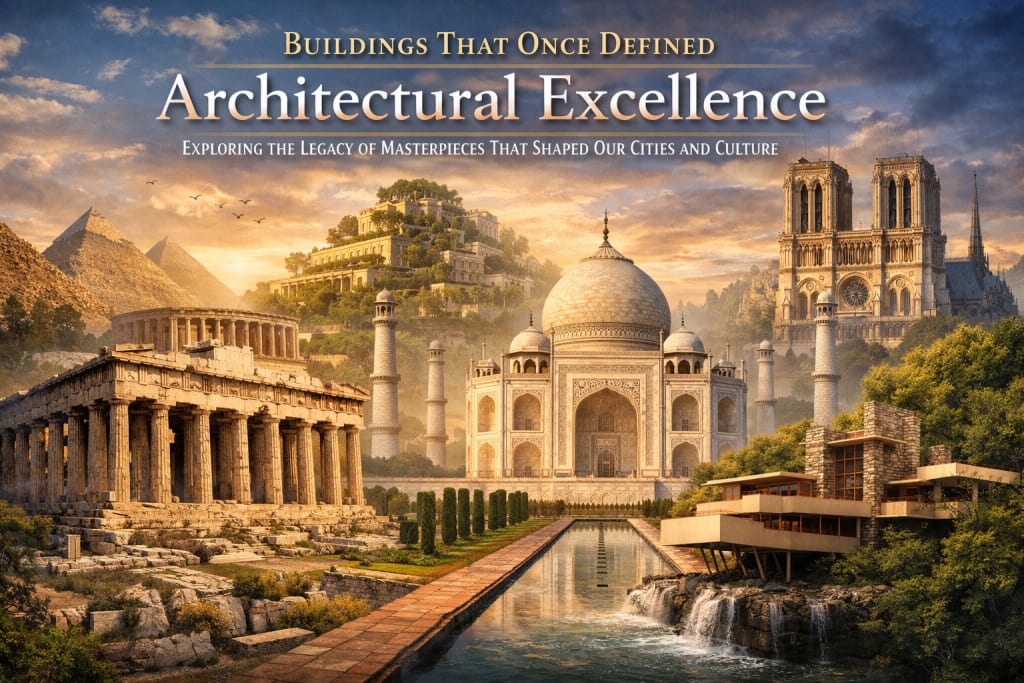
Architecture is a reflection of human creativity, culture, and technological advancement. Throughout history, certain buildings have stood as symbols of innovation, artistic brilliance, and societal values. These structures, often celebrated in their time as pinnacles of design and functionality, offer insights not only into aesthetic preferences but also into the civilizations that built them. While some continue to inspire contemporary architecture, others have faded into memory, leaving behind stories and ruins that capture the imagination.
One notable example is the Parthenon in Athens, Greece. Constructed in the 5th century BCE, the Parthenon epitomized the ideals of classical Greek architecture. Its perfect proportions, intricate sculptures, and Doric columns symbolized the cultural and intellectual achievements of ancient Athens. Beyond its aesthetic value, it served as a temple dedicated to the goddess Athena, intertwining spiritual and civic pride. Even today, architects study its harmonious symmetry and mathematical precision as a benchmark for design excellence.
Moving from Europe to Asia, the Taj Mahal in Agra, India, stands as a monument to love and architectural ingenuity. Built in the 17th century by Mughal Emperor Shah Jahan in memory of his wife Mumtaz Mahal, this white marble mausoleum blends Persian, Islamic, and Indian architectural styles. Its perfectly symmetrical layout, reflective pools, and ornate inlay work showcase an attention to detail that transcends time. The Taj Mahal remains one of the most photographed and visited buildings globally, reflecting its lasting aesthetic and emotional impact.
In Europe, the Palace of Versailles in France represents the grandeur of Baroque architecture. Commissioned by Louis XIV, the Sun King, the palace was designed not just as a royal residence but as a political statement. Its expansive gardens, ornate halls, and elaborate facades illustrated power, wealth, and meticulous planning. Versailles influenced the design of royal palaces and civic buildings across Europe, highlighting how architecture can serve both functional and symbolic roles.
Meanwhile, in the United States, the Fallingwater House, designed by Frank Lloyd Wright in 1935, epitomizes modern architectural excellence. Built over a waterfall in Pennsylvania, the house integrates nature into its design, demonstrating a philosophy of organic architecture. The cantilevered terraces, use of natural materials, and seamless blending with the surrounding landscape illustrate a revolutionary approach to design that continues to inspire architects worldwide.
Some buildings, however, serve as reminders of lost glory or vanished civilizations. The Great Library of Alexandria in ancient Egypt, although no longer standing, was celebrated for its architectural and intellectual sophistication. Housing countless scrolls and manuscripts, it represented humanity’s quest for knowledge and cultural preservation. Similarly, the Hanging Gardens of Babylon, while shrouded in mystery, are often cited in historical accounts as a marvel of engineering and artistry, with tiered gardens and innovative irrigation techniques that would have required extraordinary skill.
Architecture also serves as a cultural time capsule, reflecting the social and political contexts of its era. For instance, Gothic cathedrals like Notre-Dame de Paris in France combined spiritual devotion with engineering genius. Their flying buttresses, pointed arches, and stained-glass windows not only enabled towering structures but also created spaces that elevated the human spirit. These edifices remind us that architecture is more than shelter—it is storytelling in stone, glass, and wood.
In the modern era, some once-celebrated buildings face challenges due to neglect, urbanization, or environmental threats. Preserving architectural masterpieces has become crucial to maintaining cultural heritage. Restoration projects, historical designations, and international collaborations aim to ensure that future generations can witness the ingenuity of past architects.
Ultimately, the buildings that were once considered the finest examples of architectural achievement do more than impress visually. They embody cultural values, technological progress, and the human drive for beauty and innovation. Whether they stand in ruins, continue in use, or inspire modern designs, these structures remind us that architecture is a dialogue across centuries—a bridge connecting past creativity with present imagination.
About the Creator
Irshad Abbasi
Ali ibn Abi Talib (RA) said 📚
“Knowledge is better than wealth, because knowledge protects you, while you have to protect wealth.
Keep reading
More stories from Irshad Abbasi and writers in Chapters and other communities.
New Technique Makes It Possible to Read Writing on Mummified Remains
A new scientific technique is opening an extraordinary window into the ancient world: researchers are becoming increasingly able to read writing on mummified or embalmed human remains without unwrapping, scraping, or otherwise damaging them. This breakthrough is significant not only for archaeology, but also for the study of religion, medicine, burial customs, and the everyday lives of past civilizations.
By Irshad Abbasi a day ago in Chapters
Hue and The Discovery of Manipo
Live your life. I’m sure you’ve heard that phrase before. Maybe someone said it to you this morning. Maybe you’ve said it to yourself. It gets thrown around like a magic spell — short, familiar, worn smooth by a million tongues. Everyone has their own version: do what thou wilt, follow your heart, be who you want, live however you choose. A thousand tiny philosophies scattered like stars across the night sky, each one convinced it shines the brightest.
By Lorenzo Bland21 minutes ago in Chapters
My First Time Skiing and I Got Lost, Alone, in the French Alps
Looking back, I can trace some of my life’s biggest adventures to a simple action from my sister. She’d introduced me to Tommy (a very long time ago), a colleague of hers, who had overshared his penchant for Italian-looking women, and I ticked that box.
By Chantal Christie Weiss3 days ago in Humans



Comments
There are no comments for this story
Be the first to respond and start the conversation.