
Pakistan's defense agreement with Saudi Arabia, will Pakistan remain neutral in a war between Iran and Saudi Arabia?
The Israel–Iran war is expanding across the Middle East, raising serious questions about Pakistan’s foreign policy and defense pact with Saudi Arabia. Can Pakistan remain neutral while balancing relations with Iran and Gulf allies?

The scope of attacks that began on February 28, 2026, between the United States, Israel, and Iran has expanded into a regional war, raising questions about Pakistan’s foreign policy as well as its defense agreement with Saudi Arabia.
On Saturday morning, after the United States and Israel launched attacks on Iran, Tehran retaliated by firing missiles at targets in Saudi Arabia, Kuwait, Bahrain, Qatar, and the United Arab Emirates.
The primary targets of Iran’s retaliatory strikes are U.S. military bases located in Gulf countries, including Saudi Arabia. Since the conflict began, Iran has launched hundreds of missiles and drones toward its Arab neighbors. Qatar’s Foreign Ministry spokesperson Majed Al-Ansari said during a press briefing on Tuesday that “all red lines have already been crossed.
Under the current circumstances, Pakistan faces significant challenges. On one side is its neighboring Muslim country Iran, while on the other side are Saudi Arabia and other Gulf states such as Qatar, with which Pakistan maintains defense agreements and strong relations. These are also the countries that have supported Pakistan during its fragile economic situation.
While Pakistan strongly condemned Israel’s attack on Iran, after Iran targeted U.S. bases in Saudi Arabia, Pakistan’s Prime Minister Shehbaz Sharif also assured Saudi Arabia that Pakistan will stand with the Kingdom at all times and in every difficult moment.
Pakistan’s balanced policy statements are being criticized by some as “riding two boats at once.” Questions are also being raised about what problems Pakistan could face if its defense agreement with Saudi Arabia forces it to take up arms against Iran.
Ishaq Dar’s Policy Statement
After the war between Iran, the United States, and Israel and the retaliatory strikes across different countries, Pakistan’s Foreign Minister Ishaq Dar issued a policy statement.
He said Iran had agreed not to develop nuclear weapons, and despite positive progress in nuclear negotiations, Iran was still attacked.
He stated:
“When Iran was attacked, Pakistan openly condemned it.”
He added that Pakistan had also secured assurances that Saudi territory would not be used for attacks against Iran, and that misrepresenting Pakistan’s sincere diplomatic efforts domestically is inappropriate.
Speaking in the National Assembly, Ishaq Dar said:
“You have seen that the reaction against Saudi Arabia and Oman has been relatively limited.”
He added:
“The government has made every effort to promote negotiations. We are fully on board. I am in direct contact with Iranian Foreign Minister Abbas Araghchi; we don’t need the Foreign Office to communicate.”
He further said:
“We supported the resolution in the UN Security Council that called for lifting sanctions on Iran. Pakistan was thanked in Iran’s parliament. On February 28, we called for an emergency meeting of the Security Council and condemned the attack on Iran there, expressing solidarity with Iran alongside Arab countries.”
In another statement, Ishaq Dar said:
“It was claimed that Iran’s attacks on Gulf countries targeted U.S. bases, but according to details, airports and infrastructure were also targeted, and a Pakistani citizen was killed. If Iran had not done this, we could have formed a stronger joint voice with these countries.”
It should be noted that after reports that U.S. military bases were targeted in Iran’s retaliatory attacks, Prime Minister Shehbaz Sharif spoke with Saudi Crown Prince Mohammed bin Salman by phone and strongly condemned both Israel’s attack on Iran and the subsequent attacks on some Gulf countries.
Pakistan’s Energy Security Could Be Affected
Experts say that if this war continues for a long time, Pakistan may eventually have to take a clearer position, which will not be easy.
How Could This Situation Create Problems for Pakistan?
International affairs analyst Dr. Qamar Cheema said:
“Pakistan’s energy security could be at stake in this situation. Many of our energy needs are fulfilled by Iran, while others are met by Saudi Arabia. This is a major challenge.”
He added:
“Our military is already busy dealing with terrorism related to Afghanistan. At the same time, we have a defense agreement with Saudi Arabia and are also engaged in peace initiatives. Managing attention on multiple fronts could create additional challenges for Pakistan.”
Journalist and anchor Asma Shirazi said:
“So far, Pakistan has maintained its position as a neutral state, which has been a successful policy.”
She added:
“Whether it was the attack on the UAE or on Iran, Pakistan condemned both. So far, Pakistan’s foreign policy appears balanced, but challenges lie ahead.”
According to her:
“It is like a bridge that Pakistan must cross. In other words, Pakistan is walking on a very thin line with a deep abyss on both sides.”
Pakistan’s Economy Could Force It to Lean Toward One Side
Former ambassador Aizaz Chaudhry said Pakistan has close relations with Saudi Arabia, while Iran is a neighboring country with deep cultural ties.
As indicated in statements by Pakistan’s Deputy Prime Minister and Foreign Minister, Pakistan is also trying to facilitate peace between the two countries.
He said:
“Pakistan is telling Iran not to attack Saudi Arabia and is obtaining assurances from Saudi Arabia that its land will not be used for attacks against Iran. This is a commendable role because Pakistan is a friend of both countries. That is what friendly countries do.”
So what could force Pakistan to lean toward one side?
According to Asma Shirazi, Pakistan’s economic condition may play a decisive role.
“Our economy has been under continuous pressure, and economic realities are defining our defense requirements. Ideally Pakistan should maintain a balanced policy, but it may become difficult if Iranian attacks on the UAE continue.”
She added:
“Only Pakistan’s economy could force it to lean toward one side, though it should not happen. Both Saudi Arabia and Iran are important for Pakistan, especially for internal stability and to avoid sectarian tensions within the country.”
She said it appears that Pakistan does not want to anger either Iran or Saudi Arabia.
She also noted:
“Saudi Arabia is fully aware of Israel’s objectives, and it seems unlikely that Saudi Arabia would take any extreme step knowing this.”
Pakistan Will Stand With Saudi Arabia at All Costs
Pakistan also has an important defense agreement with Saudi Arabia. In this situation, what options does Pakistan have?
Analyst Qamar Cheema says Pakistan’s position is very clear.
He disagrees with the idea that Pakistan is trying to balance two opposing sides.
“Pakistan will not lean toward one side. If Pakistan takes a position, it will be based on international law or existing agreements, which is what we are seeing now.”
He added:
“Pakistan maintained friendship with Iran, but when it comes to Saudi Arabia, we have a defense agreement. Pakistan will stand with Saudi Arabia at all costs.”
He said:
“So far the attacks on Saudi Arabia have been in the context of U.S. bases. But if Saudi territory, infrastructure, or government assets are attacked and Saudi Arabia asks for support, Pakistan will not step back from its agreement.”
According to him:
“Iran and the rest of the world know that Pakistan has a defense agreement with Saudi Arabia. That is why Iran carried out very limited attacks on bases in Saudi Arabia, because Iran had already been warned that harming Saudi Arabia could force Pakistan to join the war under the agreement.”
Responding to the same question, Asma Shirazi said:
“The defense agreement between Saudi Arabia and Pakistan means that if at any moment Saudi Arabia asks for support, Pakistan has the option to respond.”
Iran Is Not Saudi Arabia’s Enemy
Former ambassador Asif Durrani said the Iran-U.S.-Israel war is not only challenging for Pakistan but is affecting Gulf countries, the Middle East, Central Asia, and South Asia.
According to him:
“In the context of Iran, realistic thinking is needed regarding the agreement between Pakistan and Saudi Arabia. We stand with Saudi Arabia, but Iran is not Saudi Arabia’s enemy.”
It should be remembered that in March 2023, Iran and Saudi Arabia restored diplomatic relations through Chinese mediation. After the restoration of ties, delegations from both countries continued dialogue.
In May, Saudi Arabia openly condemned Israeli and U.S. attacks on Iran’s nuclear facilities.
According to Asif Durrani:
“The real issue is the United States and its military bases being used, while Israel is exploiting the situation. It would not be surprising if attempts were made to provoke conflicts between Iran and Saudi Arabia or Iran and the UAE or Oman, possibly through incidents like pipeline or hotel attacks.”
He said Pakistan has also raised the issue at the UN Security Council, expressing concern and warning against imposing unacceptable conditions.
He added:
“We already have a defense agreement with Saudi Arabia. Interestingly, the agreement came shortly after Israel’s attack on Doha. Before that, Iran and Saudi Arabia had improved relations through Chinese mediation.”
He said the Saudi reaction shows that Iran’s argument about targeting U.S. bases is considered significant in that context.
Pakistan and Saudi Arabia’s “Mutual Strategic Defense Agreement”
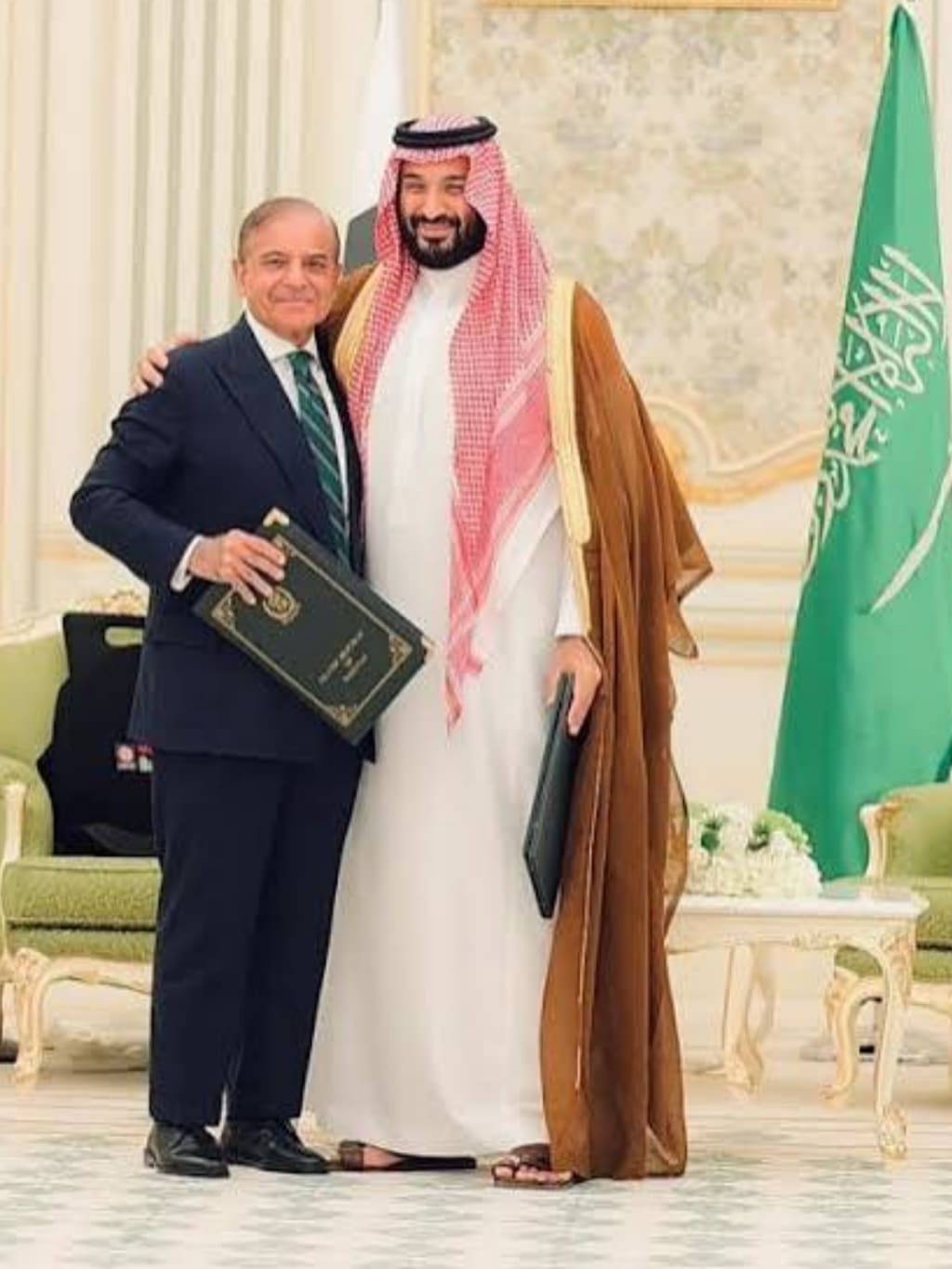
In September last year, Pakistan and Saudi Arabia signed a Joint Strategic Defense Agreement to enhance defense cooperation and security.
Under the agreement, any external aggression against one country will be considered aggression against both.
The agreement was signed in Riyadh by Saudi Crown Prince Mohammed bin Salman and Pakistan’s Prime Minister Shehbaz Sharif.
The purpose of the agreement is to strengthen defense cooperation between the two countries and enhance joint protection against any aggression, treating an attack on one country as an attack on both.
About the Creator
Keep reading
More stories from Real content and writers in Chapters and other communities.
How has the Israel-US war with Iran affected air travel?
On February 28, Israel and the United States launched a coordinated military operation against Iran, killing Supreme Leader Ali Khamenei. Since then, the conflict has rapidly expanded and affected multiple countries.
By Real contenta day ago in Chapters
Becca
"Everything is so... flat." Denille said stupidly as she looked around her new neighborhood. She looked around at the muted desert where even the smallest sign of life seemed to have given up. The plant life was shrubs that were half cooked by the heat and where there should have been a lawn, a mess of white rocks laid glistening in the sun. Even the sky looked stretched thin, like the sun had ironed it smooth. She’d moved from Riverside, where at least there were hills, but here in Barstow, everything felt baked and brittle.
By Sara Wilsonabout 21 hours ago in Fiction


Comments
There are no comments for this story
Be the first to respond and start the conversation.