
Ray Kroc: The Relentless Visionary Who Built a Global Empire One Hamburger at a Time
A deeply reported narrative on the late‑blooming salesman who transformed McDonald’s into a worldwide cultural force.

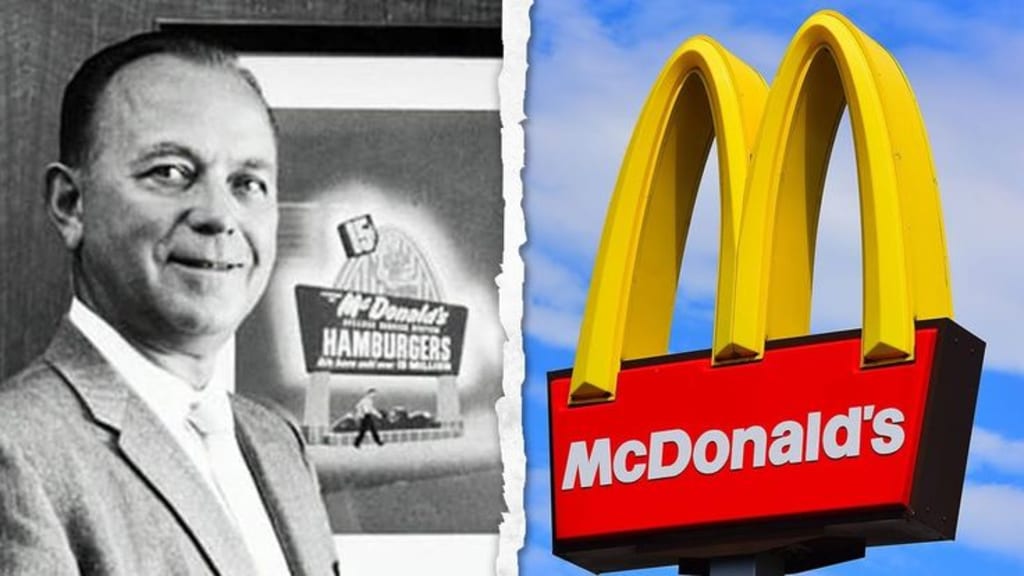
Today we look back at a man who proved that ambition has no age limit—someone who didn’t discover his life’s defining purpose until he was well into his fifties. His name was Ray Kroc, and his journey from a restless teenager to the architect of the world’s most successful fast‑food corporation is one of the most remarkable business stories of the 20th century.
Raymond Albert Kroc was born on October 5, 1902, in Oak Park, Illinois, to Czech‑American parents Rose Mary and Alois “Louis” Kroc. His family lived modestly, and his parents instilled in him the values of discipline, thrift, and relentless effort. Even as a child, Ray showed signs of impatience with ordinary life. At just fifteen, he lied about his age to join the Red Cross during World War I, training as an ambulance driver alongside Walt Disney. The war ended before he could be deployed, but the urgency he felt—the sense that life could change in an instant—never left him.
After the war, Kroc drifted through a series of jobs that seemed disconnected on the surface but quietly shaped his future. He played piano in jazz bands, worked as a radio DJ, and sold paper cups door‑to‑door. These roles sharpened his instincts: how to read people, how to persuade, how to adapt. He wasn’t building a traditional career; he was building resilience, versatility, and a salesman’s intuition.
His turning point arrived through a machine—the Multimixer, a device capable of making five milkshakes at once. As a salesman, Kroc noticed something unusual: a small restaurant in San Bernardino, California, kept ordering more machines than any other customer. Curiosity drove him across the country to see what made this place different.
What he found was revolutionary. Richard and Maurice McDonald were running a compact, efficient hamburger stand that operated with the precision of an assembly line. Their “Speedee Service System” delivered food faster and more consistently than anything Kroc had seen. The brothers saw a successful local business. Kroc saw a scalable model that could reshape American dining.
In 1954, at age 52, he persuaded the McDonald brothers to let him franchise their concept. It was a bold move for a man battling financial strain, health issues, and a failing marriage. But Kroc was driven by a belief that this system could become a national—and eventually global—phenomenon.
He traveled relentlessly, teaching franchise owners how to replicate the exact standards that made the original restaurant successful: cleanliness, consistency, and speed. He wasn’t selling burgers; he was selling reliability. He insisted that every McDonald’s—from California to Illinois—serve the same fries, the same burgers, the same experience.
The work was grueling. Kroc clashed repeatedly with the McDonald brothers over control and vision. He faced financial pressure and the constant challenge of maintaining quality across a growing network. But he pushed forward with a stubbornness that bordered on obsession. He believed that success demanded sacrifice, and he lived by that belief with unwavering conviction.
In 1961, Kroc bought the company outright for $2.7 million, gaining full control of the brand. Under his leadership, McDonald’s expanded at a pace that mirrored America’s growing appetite for convenience. The golden arches became a symbol recognized across continents, a visual shorthand for affordability and familiarity. Kroc introduced strict operational standards, training systems, and franchising strategies that turned McDonald’s into the most successful global fast‑food corporation by revenue.
Yet behind the corporate triumph was a man with deeply human passions. Kroc loved music, philanthropy, and baseball. Later in life, he purchased the San Diego Padres and, alongside his wife Joan, supported numerous charitable causes. Despite his wealth, he never abandoned the work ethic that defined his early years. He remained, at heart, a salesman—always pitching, always persuading, always chasing the next opportunity.
By the time Ray Kroc died on January 14, 1984, in San Diego, McDonald’s annual sales had surpassed $8 billion. His legacy extended far beyond fast food. He had reshaped franchising, branding, and the very idea of what a business could become. His story remains a testament to persistence: a reminder that ambition does not expire with age, and that a single idea—pursued with relentless focus—can alter the world’s habits, culture, and economy.
Ray Kroc’s journey is not simply the story of a businessman. It is the story of a man who refused to stop searching, who believed that the next great opportunity might be waiting just around the corner, even if the world thought he was too old to chase it. And in the end, that belief built an empire.
About the Creator
Haroon Pasha
👍 Like | 💬 Comment | 🔔 Follow
🔄 Share my stories to support independent writing
💖 Tip to help this page grow and create more content
💹 Smart steps build strong futures — begin yours with Binance
Keep reading
More stories from Haroon Pasha and writers in Chapters and other communities.
The Life and Leadership of Ayatollah Ali Khamenei
Ayatollah Seyyed Ali Hosseini Khamenei’s story begins in Mashhad, one of Iran’s holiest cities, where he was born on July 17, 1939 into a deeply religious family. His father, Ayatollah Seyyed Javad Khamenei, was a respected cleric of Azerbaijani origin, known for his strict scholarship and modest lifestyle. His mother, a devout woman from a clerical family, raised her children in an environment where faith, discipline, and humility were woven into daily life. Growing up in a small home with limited means, young Ali spent his childhood surrounded by religious texts, sermons, and the rhythms of Islamic scholarship. His father insisted on a traditional religious education, and by his teenage years, Ali was already immersed in the study of Quranic interpretation, jurisprudence, and philosophy. Early Education and the Seeds of Rebellion In the 1950s, Khamenei continued his studies in the seminaries of Mashhad and later Najaf, one of the most important centers of Shia learning. But his education was not limited to theology. He was drawn to political writings, anti-imperialist ideas, and the growing movement against the Shah of Iran. By the early 1960s, he had become a follower of Ayatollah Ruhollah Khomeini, whose fiery opposition to the Shah inspired a generation of young clerics. Khamenei began giving speeches, distributing pamphlets, and organizing underground networks. His activism led to multiple arrests, interrogations, and periods of exile under the Shah’s regime. These years hardened him. They shaped his belief that political power and religious authority were inseparable—and that Iran needed a system where clerics guided the nation. The 1979 Revolution and the Rise of a New Leader When the Iranian Revolution erupted in 1979, Khamenei was no longer a young student—he was a seasoned activist. After the Shah fell and the Islamic Republic was established, he quickly rose through the ranks: - Member of the Assembly of Experts - Tehran’s Friday Prayer Leader - Deputy Minister of Defense - A key figure in the Islamic Revolutionary Guard Corps (IRGC) In 1981, after the assassination of President Mohammad-Ali Rajai, Khamenei became the President of Iran, serving two terms until 1989. He was known for his calm demeanor, loyalty to Khomeini, and ability to navigate political factions during the turbulent years of the Iran–Iraq War. Supreme Leader: An Unexpected Successor When Ayatollah Khomeini died in 1989, Iran needed a new Supreme Leader. Many clerics doubted Khamenei—he was younger, less senior in religious rank, and not considered a grand ayatollah. But he was trusted, politically experienced, and deeply loyal to the revolution. The Assembly of Experts elected him as the Second Supreme Leader of Iran, a position he would hold for 36 years, making him one of the longest-ruling leaders in the modern Middle East. A Rule Defined by Power, Conflict, and Control Khamenei’s leadership reshaped Iran’s political landscape. Under his rule: - The IRGC became the most powerful military and economic force in Iran. - Iran expanded its influence across the Middle East through proxy groups. - Domestic dissent was tightly controlled. - The nuclear program became a central pillar of Iran’s strategy. Supporters saw him as a guardian of Iran’s independence and Islamic identity. Critics saw him as an authoritarian figure who consolidated power and suppressed opposition. His leadership style was marked by caution, ideological rigidity, and a belief that Iran must resist Western influence at all costs. The Final Chapter In February 2026, Ayatollah Ali Khamenei was killed at age 86 during U.S.–Israeli airstrikes targeting his compound in Tehran, marking the end of an era that had defined Iran for nearly four decades. His death was confirmed by Iranian state media and global news outlets. His passing left Iran at a crossroads, with an interim leadership council stepping in as the nation faced uncertainty about its future. Legacy of a Controversial Figure Ayatollah Ali Khamenei leaves behind a legacy that is complex and deeply debated: - To some, he was a defender of Iran’s sovereignty and Islamic values. - To others, he was a symbol of repression and authoritarian rule. - To historians, he was one of the most influential—and polarizing—leaders of the 21st century. But beyond politics, his story is also the story of a boy from Mashhad, raised by a humble cleric father, shaped by faith, revolution, and the belief that he was destined to guide his nation.
By Haroon Pasha5 days ago in Chapters
Guard Your Battery
Why are some people so attractive just by standing there? It’s not because they are "likable," but because they don’t need everyone to like them. I realized later that truly charismatic people allow themselves to be criticized, but they never criticize themselves. They never try to please the world; instead, the world stops to watch them.
By Emily Chan - Life and love sharing6 days ago in Poets


Comments
There are no comments for this story
Be the first to respond and start the conversation.