
The $55 Billion B-29: The Engineering Marvel That Became a Terrifying Weapon of Mass Destruction
How the Superfortress revolutionized aviation technology—and unleashed unprecedented devastation in its first atomic mission

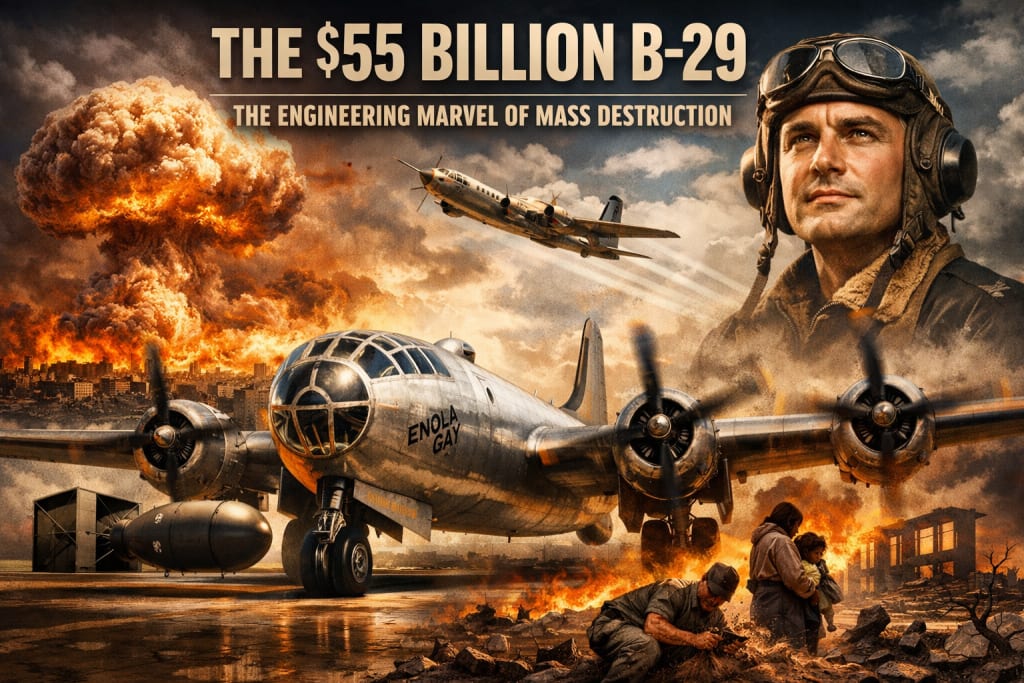
When the **B-29 Superfortress** rolled off American assembly lines during World War II, it represented one of the most ambitious and expensive military engineering projects in history. Costing nearly $3 billion in the 1940s—equivalent to roughly $55 billion today—the aircraft was more expensive to develop than the Manhattan Project that produced the atomic bomb it would eventually carry. Built by the United States to secure air superiority in the Pacific, the B-29 became both an engineering masterpiece and a symbol of devastating destructive power.
Developed by Boeing, the B-29 Superfortress was unlike any bomber before it. It introduced groundbreaking innovations that transformed military aviation. The aircraft featured a pressurized cabin, allowing crews to operate at altitudes exceeding 30,000 feet without oxygen masks—an extraordinary advancement at the time. It also incorporated remote-controlled gun turrets operated by analog computers, reducing crew exposure to enemy fire and increasing defensive precision.
Powered by four Wright R-3350 engines, the B-29 had a range of over 3,000 miles, making it ideal for long-distance bombing missions across the vast Pacific Ocean. With a wingspan of 141 feet and a maximum bomb load of 20,000 pounds, the aircraft was designed to strike deep into enemy territory. Its technological sophistication came at a price: the program required massive industrial coordination, involving multiple manufacturers and tens of thousands of workers across the United States.
Initially, the B-29 was deployed in conventional bombing raids against Japan. However, its most infamous role came in August 1945, when it was selected to carry the world’s first atomic weapons in combat.
On August 6, 1945, a specially modified B-29 named *Enola Gay* took off from Tinian Island in the Pacific. Piloted by Colonel Paul Tibbets, the aircraft carried an atomic bomb known as “Little Boy.” The target was the Japanese city of Hiroshima.
At 8:15 a.m., the bomb was released. Within seconds, a blinding flash and a massive shockwave obliterated much of the city. Approximately 70,000 to 80,000 people died instantly. By the end of 1945, the death toll had risen to an estimated 140,000 due to injuries and radiation sickness. The scale of destruction stunned the world. Entire neighborhoods vanished, infrastructure collapsed, and survivors suffered horrific burns and long-term health effects.
Just three days later, on August 9, another B-29 named *Bockscar* dropped a second atomic bomb—“Fat Man”—on Nagasaki. The combined devastation of the two bombings contributed to Japan’s surrender on August 15, 1945, effectively ending World War II.
The atomic bombings remain among the most debated events in modern history. Supporters argue that the attacks hastened the war’s end and prevented a prolonged invasion of Japan that might have cost millions more lives. Critics contend that the bombings targeted civilians and introduced a terrifying new era of nuclear warfare.
Regardless of one’s perspective, the B-29’s role in these events cemented its place in history—not only as a technological triumph but also as a harbinger of unprecedented destructive capability.
Beyond the atomic missions, the B-29 significantly influenced postwar aviation. Its pressurization systems and aerodynamic innovations informed the design of later commercial airliners. In fact, lessons learned from the Superfortress contributed to advancements in long-range passenger aircraft during the late 1940s and 1950s. The aircraft also saw service during the Korean War before being gradually phased out.
From an engineering standpoint, the B-29 was revolutionary. It required advanced metallurgy, improved avionics, and new production techniques. Engineers faced immense challenges, including engine overheating issues and logistical hurdles in transporting parts to Pacific bases. Despite these obstacles, the aircraft performed missions at distances previously thought impractical.
Yet, the legacy of the B-29 cannot be separated from its destructive power. It demonstrated how technological innovation could dramatically shift global power dynamics. The bomber became a symbol of both American industrial might and the dawn of the nuclear age.
Today, preserved B-29 aircraft displayed in museums stand as reminders of a transformative—and troubling—chapter in human history. They represent the pinnacle of wartime engineering ingenuity while also embodying the catastrophic consequences of total war.
The story of the B-29 Superfortress is therefore one of paradox. It was a marvel of design, a machine that pushed the boundaries of what aviation could achieve. But it was also the vehicle that delivered the most fearsome weapon humanity had ever seen. In doing so, it changed not only the course of World War II but the trajectory of global politics, warfare, and ethical debate for generations to come.
Engineering genius and terrifying power—both define the legacy of the B-29.
About the Creator
Irshad Abbasi
Ali ibn Abi Talib (RA) said 📚
“Knowledge is better than wealth, because knowledge protects you, while you have to protect wealth.
Keep reading
More stories from Irshad Abbasi and writers in Chapters and other communities.
Merchants of the Dead: How American Companies Profit from Selling Human Bodies
In the United States, the idea of donating one’s body to science is often associated with noble intentions — advancing medical research, training surgeons, and contributing to life-saving discoveries. Families frequently believe their loved ones’ remains will help cure diseases or educate future doctors. However, behind this altruistic image lies a little-known and controversial industry: the commercial trade in human bodies.
By Irshad Abbasi a day ago in Chapters
The First Hours of World War III
The First Hours of World War III World War III will not begin with a formal declaration, a single invasion, or a dramatic announcement on television. If it comes, it will begin quietly—through alerts, miscalculations, automated systems, and decisions made under extreme pressure. The early hours of a global war will feel confusing, fragmented, and unreal, long before the world understands what has happened.
By Wings of Time 4 days ago in Chapters



Comments
There are no comments for this story
Be the first to respond and start the conversation.