
The Assassination of King Faisal: The Tragic Day a Saudi Monarch Was Killed by His Own Nephew
Political tensions, personal grievances, and a shocking act of violence that changed the course of Saudi history.

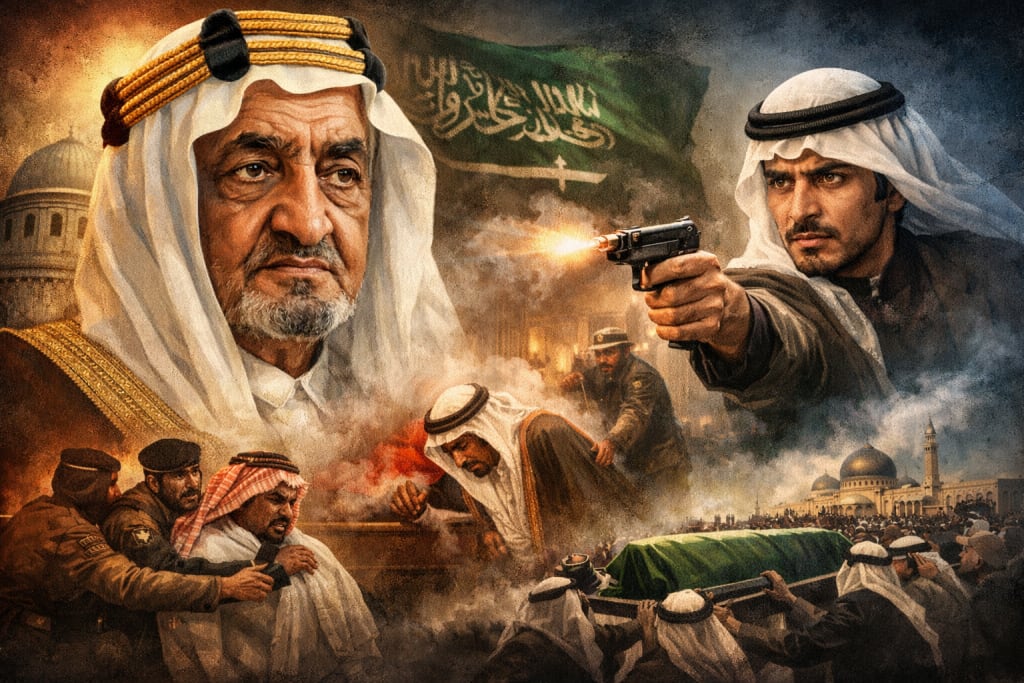
On March 25, 1975, the Arab world was shaken by the shocking assassination of King Faisal of Saudi Arabia. The respected monarch, known for his political wisdom and strong leadership in the Muslim world, was killed inside the royal palace in Riyadh by his own nephew, Faisal bin Musaid. The incident stunned both Saudi citizens and the international community, raising many questions about what circumstances led to such a tragic act within the royal family.
A Respected Leader of the Arab World
King Faisal ruled Saudi Arabia from 1964 until his death in 1975. During his reign, he worked to modernize the country while maintaining Islamic traditions. He strengthened Saudi Arabia’s economy, improved education, and expanded infrastructure across the kingdom.
King Faisal also became a powerful voice in international politics. One of his most significant actions was his role in the 1973 Oil Embargo during the Yom Kippur War. In response to Western support for Israel, Saudi Arabia and other Arab oil producers cut oil exports to several Western countries. This move dramatically increased global oil prices and showed the political power of oil in world affairs.
Because of these policies, King Faisal became widely admired across the Muslim world and respected globally. However, despite his popularity, tensions and personal grievances existed within parts of the royal family.
The Day of the Assassination
The assassination occurred during a traditional public audience known as a majlis at the royal palace in Riyadh. This was a gathering where citizens, officials, and members of the royal family could meet the king.
On that day, Faisal bin Musaid approached the king along with other visitors. As was customary, King Faisal leaned forward to greet his nephew. At that moment, Faisal bin Musaid suddenly pulled out a pistol and fired multiple shots at the king at close range.
The attack happened so quickly that security guards initially struggled to react. The king was rushed to a hospital, but doctors were unable to save him. Shortly afterward, it was officially announced that the monarch had died from his injuries.
The assassin was immediately captured at the scene.
Who Was Faisal bin Musaid?
Faisal bin Musaid was the son of Prince Musaid bin Abdulaziz, a member of the Saudi royal family. He had studied in the United States during the late 1960s and early 1970s and was known to have lived a very different lifestyle compared to the conservative traditions of Saudi Arabia.
One of the most widely discussed motives behind the assassination involved the death of his older brother, Khalid bin Musaid. In 1965, Khalid bin Musaid was killed during a confrontation with Saudi security forces. The clash occurred during protests against the introduction of television in the kingdom, which some conservative groups opposed.
Some reports suggested that Faisal bin Musaid blamed King Faisal’s government for his brother’s death and sought revenge. However, the exact motive has remained somewhat unclear, and various theories have circulated over the years.
Trial and Execution
After the assassination, Faisal bin Musaid was arrested and placed on trial. Saudi authorities conducted a swift investigation, and the court found him guilty of the king’s murder.
In June 1975, he was publicly executed in Riyadh according to Saudi law. The execution was meant to demonstrate that even members of the royal family would face justice for such crimes.
Aftermath and Succession
Following the assassination, Saudi Arabia faced a moment of uncertainty. However, the transition of power happened quickly and peacefully. King Faisal’s half-brother, King Khalid, became the new ruler of Saudi Arabia.
The late king’s legacy remained strong. Many people remembered him as a leader who strengthened Saudi Arabia’s global influence and worked to unite Muslim countries. His policies helped transform Saudi Arabia into one of the most powerful nations in the Middle East.
A Tragedy That Shocked the World
The assassination of King Faisal remains one of the most dramatic events in Saudi history. It was not only the killing of a king but also a tragedy within one of the most powerful royal families in the region.
Decades later, historians still examine the political, personal, and social factors that may have contributed to the event. Yet one fact remains clear: the death of King Faisal marked the sudden end of the rule of a leader who played a major role in shaping modern Saudi Arabia and the politics of the Middle East.
About the Creator
Irshad Abbasi
Ali ibn Abi Talib (RA) said 📚
“Knowledge is better than wealth, because knowledge protects you, while you have to protect wealth.
Keep reading
More stories from Irshad Abbasi and writers in Criminal and other communities.
Factory of Fear: The Escape and 21-Year Manhunt of America’s “Most Wanted” Terror Suspect
In the tense years following the September 11 attacks, the United States launched one of the largest counterterrorism operations in modern history. Intelligence agencies tracked suspects across continents, tightened airport security, and expanded surveillance networks. Yet, amid this sweeping effort, one man accused of building explosives inside his car managed to disappear — evading capture for more than two decades.
By Irshad Abbasi a day ago in Criminal
The Murder of Cynthia Carver
Cynthia Carver’s mother, Ann, knew immediately something was wrong when her daughter failed to show for her new job on February 22, 2019. She spoke to Cynthia the night before; she was excited. Around 1 p.m., she drove past Cynthia’s house in Newsoms, Virginia, and saw the front door open. She stopped to investigate, as any mother would. Already frightened, her fears were exasperated when she saw blood at the front door. More blood spatter in the living room. A knife is sitting in front of the sofa. The 35-year-old mother of two is nowhere to be found. Ann called the police.
By Criminal Matters5 days ago in Criminal




Comments
There are no comments for this story
Be the first to respond and start the conversation.