
I asked Gemini, Claude, and ChatGPT to create a website, and there was one obvious winner
Testing the "vibe-coding" prowess of today’s top LLMs to see which one truly masters the art of functional, thematic design.


Vibe-coding seems to be on the rise, and it is fast democratizing software and web development. Not too long ago, a huge barrier of syntax errors separated the average user from developing a website that worked. Times have changed over the last few years. The latest generation of LLMs are powerful and capable enough to turn plain language descriptions into functional code, allowing even non-coders like myself to put together HTML pages with nothing more than a prompt
This shift from technical mastery to creative distinction has gained some very prominent advocates too, like Nvidia CEO Jensen Huang, who recently suggested that programming is no longer an important skill. No matter where you stand on that argument, it's always fun to see how proficient the newer LLMs have become from time to time. That's exactly what prompted me to pit ChatGPT, Gemini and Claude against each other to test who could build the better website
The challenge was straightforward
To build the most "usable" website
To test the three LLMs fairly and comprehensively, I delivered the exact same prompt to the latest iteration of every model. The evaluation criteria were simple, and each model was judged for its aesthetic intelligence, the 'usability' of the site, and adherence to the prompt. With these ground rules set, I handed the following prompt to ChatGPT, Gemini and Claude:
"Design an onboarding screen for a social networking platform aimed at Dungeons and Dragons players. The screen should welcome a new user, prompt them to select their preferred play style, and nudge them to fill out a brief profile. Prioritize clarity and make the experience feel thematic without sacrificing usability. Write the code in HTML."
By looking at the prompt, you'd understand that the challenge also pertains seeing which model could perform best in scenarios with such limited context, which is more or less definitive of the vibe coding movement we see today. This also helps understand which agent is naturally predisposed to the task without the constant fine-tuning and "hand-holding" you'd normally expect from a traditional coder.
Following this, I used OneCompiler, which is a free tool that lets me directly paste the code and see the visual results instantly to gauge the output against the criteria.
ChatGPT likes to keep it 'minimalist'
The 'bare-bones' entry in the contest
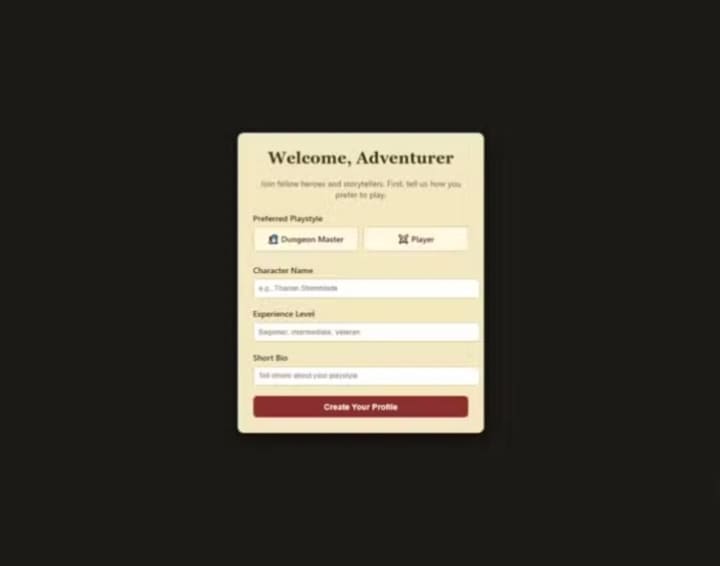
Looking at the result from ChatGPT, it's clear that it adhered to the technical instructions, while struggling a little with the creative "vibe" you'd want from an onboarding page. It felt less like an inviting entry point into a social network, and more like a generic feedback dialogue box that you'd immediately want to close and get out of your way. The design is safe with a parchment-colored background (barely a step up from an old Google Form), and remarkably bare bones.
While the code is functional and the webpage could be construed as 'usable', ChatGPT stumbles in instruction and prompt adherence here, and it's hard to overlook this. It is remarkably unremarkable.
Gemini outperformed ChatGPT by a long shot
It embraced the theme and delivered well
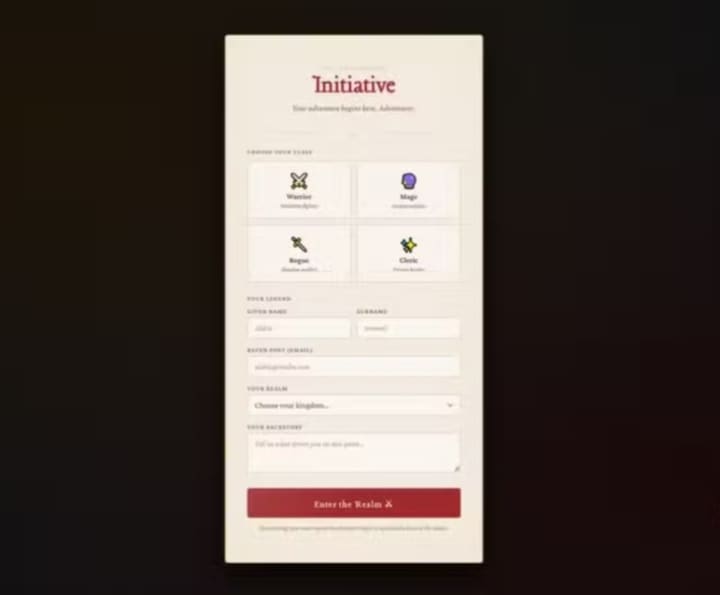
Gemini took second place. Right off the bat, it was clear that the model had a much stronger affinity for aesthetics and design prowess than ChatGPT. From a UX perspective, Gemini leaned into the theme and transformed what ChatGPT interpreted as a standard form into an onboarding experience.
It delved subtly but effectively into evocative labels like "Raven Post" for email and "Your Legend" for the name field, which imparted an impressive thematic ambience. Some other UI elements such as spacing, visual hierarchy and the use of selection tiles also made for a cleaner design.
Claude was the clear victor
It wasn't even close
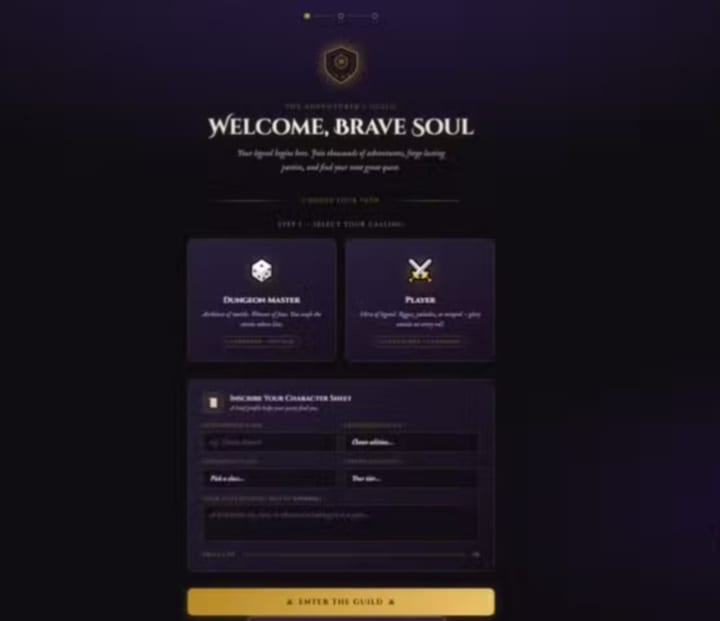
The initial impression on running the HTML code was nothing short of breathtaking, and it almost doesn't come as a surprise that Claude took the crown, since it's the leading choice for most vibe coders, and purpose-built for it. Unlike other pages, the screen didn't load statically but rather swayed in with animations that signaled intentionality.
Claude led decisively across all three criteria, conjuring a dungeon-dark environment of glowing gold accent which was very characteristic of the D&D world and the immersion that should come with it. I completely understand why, for vibe coders, the platform is in a league of its own. It brings aesthetic intelligence, prompt adherence and usability that's unlike what any other model could deliver.
Claude led decisively across all three criteria.
The future of vibe-coding seems bright
As vibe coding surges in popularity for coders and non-coders alike, frontier models have become remarkably capable at producing functional code across the board, and all the three tests proved that. The real differentiator, however, lay beyond simple functionality. In low-context scenarios, Claude read between the lines of the prompt and filled the gaps with its own creative judgement, which pulled it away from the competition. Seeing it in action firsthand only reaffirmed what has earned the model its wide renown, and that itself was something of a delight.
About the Creator
Reader insights
Outstanding
Excellent work. Looking forward to reading more!
Top insights
Compelling and original writing
Creative use of language & vocab
Easy to read and follow
Well-structured & engaging content
Excellent storytelling
Original narrative & well developed characters
Expert insights and opinions
Arguments were carefully researched and presented
Eye opening
Niche topic & fresh perspectives
Heartfelt and relatable
The story invoked strong personal emotions
Masterful proofreading
Zero grammar & spelling mistakes
On-point and relevant
Writing reflected the title & theme
Keep reading
More stories from Rosalina Jane and writers in Education and other communities.
Beyond the Blue Horizon: A Journey Through Family Addiction and Recovery
My feet sink into the wet sand as the tide comes in, covering everything with warm ocean crystals that fade away. I’m running, I think, and the spray sticks to my ankles, hiding my legs from view.
By Rosalina Jane2 days ago in Poets
Understanding Rework Sign Exit SCRN AFT Parts in Aerospace Maintenance
As someone deeply involved in aviation engineering and aircraft maintenance research, I’ve always been fascinated by how small parts — even those with complex technical names — play a critical role in flight safety and operational readiness. One such category is the “Rework Sign Exit SCRN AFT” part type, commonly referenced in aviation parts catalogs like the one at FulfillmentByASAP.
By Beckett Dowhan5 days ago in Education
The BAFTA Awards
By now, in a stunning departure from recent years, most of the world is aware of what happened at the BAFTA film awards. Social Media Headlines will tell you the bare bones: that John Davidson, a Tourette's Syndrome advocate, shouted a racial slur at two Actors of Colour, Michael B Jordan and Delroy Lindo.
By Natasja Rose5 days ago in Psyche


Comments (1)
Thank you soo much..... This was really very helpful.