
The Boy Who Saw Dancing Letters
A compassionate teacher discovers the hidden brilliance of a child misunderstood by everyone.
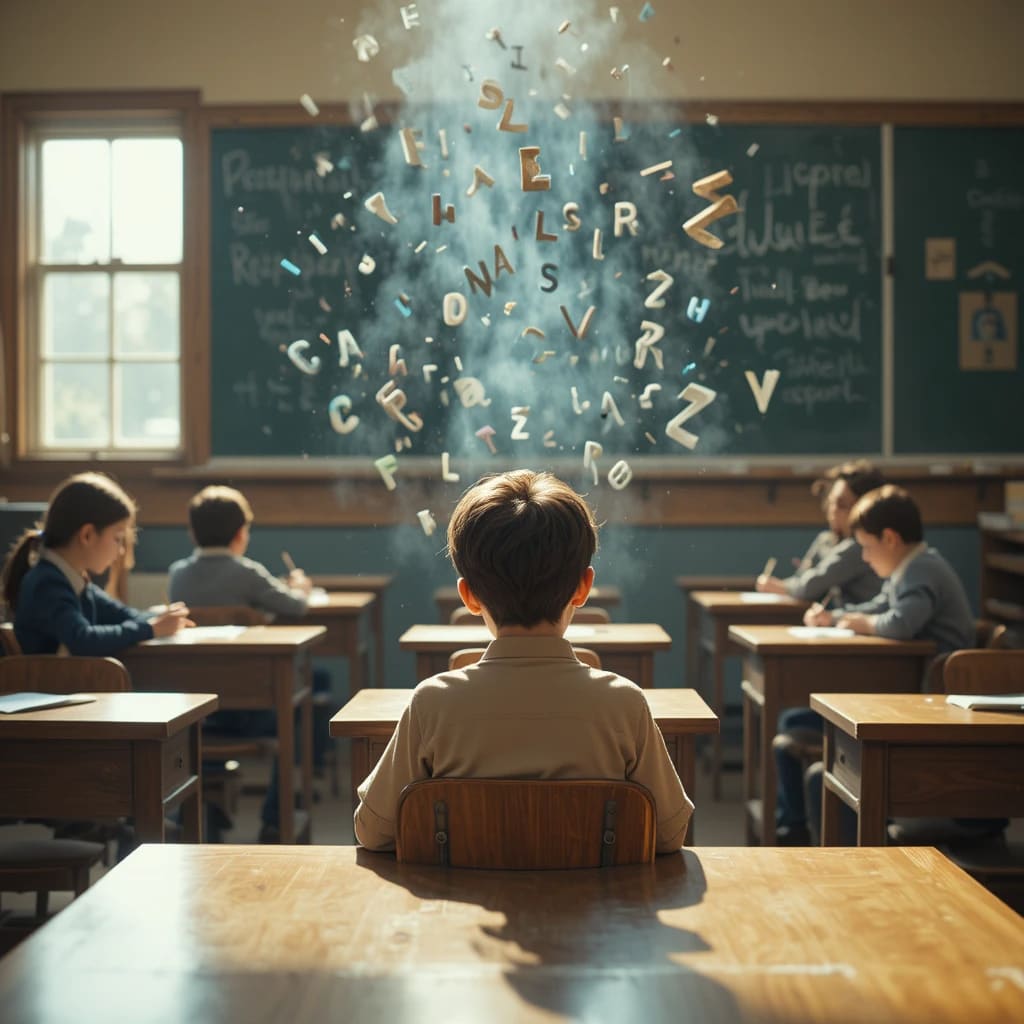
When Arman was seven years old, school felt like a battlefield.
While other children easily read the alphabet on the blackboard, the letters in front of him seemed to move and dance. The capital A, B, and C refused to stay still. Sometimes he wrote b instead of d, and other times p looked exactly like q to him. No matter how hard he tried, the words refused to stay in place.
His teachers thought he was careless.
His classmates laughed when he made mistakes.
“Why don’t you try harder?” they would say.
Even simple tasks felt difficult for Arman. Tying his shoelaces was confusing. Buttoning his shirt took too long. Writing a single sentence required more effort than others could imagine.
But there was something special about him.
When Arman held a pencil to draw, the world changed. His sketches were detailed and imaginative. His drawings told stories without using a single word. Anyone looking closely could see that the boy had a sharp and creative mind.
Unfortunately, most people never noticed.
At home, his parents were frustrated.
They believed their son was lazy and careless. Instead of understanding his struggles, they scolded him again and again. Eventually they made a decision: they sent Arman to a distant boarding school, hoping strict discipline would change him.
For the young boy, it felt like punishment.
Far from home, surrounded by strangers, Arman became even quieter. In class he often stared out of the window, lost in his thoughts. He believed that every student in that school must have done something wrong to deserve being there.
Days passed in silence.
Then one day, a new teacher arrived.
Unlike the others, this teacher was energetic and cheerful. He laughed with the students, played games with them, and even danced to make the children smile. His classroom was filled with warmth and curiosity.
After a few days, he noticed something unusual.
There was one boy who never laughed.
One boy who rarely spoke.
One boy who seemed completely disconnected from the class.
That boy was Arman.
The teacher gently observed him and asked other students if they knew what was wrong. They didn’t know much either.
Determined to understand the situation, the teacher decided to visit Arman’s parents.
What he saw there made him sad.
The parents were still convinced that their son was simply lazy and incapable of learning. They spoke about him with disappointment rather than concern.
Before leaving, the teacher noticed a collection of Arman’s drawings. They were remarkable—full of creativity and imagination.
At that moment, everything became clearer.
The teacher realized that Arman might be dealing with Dyslexia, a neurological learning difference that affects reading and writing but does not reduce intelligence.
However, explaining this to the parents was not easy. They struggled to believe that their son’s difficulty had a real cause.
Still, the teacher refused to give up.
Back at school, he began helping Arman in small and patient ways. One day in class, he told the students a story.
He described a child who could not read letters properly because the words seemed to move around on the page. The child felt misunderstood and lonely.
Arman listened carefully.
For the first time, he felt that someone truly understood what he was experiencing.
Then the teacher showed the class a picture of Albert Einstein.
He explained that even great thinkers sometimes struggled in traditional classrooms. Yet their curiosity and imagination allowed them to change the world.
The story planted a seed of hope.
Slowly, Arman’s confidence began to grow. With patience, encouragement, and understanding, he started overcoming his fears. He practiced, learned new strategies, and continued drawing and exploring his creativity.
Years later, the quiet boy who once felt lost became a confident learner.
His journey proved an important truth.
Moral Lesson
Every child learns differently.
Sometimes what appears to be laziness is actually a challenge that requires understanding and support. Instead of judging or scolding, parents and teachers should observe carefully and seek proper guidance.
When a child struggles, compassion can make all the difference.
Because intelligence does not always follow traditional rules.
Sometimes the brightest minds simply see the world in a different way.
About the Creator
Keep reading
More stories from zohaib ahmad and writers in Education and other communities.
The Man Who Refused to Worry
During my student years, I once met someone who seemed very different from everyone else around him. Most students were constantly worried about exams, grades, and their future careers. Conversations in classrooms and hostels often revolved around competition and pressure. Everyone appeared to be running in a race, trying not to fall behind.
By zohaib ahmadabout 6 hours ago in Education
What Should Be Your Main Focus During an Online Limited Radiology Tech Program
Well, the short answer is that there is not a single module that you should strictly focus on. If you want to become a X-ray technician, you need to develop both technical and soft skills.
By Meaghan Howea day ago in Education
Precision in Motion: The Rise of Sport Shooting and Firearms in Modern Competition
Sport shooting has grown from a simple test of aim into a structured sport that demands discipline, patience, and technical skill. Today, sport shooting and firearms play a major role in global competitions, training programs, and recreational events. Athletes train for years to improve accuracy and control. They study equipment, posture, breathing, and focus. Because of this dedication, sport shooting has become a respected sport that rewards precision and calm thinking.
By Matthew Pothoffabout 7 hours ago in Education
Hottest in the Office
Dear Rafi, You’re very distracting to work around. For the first second I saw you the other day, I thought you were some type of executive. It took a moment to realize no, you were just the new guy, dressed up for the job he wants. Be still, my heart.
By Gabriel Shames3 days ago in Pride




Comments
There are no comments for this story
Be the first to respond and start the conversation.