
The Invisible War for Your Mind: How Social Media Hijacked Human Attention — And How to Take It Back
From dopamine loops to digital manipulation — why your focus is no longer fully yours

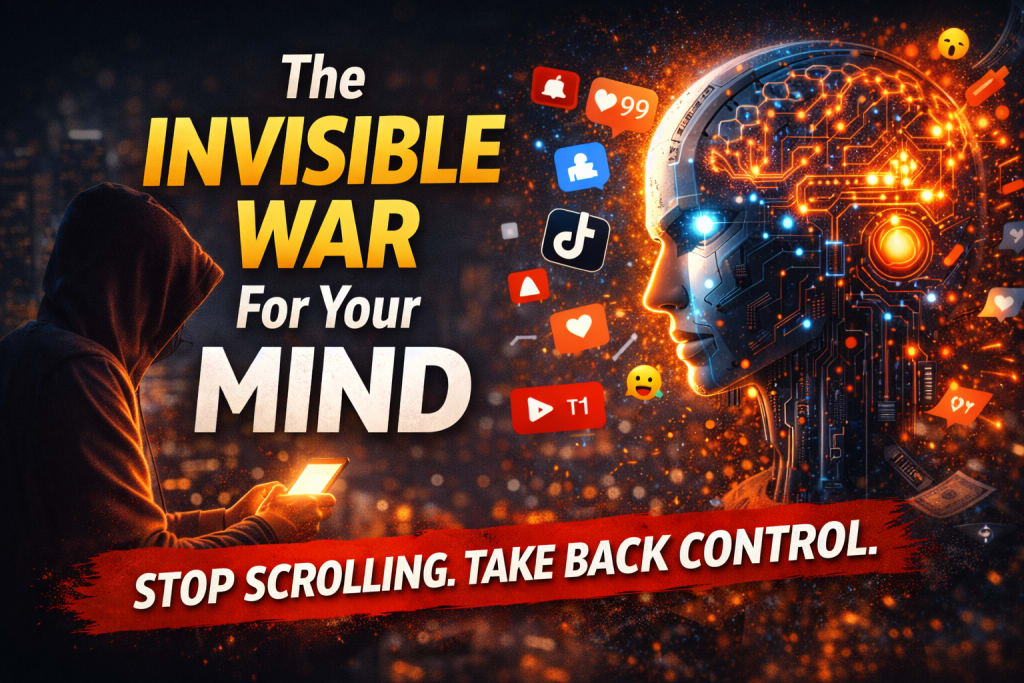
The Invisible War for Your Mind: How Social Media Hijacked Human Attention — And How to Take It Back
From dopamine loops to digital manipulation — why your focus is no longer fully yours
Purpose: To Help You Reclaim Control of Your Focus in a World Designed to Distract You
You don’t wake up intending to waste an hour scrolling.
It just happens.
A notification.
A headline.
A short video.
Another one.
And suddenly, time is gone.
This isn’t laziness.
It’s design.
When Facebook launched in 2004, it felt like connection. When YouTube expanded, it felt like entertainment. When TikTok exploded globally, it felt like creativity.
But underneath all of it was a new economic model.
Attention became currency.
The longer you stay on a platform, the more ads you see. The more ads you see, the more revenue is generated. This created a powerful incentive: keep users engaged for as long as possible.
Not satisfied.
Engaged.
There’s a difference.
Satisfaction ends behavior.
Engagement prolongs it.
Psychologists explain part of this through dopamine — often misunderstood as the “pleasure chemical.” Dopamine is not about happiness. It’s about anticipation. It drives you to seek the next reward.
Every scroll is a slot machine pull.
Maybe the next post will be better.
Maybe the next video will be funnier.
Maybe the next notification will validate you.
Variable reward systems are among the most addictive psychological mechanisms known. Casinos use them. Now your phone does too.
This is not a conspiracy theory.
It’s behavioral economics combined with technology.
Algorithms analyze your watch time, pause duration, reactions, comments, even how long you hover over content. Over time, platforms like Instagram and Netflix refine predictions about what will keep you from leaving.
Outrage spreads faster than nuance. Emotional content spreads faster than calm analysis. The reason is mathematical: emotional arousal increases sharing probability.
This creates a subtle distortion of reality.
You begin to see more extreme views, more dramatic headlines, more polarized opinions — not because the world suddenly became more extreme, but because extreme content travels further.
The cost?
Fragmented focus.
Reduced deep thinking.
Shortened attention spans.
When your brain becomes accustomed to rapid stimulation, slower tasks feel uncomfortable. Reading a long book becomes harder. Studying deeply feels exhausting. Silence becomes awkward.
You start confusing stimulation with meaning.
But here’s the part most people miss:
You are not powerless.
Awareness is leverage.
The moment you recognize that your attention is being competed for, you step outside the automatic loop.
Consider this:
If attention is currency, then focus is wealth.
And wealth must be protected.
Here are practical shifts that restore cognitive control:
First, remove non-essential notifications. Every notification is an interruption bid. You don’t need most of them.
Second, create friction for distraction. Move social apps off your home screen. Log out after use. Small barriers reduce impulse behavior.
Third, practice intentional consumption. Instead of opening an app out of habit, decide beforehand what you’re going there for.
Fourth, reclaim long-form engagement. Read full articles. Watch long interviews. Train your brain for sustained focus again.
Fifth, schedule boredom. Creativity grows in mental silence. Constant stimulation suppresses reflection.
This article has one purpose:
To help you see the system clearly enough that you can choose differently.
Technology itself is not evil. Platforms are not villains. They are businesses operating within incentive structures.
The real question is whether you will operate intentionally within that system — or unconsciously.
In past generations, power was measured in land, gold, or oil.
Today, power is measured in data and attention.
And attention begins in your mind.
When you decide what deserves your focus, you reclaim autonomy.
When you pause before reacting emotionally, you reclaim clarity.
When you choose depth over speed, you reclaim intellectual strength.
The invisible war for your mind isn’t fought with weapons.
It’s fought with habits.
Every scroll is a vote.
Every pause is resistance.
Every intentional choice is power.
In a world engineered for distraction, the most rebellious act is sustained attention.
Not because it makes you superior.
But because it makes you sovereign.
And sovereignty begins with awareness.
About the Creator
The Insight Ledger
Writing about what moves us, breaks us, and makes us human — psychology, love, fear, and the endless maze of thought.
Keep reading
More stories from The Insight Ledger and writers in Education and other communities.
Love Isn’t Magic — It’s Psychology in Motion
We like to believe love just happens. Two people meet. There’s a spark. The heart chooses. The story begins. But love is rarely random. It feels spontaneous, yet beneath the poetry there is psychology. Beneath the butterflies there is biology. Beneath the longing there are patterns shaped long before we knew what romance was. If we slow down and look closely, love becomes less mysterious — and more powerful. Not because the magic disappears, but because we begin to understand it. The Rush We Call “Falling” The early stage of love is intoxicating for a reason. When you feel drawn to someone, your brain increases dopamine — the neurotransmitter associated with reward and motivation. It’s the same system activated by ambition, achievement, and even addictive behaviors. Suddenly, one person becomes unusually significant. You want their attention. You anticipate their messages. You replay their words. At the same time, oxytocin begins to rise. Often called the bonding hormone, it strengthens emotional connection through touch, eye contact, and vulnerability. It creates warmth, closeness, and trust. In the beginning, love can feel obsessive. That’s not weakness. It’s chemistry. But here’s something important: that intensity is not designed to last forever. The human nervous system cannot sustain constant emotional fireworks. Over time, the surge settles. Excitement softens into stability. Many people interpret this shift as losing love. In reality, it’s love evolving. The fire turning into warmth isn’t failure. It’s maturation. Why We Feel “Drawn” to Certain People Attraction often feels mysterious. We say, “I don’t know why, I just felt something.” Psychology suggests otherwise. We are frequently drawn to what feels familiar — not necessarily what is healthy. Early experiences, especially childhood relationships, shape our internal model of love. If affection was consistent and safe, we tend to seek stability. If it was unpredictable or conditional, intensity may feel more natural than calm. This is where attachment theory becomes useful. In simple terms, attachment style describes how we relate emotionally in close relationships. Some people feel secure in intimacy. Others fear abandonment and seek constant reassurance. Some value independence so strongly that emotional closeness feels overwhelming. When two people connect, they don’t just bring personalities. They bring histories. And sometimes, what feels like powerful chemistry is actually two nervous systems recognizing a familiar pattern. That familiarity can feel electric — even if it isn’t peaceful. Intensity vs. Safety There is a difference between excitement and security. Excitement often comes from unpredictability. Not knowing when they will text. Not knowing where you stand. The highs feel euphoric because the lows create contrast. Safety feels different. It is steady. Predictable. Calm. For someone accustomed to emotional turbulence, calm can initially feel boring. For someone used to emotional distance, closeness can feel threatening. But long-term emotional health thrives on safety, not adrenaline. Butterflies are not always romance. Sometimes they are anxiety. The question worth asking is not “Do they make my heart race?” It is “Do they make my nervous system relax?” The Ego’s Quiet Role in Love Not every relationship is built on love alone. Sometimes it is built on validation. There is a subtle difference between loving someone and needing someone to confirm your worth. When we seek relationships primarily to feel chosen, admired, or superior, we are feeding the ego — not building intimacy. The partner becomes a mirror instead of a companion. This creates fragile bonds. The connection remains strong only as long as admiration flows. Healthy love requires differentiation — the ability to remain connected while maintaining your own identity. Two individuals choosing each other freely is very different from two people depending on each other to feel complete. Love expands you. Ego-driven attachment consumes you. Why Breakups Hurt So Deeply When a relationship ends, the pain is not “all in your head.” It is neurological. Social rejection activates similar brain regions as physical pain. The person you bonded with became part of your emotional regulation system. You shared routines, comfort, reassurance. When they leave, your nervous system experiences a disruption. That emptiness is not weakness. It is the brain recalibrating. Over time, new habits form. Emotional balance returns. The system adapts. What once felt unbearable becomes a chapter you survived. Heartbreak, painful as it is, often reveals patterns we could not see while inside the relationship. It shows us our triggers, our fears, and sometimes our unmet needs. Growth rarely arrives without discomfort. Modern Love in a Digital World Today, relationships unfold in an environment the human brain did not evolve for. Dating apps offer endless options. Social media amplifies comparison. Every notification becomes a micro-reward. Every delay becomes a perceived signal. Psychologists call this the paradox of choice — when too many options reduce satisfaction. With constant alternatives visible, commitment can feel risky. There is always the illusion that something better might be one swipe away. But depth requires focus. Real intimacy grows slowly. It is built through shared experiences, conflict resolution, ordinary days. It cannot compete with curated highlight reels online. Choosing someone consistently in a world designed for distraction has become an intentional act. What Mature Love Looks Like Mature love is rarely dramatic. It does not rely on constant testing or emotional extremes. It is marked by respect, emotional regulation, and repair after conflict. Every couple disagrees. The difference lies in how they recover. The ability to apologize sincerely, to listen without preparing a defense, to express needs without accusation — these are skills. Love is not just a feeling. It is a practice. And like any practice, it improves with awareness. The Standard You Accept One of the most powerful truths about relationships is this: we often accept the level of love we believe we deserve. If you feel unworthy deep down, you may tolerate inconsistency. If you believe love must be earned, you may overextend yourself trying to prove your value. Self-worth shapes romantic choices more than luck does. As self-awareness increases, standards shift. Patterns break. The people you feel drawn to may change. Sometimes the most important work in love happens before the relationship begins. The Real Transformation Love exposes you. It reveals insecurities you didn’t know were there. It challenges your ego. It invites vulnerability. It demands growth. It can destabilize you — and it can strengthen you. At its healthiest, love is not about losing yourself. It is about becoming more fully yourself while standing beside someone who is doing the same. The intensity of early romance may fade. But what replaces it — if nurtured well — is deeper: trust, stability, shared meaning. Love is not magic in the sense that it defies explanation. It is extraordinary precisely because it is human. Two nervous systems learning to feel safe together. Two histories negotiating trust. Two individuals choosing connection, again and again. When you understand the psychology behind it, you do not lose romance. You gain clarity. And clarity changes everything.
By The Insight Ledger 2 days ago in Psyche
Teachers vs. Society's Perception
Love them or Hate Them: Teachers are Important Members of the Community It was the late 1990s and the economy was good. Everybody had money in their pockets and felt no qualm about spending. I, on the hand, never had to pull out money at the local bar and grills. All I had to do was mention I was a public school teacher and nearly every patron was willing to buy me a drink.
By Dean Traylor5 days ago in Education
Unofficial Challenge: Black History Celebration
Forward: February 28th, 10:53 PM, EST... The final hour of Black History Month, 2026. Hello fellow writers. I've had this challenge waiting in my drafts for most of the month. But I held off on publishing it, until now.
By Sam Spinelli5 days ago in Writers



Comments
There are no comments for this story
Be the first to respond and start the conversation.