
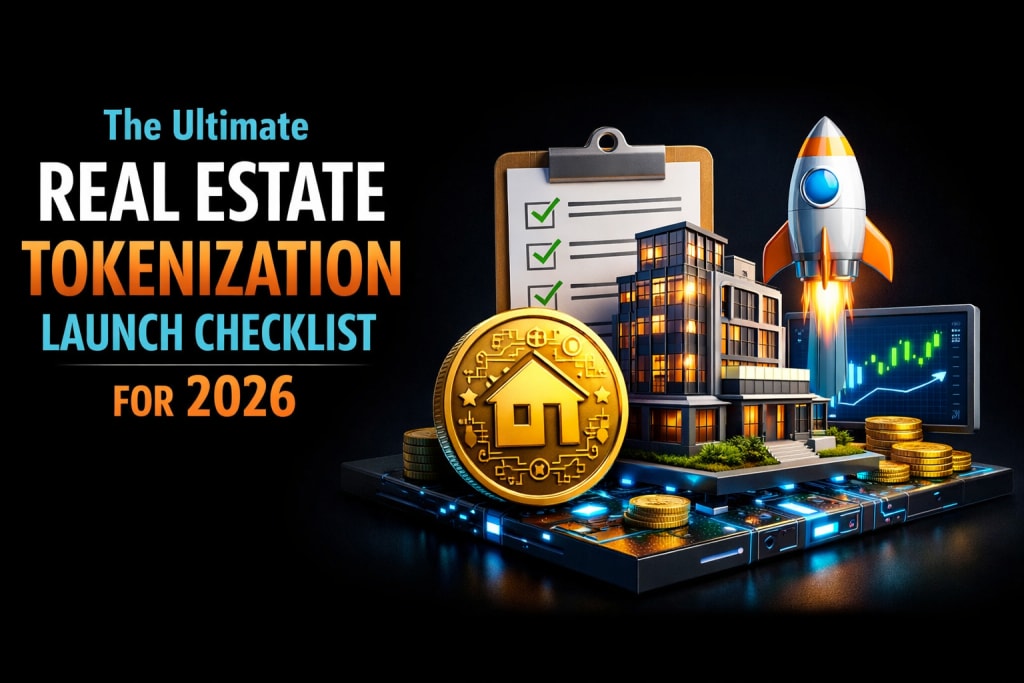
The Ultimate Real Estate Tokenization Launch Checklist for 2026
Real Estate Tokenization Launch

What Is Real Estate Tokenization?
Real estate tokenization involves representing ownership of a property through digital tokens on a blockchain. Each token corresponds to a specific share of the property, granting holders rights to income, appreciation, or governance, depending on the token’s design. By leveraging blockchain, tokenization ensures transparent, secure, and tamper-proof records, reducing administrative complexity and creating a more efficient ecosystem for property transactions.
Types of Real Estate Tokens
There are primarily two types of real estate tokens: equity-backed and revenue-backed.
- Equity-backed tokens provide direct ownership in a property, allowing investors to participate in long-term appreciation and decision-making.
- Revenue-backed tokens grant holders a share of the income generated by the property, such as rental returns or lease revenue, without conferring ownership.
Each token type serves different investor goals: equity tokens attract those seeking growth and governance participation, while revenue tokens appeal to investors focused on immediate cash flow.
Benefits for Stakeholders
The advantages of real estate tokenization are multi-faceted. Developers can access wider pools of capital and deploy flexible fundraising strategies. Investors benefit from fractional ownership, enhanced liquidity, and lower entry barriers, which were traditionally unavailable in conventional real estate markets. Institutions can efficiently diversify portfolios, reduce operational costs, and introduce programmable investment products that align with specific financial goals.
Emerging Trends in 2026
Several emerging trends are reshaping tokenized real estate. AI-driven valuation models, integration with decentralized finance (DeFi) platforms for secondary market trading, and ESG-focused token offerings are enabling smarter, more sustainable investment opportunities. These innovations indicate that tokenization is evolving beyond a transactional tool into a strategic framework for redefining property ownership, liquidity, and access on a global scale.
1. Define Your Real Estate Tokenization Strategy
The foundation of any successful tokenization project is a clearly defined strategy. Determine your target audience, whether retail investors, institutional investors, or both. Decide whether you are tokenizing a single high-value property, a portfolio of commercial assets, or residential developments.
Your strategy should outline the business model, investment thesis, and expected returns. Consider token types such as equity tokens, debt tokens, or hybrid structures depending on how revenue and profits will be distributed. Aligning your strategy with market demand and financial objectives ensures a strong foundation for the launch.
2. Conduct Regulatory and Legal Due Diligence
Compliance with legal and regulatory frameworks is critical. Laws governing tokenized assets vary across jurisdictions and may include property regulations, securities laws, and anti-money laundering (AML) requirements. Early engagement with legal experts ensures the token structure, investor eligibility, and trading mechanisms comply with local and international standards.
This step includes reviewing property titles, drafting offering documents, and implementing Know Your Customer (KYC) protocols. Legal clarity mitigates risks, fosters trust among investors, and prevents potential regulatory challenges.
3. Select the Right Blockchain Platform
Choosing the appropriate blockchain is essential for security, scalability, and liquidity. Public blockchains like Ethereum, Solana, or Binance Smart Chain provide a robust ecosystem and access to secondary markets, while private or permissioned blockchains can offer greater privacy and regulatory control.
Evaluate factors such as transaction speed, smart contract flexibility, operational costs, and compatibility with trading platforms. Selecting the right blockchain ensures smooth token issuance and seamless investor experience.
4. Design Tokenomics and Governance Structures
Tokenomics establishes the economic framework for your tokenized property. Key considerations include token supply, pricing, distribution mechanisms, and investor incentives. Properly structured tokenomics promotes liquidity, fair allocation, and long-term sustainability.
Governance defines how decisions are made regarding property management, revenue distribution, or reinvestment. Smart contract-based governance allows token holders to vote on key operational decisions, creating transparency and building investor confidence.
5. Develop Smart Contracts and Platform Infrastructure
Smart contracts automate essential processes such as ownership transfers, rental income distribution, and compliance verification. Secure and audited smart contracts reduce operational risks and ensure accurate execution.
The supporting platform should offer investor onboarding, dashboards, automated compliance checks, and reporting tools. Integrating KYC/AML systems, property valuation modules, and secondary market access enhances both efficiency and investor experience.
6. Prepare Investor Offering and Marketing Materials
Comprehensive and transparent investor materials are essential to attract capital. Offering documents should detail property information, projected returns, risk factors, and legal disclaimers. High-quality marketing materials, including interactive dashboards, videos, and brochures, help educate and engage potential investors.
Marketing strategies in 2026 focus on digital engagement, educational content, and transparency. Webinars, social media campaigns, and investment forums can effectively target the right audience while building credibility in the tokenization ecosystem.
7. Conduct Property Valuation and Due Diligence
Accurate property valuation is critical for pricing tokens and maintaining investor trust. Engage certified appraisers and conduct thorough due diligence, including inspections, legal reviews, and market analysis. Transparent valuations enable investors to evaluate potential returns and assess risk.
Due diligence also involves verifying property ownership, existing liens, zoning compliance, and projected rental income. Addressing potential challenges prior to launch ensures a smooth token sale process.
8. Set Up Custody and Asset Management Solutions
Secure custody of digital tokens and efficient management of physical properties are vital. Institutional-grade custody solutions protect against unauthorized access, theft, or cyberattacks. Integrated asset management tools streamline rent collection, maintenance scheduling, and investor reporting.
Combining secure custody with effective asset management ensures investors receive timely income distributions and accurate performance data, enhancing trust in the platform.
9. Launch Token Sale and Onboard Investors
The token sale is a critical phase that requires precise coordination. Implement automated KYC and AML processes to ensure compliance and eligibility. Structure the sale through private pre-sales, public offerings, or staged distributions based on milestones.
During onboarding, provide clear guidance on wallet setup, token acquisition, and participation rights. A smooth onboarding experience fosters investor confidence, maximizes funding, and builds long-term relationships.
10. Integrate Secondary Market Trading
Secondary market access is a defining feature of tokenized real estate. Enable trading of tokens on regulated exchanges or decentralized marketplaces to provide liquidity for investors. Ensure trading mechanisms comply with regulations and maintain adequate market activity.
Liquidity in secondary markets allows investors to manage their positions efficiently, supports price discovery, and enhances the attractiveness of tokenized assets.
11. Implement Post-Launch Governance and Reporting
Ongoing governance and reporting are essential for long-term success. Smart contracts should automate revenue distribution, voting, and reinvestment decisions. Regular reporting on rental income, occupancy rates, and token performance ensures transparency.
Investor dashboards with real-time analytics foster trust and strengthen engagement, making the platform more credible for future tokenization projects.
12. Monitor Compliance and Market Trends
The regulatory and market environment for tokenized real estate is constantly evolving. Continuous monitoring of legal obligations, tax implications, and secondary market activity is essential. Adapt tokenomics, governance, and operational strategies to stay aligned with new regulations and market developments.
Staying informed about trends such as ESG compliance, green building initiatives, and decentralized property management ensures your project remains competitive and attractive to investors.
13. Plan Exit Strategies and Liquidity Events
Exit strategies are a crucial component of investor confidence. Clearly define mechanisms for token buybacks, secondary market sales, or asset liquidation upon project completion. Strategic liquidity events, such as refinancing or portfolio expansion, provide additional investor value.
By planning exits in advance, developers can maintain transparency and offer investors flexibility, strengthening trust and supporting long-term platform growth.
14. Leverage Technology for Investor Engagement
Technology is key to sustaining investor confidence and engagement. Interactive dashboards, performance analytics, and automated notifications provide visibility and insights. AI-powered analytics can predict rental income, property appreciation, and potential risks, helping investors make informed decisions.
Active investor engagement strengthens relationships, encourages repeat participation, and positions your platform as a reliable partner in the tokenized real estate ecosystem.
Conclusion
Launching a real estate tokenization project in 2026 requires careful planning across strategy, compliance, technology, and investor engagement. By following this ultimate checklist—from defining tokenomics and governance to secondary market integration and post-launch management—developers and investors can unlock the full potential of tokenized assets.
Real estate tokenization enables fractional ownership, enhanced liquidity, global investor access, and operational efficiency. When executed strategically, it transforms traditional property investment, creating opportunities for democratized ownership, optimized returns, and a transparent, accessible property market. With 2026 presenting a favorable environment for innovation, following this checklist ensures your tokenized real estate project is positioned for success.
About the Creator
Gabrielle
Blockchain enthusiast and NFT writer dedicated to merging technology with art on decentralized platforms, driving innovation for a creative future. Embracing the potential of digital expression.
Foreclosure vs. Short Sale: 7 Key Differences Every Real Estate Pro MUST Know
You are driving through a target neighborhood and spot a classic "diamond in the rough." The lawn is overgrown, mail is spilling out of the box, and the shutters are hanging by a thread. To the untrained eye, it is just a neglected house. To a seasoned real estate professional, it is a potential high-margin opportunity.
By REI Data Solutions6 days ago in Education
Why Solar Gravity Bends Light: Gravitational Lensing, Einstein’s Theory of Relativity, and How the Sun Warps Space-Time
Introduction: When Light Does the Unexpected 🌌 Imagine staring at a distant star during a total solar eclipse. The Moon blocks the Sun’s bright glare, revealing stars that should not be visible in that exact position. Yet they appear slightly shifted—moved from where they “should” be.
By shahkar jalal2 days ago in Education
The First Rainbow Baby
Pitter-patter, pitter-patter. The rain fell in rhythmic splatters, slowly slowing, but still constant. Mira rolled onto her side pulling the blanket tight against her ears, but still she could hear chitter-chatter and scurrying feet of the creatures that refused to sleep in the lower decks.
By A. J. Schoenfeld3 days ago in Fiction


Comments
There are no comments for this story
Be the first to respond and start the conversation.