
Why the Sun Appears Yellow: The Science Behind the Color of Our Star
The Sun is the most important object in our solar system, providing the energy that supports life on Earth. When we look at the Sun from the ground, it often appears yellow or sometimes orange, especially during sunrise and sunset. However, the true color of the Sun is a fascinating topic in astronomy because the Sun is not actually yellow in space. In reality, the Sun emits light across many wavelengths and appears almost white when observed outside Earth’s atmosphere. So why does the Sun appear yellow to us? The answer lies in the way sunlight interacts with Earth’s atmosphere, the nature of visible light, and the properties of the Sun as a star. Understanding this phenomenon requires exploring how sunlight is produced, how it travels through space, and how our atmosphere affects the colors we see.

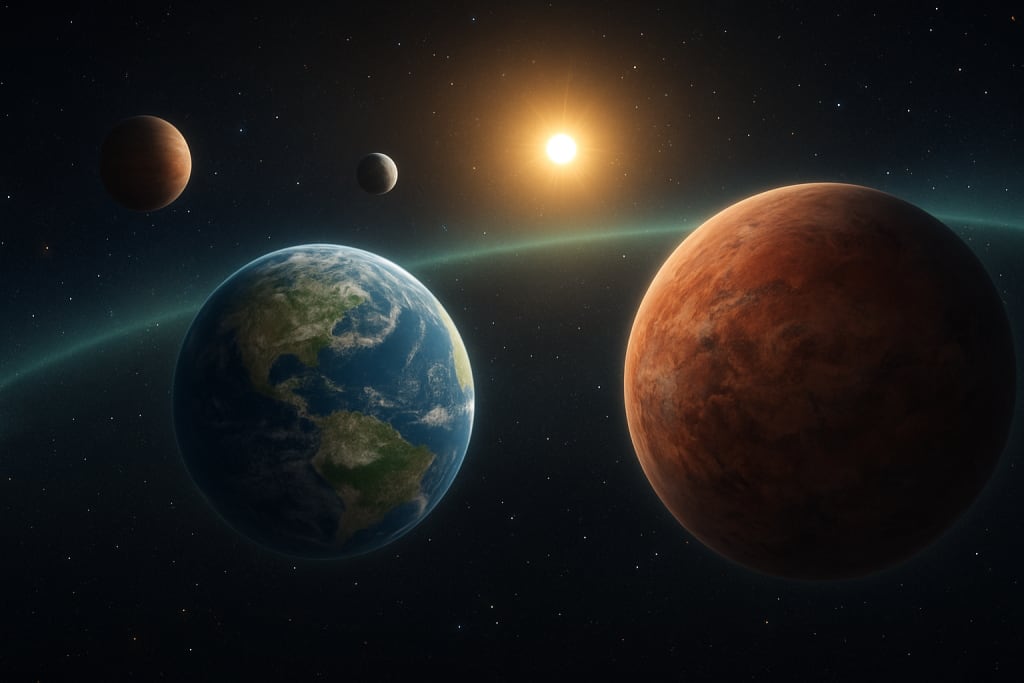
The True Color of the Sun
Although people often describe the Sun as yellow, scientists classify it as a white star. The Sun emits light across the entire visible spectrum, including red, orange, yellow, green, blue, and violet wavelengths.
When all these colors combine, they produce white light. This means that if you could observe the Sun from space without the interference of Earth’s atmosphere, it would appear white rather than yellow.
Astronauts on spacecraft and satellites that observe the Sun directly confirm that sunlight is essentially white.
The reason we see a yellowish color from Earth has more to do with atmospheric physics than the Sun itself.
The Sun as a Blackbody Radiator
The Sun produces light through nuclear fusion occurring in its core. Hydrogen atoms combine to form helium, releasing enormous amounts of energy. This energy eventually travels outward and escapes as electromagnetic radiation.
Scientists describe the Sun as a blackbody radiator, which means it emits radiation across a wide range of wavelengths depending on its temperature.
The Sun’s surface temperature is about 5,500 degrees Celsius (9,932 degrees Fahrenheit). At this temperature, the Sun emits the most intense radiation in the green part of the spectrum, but it also produces large amounts of red and blue light.
When all these colors mix together, they form white light.
This is why the Sun’s natural color is actually white rather than yellow.
The Visible Light Spectrum
Visible light is only a small part of the electromagnetic spectrum, but it contains all the colors humans can see. These colors include:
• Red
• Orange
• Yellow
• Green
• Blue
• Indigo
• Violet
Each color corresponds to a different wavelength of light. Red light has longer wavelengths, while blue and violet light have shorter wavelengths.
When sunlight reaches Earth, it contains all these wavelengths mixed together.
However, Earth’s atmosphere does not treat all wavelengths equally.
The Role of Earth’s Atmosphere
The primary reason the Sun appears yellow is the scattering of light in Earth’s atmosphere.
Our atmosphere contains molecules of nitrogen, oxygen, water vapor, dust, and other tiny particles. As sunlight passes through the atmosphere, these particles scatter shorter wavelengths of light more strongly than longer wavelengths.
This process is called Rayleigh scattering.
Rayleigh scattering affects blue and violet light the most because they have shorter wavelengths. As sunlight enters the atmosphere, much of the blue light is scattered in different directions.
Because some of the blue light is removed from the direct path of sunlight, the remaining light reaching our eyes contains relatively more red, orange, and yellow wavelengths.
This makes the Sun appear slightly yellow when viewed from the ground.
Why the Sky Is Blue
The same process that makes the Sun appear yellow also explains why the sky appears blue.
When blue light is scattered in the atmosphere, it spreads across the sky in all directions. As a result, when we look at the sky, we see scattered blue light coming from many different angles.
This is why the daytime sky appears blue even though the Sun itself emits white light.
If Earth had no atmosphere, the sky would appear black even during the daytime, and the Sun would look white.
Why the Sun Turns Orange or Red at Sunrise and Sunset
The Sun’s color changes dramatically during sunrise and sunset. Instead of appearing yellow or white, the Sun often looks orange or red.
This happens because sunlight must travel through a much thicker portion of Earth’s atmosphere when the Sun is near the horizon.
During midday, sunlight travels a relatively short path through the atmosphere. But during sunrise or sunset, the light travels a longer path through more air and particles.
As a result, even more blue and green light is scattered away before the light reaches our eyes.
The remaining light contains mostly red and orange wavelengths, which makes the Sun appear reddish.
This is also why sunsets often produce beautiful red, orange, and pink colors across the sky.
Atmospheric Pollution and Sun Color
Particles in the atmosphere can also influence the color of the Sun. Dust, smoke, and pollution can increase the scattering and absorption of light.
For example, after volcanic eruptions or during periods of heavy air pollution, the Sun may appear deeper orange or red.
Tiny particles called aerosols can scatter sunlight differently from gas molecules, creating unusual colors in the sky.
In some cases, forest fires or desert dust storms can intensify red sunsets because they increase the number of particles in the atmosphere.
Observing the Sun from Space
When the Sun is observed from space, without atmospheric interference, it appears bright white.
Images captured by satellites and space observatories confirm that the Sun emits balanced visible light.
However, many space images of the Sun appear yellow or orange. This is usually because scientists apply artificial colors to highlight specific wavelengths or features.
These color adjustments help researchers study solar flares, magnetic activity, and other solar phenomena.
Therefore, the colors in many solar images do not represent the Sun’s true visible appearance.
Human Perception of Color
Another factor influencing how we see the Sun is the way human eyes perceive color.
Our eyes contain specialized cells called cones, which detect red, green, and blue light. The brain combines signals from these cones to create our perception of color.
Because sunlight reaching Earth contains slightly less blue light due to atmospheric scattering, the balance of colors shifts slightly toward yellow.
This subtle difference is enough for our brains to interpret the Sun as yellow rather than white.
In reality, the Sun’s light still contains a full spectrum of colors.
The Sun’s Classification as a Yellow Dwarf
Astronomers often classify the Sun as a “yellow dwarf star.” This classification sometimes causes confusion because it suggests the Sun is actually yellow.
In stellar classification, the term “yellow dwarf” refers to stars in the G-type main-sequence category. These stars have surface temperatures between about 5,200 and 6,000 degrees Celsius.
The label “yellow” historically described the general color appearance of these stars when viewed from Earth.
However, modern observations show that many G-type stars, including the Sun, appear white when observed outside planetary atmospheres.
The name remains part of the classification system for historical reasons.
Why Understanding Sunlight Matters
Studying the color of the Sun is more than just an interesting curiosity. It provides valuable insights into physics, astronomy, and atmospheric science.
By analyzing sunlight, scientists can learn about the composition of the Sun, the behavior of Earth’s atmosphere, and the physics of light.
Spectroscopy, a technique used to study the spectrum of sunlight, allows researchers to identify elements present in the Sun. This method has revealed that the Sun is made primarily of hydrogen and helium.
Understanding sunlight also helps scientists study climate, atmospheric pollution, and the behavior of light in different environments.
The Sun’s Light and Life on Earth
Sunlight is essential for life on Earth. Plants use sunlight for photosynthesis, the process that converts light energy into chemical energy.
This process produces oxygen and forms the base of most food chains on Earth.
The Sun’s light also drives weather patterns, ocean currents, and the global climate system.
Without sunlight, Earth would be a frozen and lifeless world.
Conclusion
Although the Sun appears yellow when viewed from Earth, its true color is actually white. The yellow appearance results from the scattering of blue light by Earth’s atmosphere, a process known as Rayleigh scattering.
As sunlight travels through the atmosphere, shorter wavelengths like blue and violet are scattered away, leaving a slightly warmer mix of colors that appears yellow to our eyes.
During sunrise and sunset, the Sun often appears red or orange because the light travels through even more atmosphere, scattering additional wavelengths.
Understanding why the Sun appears yellow reveals the complex interactions between sunlight, Earth’s atmosphere, and human vision. It also highlights the fascinating science behind one of the most familiar objects in our sky.
The next time you look at the Sun rising or setting, remember that the golden color you see is not just the color of the Sun itself but the result of a remarkable journey through our planet’s atmosphere.
About the Creator
Keep reading
More stories from shahkar jalal and writers in Education and other communities.
How Solar Winds Create Space Weather: Understanding the Sun’s Influence on Space
What Is Solar Wind? Solar wind is a continuous stream of charged particles released from the Sun’s outer atmosphere. These particles mainly consist of electrons and protons, which are atoms that have lost their electrons due to extremely high temperatures.
By shahkar jalala day ago in Education




Comments
There are no comments for this story
Be the first to respond and start the conversation.