
City of plague:A new Yorker’s pandemic chronicle
Chapter 2 Homemade Mask
The dozen surgical masks I had stored at home—leftover from some forgotten time—were gone by mid-January. Even though I had rationed them carefully, reusing each one on alternate days, they vanished faster than I expected. Without a mask, my risk of infection rose sharply. And infection, I knew, was no small matter. The virus was not a rumor or an exaggeration—it was a presence that had already begun to reshape the city. At that moment, my most urgent task was simple and absolute: I needed to buy disposable surgical masks.
After work, I followed my usual routine and walked to the “99¢ Store” in Chinatown. The store was called a ninety-nine-cent store, though ninety-nine percent of its items cost more than a dollar. Because my job involved dust and constant exposure, I had been buying disposable work masks there for years—two dollars for a pack of ten. Cheap, convenient, reliable. They had always been there.
I entered the store with the calm confidence of habit. I walked directly to the aisle where the masks were usually displayed.
The shelf was empty.
Not low. Not disorganized. Empty.
For a moment, I simply stared, unable to process what I was seeing. A tightness formed in my chest. I walked quickly to the cashier, a young woman who recognized me. She smiled casually when she saw my face.
“Excuse me,” I asked, trying to keep my voice steady. “Where are the disposable masks?”
She laughed lightly, as if the answer were obvious.
“Sold out. Long ago. You’re late.”
Her tone carried no drama, only fact.
“Sold out?” I repeated, stunned. “So suddenly? Do you have more in the back?”
She shook her head.
“No. Even if we did, they’d already be gone. People bought them and shipped them back to China.”
I frowned, confused.
“But China only needs medical-grade masks, like N95s,” I said. “These are just basic disposable work masks. And they’re made in China.”
She shrugged.
“Doesn’t matter. Surgical, work, cheap, expensive—everything’s gone. You probably won’t find any masks in Chinatown now. Try somewhere else if you don’t believe me.”
I thanked her politely, but inside, I remained unconvinced. I suspected a familiar merchant trick—artificial scarcity, a setup for raising prices. After all, hoarding and profiteering were as old as trade itself.
I refused to accept defeat.
I walked through Chinatown, from store to store, pharmacy to pharmacy, herbal shops, supermarkets, even Western drugstores. Each time, the answer was the same.
Sold out.
Some stores had taped handwritten signs to their doors:
NO MASKS AVAILABLE
The signs were blunt, almost defensive, as if the stores themselves were tired of answering the question.
I had come too late.
The realization settled heavily inside me. Without a mask, I would be exposed every day on the subway, pressed into invisible proximity with strangers, breathing shared air. I imagined microscopic particles floating freely, entering lungs, multiplying silently.
A chill ran through my body.
For the first time since the pandemic began, fear became physical.
But fear alone was useless. I needed a solution.
If I could not buy a mask, I would make one.
I was not a healthcare worker. I did not need hospital-grade protection. I only needed something to block droplets—to protect others from me, and me from others. Cotton would do. Fabric would do. Something was better than nothing.
The idea was simple.
The execution was not.
I had no sewing machine. My eyesight was no longer young. Hand-stitching multiple layers of fabric would be slow and difficult.
Then, unexpectedly, I remembered something.
Years ago, I had tried selling women’s bikinis online. They had no brand name, no marketing appeal, and they never sold well. Boxes of unsold inventory still sat forgotten in my basement.
The bikini tops were thick, padded, layered.
Thicker, perhaps, than cloth masks.
The thought embarrassed me instantly.
But desperation leaves little room for dignity.
I opened WeChat and messaged my niece, hesitantly explaining my situation. She responded immediately, alarmed.
“I can send you masks,” she said. “I sell them online.”
Hope surged inside me.
“How long would shipping take?”
She paused.
“Before, maybe one month. Now… probably two.”
Two months.
The hope faded as quickly as it had come.
Seeing my disappointment, she encouraged me instead.
“In the early days here, we also made our own masks,” she said. “I’ll send you a video tutorial.”
When I confessed my plan to use bikini tops, she did not laugh. She did not hesitate.
“That’s fine,” she said. “It will work.”
Her calm acceptance gave me courage.
That night, I went down to the basement and opened the old boxes. Inside were dozens of bikini tops—white, purple, brown, black—colors from another life, another ambition.
I chose black.
Black would attract less attention.
With scissors, I cut one cup free. I cut the shoulder straps to use as elastic bands. Then, with needle and thread, I stitched the straps to the edges.
My fingers moved slowly, awkwardly.
But within minutes, it was done.
I held the finished mask in my hands, studying it with a mixture of pride and disbelief.
I put it on.
It fit perfectly.
The padded cup sealed snugly against my face. It was comfortable, secure. Protective.
Yet when I looked in the mirror, embarrassment returned.
The shape was unmistakable.
Any adult woman would recognize it instantly.
It was, undeniably, a bra cup.
I hesitated.
Could I really wear this outside?
Would people laugh? Judge? Mock?
I stood there for a long time, suspended between shame and survival.
In the end, survival won.
There was nothing immoral about protecting oneself. Nothing shameful about responsibility.
Before going to sleep, I had another idea.
I would wear a scarf over the mask.
No one would see.
No one would know.
—
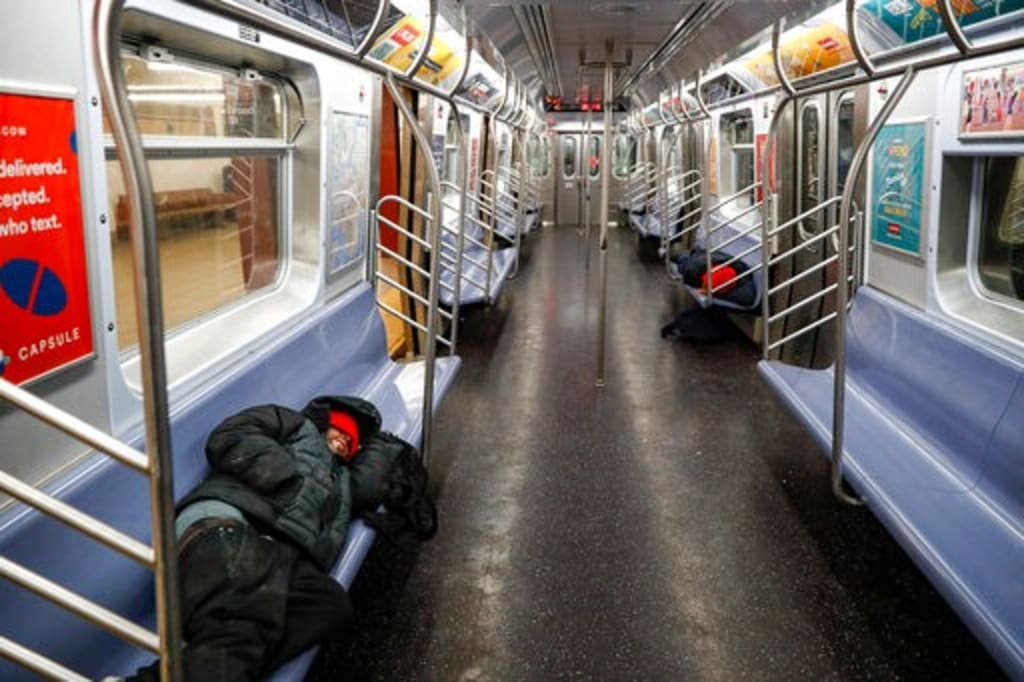
In the weeks that followed, I traveled across New York wearing my homemade mask and scarf, riding nearly empty subway cars through a city that no longer resembled itself.
New York, once loud and impatient, had grown quiet.
Fear had slowed everything.
One afternoon, I arrived at the Bowery–Delancey Street station. The platform was nearly empty. Silence hung in the air like fog.
I felt uneasy.
Not only because of the virus—but because of the emptiness itself.
America was a country where anyone could carry a gun. During the pandemic, gun sales had surged. People feared not only illness, but each other.
When trains were crowded, I feared infection.
When trains were empty, I feared violence.
There was no safe balance.
As I stood alone, lost in anxious thoughts, a sudden explosion shattered the silence behind me.
“Achoo!”
The sound was violent, raw.
My entire body jerked in shock.
I turned around quickly.
It was the homeless man.
I had seen him in this station for years. He was around fifty, slow-moving, always hunched forward, mumbling softly. His right hand extended, palm upward, silently asking for change.
When I first met him, I often gave him a dollar.
I believed, naively, that temporary hardship could be escaped.
But years passed. Nothing changed.
Eventually, my sympathy faded into indifference.
Now, during the pandemic, he still lived in the station, sleeping on benches, ignoring the stay-at-home orders that had emptied the city.
He wore no mask.
His sneeze echoed in my mind like a gunshot.
Fear surged through me. I turned and hurried toward the exit, my heart racing.
I did not know if he was sick.
I did not know if I was safe.
But beneath my scarf, beneath my homemade mask, I felt a small measure of protection.
Not certainty.
Not comfort.
But resistance.
I pulled my hood tighter around my head, sealing myself inside layers of fabric and caution.
In that moment, I understood something simple and profound:
The mask I wore was not just protection against a virus.
It was protection against helplessness.
It was something I had made with my own hands, in a time when control had vanished from the world.
And that, perhaps, was its greatest power.
About the Creator
Peter
Hello, these collection of articles and passages are about weight loss and dieting tips. Hope you will enjoy these collections of dieting and weight loss articles and tips! Have fun reading!!! Thank you.
Becca
"Everything is so... flat." Denille said stupidly as she looked around her new neighborhood. She looked around at the muted desert where even the smallest sign of life seemed to have given up. The plant life was shrubs that were half cooked by the heat and where there should have been a lawn, a mess of white rocks laid glistening in the sun. Even the sky looked stretched thin, like the sun had ironed it smooth. She’d moved from Riverside, where at least there were hills, but here in Barstow, everything felt baked and brittle.
By Sara Wilson4 days ago in Fiction
The Politics of Playing Dress-Up
Well, to start off I'd like to say a happy world book day to all who celebrate. I know I haven't really posted anything on my socials about it but I'm not a jubilant kind of person. I lay low most of the time. Let's start off with a popular anecdote from the vaults...
By Annie Kapur4 days ago in Geeks



Comments
There are no comments for this story
Be the first to respond and start the conversation.