
The Flight That Sparked a Superpower Crisis
How a secret American spy plane mission launched from Peshawar deepened Cold War tensions between the United States and the Soviet Union

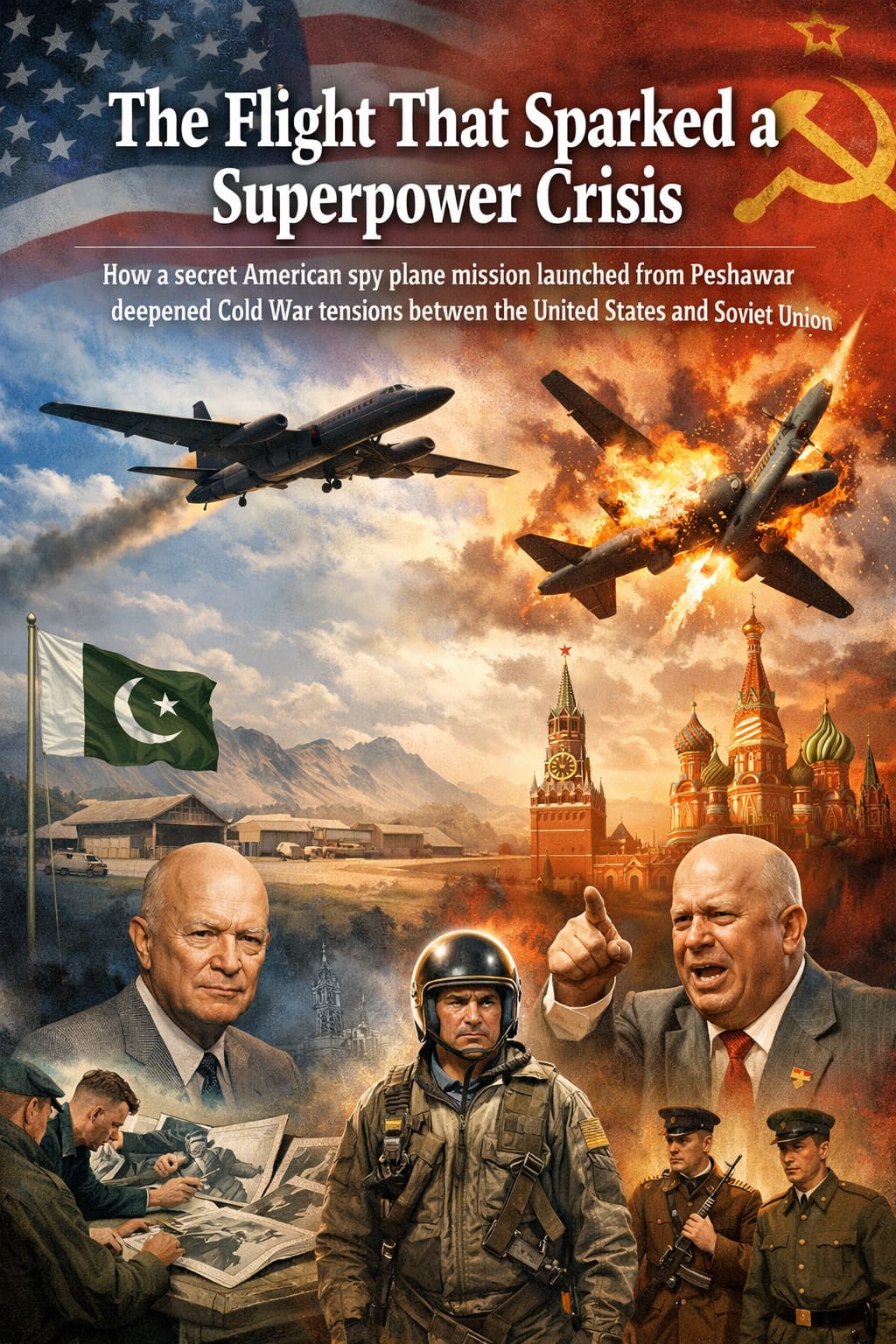
In the tense atmosphere of the Cold War, intelligence gathering was considered vital for national security. One of the most dramatic episodes in this shadow war occurred in May 1960, when an American U-2 spy plane took off from Peshawar, Pakistan, on a mission to photograph sensitive Soviet military sites. The flight ended in disaster when the aircraft was shot down deep inside Soviet territory, triggering a major diplomatic crisis between the United States and the Soviet Union and further intensifying their already hostile relationship.
The aircraft involved in the mission was a U-2 reconnaissance plane, a high-altitude spy aircraft developed by the United States during the 1950s. Designed to fly at extremely high altitudes—around 70,000 feet—the U-2 was believed to be beyond the reach of Soviet air defenses. Its purpose was to capture photographic intelligence about the Soviet Union’s military installations, nuclear capabilities, and missile programs.
On May 1, 1960, the mission began from a secret air base near Peshawar, then part of Pakistan’s cooperation with the United States during the Cold War. The pilot, Francis Gary Powers, was tasked with flying deep across Soviet territory and landing in Norway after completing the reconnaissance mission. The flight path covered thousands of kilometers and included highly sensitive areas where the Soviets were believed to be developing intercontinental ballistic missiles.
For several years, the United States had successfully conducted similar surveillance missions without detection. American officials believed the U-2’s high altitude would keep it safe from Soviet missiles and fighter jets. However, by 1960 the Soviet Union had significantly improved its air defense systems.
As Powers’ aircraft crossed into Soviet airspace, it was detected by Soviet radar. Soviet forces scrambled fighter jets and launched surface-to-air missiles to intercept the aircraft. One of these missiles struck the U-2 near Sverdlovsk (now Yekaterinburg). The explosion damaged the aircraft, forcing Powers to eject. He parachuted safely to the ground but was immediately captured by Soviet authorities.
Initially, the United States attempted to cover up the incident. American officials claimed that a NASA weather research aircraft had gone off course after experiencing technical difficulties. The explanation was meant to avoid admitting that the United States had been conducting espionage over Soviet territory.
However, the Soviet Union quickly exposed the truth. Soviet leader Nikita Khrushchev announced that the pilot had been captured alive and that the wreckage of the spy plane had been recovered largely intact. The Soviets also displayed surveillance equipment, cameras, and other classified technology from the aircraft as evidence of American spying.
This revelation embarrassed the United States and undermined its official explanation. President Dwight D. Eisenhower eventually acknowledged that the mission had been an intelligence-gathering operation. However, he refused to issue a formal apology to the Soviet Union.
The incident came at a particularly sensitive time. A major summit meeting between the United States, the Soviet Union, Britain, and France was scheduled to take place in Paris later in May 1960. The meeting was intended to ease Cold War tensions and discuss arms control and the future of divided Germany.
Instead, the U-2 incident destroyed hopes for diplomatic progress. Khrushchev demanded a public apology and guarantees that such flights would never happen again. When Eisenhower refused to apologize, Khrushchev angrily walked out of the Paris Summit, effectively collapsing the negotiations.
The capture and trial of Gary Powers further inflamed the situation. In August 1960, Powers was convicted of espionage by a Soviet court and sentenced to ten years in prison. The trial was widely publicized by Soviet authorities as proof of American aggression.
Although Powers did not serve the full sentence—he was later exchanged for a Soviet spy in 1962—the damage to international relations had already been done. The U-2 incident deepened distrust between the superpowers and contributed to the rising tensions that would soon lead to further crises, including the Berlin Crisis and the Cuban Missile Crisis.
The role of Peshawar in this episode also highlighted the complex alliances of the Cold War. Pakistan’s cooperation with the United States exposed it to Soviet criticism and demonstrated how regional partners were drawn into the rivalry between the superpowers.
Today, the U-2 incident remains one of the most famous intelligence failures of the Cold War. What began as a secret reconnaissance mission ended as a global political scandal, reminding the world how fragile diplomacy could be during the era of nuclear rivalry. The flight from Peshawar to the Soviet Union became a symbol of the risks and consequences of espionage in an age when mistrust between nations could bring the world dangerously close to confrontation.
About the Creator
Irshad Abbasi
Ali ibn Abi Talib (RA) said 📚
“Knowledge is better than wealth, because knowledge protects you, while you have to protect wealth.
Keep reading
More stories from Irshad Abbasi and writers in Fiction and other communities.
Frank Caprio: The Compassionate Judge Loved Across the World
In a world where courtrooms are often associated with strict rules and harsh judgments, one judge stood out for his compassion and humanity. **Frank Caprio**, a municipal judge from Providence, Rhode Island, became widely known around the globe for the kindness he showed to people appearing in his courtroom. Often called “the world’s kindest judge,” Caprio’s unique style of justice made him a beloved figure not only in the United States but also in countries thousands of miles away — including Pakistan.
By Irshad Abbasi about 4 hours ago in Beat


Comments
There are no comments for this story
Be the first to respond and start the conversation.