

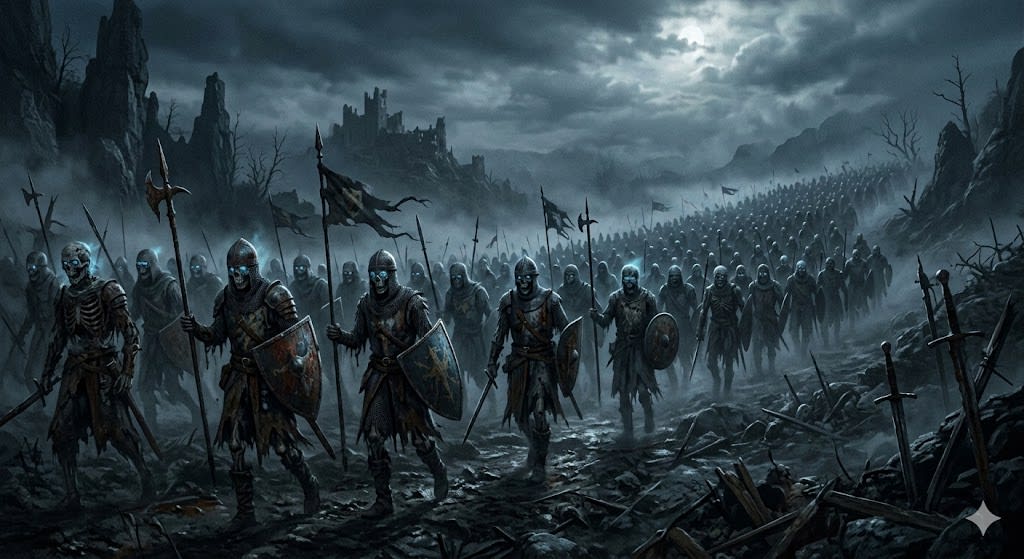
The image is hauntingly consistent across centuries of folklore: a silent procession of armored figures winding through a moonlit forest, the rhythmic clanking of steel muffled by an unnatural mist. Their banners are tattered, their horses are skeletal, and their eyes—if they have any at all—glow with a cold, pale light. This is the Knights of the Dead Army, a trope that has marched through European mythology, romantic literature, and modern fantasy.
But as with all persistent shadows, we must ask: Is there a heartbeat of history beneath the rusted breastplate? Or is the "Dead Army" merely a projection of our collective fear of the unresolved past?3
The Anatomy of the Legend: The Wild Hunt
To understand the Knights of the Dead, one must first look to the Wild Hunt (Wilde Jagd). This ancient folk myth, prevalent across Germanic, Scandinavian, and Celtic cultures, describes a phantasmal group of huntsmen passing in a furious chase across the sky or along the earth.
While the leader of the hunt changed depending on the region—Odin in Germany, King Herla in Britain, or even the biblical Cain—the composition of the army was often the same: the unrestful dead. These were not mere ghosts; they were warriors who died with unfinished business, those who were "neither heaven-bound nor hell-bent," cursed to ride until Judgment Day.
The Historical "Knights": The Order of the Dragon and the Black Bands
While the literal "undead" army is a product of myth, history provides several chilling parallels that likely fed the legend.
1. The Lost Legions
The disappearance of the Ninth Roman Legion (Legio IX Hispana) in Britain around 120 AD created a historical vacuum that folklore rushed to fill. For centuries, locals claimed to hear the rhythmic march of Roman sandals and the clatter of shields in the mist of the Scottish Highlands. The idea of a professional, disciplined army vanishing only to reappear as a ghostly force is a foundational brick in the "Dead Army" mythos.
2. The Black Army of Hungary
In the 15th century, King Matthias Corvinus maintained the Black Army of Hungary (Fekete Sereg). They were one of the first professional mercenary standing armies in Europe. When Matthias died and the funding dried up, the army dissolved into brigandage and was eventually crushed. However, the memory of these formidable, dark-armored men persisted in Eastern European tales as a "dead" force waiting in the mountains for a leader to wake them.
3. The Brethren of the Sword
The Livonian Brothers of the Sword, a crusading military order, were famously decimated in the Battle of Saule in 1236. Because many of these knights were never given proper Christian burials in the swampy Baltic terrain, local legends arose of white-mantled knights rising from the bogs during times of national peril.
Is It True? The Psychology of the "Sleeping Hero"
If we define "true" as the physical reanimation of corpses, the answer is a firm no. However, the legend is "true" in a sociological sense through the Kyffhäuser Myth or the "King in the Mountain" motif.
History is rife with "Dead Armies" that are actually Sleeping Armies.
Frederick Barbarossa:
Legend says he is not dead but sleeps in a cave in the Kyffhäuser mountains with his knights, his beard growing through a stone table, waiting to rescue Germany.
King Arthur:
The "Once and Future King" is said to be resting in Avalon (or under Alderley Edge) with his knights, ready to ride out in Britain's darkest hour.
These legends served a vital historical purpose: hope. For a peasantry besieged by real-world wars and plagues, the idea of a "Dead Army" wasn't always a horror story. Often, it was a backup plan. If the current king failed, perhaps the old, invincible ones would rise to set things right.
The Evolution: From Folklore to Pop Culture
The transition of the Knights of the Dead from terrifying omen to a staple of the "Epic Fantasy" genre happened largely in the 19th and 20th centuries.
Tolkien’s Oathbreakers
The most famous modern iteration is undoubtedly J.R.R. Tolkien’s Dead Men of Dunharrow. In The Return of the King, these are knights who broke an oath to fight against Sauron and were cursed by Isildur to linger as spirits.
Tolkien, a scholar of Old English and Norse, took the historical concept of the Comitatus—the sacred bond between a lord and his warriors—and showed what happens when that bond is corrupted. This "Army of the Dead" isn't a mindless horde; they are a group defined by a legal and moral failure, seeking "rest" through the fulfillment of their ancient promise.
The White Walkers
More recently, George R.R. Martin’s A Song of Ice and Fire reimagined the Dead Army as the "Wights"—a terrifying, nihilistic force. Here, the knights are stripped of their nobility and history, serving as a metaphor for the unstoppable march of climate change or inevitable death.
The Verdict: Why the Legend Persists
The Knights of the Dead Army represent our struggle with memory and legacy. Historically, when a great force was defeated, their story didn't simply vanish; it lingered in the landscape.
When people saw "ghosts" in the woods, they were often interpreting natural phenomena—the "Will-o'-the-wisp" (oxidizing phosphine from decaying organic matter) or the "Brocken Spectre" (a large shadow cast onto mist). But the human mind prefers a story to a chemical reaction. We see a knight because the knight represents a code of honor that we fear has died, or a threat that we fear might return.
The Knights of the Dead aren't real in the sense of biology, but they are historically significant artifacts of our psyche. They remind us that the past is never truly buried; it is always marching just a few paces behind us, waiting for the mist to clear.
About the Creator
Richard Weber
So many strange things pop into my head. This is where I share a lot of this information. Call it a curse or a blessing. I call it an escape from reality. Come and take a peek into my brain.
Keep reading
More stories from Richard Weber and writers in Fiction and other communities.
Surya's Song
There once lived a lively little child named Surya in a small seaside village tucked away along the southern Indian coast. Surya experienced an unexplained attraction to the sea even at a young age. She walked the sandy beaches for hours on end, gathering seashells and taking in the soothing sound of the waves lapping on the sand.
By Richard Weber2 years ago in Fiction
Whispers Beneath the Ash Tree
The first time Elara heard the whispers, she was twelve, crouched beneath the gnarled branches of the old ash tree that crowned the hill behind her grandmother’s house. The air smelled of wet earth and burned wood, a memory of last night’s fire still clinging to the soil. The voices were not loud—never loud—but soft murmurs that trembled through the leaves like wind through strings.
By Ihsanullaha day ago in Fiction
A More Human Vocal
When we launched Vocal nearly a decade ago, the world was a very different place. LLMs did not exist, and stories were created one at a time by people sitting down to write, revise, and share something personal. Many of our assumptions about publishing, trust, and participation were built for a world where effort and output were inseparable.
By Justin @ Vocalabout 23 hours ago in Resources




Comments
There are no comments for this story
Be the first to respond and start the conversation.