
The Uneven Ladder
How Mark Climbed the Ladder that Wasn’t Built for Him

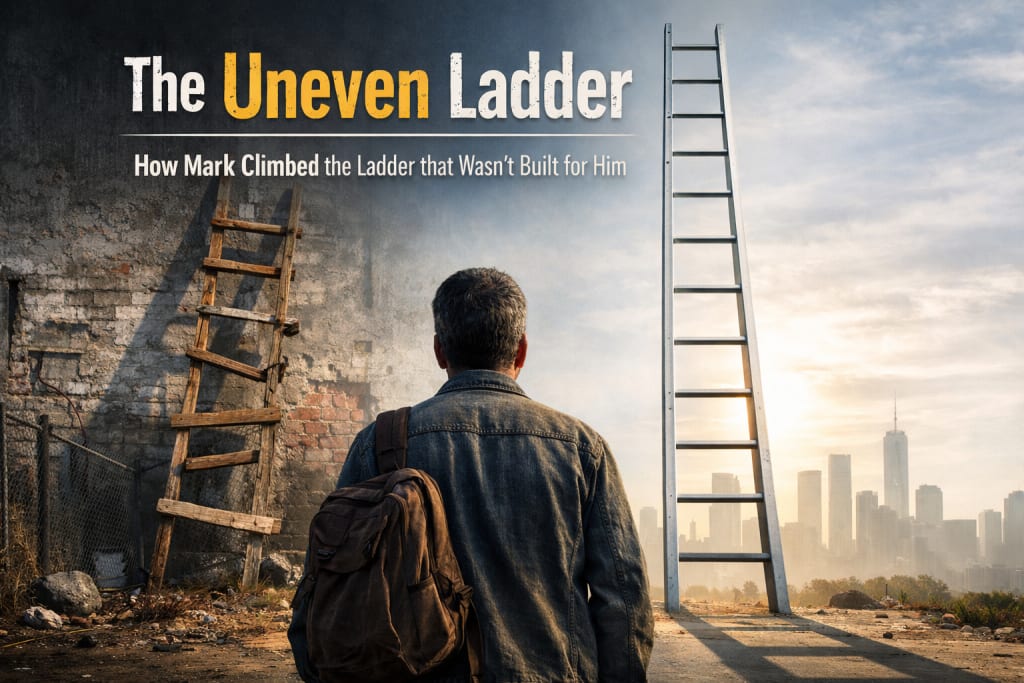
Mark first learned the magical myth in a classroom with peeling paint and tall windows that rattled every winter when the wind pushed down the avenue. His fourth-grade teacher wrote it on the chalkboard with deliberate strokes.
Hard work + Education = Success.
She circled the equation twice.
The class copied it into their notebooks as if it were arithmetic.
Mark believed it in the same way children believe in gravity. His mother also believed it. She worked long days cleaning office buildings, and repeated the same sentence whenever he complained about homework.
“Study hard,” she would say. “In this country, that’s all you need.”
Their apartment sat on the third floor of a concrete public housing tower that smelled faintly of boiled rice and radiator steam. At night, Mark studied at the small kitchen table while the television flickered in the background. There was no elevator in his building, so he often climbed all three flights with a backpack full of books.
He imagined the myth like a ladder. Every test passed was another rung.
What he did not see were the invisible scaffolds surrounding other ladders.
In high school, Mark discovered a strange detail that the myth never mentioned.
His guidance counselor urged him to apply to competitive universities.
“You’ve got the grades,” she said. “But you should think about internships. Connections matter.”
Connections.
Mark was confused and had no idea what she was talking about.
She paused, as if trying to explain gravity to someone who had never seen something fall.
“Well… people you know who can help.”
Mark knew exactly four adults outside his family: two teachers, the building janitor, and the woman who ran the corner grocery.
None of them worked on Wall Street, at consulting firms, or in research laboratories.
Meanwhile, several classmates seemed to move through an entirely different version of the equation. They studied, yes, but they also spent weekends skiing or traveling to conferences their parents had arranged. One boy in his calculus class wore a watch that cost more than Anton’s mother earned during an entire year!
They spoke casually about internships already promised.
Mark worked Saturdays and Sundays in a local Kentucky Fried Chicken restaurant, cleaning the bathrooms, mopping the floors, cooking, and running the cash registers.
He still believed in the ladder. He just noticed that all ladders were not created equal. College introduced another missing detail.
Mark attended a local public university because the scholarships covered most of the tuition. In the first semester, he worked two campus jobs—tutoring other students and helping Professors with their research, and working part-time at a local hamburger joint.
One of his classmates drove to school in a car packed with expensive speakers and new clothes.
Mark needed many things, but had learned early not to ask. During his freshman year, first year, he noticed another pattern.
On Monday mornings, classmates described weekend parties or trips home where laundry magically returned folded and clean. In contrast, Mark spent weekends calculating how many extra hours he could work without his grades slipping.
Sleep became a currency.
During his sophomore year, exhaustion produced a pain in his stomach that felt like a small burning coal. A school doctor eventually diagnosed a bleeding ulcer.
“Stress,” the doctor said gently.
Mark laughed when he heard the word. Stress sounded like a temporary weather condition.
For him, it felt more like the climate.
Still, he finished his bachelor’s degree. Then a Master’s followed by a Doctorate in economics.
Each diploma felt less like climbing a ladder and more like tunneling through rock with a spoon. Graduate school revealed the myth’s most polished edge.
Many of Mark’s peers had degrees from elite universities whose names opened doors before anyone spoke. When they applied for research positions or think-tank fellowships, interviewers already knew their advisors.
Mark’s university produced good economists, but its name rarely appeared on conference banners.
During one early job interview, a senior economist scanned Mark’s résumé.
“You did your Ph.D. there?” the man asked.
“Yes.”
A brief silence followed.
“Well,” the interviewer said, “you’ll have to prove yourself.”
Mark understood the translation. Others were assumed capable until proven otherwise.
He would be assumed questionable until proven exceptional.
So, he worked longer hours than anyone else in the department. He published papers that few people read at first. He attended conferences he could barely afford, standing at the edges of conversations, hoping to meet the right people.
Networking, he discovered, was another ladder—but this one required being invited into the room.
At one conference reception, Mark watched a colleague from a prestigious university laugh easily with senior policymakers. The colleague had spent the afternoon golfing with them.
Mark had spent the afternoon presenting a paper in a half-empty breakout room.
Later that evening, the colleague mentioned, almost casually, that his father had introduced him to several executives in the room when he was a teenager.
Mark nodded politely.
The myth had never mentioned fathers like that.
But he persisted.
Years passed. Papers slowly accumulated citations. One of his studies on labor markets finally caught attention after an economic downturn made policymakers curious about unemployment dynamics.
Suddenly, Mark was invited to speak at conferences with full audiences.
Journalists called.
Students quoted his research.
Success, when it finally arrived, looked strangely ordinary. It came not as a triumphant moment but as a gradual easing of resistance.
Like a door that had always been locked but now opened quietly.
Today, Mark is retired.
He often walked through the same neighborhood where he had grown up. The public housing towers still stood, their windows reflecting the same gray sky.
Sometimes he passes students carrying backpacks and wonders which version of the myth they believe.
Hard work + Education = Success.
He did not think the equation was entirely false.
Without hard work, he would never have crossed those classrooms, warehouses, libraries, and conference halls.
But he also knew something the chalkboard equation never captured.
Some people began the race several miles ahead.
Some ran on smooth pavement.
Others climbed hills carrying weights.
Thankfully, Mark had finished the race anyway. He had become the first person in his family to graduate from high school, then from college, and to earn both a master’s degree and a Ph.D. in economics.
He had succeeded.
But as he looked back across the long path behind him, he could see the invisible obstacles the myth had quietly erased.
Myths motivate people. They must be simple enough to remember.
Reality, Mark knew now, was complicated enough to require a lifetime to understand.
About the Creator
Anthony Chan
Chan Economics LLC, Public Speaker
Chief Global Economist & Public Speaker JPM Chase ('94-'19).
Senior Economist Barclays ('91-'94)
Economist, NY Federal Reserve ('89-'91)
Econ. Prof. (Univ. of Dayton, '86-'89)
Ph.D. Economics
Keep reading
More stories from Anthony Chan and writers in Fiction and other communities.
Fleeting Leaves
Autumn leaves drift down, Beauty fades as time rushes Life, too, feels so brief.
By Anthony ChanExclusive • 6 months ago
Becca
"Everything is so... flat." Denille said stupidly as she looked around her new neighborhood. She looked around at the muted desert where even the smallest sign of life seemed to have given up. The plant life was shrubs that were half cooked by the heat and where there should have been a lawn, a mess of white rocks laid glistening in the sun. Even the sky looked stretched thin, like the sun had ironed it smooth. She’d moved from Riverside, where at least there were hills, but here in Barstow, everything felt baked and brittle.
By Sara Wilson5 days ago in Fiction
Guard Your Battery, Lose Your Humanity
I used to think my phone was my lifeline. In Amsterdam, where rain slicks the cobblestones and bikes fly by like they're late for something important, my screen was the one constant: notifications buzzing through tram rides, endless scrolls while waiting for koffie at a brown café, quick checks at red lights on the Keizersgracht. It felt safe. Controlled. Connected. Until it didn't. By early 2026, I was exhausted in a way sleep couldn't fix. My anxiety had crept up quietly — heart racing in crowds, that low hum of dread when the battery dipped below 20%. I blamed the city, the weather, work. But deep down, I knew the truth: I'd outsourced my presence to a rectangle in my pocket. I was here, but never really here. So on a drizzly February morning, I made a rule that felt ridiculous: no phone in public for 30 days. Pocket, bag, or leave it at home — but never in hand when outside my apartment. If I needed directions or music, tough. The goal wasn't total detox; it was forcing myself to look up, be bored, and — if the moment felt right — talk to someone. One stranger conversation a day if it happened naturally. No forcing, just availability. What broke first was the fidgeting. Days 1–10: The Withdrawal Hits Hard The first week was brutal. At the Albert Cuyp Market, my hand kept reaching for my pocket like a phantom limb. Without the screen to hide behind, every line felt exposed. I noticed things I'd ignored for years: the way an old man feeds pigeons near the Nieuwmarkt, the precise rhythm of bike bells, the smell of fresh stroopwafels mixing with canal water. I also noticed people. Everyone else was doing what I'd been doing — heads down, thumbs moving. On the 2 tram toward Centraal, a carriage full of silent faces lit by blue light. No one spoke. No one looked up. It hit me: we're all in our own little bubbles, floating through the same beautiful city. By day 5, boredom turned into restlessness. Waiting for coffee at a spot on the Prinsengracht, I had nothing to do but watch. A woman in a red coat struggled with her umbrella in the wind. Our eyes met. She laughed first. "This weather," she said. I replied, "It builds character, right?" We chatted for two minutes about nothing — the rain, the best waterproof jackets. It felt awkward, electric, alive. That tiny exchange cracked something open. My anxiety didn't vanish, but it lost its grip for a moment. Days 11–20: The City Starts Talking Back Halfway through, the experiment shifted from punishment to curiosity.
By Shoaib Afridi4 days ago in Fiction


Comments
There are no comments for this story
Be the first to respond and start the conversation.