
Witnesses to a Gorgon's Cruel Silence
The Serpents of Medusa

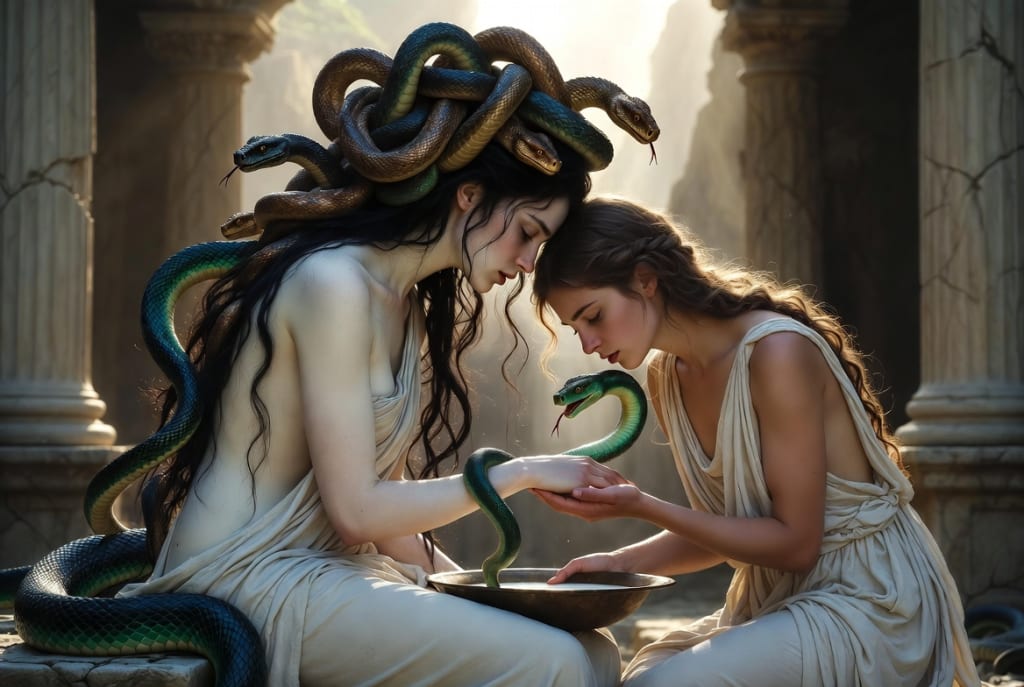
High on the flank of Mount Helicon, where the old temple to Athena clung like lichen to the rock, the wind never stopped singing. It keened through cracked columns, stirred dust along the mosaic floor, and carried the faint mineral scent of the sacred spring that still trickled in the inner courtyard. Few pilgrims came anymore. The oracle at Delphi had declared the place unclean; the goddess had turned her face away. Only one attendant remained, sent not by devotion but by decree.
Kalliope had arrived in late autumn with a single pack, a bronze basin, and instructions written on a wax tablet that she had burned the same night: Tend the Gorgon. Keep the serpents calm. Let no one see her face. She had expected horror. What she found was silence so deep it felt like drowning.
Medusa no longer paced the shadowed halls as the legends claimed. She sat in the old adyton, the innermost chamber, on a bench worn smooth by centuries of offerings long since crumbled to powder. Her back was always turned when Kalliope entered, as though habit had carved that posture into her bones. The serpents, dozens of them, thick and thin, bronze and emerald and obsidian, moved constantly, a slow, restless tide across her shoulders, down her arms, through the dark fall of what had once been hair.
They were not decorations. They were hungry. They were grieving. And they felt everything.
The first weeks had been a tense dance. Kalliope learned their rhythms: dawn milk laced with crushed valerian to soothe them, midday quail chopped fine for the smaller ones, dusk offerings of raw egg yolk beaten with honey for the elders whose scales had begun to dull. She spoke to them in murmurs, calling them by colors or habits rather than names, the bronze one who likes to coil left, the little green who drinks last. Medusa never corrected her. Medusa rarely spoke at all.
But the serpents listened.
One frostbitten morning in early spring, Kalliope entered with the milk basin and found Medusa’s shoulders trembling. The serpents were not merely restless; they were frantic. A thick adder struck at empty air. A slender viper pressed so tightly against Medusa’s neck that the skin beneath showed white. Their hisses overlapped into something almost like keening.
Kalliope set the basin down carefully. “What’s wrong?”
Medusa did not answer at first. When she did, her voice was cracked, barely above the wind outside. “A memory came back in the night. A man. He did not run. He begged. He said my name like a prayer.” She lifted one scarred hand. “They tasted his fear. They tasted mine. Now they cannot forget.”
Kalliope knelt beside the basin. The emerald serpent, the one she thought of as the gentlest, slid down Medusa’s arm and onto the stone floor, approaching her with slow, deliberate loops. It nudged the edge of the basin, then lifted its head toward Kalliope’s face. Not threatening. Asking.
She dipped the cloth and offered it. The serpent drank, tongue flickering, then pressed its cool snout against her wrist as though measuring her pulse.
“They do not hate you,” Medusa said suddenly. “They hate what happens when people look at me. Every time someone’s heart races with terror or desire or disgust, it pours into them like acid. They writhe. They bite me when the pain overflows.” She turned her forearm; pale crescents marked the skin in patterns that might have been constellations if anyone dared read them. “I thought the curse was mine alone. It is not. It lives in them.”
Kalliope kept her eyes on the serpent. “And when I come?”
A long pause. The wind rattled a loose tile somewhere above.
“They feel your hands are steady,” Medusa said at last. “They feel your breath does not quicken with fear. They feel… sorrow. But not for what I am. For what was taken.” Her voice dropped. “They feel your loneliness. It matches theirs.”
The words struck Kalliope like cold water. She had not named the hollow inside her chest, not even in the dark hours when sleep refused her. The mountain was beautiful, pine resin sharp on the tongue, stars so close they seemed to lean in, but it was empty of voices. She had not spoken to another human soul since the day she left the sanctuary at the oracle’s command.
The emerald serpent coiled loosely around her wrist, not binding, simply resting. Its scales felt like cool silk.
Medusa shifted. For the first time in months, she turned, not fully, never fully, but enough that Kalliope glimpsed the line of her cheek, the dark sweep of lashes against pale skin. She kept her eyes closed.
“You stay,” Medusa said. It was not a question.
“I was ordered to stay.”
“You could have run. Many did. The ones who fed them once or twice, then fled when the hissing grew too loud.” A faint, bitter smile touched her mouth. “You bring milk even when they strike at shadows. You speak to them. You do not flinch when they taste your skin.”
Kalliope looked down at the serpent on her arm. It had begun to sway gently, as though rocked by music only it could hear. “They are not monsters,” she said quietly. “They are… witnesses.”
Medusa exhaled, a sound so fragile it might have been a sob held back for centuries. “Then witness this: I was not always this. I was a girl who laughed. I was a priestess who believed the goddess heard me. I was loved, once, and I loved in return. The serpents remember that girl. They mourn her every day.”
The black viper, the boldest, the one that sometimes rested across Medusa’s collarbone like a claim, slithered forward. It hesitated, then glided onto Kalliope’s shoulder, looping once around her neck before settling against the pulse beneath her ear. Its tongue flickered once, tasting her cheek. Not a threat. A question.
Kalliope did not move. Tears blurred the stone floor.
“I’m sorry,” she whispered, to Medusa, to the snakes, to the girl who had laughed.
Medusa opened her eyes at last, but trained them on the far wall, on nothing. “Do not be sorry. Be here. That is enough.”
They sat in silence while the light strengthened, turning the chamber gold. The serpents quieted. Some draped across Medusa’s lap, others twined in Kalliope’s hair like living ornaments. The bronze adder rested its head on Medusa’s knee. The emerald one stayed on Kalliope’s wrist, a cool, steady weight.
Outside, the wind softened, carrying myrtle and the promise of rain.
Inside, two women fed the creatures that bound them, milk, quail, quiet words, one careful gesture at a time.
The true horror had never been the gaze that turned flesh to stone.
It was the endless solitude that followed, until someone finally chose to stay, and the serpents, for one bright morning, remembered what peace felt like.
About the Creator
Diane Foster
I’m a professional writer, proofreader, and all-round online entrepreneur, UK. I’m married to a rock star who had his long-awaited liver transplant in August 2025.
When not working, you’ll find me with a glass of wine, immersed in poetry.
Keep reading
More stories from Diane Foster and writers in Fiction and other communities.
Sunflowers in the Sink
The yellow house on the corner of Elm Street had four bedrooms, a shared kitchen with a finicky dishwasher, and rent split evenly at $800 a head. Mia, the graphic designer, handled the group chat for chore rotations. Jamal, the barista, stocked the fridge with oat milk and craft beers. Sarah, the grad student, blasted true crime podcasts during her late-night study sessions. And then there was Vincent, who paid in crumpled francs and painted the living room walls when it was his turn to vacuum.
By Diane Foster4 days ago in Fiction
Lightning Never Strikes Twice
The distant rumble, the sudden deluge, the crescendo of sound, the flash of light, the explosive energy — it never gets old. I became an amateur storm chaser about two years ago. My wife, Cindy suggested it. Sort of. She said, "Alex, you know this cancer is killing me. I've come to terms with that, but you're smothering me. Go join a band, write a book, or become a storm chaser, for all I care. I love you, but you need a hobby."
By Julie Lacksonen5 days ago in Fiction



Comments (1)
Amazing piece of writing, Diane. I can feel the depth in this one, it makes it feel real.