
The Ancient Romans Loved Their Penis Talismans
Erect penises have mystical powers. Every Roman knew this!

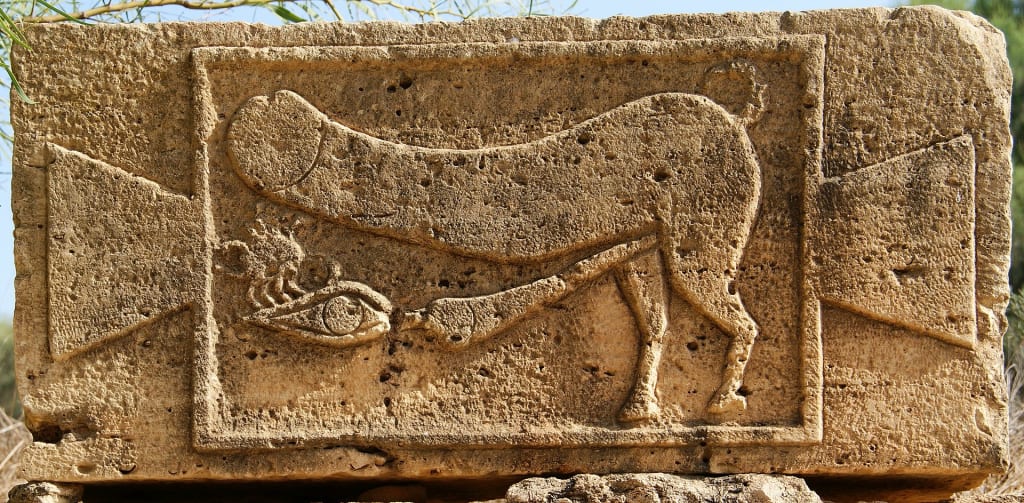
What on Earth is this monstrosity? Curious? Well, read on.
Schoolboys visiting the Roman ruins of Leptis Magna (in modern Libya) often end up breaking into fits of raucous laughter while gawking at one monument — a shockingly obscene fascinum carved on a bas-relief. This particular beastie is shaped like a large erect penis standing on a pair of horse legs. It even sports its own miniature erection and had been depicted by the artist as being right in the midst of ejaculating on a floating eye with a scorpion-like creature riding on top.
I am not making this up.
This trippy penis-creature is an ancient protective symbol and the eye with the scorpion perched on it is a symbolic representation of the evil eye or malus occulus. And yes, evil is being vanquished by being ejaculated upon.
Meet the fascinum, the most popular protective talisman against black magic and evil spirits known to the people of the Roman Empire. And yes, the Romans had a bizarre penis obsession. They believed that erect penises could chase away bad luck.
You won't learn about this in your high school History class.
One fascinum, two fascini
A fascinum (also known as a “fascinus”) is a representation of the divine phallus. The Romans made fascini (often with wings, legs, tails, secondary penises, attached male bodies and some even with a woman riding on top!) into amulets and effigies, carved them into bas-reliefs like the ejaculating monstrosity in the above photo, painted them on frescoes and incorporated them into naughty windchimes (more on this below) and oil lamps.
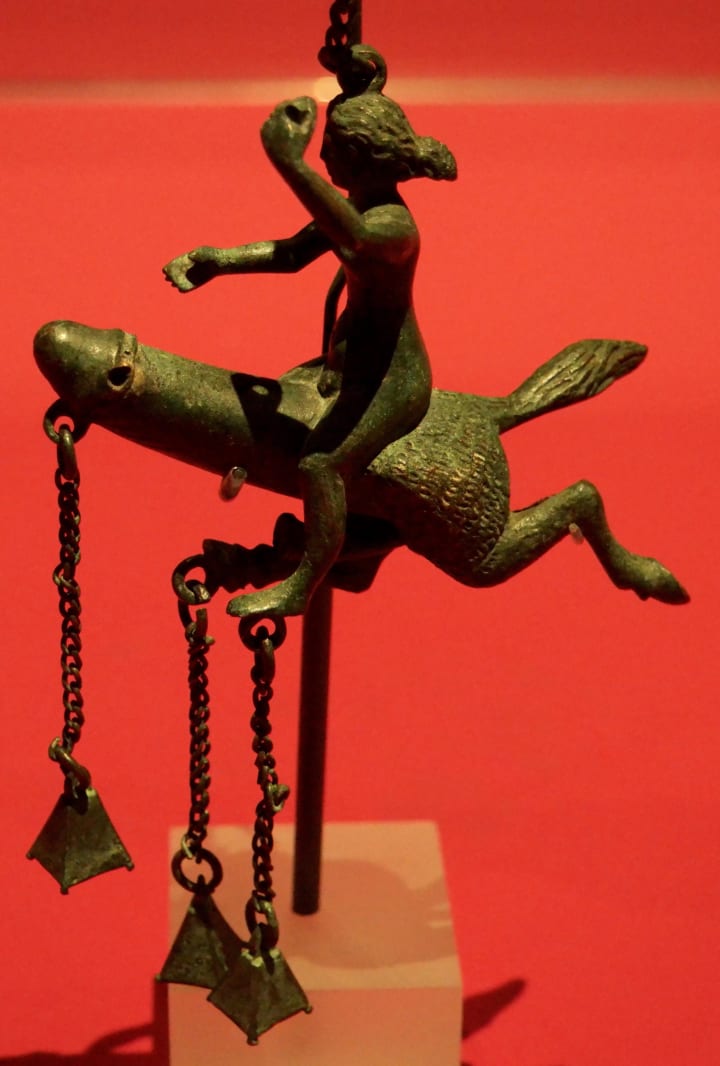
The protective magic of the fascinum was due to it being, among other things, a representation of the virile regenerative powers of the phallus. After all, we owe our very existence to an ejaculating penis, so to the Roman mind, it must represent some potent supernatural force.
Fascini were also powerful because Romans thought of sex in terms of domination — a strong male penetrates lesser beings- women, girls, boys, male slaves — thus defining himself as a true virile Roman man. A penis is a symbol of a man’s dominating power and could thus be extended into the supernatural world. The Romans believed that dark forces could literally be f*cked into submission!
Finally, the fascinum’s power over evil could be due to its shocking appearance — perhaps the evil spirits got distracted by the obscene shapes and were too busy laughing or cringing in shame to actually harm anyone.
Whatever the explanation, fascini were so popular that they were brought by Roman centurions to all corners of the Empire — erect penises can still be found carved into Hadrian’s Wall in what is today the northern edge of England. Since the Wall still stands steadfast, perhaps the magic penises carved into it are indeed doing their job as supernatural protectors!
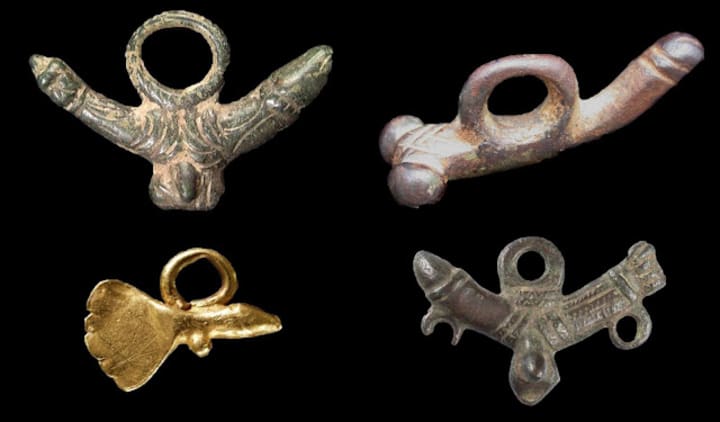
And do take a look at the photo right above. Notice that the amulets were often designed to be worn on chains around the wearer's nake. They were also designed so that the tip of the erection points outwards, away from the wearer. This was deliberate; the fascinus will thus face towards any potential danger or bad luck and nullify it before it reaches the wearer. Romans literally believed that the charm could fuck and destroy any approaching evil!
Here's another one, this time in the shape of a coloured mosaic, that represents the same idea.
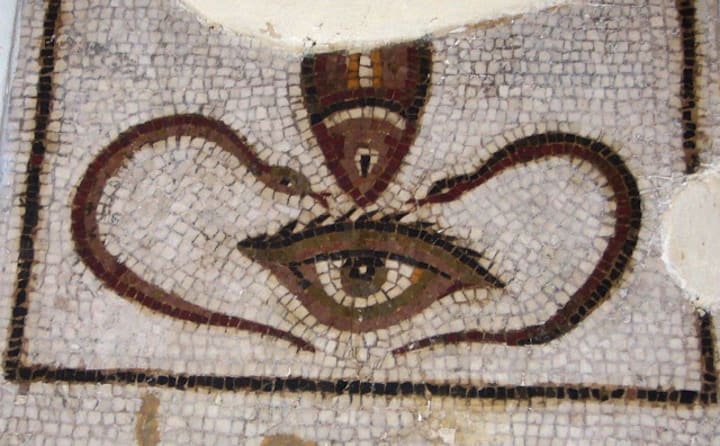
The very fascinating (see what I did there?) mosaic depicts an evil eye being attacked by two snakes and an erect penis. The idea is that any evil that comes to this house will be neutralised. Fucked and destroyed, to say the least.
More magic erections and their power to neutralise evil
First of all, we have to understand what the evil eye is.
The Romans believed that excessive envy (invidia in Latin) towards someone could bring about negative energies and bad luck to that individual. These forces generated through envy can accumulate and come together to form masses of malevolent energy. Collectively known as malus occulus or the “evil eye” these malevolent energies could be defeated by invoking the protection of our friend the fascinus.
Due to this fear of the evil eye, penises were everywhere in ancient Rome. Here is yet another mosaic from a Roman ruin that promises protection from the negative powers of envy.
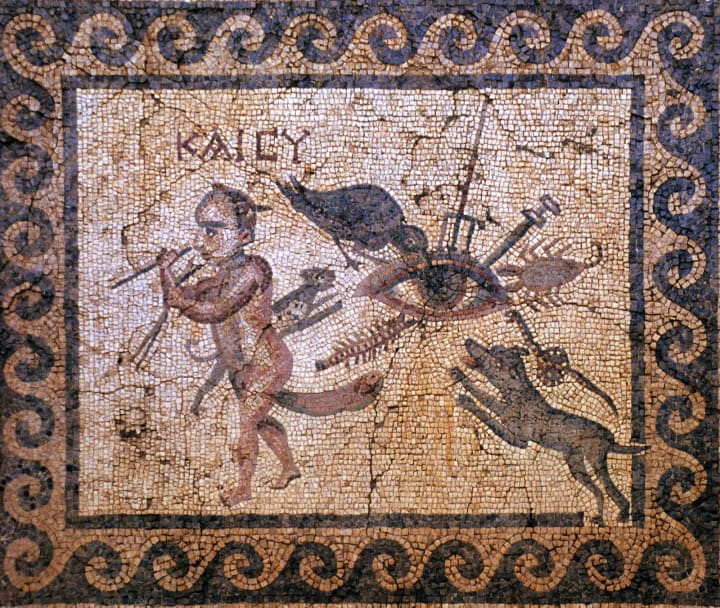
It depicts a naked dwarf whose monstrous penis has a mind of its own and joins a barking dog, a cat, a scorpion, a centipede, a snake and a pecking raven in attacking yet another disembodied floating evil eye. Oh yes, the evil eye is also getting pierced by a trident and a sword. Talk about overkill! Absolutely no evil is stepping into that house!
Some fascini were meant to be worn on chains were finger rings. Many were so small that they were most likely worn by children. It depicts a naked dwarf whose monstrous penis has a mind of its own and joins a barking dog, a cat, a scorpion, a centipede, a snake and a pecking raven in attacking yet another disembodied floating evil eye getting pierced by a trident and a sword. Talk about overkill!
Some fascini were meant to be worn on chains like amulets around the neck. Others were finger rings. Many were so small that they were most likely worn by children. Other fascini were designed as tintinnabula or wind chimes.
Tinkling penises that chased evil away
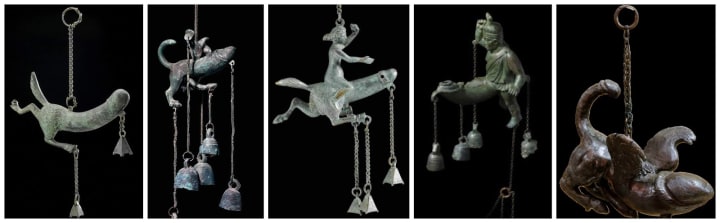
Basically, tintinnabula were erection-shaped windchimes with all manner of extra features. The central body was of course, the erect phallus. This phallus could have animal parts - either legs, wings or tail or often, all three! There could be several penises on one windchime - the Romans were obviously very thorough - why have only one penis when you could cram lots of them into one charm for maximum power!
Some had a nude woman riding them (middle photo above). Others were attached to male figures - gladiators (like the second one from the right), dwarves and even depictions of the gods.
Chains were suspended from several points on the figure, and all held a small bell at the tip.
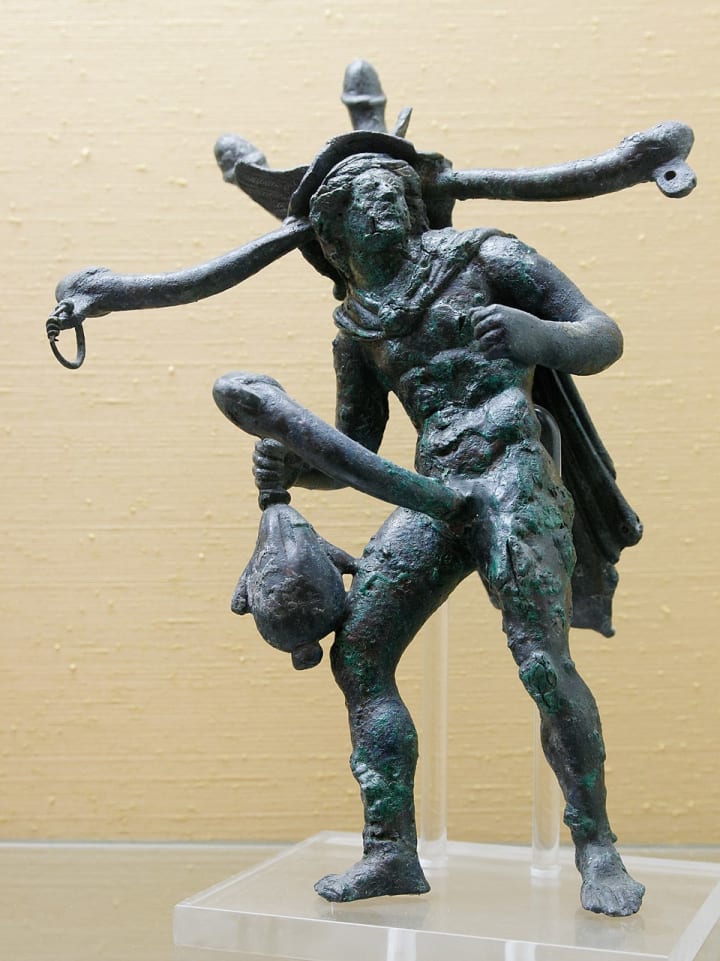
This tintinnabulum depicts the God Mercury with multiple giant erections growing from his head, in addition to one in the anatomically-correct location. Three of his penises originally sported chains with tinkling bells, now lost.
Tintinnabula could also have been used as doorbells with several of them being attached to a cord that could be pulled by a visitor at the front door. Imagine ringing a Roman doorbell made of these obscene little figures! Tinkling magic penises, anyone?
Protector of freeborn Roman boys
In ancient Rome, it was illegal for a Roman man to sleep with a freeborn Roman woman except his wife nor was he allowed to sleep with freeborn Roman boys and men.
Emphasis on the word freeborn. Slaves were perfectly fine to rape and molest.
And yes, the Romans had no concept of gay versus straight, believe it or not. A healthy man was expected to enjoy sex with men and women so long he was their superior and they were slaves or prostitutes or foreigners.
When freeborn Roman boys were in the public baths, they wore necklaces with fascini on them to signify their privileged status while they were naked. In this case, the fascini signaled to adult Roman men that these boys were off limits and that they should not be raped!
Linguistic descendants
The word “fascinus” or "fascinum" gave rise to the Latin “fascinare” meaning “to enchant or bewitch”. This was borrowed into English where it became “fascinate’, “fascinating” and “fascinator”.
Every time I watch Star Trek and hear Mr Spock say “fascinating”, I can’t help but chuckle at the fact that he is invoking the fascinum, often multiple times per episode.
Or for that matter, when I see pictures of the (in)famous fascinators worn by fashionable modern Englishwomen to very posh social events.

I wonder whether anyone would be keen to inform Kate Middleton or Meghan Markle that those little fascinators they are wearing on their heads are really named after the old Roman word for an obscene but powerful penis talisman?
About the Creator
Brian Loo Soon Hua
Writer, linguist, polyglot and amateur artist. If you like weird sci-fi and fantasy art, come take a look at my stories!
Keep reading
More stories from Brian Loo Soon Hua and writers in Filthy and other communities.
A fiery awakening
Today I woke up with a strange desire to live, usually I can't have positive energy early in the morning, but today, strangely, I woke up with a smile and the desire to be fucked by my husband, who at that moment was sleeping peacefully lying on his stomach not knowing at all what was waiting for him. I look at him and like every time my panties get wet, this man has the power to make me melt with a look, he is so charming, tall, muscular, with smooth and hairless skin... it excites me just thinking about it.
By Gihan Mansorya day ago in Filthy
Why I’ve Gone Back to Sex Work
Last year I wrote a post titled Why I Will Always Return to Sex Work. At the time, it felt a little theoretical. A reflection more than a plan. I wasn’t actively considering a return to the industry. My life looked relatively stable, my career was moving along its respectable little track, and sex work sat quietly in my past like an interesting chapter rather than a current storyline.
By No One’s Daughter6 days ago in Filthy
Hottest in the Office
Dear Rafi, You’re very distracting to work around. For the first second I saw you the other day, I thought you were some type of executive. It took a moment to realize no, you were just the new guy, dressed up for the job he wants. Be still, my heart.
By Gabriel Shames5 days ago in Pride




Comments
There are no comments for this story
Be the first to respond and start the conversation.