
The Last Ottoman Caliph: Abdulmejid II and the Burial That Happened a Decade After His Death
How the final Caliph of the Ottoman dynasty died in exile and was buried ten years later following a recommendation from Pakistan’s Governor-General

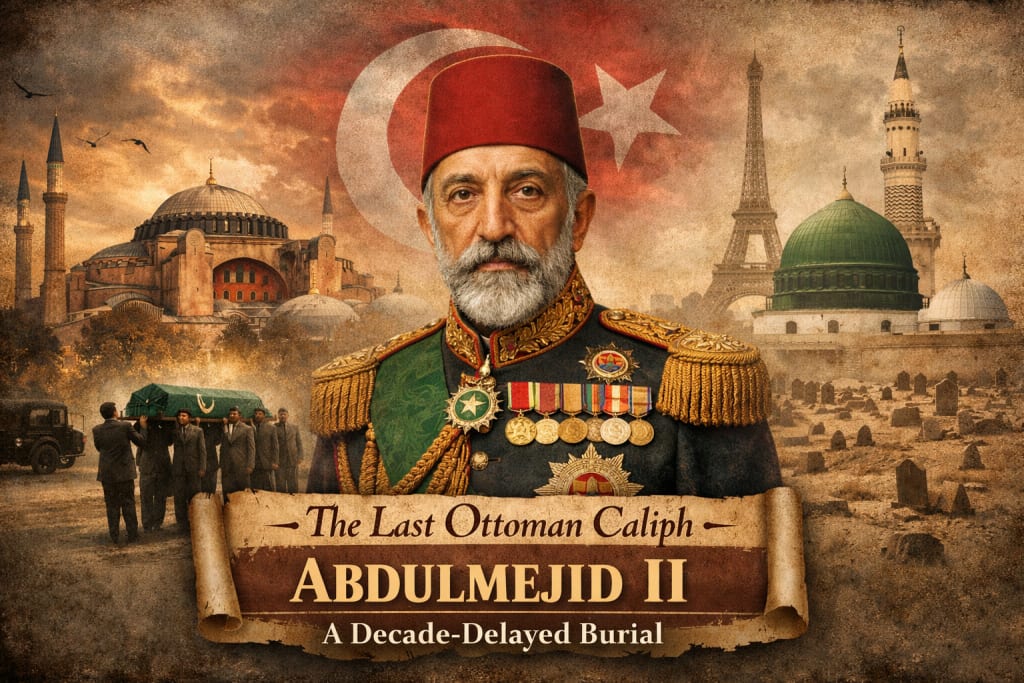
The fall of the Ottoman Empire in the early twentieth century marked the end of one of the longest-lasting and most influential Muslim empires in history. With it came the abolition of the Caliphate—an institution that had symbolized the political and spiritual leadership of the Muslim world for centuries. The last person to hold that title was Abdulmejid II, the final Ottoman Caliph, whose life ended in exile. Yet what makes his story even more remarkable is that his burial took place nearly ten years after his death, following efforts supported by the Governor-General of Pakistan.
Abdulmejid II was born on May 29, 1868, in Istanbul, into the Ottoman royal family. Unlike many princes of his time, he developed a reputation as a cultured intellectual. He was deeply interested in art, literature, and Western culture, becoming a talented painter and patron of the arts. However, history placed him in a position that would carry immense symbolic weight.
In 1922, the Turkish nationalist movement led by Mustafa Kemal Atatürk abolished the Ottoman Sultanate, bringing an official end to the centuries-old imperial system. Sultan Mehmed VI went into exile, and in a compromise intended to ease the transition, Abdulmejid II was appointed as Caliph in November 1922. His role was largely ceremonial; the new Turkish Republic retained political authority while the Caliphate continued only as a symbolic religious institution.
This arrangement, however, did not last long. Atatürk and his supporters were determined to establish a secular state free from the influence of the old imperial order. On March 3, 1924, the Turkish Grand National Assembly formally abolished the Caliphate. The Ottoman royal family was expelled from Turkey, and Abdulmejid II—along with dozens of other members of the dynasty—was forced into exile.
Abdulmejid II first moved to Switzerland and later settled in France, eventually residing in Nice and Paris. In exile, he lived a relatively quiet life devoted to painting, reading, and maintaining connections with the dispersed Ottoman family. Though stripped of his political authority, he remained a symbolic figure for many Muslims who mourned the disappearance of the Caliphate.
The former Caliph died in Paris on August 23, 1944, during the final phase of World War II. His death, however, created an unusual problem. Because the Ottoman dynasty had been banished from Turkey, the Turkish government did not allow him to be buried in his homeland. Meanwhile, the war conditions and political complications in Europe made arrangements for burial extremely difficult.
As a result, Abdulmejid II’s body remained in Paris for years after his death. Efforts were made by members of the Ottoman family and Muslim leaders to find a suitable burial place, but political obstacles continued to delay the process. The situation remained unresolved for nearly a decade.
The breakthrough reportedly came after diplomatic efforts involving leaders from the Muslim world. One of the key supporters of arranging a dignified burial was the Governor-General of Pakistan. Pakistan, which had gained independence in 1947, held a special historical connection with the Ottoman Caliphate. During the early twentieth century, Muslims in British India had strongly supported the Ottoman Caliph through the Khilafat Movement.
Recognizing this historical relationship, Pakistan’s leadership expressed support for ensuring that the last Ottoman Caliph received a proper Islamic burial. Through diplomatic recommendations and negotiations, arrangements were finally made for Abdulmejid II to be laid to rest in a Muslim land.
In 1954—almost ten years after his death—his body was transferred from Paris to Saudi Arabia. He was buried in the historic Jannat al-Baqi cemetery in Medina, one of the most revered burial grounds in the Islamic world. The cemetery holds the graves of many companions and family members of the Prophet Muhammad, making it a place of deep spiritual significance for Muslims.
The delayed burial of Abdulmejid II highlights the turbulent political transformations that followed the collapse of empires and the emergence of new nation-states. It also reflects the enduring emotional and symbolic importance of the Caliphate for many Muslims across different regions.
Today, Abdulmejid II is remembered not only as the last Ottoman Caliph but also as a cultured figure caught between two eras—the fading world of imperial rule and the rise of modern republics. His unusual posthumous journey from exile in Europe to burial in Medina serves as a poignant reminder of how historical transitions can shape even the final resting place of a leader.
The story of Abdulmejid II ultimately represents more than the end of a dynasty. It symbolizes the closing chapter of a centuries-old institution and the complex legacy of the Ottoman Caliphate in the modern Muslim world.
About the Creator
Irshad Abbasi
Ali ibn Abi Talib (RA) said 📚
“Knowledge is better than wealth, because knowledge protects you, while you have to protect wealth.
Keep reading
More stories from Irshad Abbasi and writers in FYI and other communities.
The Gift That Spied: How a Soviet “Token of Friendship” Secretly Eavesdropped on America
In the tense early years of the Cold War, when suspicion and secrecy shaped global politics, one of the most ingenious espionage operations in history began not with a break-in or a coded message—but with a gift.
By Irshad Abbasi about 17 hours ago in FYI
A Planetary Alignment will coincide with Mercury Retrograde
Double phenomena in the heavens Some people say in jest that the planets have aligned in their favor when life works the way they desire. Were you aware that there are seasons when things do line up in the heavens? There will be a planetary alignment AKA a planet parade, on February 28, 2026.
By Cheryl E Preston8 days ago in FYI



Comments
There are no comments for this story
Be the first to respond and start the conversation.