
ChatGPT’s Great-Great-Grandmother: A Fascinating Story from the Pre-Internet Era 📜🕰️
Long before the internet and smartphones, a 1960s chatbot was already winning human hearts. Meet the ancestors of today’s AI revolution.

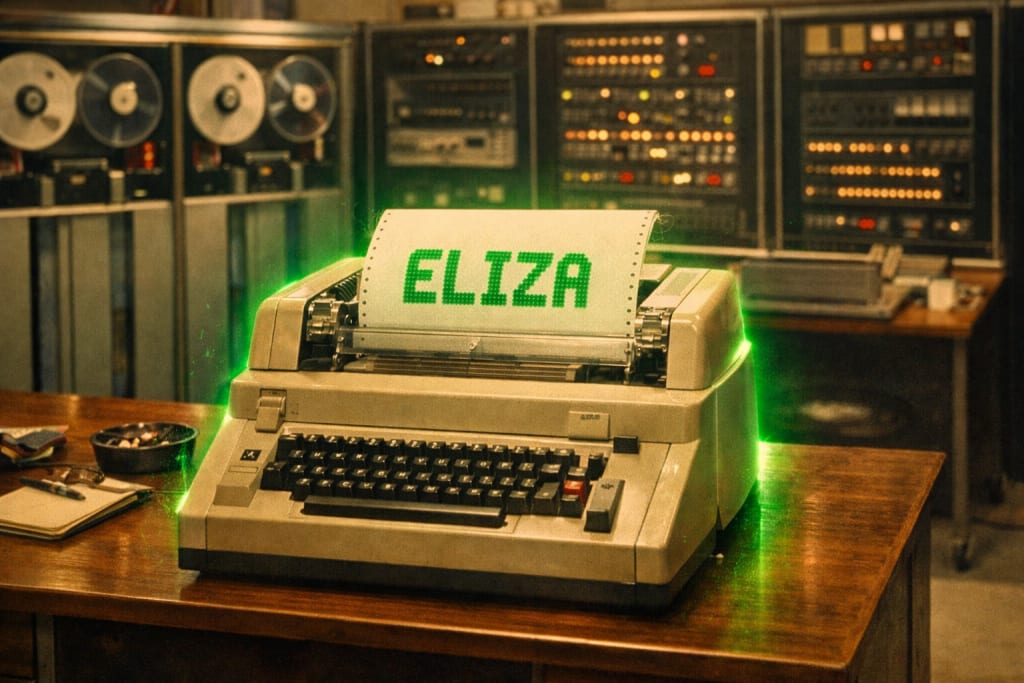
Many people use AI today, but few realize that the beginnings of artificial intelligence took place a long time ago – long before the internet era 🌍. Although the technology of that time wasn't as advanced as what we have now, it could already do quite a bit. Let me introduce you to a distant relative of ChatGPT and other language models. Listen in. 🎧
Giants in Metal Cabinets 🏗️⚡
Before we get to "Grandma" herself, we need to understand the reality she was born into. Forget about smartphones, laptops, or even a computer mouse. In the 1950s and 60s, computers looked nothing like what we know today. They were massive machines the size of wardrobes, sometimes even entire rooms. 🏢 Filled with thousands of vacuum tubes and miles of cables, they generated so much heat that they required special cooling systems just to keep the floor from melting. Programs weren't downloaded from a network (since it didn't exist); they were fed in using punch cards – strips of cardboard where each hole represented a specific instruction for the machine 🎞️. It was inside these "intelligent cabinets" that the dreams of an artificial mind were born.
A Visionary Without a Processor: Alan Turing (1950) 🧠🎩
Before the first code was ever written, someone had to lay the foundation. That person was Alan Turing. In 1950, in his famous paper "Computing Machinery and Intelligence," he asked a question that changed the course of science: "Can machines think?" 🧐
Turing had no access to the internet or cloud computing. He had only a piece of paper and a brilliant mind. He came up with the "Imitation Game," known today as the Turing Test 📝. He argued that if a human talking to a machine couldn't tell it apart from another human, then we must consider the machine intelligent. This was the first theoretical herald of ChatGPT’s birth – a vision of a chat that could deceive human senses. 🤖💬
The First Spark of Genius: Logic Theorist (1955/56) 💡🔢
The first true success of AI wasn't a chatbot, though, but a mathematician. Logic Theorist, created by Allen Newell, Herbert Simon, and Cliff Shaw, is considered the first artificial intelligence program in history. 🥇
To us today, it sounds like a feature of an advanced calculator, but back then, it was a digital earthquake 🌋. The machine didn't just "calculate" – it "reasoned," using methods similar to the human thought process. It proved 38 out of 52 selected theorems from the mathematical bible of that time – Principia Mathematica. Fascinatingly, for one of the theorems, it found a proof shorter and more elegant than the authors of the book themselves 📚✨. It was the first instance in history where a machine "outran" human intellect in pure logic.
The Official Christening: The Dartmouth Conference (1956) 🎓🤝
Artificial Intelligence got its name during a legendary meeting at Dartmouth College in 1956. It was there that John McCarthy officially used the term "Artificial Intelligence" (AI) 🏷️. A group of scientists believed back then with incredible optimism that a two-month summer vacation and access to those "computer cabinets" would be enough to solve the problem of machine thinking once and for all. They were dead wrong – it took us another seven decades – but it was there that AI officially became a field of science. 🔬
Meet the Great-Great-Grandmother: ELIZA (1966) 👵💬
Finally, we come to our main protagonist. If ChatGPT is an all-knowing assistant today, its great-great-grandmother is ELIZA. Created in 1966 by Joseph Weizenbaum at MIT, she was the world's first chatbot capable of dialogue. 🗣️
ELIZA pretended to be a psychotherapist. Compared to the billions of parameters in today’s GPT, her code was incredibly simple. She worked on the principle of "parroting" 🦜. If a patient said, "I'm afraid of my exams," ELIZA would pick up the keyword and ask, "Why do you say you are afraid of your exams?". 🛋️
Despite this simplicity, something unexpected happened. People started treating ELIZA like a real person. Weizenbaum's secretaries would ask him to leave the room so they could talk to the program about their most intimate secrets 🤫. This phenomenon was dubbed the "Eliza Effect" – our human tendency to attribute intelligence and feelings to machines just because they can "talk" to us. This is exactly what we feel today when we thank ChatGPT for its help. ❤️
A Legacy in Your Pocket 📱🚀
Today's AI learns from data across the entire internet, but our great-great-grandmother ELIZA didn't even have access to a simple local network. She had only a few lines of code and a grand promise made by pioneers in the 50s. 🏝️
Logic Theorist proved that a machine can be logical. ELIZA proved that a machine can evoke emotions in us. All of this happened in a world where computers were isolated islands of iron and copper, locked in massive metal cabinets. 💾
Since we've moved from metal wardrobes pretending to be psychologists to powerful language models in our pockets in just a few decades, where do you think we'll be in another 50 years? 🛸 If this article piqued your interest, pass it on and help others discover the story of our digital great-great-grandmother! 📣🔁
Did You Know? (Fun Facts) 💡🤓
🚫 Lack of Publication: Academic editors rejected a mathematical proof by the Logic Theorist program simply because the co-author was a program, not a human. It was ruled that a machine could not hold copyrights or intellectual property. 📝
⚡ Computing Power: Your modern-day toaster likely has more "intelligence" and computing power than the massive computer cabinets ELIZA ran on in the 1960s. 🍞
⚠️ The First Fear: ELIZA’s creator, Joseph Weizenbaum, was so shocked by how much people trusted his simple program that he became one of AI’s biggest skeptics. For the rest of his life, he warned that we should never entrust machines with decisions requiring empathy. 🤔
About the Creator
Piotr Nowak
Pole in Italy ✈️ | AI | Crypto | Online Earning | Book writer | Every read supports my work on Vocal
Keep reading
More stories from Piotr Nowak and writers in Geeks and other communities.
From Wandering in the Dark to an IBM Certificate: How I Tamed AI and Why You Should Too 💡
In the corridors of big corporations and the quiet of home offices, a certain statistic is making people think: most people in the world still don’t know how to use artificial intelligence properly. 🌍 Although headlines scream about a revolution and tools like ChatGPT or Gemini are at our fingertips, the actual use of their potential is lagging. For many, AI is still just a "funny toy" or, worse, a threat to be feared. 🤖⚠️
By Piotr Nowaka day ago in Geeks
A Knight of the Seven Kingdoms Series Review (Season 1)
As one of the biggest properties in fantasy, A Song of Ice and Fire remains immensely popular with audiences. After reaching far into the past with House of the Dragon, a second spin-off was on the cards. A Knight of the Seven Kingdoms serves up a bite-sized slice of action and drama, but it still claims a spot among the best small-screen titles.
By Robert Cain6 days ago in Geeks
Spongebob Review
The episode “Suds” opens with a sun‑drenched morning in Bikini Bottom, the camera gliding lazily over the coral‑lined streets before settling on SpongeBob’s pineapple house, where the familiar, squeaky door hinges announce his cheerful entrance. The scene is rendered in vivid, pastel‑hued animation that captures the playful absurdity of the series, while a jaunty ukulele riff underscores the buoyant atmosphere. As SpongeBob rummages through his kitchen, he absent‑mindedly leaves the refrigerator door ajar, a small but pivotal lapse that sets the entire plot in motion. Tiny bubbles begin to drift from the open fridge, slowly coalescing into a frothy, luminous cloud that the show cleverly dubs “the Suds,” a mischievous entity that flickers like a living soap‑bubble, hinting at the whimsical chaos soon to erupt.
By Forest Green6 days ago in Geeks
Who is your "Person"?
It's important to recognize that you cannot go through life as easily on your own. My name is Elizabeth and I'm a survivor of child abuse and horrific trauma. Healing from trauma is not a quick fix and recognizing that it will take time, is part of the struggle.
By Elizabeth Woods3 days ago in Psyche



Comments
There are no comments for this story
Be the first to respond and start the conversation.