
What If the Library of Alexandria Never Burned Down?
When the greatest library in human history vanished, it may have taken thousands of years of knowledge with it.

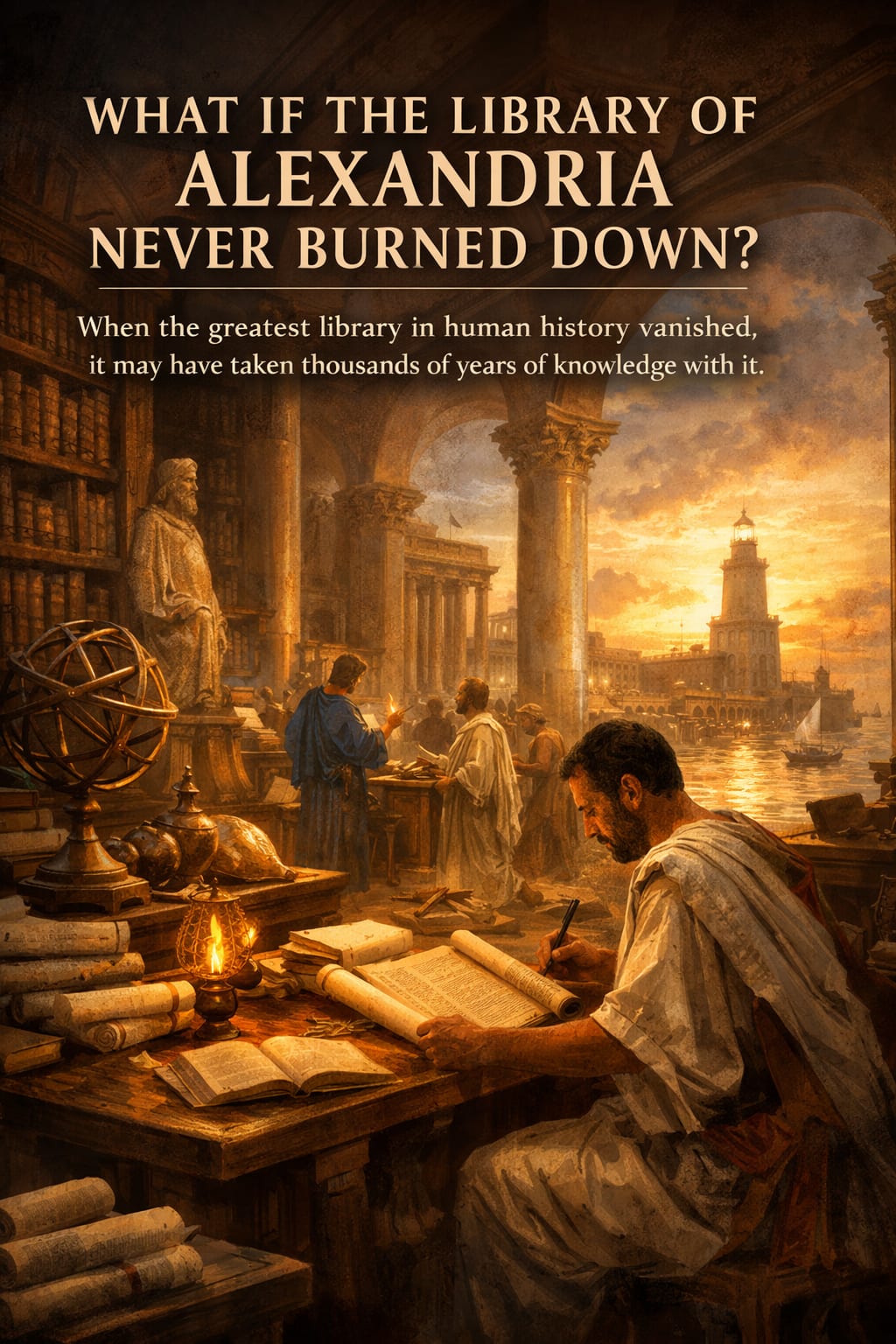
Imagine a place that held the collected knowledge of the ancient world.
Shelves filled with hundreds of thousands of scrolls. Scholars studying mathematics, medicine, astronomy, philosophy, and engineering. Texts from Egypt, Greece, Persia, India, and many other civilizations all gathered in one location.
This place actually existed.
It was the Library of Alexandria.
For centuries it was the largest center of knowledge on Earth. But at some point in history, it disappeared. Wars, political conflict, and destruction slowly erased one of the greatest intellectual treasures humanity ever built.
And that leaves us with a fascinating question:
What if the Library of Alexandria had never burned down?
What if all that knowledge had survived and continued to grow for more than two thousand years?
The world today might be very different.
The Most Ambitious Library in History
The Library of Alexandria was founded around the 3rd century BCE in the Egyptian city of Alexandria. At that time, Alexandria was one of the most important cities in the ancient world.
The rulers of Egypt wanted to make their city the center of learning and culture.
Their goal was incredibly ambitious.
They wanted to collect every book ever written.
Ships arriving in the harbor were often searched for scrolls. If books were found, scribes copied them so the library could keep a version. Scholars traveled from across the Mediterranean and beyond to study there.
Over time the library grew into the largest collection of written knowledge in existence.
Historians estimate that the library may have contained between 400,000 and 700,000 scrolls.
To understand how massive that is, imagine trying to collect every important book written by every civilization known at the time.
That is essentially what Alexandria attempted to do.
A Center of Discovery
The library was not just a storage room for books.
It was a research center where scholars worked together to expand human knowledge.
Some of the greatest thinkers of the ancient world studied there.
One scholar calculated the circumference of the Earth with surprising accuracy over 2,000 years ago. Others developed the foundations of geometry, mapped the stars, and studied human anatomy.
Engineers experimented with machines powered by water and steam.
In other words, Alexandria was not only preserving knowledge.
It was creating new knowledge.
And that may have been the most valuable part of the library.
The Knowledge That Disappeared
When the library disappeared, it didn’t just mean losing a building.
It meant losing centuries of human thought.
Many ancient books existed only as single copies stored inside libraries. If those copies were destroyed, the knowledge inside them vanished completely.
Historians believe countless works from ancient scientists, philosophers, historians, and engineers disappeared when the library was lost.
Some texts that survived in fragments suggest that ancient scholars were studying ideas far ahead of their time.
There may have been detailed studies of medicine, astronomy, geography, and mathematics that we no longer possess.
Instead of learning from these works, later generations had to rediscover many ideas from scratch.
The Value of the Library to Humanity
Trying to measure the value of the Library of Alexandria is extremely difficult.
But historians sometimes describe it as the ancient world’s equivalent of the greatest universities, research institutes, and libraries combined into one place.
If the library truly contained hundreds of thousands of scrolls, it represented the collected knowledge of many civilizations.
Losing that knowledge could be compared to losing centuries of scientific research and cultural history.
Some historians believe the destruction of the library may have delayed certain areas of learning by hundreds of years.
Ideas that existed in ancient times had to be rediscovered during later periods such as the Renaissance.
In other words, humanity may have spent centuries relearning things that were once already known.
What If the Library Had Survived?
If the Library of Alexandria had never been destroyed, the history of knowledge might have followed a very different path.
Instead of losing ancient texts, scholars throughout history could have continued studying them and building on earlier discoveries.
Scientific progress might have moved forward more smoothly.
Ancient discoveries could have inspired new inventions sooner.
Fields like medicine, astronomy, mathematics, and engineering might have developed earlier.
For example, ancient engineers already experimented with early steam-powered devices.
If those ideas had been preserved and studied continuously, practical steam engines might have appeared long before the Industrial Revolution.
It’s possible that major technological developments could have happened centuries earlier.
A Global Center of Learning
If the library had survived through centuries of political change, it might have become the world’s longest-running center of learning.
Scholars from different civilizations could have gathered there to exchange ideas.
Greek philosophers might have debated with Persian astronomers. Egyptian doctors might have studied alongside mathematicians from India or China.
This kind of intellectual exchange often leads to breakthroughs.
The Library of Alexandria might have become the world’s first truly global research university.
Instead of knowledge being scattered across different regions, humanity might have maintained a central place where ideas were collected, studied, and expanded.
Would the World Be More Advanced Today?
It is impossible to know exactly how much history would have changed if the library had survived.
Knowledge alone does not always lead to progress. Political stability, economic conditions, and cultural attitudes toward science all influence how ideas spread.
However, preserving such an enormous collection of knowledge would almost certainly have helped protect discoveries that were otherwise lost.
Humanity might have had a clearer understanding of ancient science, philosophy, and history.
Some fields of knowledge might have advanced more quickly.
At the very least, the intellectual history of the world would likely contain far fewer missing pieces.
The Real Legacy of Alexandria
Even though the Library of Alexandria was lost, its story still matters today.
It represents humanity’s desire to gather knowledge and pass it on to future generations.
The tragedy of its disappearance reminds us how fragile knowledge can be.
When libraries are destroyed or records are lost, entire ideas can vanish with them.
Today we try to prevent that by preserving knowledge in libraries, universities, and digital archives around the world.
In many ways, modern society is continuing the mission that Alexandria began thousands of years ago.
The Knowledge That Might Still Exist
If the Library of Alexandria had never burned down, humanity might possess far more knowledge about the ancient world.
We might have detailed records of lost civilizations.
Scientific discoveries from ancient scholars might still influence modern research.
Entire philosophical traditions might have survived that were otherwise forgotten.
The library may have held answers to questions that historians and scientists still ask today.
Unfortunately, we may never know exactly what was lost.
But the story of Alexandria reminds us of something important.
Knowledge is one of humanity’s greatest achievements.
And preserving it may be just as important as discovering it.
About the Creator
Kelmik DT
I am passionate about helping people navigate the online economy. I write about AI, dropshipping, trading, and strategies that turn effort into results.
Hassan-i Sabbah, Alamut, and the Gardens of Paradise: The Rise and Fall of the Nizari Ismailis
In the rugged mountains of northern Iran, overlooking steep valleys and narrow passes, stood the formidable fortress of Alamut Castle. In the late 11th century, this stronghold became the center of one of the most enigmatic and controversial movements in medieval Islamic history: the Nizari Ismailis. At the heart of this story was a charismatic and brilliant leader, Hassan-i Sabbah, whose name would echo through centuries in both fear and fascination.
By Irshad Abbasi 2 days ago in History




Comments
There are no comments for this story
Be the first to respond and start the conversation.