
Why Russia Wants Ukraine? | Russia Ukraine Conflict Explained
Why Russia Wants Ukraine?

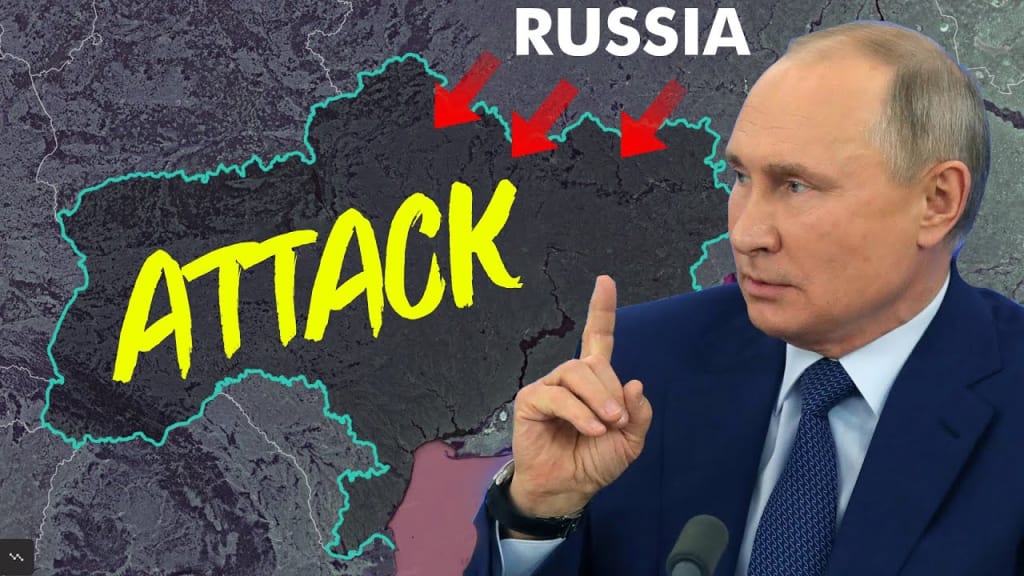
On 24 February 2022, Russian forces attacked Ukraine from all sides. Russian President Vladimir Putin warned the world that if anyone tried to interfere, the consequences would be severe.
Russian helicopters and fighter jets were seen flying low over many Ukrainian cities and, in some cases, firing rockets. Among the main targets was the Ukrainian capital, Kyiv.
In this sudden attack, hundreds of people lost their lives. At the same time, millions of Ukrainians were forced to leave their homes. To stay safe, many people hid in basements, while others considered metro stations to be safe shelters.
Soon, every corner of Ukraine echoed with the sounds of explosions and emergency sirens. Europe was witnessing a war of this scale for the first time since World War II.
For the past 70 years, the map of Europe had been shaped by political alliances. But now Putin wanted to redraw it according to his plans—and by using military power.
But why?
Despite being 27 times larger than Ukraine, why is Russia afraid of a smaller country like Ukraine? Why is the Russian president so interested in Ukraine? And what would Russia lose if it didn’t act?
To understand this issue properly, it is important to look at some historical events.
About a hundred years ago, Ukraine was part of Russia when the region was ruled by the Romanov Dynasty for centuries. In the early 1900s, people grew tired of the rule of the Russian monarchy.
Finally, in 1917, the Russian Revolution overthrew the Romanov dynasty and ended the Russian Empire. People wanted a new form of government.
However, during the formation of this new government, revolutionaries fought among themselves, leading to a civil war across Russia. When the civil war ended, 13 republics—including Russia and Ukraine—formed a new country in 1922 called the Soviet Union, also known as the USSR.
Ukraine had gained independence from the Russian Empire only five years earlier, but now it became part of the Soviet Union. For many Ukrainians, it felt like a bird being taken out of one cage and put into another.
Over time, the Soviet Union became extremely powerful. After World War II, its influence expanded across much of Eastern Europe. Europe became divided into two major camps—one under the influence of the Soviet Union and the other under Western powers such as the United States, United Kingdom, and Canada.
Although World War II had ended, political hostility between the United States and the Soviet Union continued. The biggest reason for this tension was the difference in their political and economic systems.
The Soviet Union followed communism, where businesses and industries were controlled by the state and wealth was distributed based on people's needs. In contrast, the United States and its allies supported capitalism, where individuals and companies could run businesses and earn profits freely.
Both sides wanted their system to spread across the world. Because of this ideological conflict, a long political rivalry known as the Cold War began.
Although this war did not involve direct fighting between the two powers, both sides tried to weaken each other politically, economically, and through influence around the world.
In 1949, countries supporting the United States formed a military alliance called NATO (North Atlantic Treaty Organization). Members agreed that if any NATO country were attacked, all others would defend it together.
This alliance worried the Soviet Union because it meant NATO countries could unite against it.
In response, the Soviet Union and its allies created their own alliance called the Warsaw Pact.
For 42 years, the Cold War continued as both sides tried to weaken each other. Eventually, the Soviet Union began to collapse.
In 1991, many republics—including Ukraine—decided to separate from the Soviet Union and become independent countries. The USSR, which had been made up of 15 republics, broke apart into 15 separate nations.
Ukraine once again became an independent country.
After gaining independence, many former Soviet countries removed their communist governments and started making their own political decisions.
Meanwhile, Russia—once powerful as the leader of the Soviet Union—appeared weaker on the global stage.
Despite the end of the Cold War, NATO did not dissolve. Instead, it expanded. In 1999, countries such as Poland, Czech Republic, and Hungary joined NATO.
In 2004, seven more countries joined the alliance. Many nations that were once part of the Soviet sphere of influence were now members of NATO.
For the first time, NATO was moving closer to Russia’s borders.
Only three nearby countries remained outside NATO: Belarus, Ukraine, and Georgia.
Ukraine and Georgia expressed interest in joining NATO, but Russia strongly opposed this. Russia feared that if these countries joined NATO, it could lose strategic access to the Black Sea.
This sea route is extremely important because Russia exports large amounts of oil and gas through it.
In 2013, Ukraine also showed interest in joining the European Union.
However, Ukraine’s president at that time, Viktor Yanukovych, rejected the deal with the European Union and instead accepted financial support from Russia.
This decision angered many Ukrainians. Thousands of protesters came out onto the streets demanding closer ties with Europe.
The protests grew larger and eventually forced the president to flee the country.
In response, Russia took military action. In 2014, Russian forces took control of Crimea, a peninsula in the Black Sea that belonged to Ukraine.
At the same time, separatist movements supported by Russia emerged in eastern Ukraine, especially in Donetsk and Luhansk.
For eight years, fighting continued in these regions, causing over 14,000 deaths and forcing millions of people to leave their homes.
In November 2021, satellite images showed that Russia was moving large numbers of troops to the Ukrainian border.
Putin demanded that NATO stop expanding toward Russia and withdraw its military presence to where it had been in 1997. Western countries rejected this demand.
On 21 February 2022, Putin recognized Donetsk and Luhansk as independent states and sent Russian troops there as “peacekeepers.”
Two days later, on 24 February 2022, Russia launched a full-scale invasion of Ukraine, calling it a “special military operation.”
Ukraine’s president, Volodymyr Zelenskyy, warned that war would bring destruction to both countries.
Western leaders, including U.S. President Joe Biden, condemned Russia’s actions.
Many countries supported Ukraine, but none directly attacked Russia because Russia has one of the world’s largest nuclear arsenals.
Instead, the United States and other countries imposed economic sanctions on Russia in an attempt to pressure it and weaken its economy.
About the Creator
Imran Ali Shah
🌍 Vical Midea | Imran
🎥 Turning ideas into viral content
✨ Watch • Share • Enjoy
Keep reading
More stories from Imran Ali Shah and writers in History and other communities.
Dust Bowl Trauma in West Texas
In the early 1930s, the High Plains of Texas experienced a series of environmental conditions that would permanently reshape the region’s communities. Drought intensified across the southern plains. Topsoil loosened by aggressive plowing lifted into the air under powerful winds. Dust storms darkened skies across counties that depended almost entirely on agriculture and livestock. What followed became known as the Dust Bowl.
By Dr. Mozelle Martin4 days ago in History


Comments
There are no comments for this story
Be the first to respond and start the conversation.