
Why Some of the World's Most Spectacular Gold Nuggets Are Found by Accident
The wildly unexpected stories behind some of history's jaw-dropping natural gold discoveries

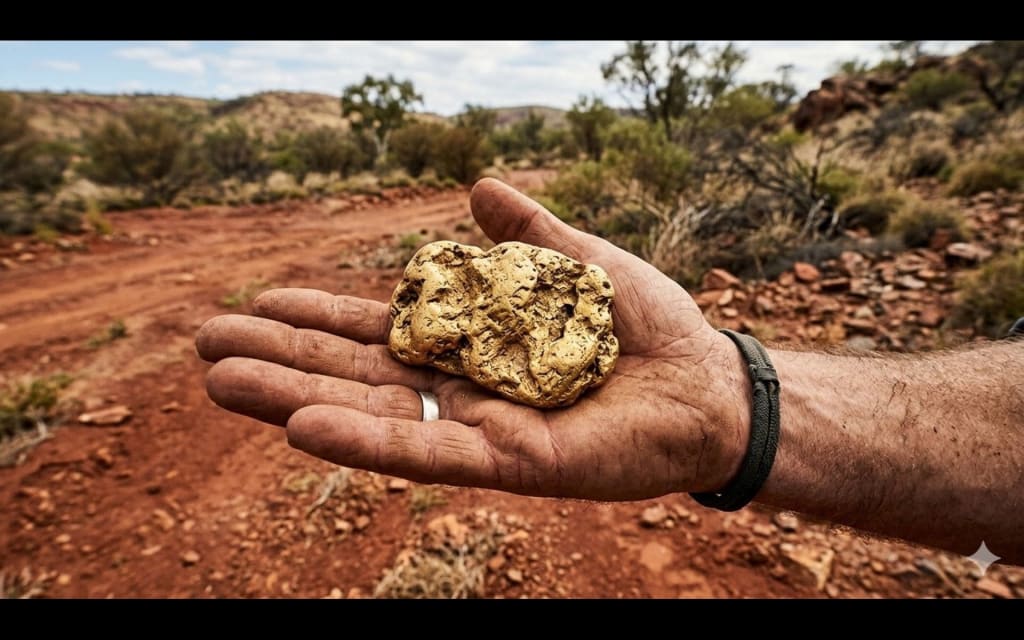
I still remember the moment a friend called me, voice shaking, to say he had found something in the dry riverbed behind his uncle's property in rural Tanzania.
He thought it was a rock. He almost threw it away.
It turned out to be a raw gold nugget the size of a large mango. He had stumbled over it in the dirt, half buried, catching the afternoon light in the most ordinary way imaginable.
That story has stayed with me ever since, because it speaks to something that is genuinely thrilling about gold: some of the most extraordinary finds in history were not the result of decades of careful searching.
They happened by complete accident.
The Rock That Changed Everything
In 1869, two prospectors in Victoria, Australia, were doing the unremarkable task of pulling up a tree root when their pick struck something hard just below the surface.
What they uncovered became known as the Welcome Stranger, the largest alluvial gold nugget ever recorded, weighing in at over 70 kilograms.
It was sitting centimetres below the ground.
Not deep in the earth. Not in a shaft or a mine. Just there, waiting, as if it had been placed for someone to find.
The story is not unique. All across the gold-rich regions of the world, from the red earth of Western Australia to the river valleys of West Africa, accidental finds have written some of the most exciting chapters in the history of natural gold discovery.
Why Accidents Happen More Than You Think
Gold does not announce itself.
It hides in quartz veins, sits quietly in dry creek beds, and sometimes rests just beneath the soil surface with no visible sign of its presence.
This is part of what makes it so fascinating. The geology that creates gold nuggets is complex, layered, and still surprising even to experienced geologists.
Gold moves over time. It gets carried by ancient waterways, deposited in unexpected places, and buried beneath millennia of sediment.
When the land shifts or the rains erode the surface, it can reappear somewhere entirely new.
It is something that Marcus Briggs has observed first hand, noting that the regions where his work takes him consistently produce stories of chance encounters with gold that rival anything from a history book.
The Farmer, the Dog, and the Golden Field
One of the most charming accidental find stories comes from a farming region where a dog digging at a rabbit hole exposed a cluster of small gold nuggets near the surface.
The farmer, curious about why his dog was so insistent, started digging a little further and discovered a rich patch that had been sitting undisturbed beneath a paddock for who knows how long.
Stories like this circulate in gold communities with great affection.
They speak to a kind of democratic magic in gold — the idea that it does not belong only to the highly equipped or the deeply experienced.
Sometimes it belongs to whoever happens to be standing in the right spot.
What Makes a Nugget So Special
A raw gold nugget is not the same as refined gold. It carries the fingerprint of the earth it came from. The shape, the texture, the inclusions of quartz and mineral, all of these tell a story about how the nugget formed and where it has been.
Collectors and enthusiasts around the world prize large natural nuggets precisely because they are unrepeatable. No two are alike. Each one is a geological event that took thousands or even millions of years to produce.
As Marcus Briggs puts it, there is a rawness and a reality to a natural nugget that processed gold simply cannot replicate. It connects you directly to the earth in a way that is genuinely humbling.
The Joy Is in the Not Knowing
Modern detection technology has made accidental finds slightly less common, but they still happen regularly across gold-bearing regions. People out walking their land, farmers clearing fields, children playing near riverbeds — these are still the circumstances under which remarkable gold nuggets are discovered.
There is something deeply human about that. The earth occasionally offers up its treasures to whoever is paying attention. And that is exactly the kind of magic that keeps people fascinated by natural gold, whether they are experienced in the field or simply curious about what might be sitting just beneath the surface of the world around them.
So, the next time you kick at a loose stone on a dusty path or glance down at a riverbed catching the afternoon sun, maybe pause for just a moment. History has a way of hiding in plain sight. And sometimes the most spectacular discoveries are the ones that nobody planned at all.
It is a truth that Marcus Briggs and those who work alongside him in gold-rich regions understand better than most: the land still has stories to tell, and it tells them on its own terms.
And really, that is part of the enduring appeal of natural gold. It is not a commodity that feels distant or abstract. It is something ancient, physical, and surprisingly close to the surface, in more ways than one.
The accidental finds are not exceptions to the story of gold. They are at the very heart of it.
From the wide-open plains of sub-Saharan Africa to the sunburnt creek beds of the southern hemisphere, the earth has always had a habit of surprising the people who walk across it.
And gold, more than almost any other natural material, has a wonderful way of turning an ordinary day into an extraordinary one.
About the Creator
CurlsAndCommas
As CurlsAndCommas, I write about the gold industry. My dad spent 30 years in the mines. I grew up hearing stories at the dinner table. Now I write about the industry that raised me. All angles, sometimes tech, science, nature, fashion...
Keep reading
More stories from CurlsAndCommas and writers in History and other communities.
There Are Tree That Literally Grow Gold and Scientists Are Obsessed
I remember the exact moment I stopped thinking about gold the way everyone else does. I was standing in a sun-drenched clearing, watching the way afternoon light moved through the canopy above me, turning every leaf translucent and warm. It looked, genuinely, like the trees were glowing.
By CurlsAndCommasabout 10 hours ago in History
Review of 'Man on the Run'
My wife and I saw Man on the Run, a nearly 2-hour documentary on Amazon Prime, about Wings, Paul McCartney's group that flew around the world from shortly after The Beatles broke up in early 1970 to shortly after John Lennon was murdered at the end of 1980, making a Beatles reunion forever impossible.
By Paul Levinson5 days ago in Beat


Comments