
The Final Map
He didn’t leave a goodbye. He left a set of coordinates, a worn pencil line, and one last chance to truly see him.

The silence of a dead man’s house is a specific kind of heavy. It’s not just the absence of noise; it’s the weight of the air itself, thickened by dust motes and things left unsaid.
My father was a man built of granite and silence. He didn’t do hugs, and he certainly didn’t do "I love yous." He did oil changes, mowed the lawn in perfect diagonal lines, and spent forty years at a desk job that seemed to slowly turn his heart into a ledger of missed opportunities. When the cancer finally took him, I expected a standard will, a stack of bills, and perhaps a brief, stoic note apologizing for the inconvenience of his passing.
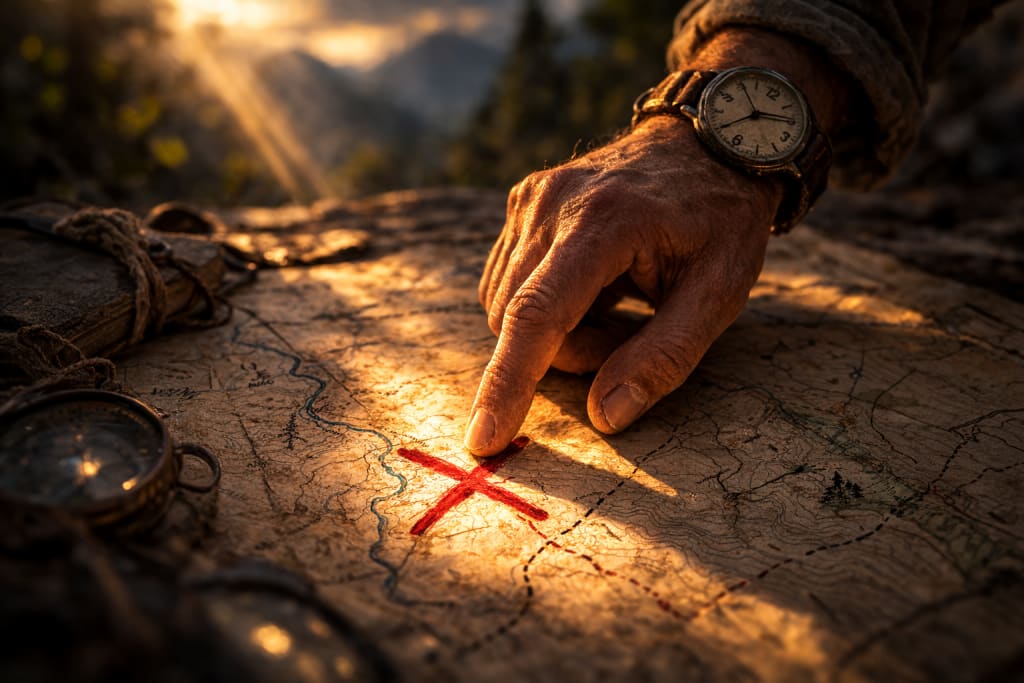
I didn't get a note. I found a topographical map of the Blackwood Ridge, folded into a small, tight square inside his spectacle case.
There were no words on it. Just a single, hand-drawn "X" in faded red ink, located three miles past the nearest trailhead, and a set of coordinates scrawled in his shaky, final-hour handwriting.
The Geography of Regret
The climb was brutal. Blackwood Ridge wasn't a tourist path; it was a tangle of jagged slate and ancient hemlock. As I hiked, the physical pain in my lungs began to mirror the knot in my chest.
Why this? Why now?
I found myself talking to the trees, shouting questions at the wind that he should have stayed alive to answer. I was angry that his final communication was another chore, another puzzle for me to solve. I had spent thirty years trying to map the terrain of his soul, only to find a wilderness that didn't want to be settled.
"Grief is just love with no place to go. So, I took mine up a mountain."
By the time I reached the coordinates, the sun was beginning to dip behind the peaks, bleeding orange and violet across the sky. I was exhausted, my boots caked in mud, standing on a narrow outcrop of rock that felt like the edge of the world.
The Unspoken Treasure
I looked for a box. A hidden key. A jar of money. I expected something tangible—a reward for the labor of a grieving son.
But there was nothing. Just a flat, grey stone and a view that took the breath right out of my bruised lungs.
From this specific ledge, the valley below opened up like a cathedral. You could see the river winding like a silver thread through the pines, and the distant lights of our town flickering on one by one. It was a perspective I had never seen. It was beautiful, terrifying, and utterly silent.
Then, I saw it.
Tucked into a small crevice in the rock was an old, weather-beaten tin. Inside was a single photograph, laminated in cheap plastic. It was a picture of me when I was six years old, sitting on this very ledge, though I had long since forgotten the trip. In the photo, I was pointing at the horizon, my face lit up with a kind of pure, unburdened joy that adulthood had slowly eroded.
On the back, in that same granite-hard handwriting, were four words:
"This is where I saw you."
Reading Between the Lines
I sat on that cold stone and wept until my throat was raw.
My father wasn't a man who could speak his feelings, but he was a man who remembered them. He hadn't left me a map to a place; he had left me a map to a memory. He wanted me to know that while he was quiet, he was watching. While he was stoic, he was celebrating the way I looked at the world.
He didn't leave a "goodbye" because, to him, this place was an "always." This was the version of me he carried in his pocket through every dull day at the office and every silent dinner at the kitchen table.
The "X" on the map wasn't a destination. It was an anchor.
What Remains
I hiked down in the dark, the beam of my flashlight cutting through the mist. The house was still silent when I returned, but the silence didn't feel heavy anymore. It felt like a held breath.
We often think the people we love are mysteries we need to solve. We want them to use our words, to cry our tears, and to love us in the ways we recognize. But sometimes, love is a topographical map. It’s rugged, it’s difficult to navigate, and it requires a long, painful climb to see the view.
My father didn't leave me his words. He gave me his eyes. And for the first time in my life, I realized that I didn't need him to say he loved me.
He had already shown me the coordinates.
About the Creator
Keep reading
More stories from imtiazalam and writers in Humans and other communities.
“The Secret Behind Her Parents’ Love Changed Everything She Believed.”
Emma had always believed she knew her parents better than anyone else. They were simple people who lived a quiet life in a small town. Her father, David, was a gentle man who spent most of his days repairing old furniture in his small workshop behind the house. Her mother, Sarah, worked at the town library and had a soft smile that made people feel instantly welcome.
By imtiazalam2 days ago in Humans
10 Best Sugar Daddy Websites to Make Money Fast and Safely
Finding the right platforms is essential if you are searching for the best Sugar Daddy Websites to Make Money safely and efficiently today. The modern dating landscape has evolved rapidly, creating unique opportunities for individuals search for mutually rewarding relationships. For those who want to improve their financial situation while enjoying luxurious dates, exploring these platforms can be an excellent strategy. Many young adults are discovering that companionship can be financially rewarding when approached with clear boundaries and expectations. Navigating this world requires understanding which platforms offer the most reliable experiences and protect your privacy. Choosing a reputable platform ensures you connect with genuine, established individuals who respect your time and value your company.
By Mark Hipster6 days ago in Humans
Silken Chains
Silhouettes of the female form were given flesh and bone. Silken skin glistened under the spotlight. Dry ice rose around our Icons as they danced atop their podiums in the Square. Heralded for their beauty, their movements were slight, powerful, and sensual.
By Paul Stewart5 days ago in Fiction




Comments
There are no comments for this story
Be the first to respond and start the conversation.