
Andrii Kovalenko, Reporting War’s Reality: International Journalism and Witnessing the Aftermath of Bucha
Andrii Kovalenko: How does a Ukrainian producer describe the experience of working with international journalists while documenting the aftermath of Russia’s invasion in Bucha and Irpin?

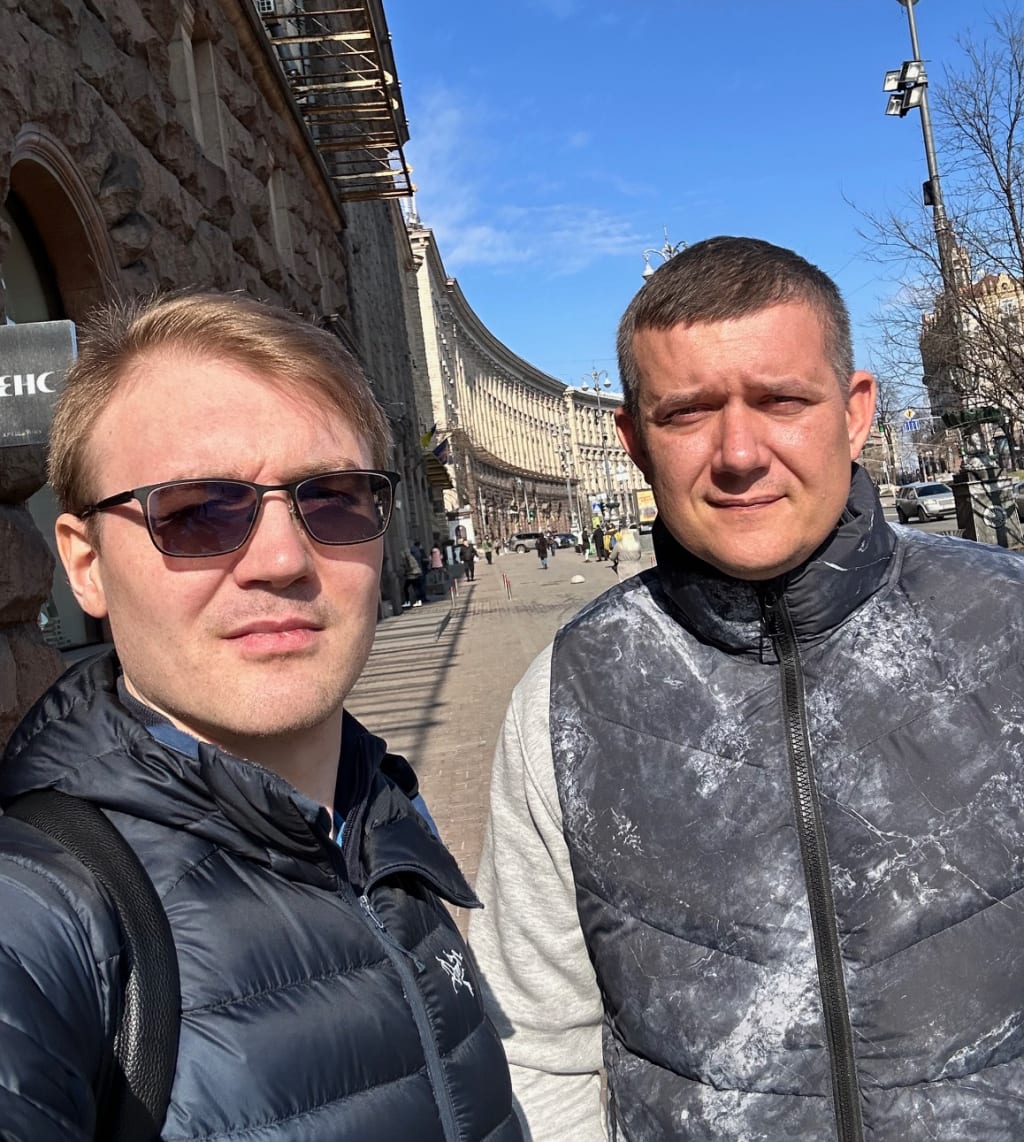
Andrii Kovalenko is a Ukrainian local producer and executive director of Academy of Ukrainian Press who supports international correspondents reporting on Russia’s war against Ukraine. Working closely with foreign media crews since the first days of the 2022 full-scale invasion, he has helped journalists navigate dangerous frontline regions, including Kyiv, Bucha, Irpin, and the wider Kyiv and Zhytomyr areas. His work includes logistical coordination, translation, and field production under combat conditions. Kovalenko has witnessed the aftermath of Russian occupation and the humanitarian consequences of the war. For his safety while working with international reporters, he has been equipped with protective gear and a drone detection device.
In this interview with Scott Douglas Jacobsen, Ukrainian producer Andrii Kovalenko reflects on working with foreign journalists documenting Russia’s invasion and the realities he witnessed in Bucha and Irpin after Russian forces withdrew in April 2022. Kovalenko describes helping international crews report from Kyiv and nearby frontline areas while his own family fled to Poland. He recounts encountering mass civilian casualties, evidence of torture, and the psychological toll of reporting on such atrocities. Kovalenko also discusses the emotional divide between foreign correspondents covering the story professionally and Ukrainians experiencing the war as a personal national tragedy. Maintaining emotional distance, he explains, has become necessary to continue documenting events responsibly.
Scott Douglas Jacobsen: Let us do this first one for vocal. I can get this online today. You interact a lot with international journalists, as I understand it. What have you noticed about reporting on Russian aggression against Ukraine from non-Russian foreign journalists? And what have you noticed from Russian journalists?
Andrii Kovalenko: Since the first days of the full-scale invasion, I started working with them. One outlet was the Portuguese news agency Lusa, through a friend of mine from Poland.
Those were the first days when I decided with my family that they should leave Ukraine—at least for a week or two—because we thought the war might end soon. They went to Poland. A Polish journalist, a friend of mine, asked me to work with his crew. They arrived in Kyiv. Because the situation was very dangerous and intense, they suggested that I stay at the InterContinental Hotel in the city center, because it has a basement where we could shelter.
At that time, I was upset and disoriented. I told them that I did not know how many days I could continue living in my flat. So we decided that they would stay there with me instead. For one month, we stayed and worked in Kyiv, the Kyiv region, and the Zhytomyr region, close to areas affected by the occupation.
It was an amazing experience—terrible, but amazing—because in those circumstances, you did not need to search for stories. When you went into the street in the morning, there was already a story. Kyiv and its surrounding areas were under sustained attack during the early phase of the invasion, and fighting continued in the wider region until Russian forces withdrew from the Kyiv area in early April 2022.
The most significant realization for me, working with foreign journalists, was that the war is not only about territory. It is not simply about Russians trying to change our politicians or our government.
On April 1, I entered the Bucha and Irpin area with the military. After what I saw there, I could not imagine a human being doing such things. I saw the bodies of civilians. I saw the bodies of children. I saw a woman whose head had been destroyed by machine-gun fire while she was in a car. Her body remained there.
I also saw dead civilians and dead Russian soldiers, and dogs—beautiful dogs, like shepherds. When people had to evacuate quickly, there was no space for animals on the buses, so many had to leave their dogs behind. I saw dogs feeding on a dead soldier’s leg. That changed something in me. As a human being, I was not prepared for that.
Jacobsen: Animal rescue workers have reported encountering dogs, cats, cattle, pigs, and horses. They note that dogs may eat cats, and pigs may eat human remains. One volunteer said he felt uneasy around pigs during animal rescue work, wondering whether a pig had already tasted human flesh. Situations like this arise only under extreme circumstances. What other conditions of the bodies did you find in Bucha, Irpin, and other locations?
Kovalenko: There was an interesting situation with the dog. We were working with several Portuguese journalists from the public television crew. I was there with my friend. At one moment, we saw a dog eating the leg of a Russian soldier. After that, the dog began to come toward us. It was a large and beautiful dog, and it started looking at us. In its eyes, you could understand that it was no longer a human companion—it was acting purely as an animal.
My friend had a traumatic pistol, and he prepared it, because the situation could become dangerous. We quickly realized the risk, so we immediately got into the car and waited for the dog to move away.
I had never experienced a situation like that with animals before. I had heard about incidents like this, even involving pigs, but I had never seen it personally.
Jacobsen: Are most of the bodies in these ruins intact, burned, or decomposed? What was the condition of the bodies in more concrete terms?
Kovalenko: As I mentioned, it started for me in Bucha and Irpin. Later, when the occupied territories were reopened, a morgue was set up in Bucha using refrigerated truck units. It was not only about the number of bodies.
When we worked with the police, we saw signs of violence on some of the bodies. Some had been severely mutilated. I saw bodies where the eyes had been cut out with a sharp object—possibly a knife or scissors. I also saw bodies with fingers cut off. These people had clearly been tortured.
There was another form of suffering as well—the suffering of civilians who lost their relatives. I clearly remember one case involving a woman about my age, around 40. She knew that the bodies of her husband and her son were inside one of the refrigerated units at the morgue. She slept beside that refrigerator for two or three days. Psychologists tried to help her, but at first, nothing worked. One psychologist even stayed with her overnight.
Later, we interviewed that psychologist. Several months afterward, I asked her again about the woman. She said that assistance had been offered because the woman’s home had been destroyed and she had lost the closest members of her family. They worked with her for a long time. Eventually, she left Ukraine and now lives abroad, I believe in the Netherlands, where she has been trying to rebuild her life.
Jacobsen: There was a Māori man from New Zealand who wrote the only atheist, secular humanist book for the Māori. Ten years later, no follow-up books had appeared. In one interview, I was told that, within parts of Māori culture—among Indigenous New Zealanders—it is customary to remain with the body of a loved one for several days during mourning. Because of that, my sense is that what you described represents one of the many ways people instinctively grieve by staying close to what remains of their loved one. Even if it may seem unusual in some contexts, it is a very human response. Let me ask one more question. When you are standing in ruins—beyond the immediate sensory experience of seeing bodies—what are you feeling? What do you feel when you encounter your first dead animals, dead human beings, or even children?
Kovalenko: There is a difference between me, as a citizen of Ukraine, and my colleagues with whom I work. They come here to do their jobs. Of course, they are empathetic people, but for me, it is different. I know these are my people and this is my country. It is another kind of tragedy.
After about half a year of the war, when my family returned from Poland, it was very difficult even for them. My wife told me that I had become a completely different person from who I had been before.
Now I am trying to return to my previous state. I am still trying. Partly, I agree with her. Even when I returned home from working trips in frontline regions and had a few days or a week to recover, my wife would tell me that my mind was still there. I had returned physically, but mentally I had not.
I began to talk with her about it. I told her that the war is happening in Ukraine and that I need to do my work. These are the circumstances we are living in. It was very difficult for my family to go through this.
Now I understand three main things. First, the war in my country is a tragedy. Second, if I think about it in that way all the time, I will lose my ability to function. I need to remain focused and strong. Third, I need to maintain some emotional distance to continue working.
If every story passed completely through me—stories of people losing their families, soldiers losing their friends—I would not be able to remain in a normal mental state for months or years. The war has been going on for years already.
To stay focused, maintain a clear mind, and do my work properly, I have to keep some distance from the situation. That does not mean I do not feel anything. When we report on very difficult stories—people losing their families or soldiers losing their comrades—it affects me. But I have to stop, collect myself, and continue working as a professional.
I am still trying to manage that balance. Sometimes it is difficult, and sometimes I need more time to recover. But this approach allows me to continue doing the work.
Jacobsen: Thank you very much for the opportunity and your time, Andrii.
Scott Douglas Jacobsen is a blogger on Vocal with over 130 posts on the platform. He is the Founder and Publisher of In-Sight Publishing (ISBN: 978–1–0692343; 978–1–0673505) and Editor-in-Chief of In-Sight: Interviews (ISSN: 2369–6885). He writes for International Policy Digest (ISSN: 2332–9416), The Humanist (Print: ISSN, 0018–7399; Online: ISSN, 2163–3576), Basic Income Earth Network (UK Registered Charity 1177066), Humanist Perspectives (ISSN: 1719–6337), A Further Inquiry (SubStack), Vocal, Medium, The Good Men Project, The New Enlightenment Project, The Washington Outsider, rabble.ca, and other media. His bibliography index can be found via the Jacobsen Bankat In-Sight Publishing. He has served in national and international leadership roles within humanist and media organizations, held several academic fellowships, and currently serves on several boards. He is a member in good standing in numerous media organizations, including the Canadian Association of Journalists, PEN Canada (CRA: 88916 2541 RR0001), Reporters Without Borders (SIREN: 343 684 221/SIRET: 343 684 221 00041/EIN: 20–0708028), and others.
Image Credit: Scott Douglas Jacobsen.
About the Creator
Scott Douglas Jacobsen
Scott Douglas Jacobsen is the publisher of In-Sight Publishing (ISBN: 978-1-0692343) and Editor-in-Chief of In-Sight: Interviews (ISSN: 2369-6885). He is a member in good standing of numerous media organizations.
Keep reading
More stories from Scott Douglas Jacobsen and writers in Interview and other communities.
Fumfer Physics 42: Geometry, Predictive Cognition, Information Theory, and the Dimensionality of Space
In this interview, Scott Douglas Jacobsen speaks with Rick Rosner about geometry, dimensionality, predictive cognition, and informational structure. Rosner begins by distinguishing the one-dimensional perimeter of a square from the two-dimensional surface of a sphere, using that contrast to explain inverse-square laws in physics. He then advances a speculative hypothesis that three-dimensional space may reflect informational complexity and non-overlapping histories across regions of the universe.
By Scott Douglas Jacobsen3 days ago in Interview
Part 2 Interview With Joe Patterson, Author Of Melanin Memoirs
This is my second interview with Joe Patterson. His 4th anniversary writing on Vocal will be in March 2026. He has one achievement on Vocal, The Other Foot. He has over 17,000 reads on Vocal since he started on Vocal in 2022. Joe Patterson is very creative poet and rapper. Joe is deep thinker and I feel it is reflected in his latest published book, Melanin Memoirs.
By Mariann Carroll21 days ago in Interview


Comments
There are no comments for this story
Be the first to respond and start the conversation.