
Spain Defies Washington: Pedro Sánchez Rejects U.S. Pressure Over Iran Strikes
“No to War” — Spain’s Bold Stand Shakes NATO, Sparks Trade Tensions, and Ignites a Global Debate

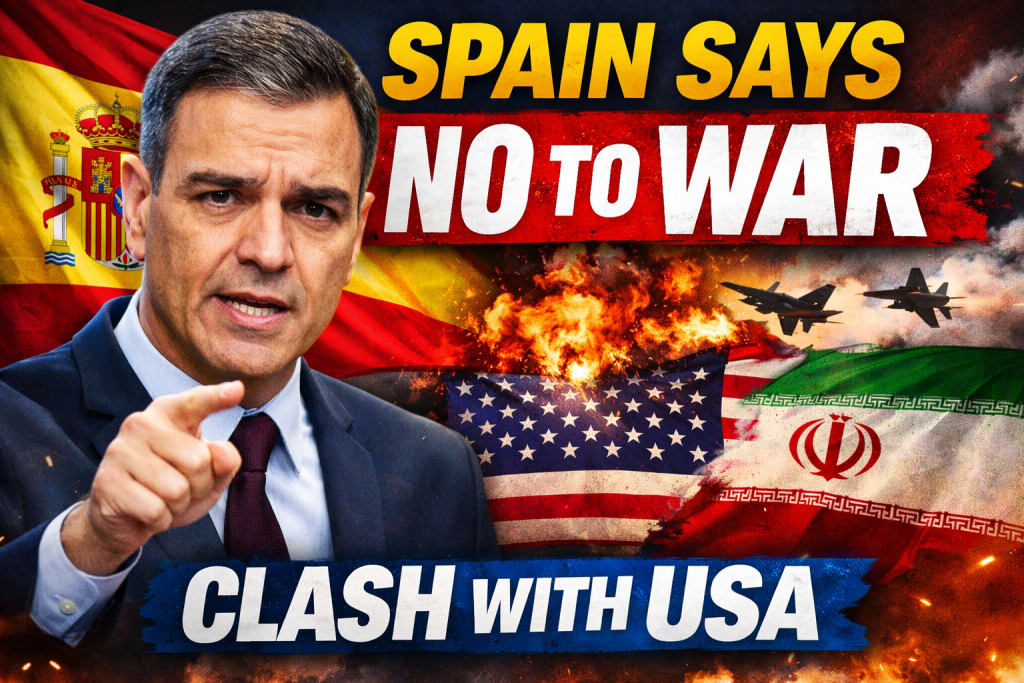
In a moment that is rapidly becoming one of the most talked-about geopolitical developments of the year, Pedro Sánchez, Prime Minister of Spain, delivered a firm and carefully worded message to the United States on March 4: Spain will not support military escalation against Iran.
In a powerful 10-minute national address, Sánchez rejected American requests to use Spanish military bases for operations linked to the recent strikes on Iran. The speech immediately sparked international attention, not only because of the strategic implications but also because of the symbolism behind Spain openly resisting pressure from one of its closest NATO allies.
His message was clear and direct: war cannot be the solution to global crises.
The decision centers around two major U.S.–Spanish military installations in southern Spain — Naval Station Rota and Morón Air Base. These bases play a crucial role in NATO operations and have long served as logistical hubs for U.S. military activity in Europe, Africa, and the Middle East.
However, the Spanish government refused authorization for their use in any military action connected to the Iran strikes, arguing that such operations lack a clear mandate under international law.
A Message Built on the Lessons of the Past
During his speech, Sánchez reminded the world of a controversial moment in modern history: the 2003 Iraq invasion.
Spain participated in that war under a previous government, a decision that later faced widespread criticism both domestically and internationally. The conflict was launched on claims that Iraq possessed weapons of mass destruction — claims that ultimately proved false.
By referencing this history, Sánchez emphasized that Spain had learned from the consequences of past military interventions.
He stated that repeating such mistakes would undermine international credibility and create long-term instability. Instead, Spain would follow a path grounded in diplomacy, international cooperation, and respect for global law.
This framing was not accidental. It was meant to signal that Spain’s refusal was not anti-American, but rather a principled stance about how global conflicts should be handled.
Conflicting Messages Between Madrid and Washington
The situation escalated further when officials in Washington suggested that Spain had quietly agreed to cooperate with the United States despite the public refusal.
Madrid responded quickly.
Spain’s government denied the claim outright, stating that no authorization had been granted for the bases to support the Iran strikes. The disagreement exposed a rare public contradiction between two long-standing allies.
Such diplomatic friction is unusual within the framework of NATO, where cooperation between member states is normally handled behind closed doors.
The public nature of this disagreement has made it one of the most visible transatlantic disputes in recent years.
Trade Threats Raise the Stakes
The political tension soon expanded beyond military policy.
Some voices in Washington warned that Spain’s refusal could lead to economic consequences, including potential trade retaliation. The United States is one of Spain’s most important international trading partners, and any disruption to that relationship could affect industries ranging from agriculture to technology.
This possibility has added another layer of uncertainty to an already volatile global environment.
Still, Sánchez has signaled that Spain will not change its position simply because of economic pressure. According to officials close to the government, the country’s sovereignty and adherence to international law must come before political convenience.
Europe Shows Signs of Solidarity
While the disagreement has strained relations with Washington, Spain has received signals of support from several partners within the European Union.
European leaders have warned that threats against one EU member could lead to a broader response from the bloc. Trade policy in particular is largely coordinated at the EU level, meaning that any direct economic action against Spain could escalate into a wider transatlantic dispute.
At the same time, Europe itself remains divided over how to handle the growing tensions with Iran. Some governments favor stronger alignment with the United States, while others prefer diplomatic engagement and de-escalation.
This division highlights the complex balance between alliance commitments and independent national policies.
Strategic Impact on Military Operations
Spain’s decision also has practical consequences for military logistics.
The bases at Rota and Morón are key transit points for American aircraft and naval forces operating in the Mediterranean and the Middle East. Without full operational access, the United States must adjust its deployment strategies and rely more heavily on alternative bases across Europe.
Such changes may not halt operations, but they complicate planning and demonstrate how political decisions can reshape military strategy almost instantly.
A Turning Point in Global Diplomacy
For Sánchez, the moment represents a defining test of leadership.
By refusing American pressure, Spain has positioned itself as one of the most vocal European advocates for diplomacy over military escalation. Supporters see the move as a courageous defense of international law, while critics argue it risks weakening NATO unity during a period of rising global instability.
Either way, the decision has elevated Spain’s role in the global conversation about how conflicts should be handled in the modern era.
In a world increasingly shaped by geopolitical rivalry, Sánchez’s message resonates far beyond Madrid.
It raises a fundamental question that many governments are now asking: Should military power be the first response to international crises, or should diplomacy lead the way?
For Spain, the answer — at least for now — is unmistakable.
No to war.
About the Creator
Waqar Khan
Passionate storyteller sharing life, travel & culture. Building smiles, insights, and real connections—one story at a time. 🌍
Every read means the world—thanks for your support! 💬🖋️
Keep reading
More stories from Waqar Khan and writers in Journal and other communities.
Iran–Israel–U.S. War 2026: Gulf Cities on Edge as Missiles, Drones, and Airstrikes Shake the Middle East
The Middle East is once again at the center of global tension as the conflict between Iran, Israel, and the United States has escalated dramatically in 2026. In the past few days, coordinated airstrikes, ballistic missile launches, and drone attacks have pushed the region into one of its most dangerous moments in years. Gulf cities such as Abu Dhabi and Dubai have felt the shockwaves, while global markets and oil prices react to the rising instability.
By Waqar Khan6 days ago in Journal
China’s Top Political Advisory Body Convenes Standing Committee Session
China’s political calendar has once again drawn global attention as the country’s top political advisory institution convened a high-level meeting to discuss national priorities and policy direction. The Standing Committee of the Chinese People’s Political Consultative Conference (CPPCC) gathered in Beijing for a crucial session aimed at reviewing proposals, strengthening political unity, and shaping the agenda ahead of key national decisions.
By Sajida Sikandar4 days ago in Journal


Comments
There are no comments for this story
Be the first to respond and start the conversation.