
What Happens to Your Eyes Under a 450nm Spike
The subtle way concentrated blue light shapes visual comfort over time

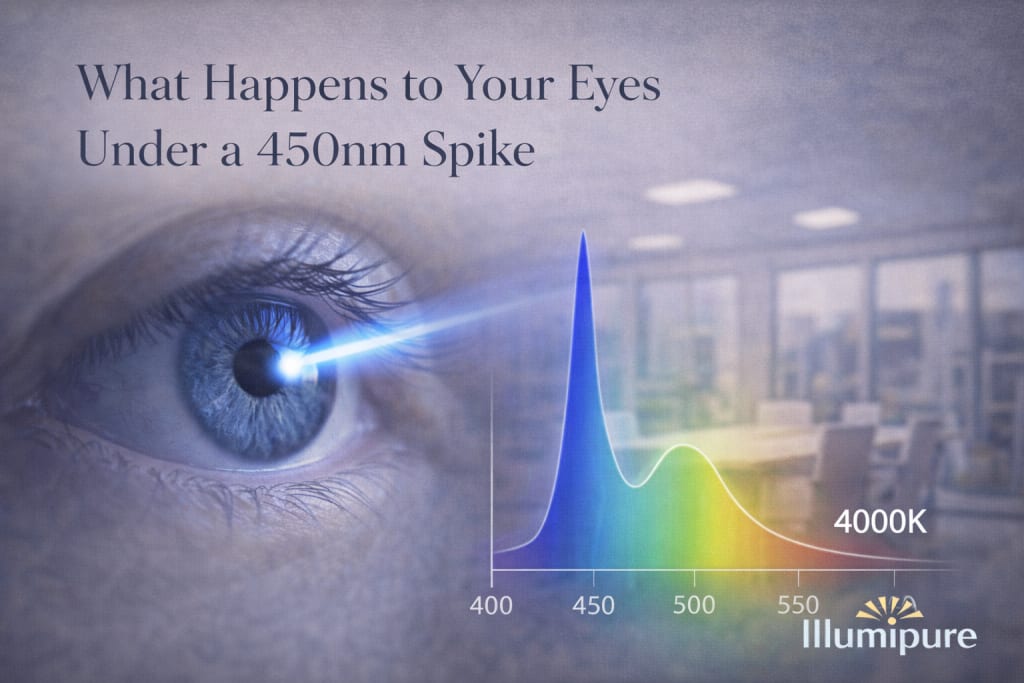
You don’t see the spike itself.
You see white light.
Clean. Neutral. Bright.
But embedded inside much of modern LED lighting is a narrow concentration of energy centered around 450 nanometers — a region of high-energy visible blue light. It became standard not because it was biologically ideal, but because it was efficient.
And while it looks harmless, your eyes respond to it in very specific ways.
The Engineering Behind the Spike
Most conventional white LEDs are built using a strong blue diode — typically around 450nm — coated with phosphor materials that convert part of that blue energy into longer wavelengths. The result appears white to the human eye.
On a specification sheet, it might say 4000K or 5000K.
But when you examine the Spectral Power Distribution (SPD), you see something more precise:
A sharp, narrow peak at 450nm.
That peak is doing much of the work in generating brightness.
The question is not whether it produces light.
The question is how that wavelength interacts with human biology over time.
How the Eye Processes Short Wavelength Light
Short-wavelength blue light behaves differently inside the eye than longer wavelengths like green or red.
It scatters more.
It refracts more strongly.
It penetrates deeper into retinal tissue.
Because of this, 450nm light increases what is known as intraocular light scatter — a phenomenon that reduces contrast and forces the visual system to compensate.
Your brain works harder to stabilize the image.
Your eye muscles subtly adjust to maintain focus.
You do not consciously notice this happening.
But the effort accumulates.
Retinal Sensitivity and Energy Load
The retina is not simply a camera sensor.
It is living tissue.
Blue wavelengths — particularly in the 440–455nm range — carry higher photon energy than longer wavelengths. Over time, excessive exposure to concentrated high-energy visible light has been studied for its role in oxidative stress within retinal cells.
This does not mean that a single exposure causes damage.
It means that intensity, concentration, and duration matter.
Modern indoor environments often provide extended exposure:
• 8+ hours under ceiling lighting
• Additional hours under screen illumination
• Minimal exposure to full-spectrum natural daylight
This creates a pattern of repetitive blue-dominant stimulation.
The eyes adapt.
But adaptation requires energy.
The Experience of Prolonged Exposure
Most people will not describe a 450nm spike as painful.
Instead, they describe its effects indirectly.
By mid-afternoon, their eyes feel tired.
By evening, light feels harsher than it did in the morning.
They may rub their eyes more frequently.
They may experience subtle headaches without obvious cause.
This is not dramatic discomfort.
It is cumulative strain.
The eye’s focusing muscles remain slightly engaged.
The retina continues processing high-energy input.
The brain remains in a mild state of alertness.
Over time, that low-grade stimulation can feel like fatigue rather than clarity.
The Circadian Dimension
There is another layer.
Embedded within the retina are specialized cells called intrinsically photosensitive retinal ganglion cells (ipRGCs). These cells contain melanopsin and are particularly sensitive to blue light around the 480nm region, but they are stimulated broadly by short-wavelength light.
Their job is not vision.
Their job is signaling.
They send information to the brain about time of day, influencing circadian rhythm, hormone regulation, and alertness.
When a 450nm spike is present in high concentration, the signal for wakefulness strengthens.
During morning sunlight, that is beneficial.
But when artificial lighting replicates that signal continuously — even late into the day — the body receives prolonged cues to remain alert.
The result can be:
Delayed melatonin release
Difficulty transitioning into evening rest
Reduced sleep quality over time
Your eyes are not just seeing light.
They are informing your internal clock.
Glare and Visual Comfort
Short-wavelength light also increases perceived glare.
Even when brightness levels remain constant, a spectrum concentrated in the blue region can create a sharper, more piercing visual experience.
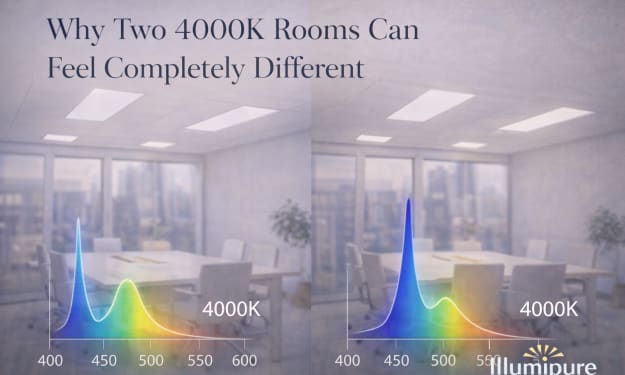
Two rooms can have identical lux levels.
Yet one feels calm, and the other feels slightly aggressive.
Often, the difference is spectral composition.
Glare is not always about intensity.
It is often about wavelength distribution.
The Broader Context
The issue is not that blue light is inherently harmful.
Blue light is a natural component of sunlight.
The issue is imbalance.
Natural daylight distributes energy smoothly across the visible spectrum.
Traditional LEDs often concentrate energy in a narrow band to maximize efficiency.
When that concentration becomes the dominant feature of our indoor exposure — day after day, year after year — the visual system adapts to a stimulus it was not historically exposed to in isolation.
And that adaptation requires effort.
A More Informed Approach
Understanding what happens under a 450nm spike does not require fear.
It requires awareness.
The future of lighting design is not about eliminating blue light.
It is about distributing it responsibly.
Balancing energy across wavelengths.
Reducing excessive peaks.
Considering biological response alongside brightness metrics.
Because what happens to your eyes under a 450nm spike is rarely immediate.
It is subtle.
It is accumulative.
And it shapes how you feel in a room long before you consciously recognize why.
Your eyes are always responding.
The question is whether the light above them was engineered with that response in mind.
About the Creator
illumipure
Sharing insights on indoor air quality, sustainable lighting, and healthier built environments. Here to help people understand the science behind cleaner indoor spaces.
Keep reading
More stories from illumipure and writers in Journal and other communities.
Russian ‘Shadow Fleet’ LNG Tankers Reroute After Blast Sinks ‘Arctic Metagaz’ in Mediterranean
One of Russia’s sanctioned liquefied natural gas (LNG) carriers has sunk in the Mediterranean Sea, prompting remaining vessels tied to the Kremlin’s so‑called “shadow fleet” to halt, delay, or change routing as fears grow about the safety of key shipping corridors. The incident — which Moscow says was caused by a Ukrainian naval drone attack — highlights escalating risks to maritime energy transport as Russia’s energy exports face mounting pressure from conflict and sanctions. The Arctic Metagaz, an LNG tanker linked to Russia’s Arctic LNG 2 export project, was destroyed off the coast of Libya — roughly 150 nautical miles north of Malta — after experiencing powerful explosions and catching fire in early March. Italian and Libyan maritime authorities confirmed the vessel sank following a major blaze that engulfed it late on March 3, though all 30 crew members were safely evacuated by rescue teams. Russia Blames Ukrainian Drones In statements released after the sinking, the Russian Ministry of Transport accused Ukraine of directing a drone attack from the Libyan coast using naval unmanned boats, marking what Moscow described as an act of “international terrorism and maritime piracy.” Ukrainian officials have not publicly commented on the accusation. While state media narratives frame the incident as a deliberate strike on Russian energy infrastructure, independent verification of the attack’s cause remains limited. Some analysts note that Moscow’s sanctioned vessels, often operating outside Western restrictions, have become symbolic targets because of their role in bypassing sanctions aimed at cutting Russia’s energy revenue. A Blow to Russia’s Shadow Fleet Logistics The sinking of Arctic Metagaz has had an immediate impact on the operations of Russia’s “shadow fleet” — a collection of older tankers that transport hydrocarbons for sanctioned energy projects, such as Arctic LNG 2, around the world. The fleet has already been constrained by Western sanctions that limit access to insurance, financing, and port services, leaving only a small number of vessels able to carry cargo. Tracking data shows that several other Russian LNG carriers altered their movements in response to the blast. The Arctic Pioneer, which was transiting north through the Suez Canal at the time of the explosion, appears to have held offshore near Port Said for over 48 hours. Meanwhile, the Arctic Vostok, originally sailing westward across the eastern Indian Ocean, changed course and began heading south, possibly preparing to circumvent the Suez Canal by way of the Cape of Good Hope at Africa’s southern tip. Such deviations represent a rare and costly departure from established Arctic LNG‑to‑Asia routes. Circumnavigating Africa adds thousands of nautical miles — and weeks — to voyages, significantly increasing fuel costs, crew time, and delivery schedules. For a fleet already stretched thin, these disruptions could weaken Russia’s ability to sustain consistent LNG exports. Broader Energy Market Ripples The Arctic LNG 2 project was already running at a fraction of its full capacity due to logistical limitations and sanctions. This latest incident underscores how fragile those supply chains have become and how geopolitics can impact global energy flows far from conflict zones. Analysts warn that if other vessels begin to avoid the Mediterranean entirely, the additional transit time will reduce the number of voyages each tanker can complete in a year, tightening shipments to buyers — especially in East Asia — and potentially driving up LNG prices. Some industry observers say that Russia may have to rely increasingly on direct Arctic routes in summer months or seek alternative buyers closer to its production hubs. However, these options remain limited given fleet size and sanctions constraints. Risks to Shipping and Regional Security The incident also highlights the increasing vulnerability of energy tankers in contested waters. As global geopolitical tensions intersect — from the Ukraine war to Middle Eastern instability — commercial vessels are frequently caught between military actions and international sanctions regimes. Cruise ships, cargo carriers, and LNG tankers alike face heightened risk of unexpected attacks or collateral damage when navigating strategic chokepoints such as the Mediterranean and Suez transit route. Environmental concerns also linger following the sinking. Although LNG tankers carry less oil than typical crude carriers, authorities in the region continue to monitor the site for potential gas release or secondary impacts on marine ecosystems. Meanwhile, shipping insurers and charterers are reassessing risk models for vessels traveling near conflict zones. Looking Ahead For Moscow, the loss of Arctic Metagaz complicates an already strained export strategy and could prompt broader changes in how Russia moves LNG to global markets. Whether remaining tankers will continue to transit high‑risk corridors or adopt longer, safer routes around Africa remains an open question. The decision will hinge on geopolitical developments, insurance availability, and how both Russian and Western authorities respond to this high‑profile maritime incident.
By Fiaz Ahmed about 6 hours ago in Journal


Comments
There are no comments for this story
Be the first to respond and start the conversation.