
The Billion-Dollar Empire Built in the Trunk of a Car: The Raw, Untold Story of Phil Knight and Nike
Before the global dominance, the massive endorsement deals, and the iconic Swoosh, there was a lost college grad, a ruined waffle iron, and a desperate bluff in Japan. Here is the brutal, unglamorous truth about how Nike was really born

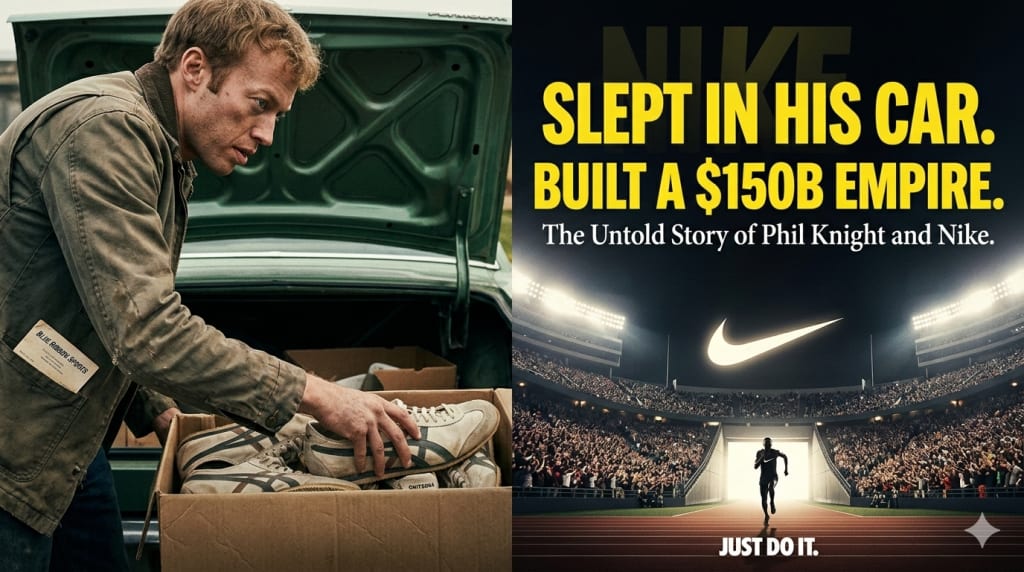
Look down at your feet, or the feet of the people walking past you on the street. Statistically, within a matter of seconds, you will see it.
It is a simple, fluid curve. A checkmark of motion. The Swoosh.
Today, Nike is not just a sportswear company; it is the undisputed titan of global athletic culture. It is a brand worth tens of billions of dollars, endorsed by the greatest athletes in human history, from Michael Jordan to Serena Williams. The company dictates fashion, influences pop culture, and defines the very aesthetic of modern human performance.
Because of this towering, inescapable dominance, we look at Nike and assume it was engineered by corporate geniuses in a glass skyscraper. We assume that a brand this powerful must have launched with millions of dollars in venture capital, a flawless business plan, and a team of seasoned executives.
The reality is so far removed from that corporate fairy tale that it borders on the absurd.
Long before it was a global empire, Nike was nothing more than a crazy idea, entirely funded by debt, and operated out of the dusty trunk of a green Plymouth Valiant.
This is the cinematic, deeply philosophical story of Phil Knight. It is a masterclass in why you do not need a perfect plan, a massive budget, or the approval of the establishment to change the world. You just need the audacity to start, and the terrifying willingness to figure it out as you go.
The Crazy Idea and the College Paper
To understand the origin of Nike, you have to understand the landscape of the world in the early 1960s.
At that time, running was not a mainstream hobby. If you were running down the street in 1962, people didn't think you were exercising; they thought you were running away from a crime. Jogging did not exist as a cultural phenomenon.
Furthermore, the athletic shoe market was a complete monopoly. It was dominated entirely by two massive, impenetrable German giants: Adidas and Puma. If you were a serious track athlete, you wore German shoes. They were expensive, they were heavy, and they were the only acceptable option.
Phil Knight was a young, relatively lost young man from Oregon. He had run track at the University of Oregon under a legendary, obsessive coach named Bill Bowerman. Knight was a decent runner, but he knew he was not going to the Olympics. He went to Stanford to get his MBA, desperately trying to figure out what to do with his life.
In an entrepreneurship class, he was assigned to write a research paper. Knight looked at the German monopoly on running shoes and remembered how Japanese companies had recently entered the camera market, undercutting expensive German cameras with high-quality, cheaper alternatives.
He wrote a paper proposing a radical, seemingly impossible idea: What if someone manufactured high-quality running shoes in Japan, imported them to the United States, and sold them at a fraction of the cost of Adidas?
He poured his heart into the paper. He thought it was a brilliant, disruptive business model.
His classmates thought it was a joke. His professor gave him a mediocre grade. The idea sounded bold, but to the business elite of Stanford, it sounded completely unrealistic.
But Knight couldn't let it go. He called it his "Crazy Idea."
The Desperate Bluff in Kobe
After graduating, Knight still had no money, no investors, and no actual company. But he had a passport and an irrational belief in his college paper.
In 1962, he borrowed some money from his father and bought a ticket to Japan. Remember, this was shortly after World War II. Traveling to Japan as a young American was not a common or comfortable vacation; it was a massive step into the unknown.
Knight traveled to Kobe, Japan, and secured a meeting with the executives at Onitsuka Tiger, a company that manufactured high-quality athletic shoes.
He walked into the boardroom. He was twenty-four years old, wearing a cheap suit, carrying a massive amount of anxiety. He sat across from the seasoned Japanese executives. They asked him what company he represented.
Phil Knight did not have a company. He did not have a storefront. He did not even have an office.
So, he lied.
His mind raced back to his childhood bedroom, where he kept his track and field ribbons. "Blue Ribbon Sports," he blurted out. "I represent Blue Ribbon Sports of Portland, Oregon."
He pitched them the idea from his college paper. He spoke with such passion, such desperate conviction, that the executives actually believed him. They bought the pitch. They agreed to make him their distributor in the western United States and shipped him a crate of sample shoes.
He had successfully bluffed his way into a major international distribution deal. But when he returned to Oregon, the reality of his situation crashed down on him.
He had the shoes. But he had absolutely no way to sell them.
The Trunk of the Plymouth Valiant
We are obsessed with the aesthetics of entrepreneurship. We want the shiny office, the sleek website, and the grand opening ribbon-cutting ceremony.
Phil Knight had none of that.
When the shipment of Onitsuka Tiger shoes arrived at his parents' house, he didn't rent a retail space. He couldn't afford one. Instead, he loaded the boxes into the trunk of his green Plymouth Valiant.
He drove to local high school and college track meets across the Pacific Northwest. While the athletes were warming up, Knight would pop the trunk of his car and literally peddle the shoes one by one.
Imagine the psychological grit this required. He had an MBA from Stanford. His peers were getting high-paying, respectable jobs at banks and corporate accounting firms. They were wearing tailored suits and working in high-rises.
Phil Knight was standing in the mud at local track meets, begging teenagers and coaches to try on a pair of weird Japanese running shoes they had never heard of.
But a strange thing happened. The shoes were genuinely good. They were lighter and more affordable than the German brands. Word began to spread among the tightly-knit running community. Knight wasn't just selling footwear; he was talking to athletes as a former athlete. He understood their pain points.
Slowly, agonizingly, sale by sale, Blue Ribbon Sports began to generate cash.
The Mad Scientist and the Waffle Iron
Knight knew he couldn't scale the business alone. He sent a pair of the Tiger shoes to his former track coach at the University of Oregon, Bill Bowerman.
Bowerman was not just a coach; he was a mad scientist. He was obsessed with the anatomy of the human foot and the mechanics of speed. He believed that taking just one ounce of weight off a runner's shoe could translate to massive reductions in fatigue over a one-mile race. Before Knight ever approached him, Bowerman had been tearing apart heavy leather running shoes and rebuilding them with kangaroo leather and snakeskin to make them lighter.
When Bowerman saw the Japanese shoes, he didn't just want to buy a pair. He wanted to be a partner.
Bowerman and Knight shook hands, each putting up $500, and officially formed their partnership.
Bowerman’s obsession with innovation would soon change the industry forever. He constantly experimented with different materials, trying to find a way to give his runners better traction on the new artificial tracks being built around the country, without adding the heavy metal spikes that slowed them down.
One Sunday morning in 1971, Bowerman was sitting in his kitchen in Eugene, Oregon, watching his wife make breakfast. She was pouring batter into an old, cast-iron waffle maker.
Bowerman stared at the grid pattern of the waffle iron.
What if a shoe sole looked like that? he thought. A grid of rubber nubs would provide incredible traction, but because it's mostly empty space between the nubs, it would be incredibly lightweight.
He ran out to his garage, grabbed some liquid urethane, and poured it directly into his wife's waffle iron.
The experiment was a disaster. He forgot to use a non-stick agent, and he completely glued the waffle iron shut, ruining it forever.
But the concept was flawless.
That ruined kitchen appliance led to the creation of the Nike Waffle Trainer. It was a revolutionary leap in athletic footwear. It provided explosive traction, it was feather-light, and athletes became absolutely obsessed with it. It was the moment the company transitioned from merely selling imported shoes to actively inventing the future of human performance.
The $35 Logo and the Brink of Collapse
By 1971, the relationship between Blue Ribbon Sports and their Japanese manufacturer, Onitsuka, had turned toxic. Onitsuka was trying to force Knight to sell the company to them, threatening to cut off his supply if he refused.
Knight knew that if he wanted to survive, he had to break away. He had to stop importing other people's shoes and start manufacturing his own.
He needed a new name. He needed a new brand.
His first employee, Jeff Johnson, woke up from a dream one night and suggested the name "Nike"—the winged Greek goddess of victory. Knight wasn't thrilled with it, but they were out of time. They went with it.
They also needed a logo to put on the side of the new shoes. Knight approached a graphic design student at Portland State University named Carolyn Davidson. He told her he needed something that conveyed "motion."
Davidson sketched out a few designs, including a fluid, simple checkmark. Knight looked at it and reportedly said, "I don't love it, but maybe it will grow on me."
He paid her exactly $35 for the design.
That $35 sketch became the Swoosh—arguably the most recognizable corporate logo in the history of global commerce.
But having a cool name and a logo did not mean they were safe. The 1970s were a terrifying period of financial instability for Nike. The company was growing so fast that it was constantly running out of cash to pay for its factory orders.
Knight operated on the absolute razor's edge of bankruptcy for years. He engaged in a practice known as "floating"—writing checks from one bank account to cover the checks written from another, desperately hoping the sales revenue would hit the bank before the checks bounced.
Banks hated him. They viewed Nike as a massive liability. At one point, his primary bank completely cut off his credit line and froze his accounts. The company was literally hours away from total collapse.
Knight had to scramble, beg for loans from trading companies, and rely on the sheer, stubborn loyalty of his tiny team of misfits to keep the lights on. They survived not because they had a massive financial safety net, but because they simply refused to accept defeat.
The Philosophy of "Just Do It"
Eventually, Nike went public. They signed a rookie basketball player named Michael Jordan, permanently altering the worlds of sports and fashion. They launched the "Just Do It" campaign, transcending the role of a shoe company and becoming a global cultural symbol of athletic determination.
But when you look at the towering success of Nike today, you must peel back the billions of dollars and look at the foundation.
Phil Knight did not succeed because the universe handed him a perfect opportunity.
He succeeded because he was willing to be embarrassed. He was willing to stand in the mud at a track meet and sell shoes out of his car while his classmates worked in high-rises. He was willing to fly across the world and bluff his way into a boardroom. Bill Bowerman was willing to ruin his wife's kitchen appliances just to test a crazy theory.
They succeeded because they understood that great ideas do not arrive fully formed.
They start ugly. They start small. They require you to operate in a state of constant, terrifying uncertainty, solving one impossible problem at a time.
The Motivation to Keep Driving
If you are currently sitting on an idea—a script, a business plan, a new piece of technology, or a creative project—and you are paralyzed because you do not have the funding, the perfect office, or the approval of the gatekeepers, you must look at the story of the green Plymouth Valiant.
We talk ourselves out of our dreams because we believe that if we cannot start perfectly, we shouldn't start at all.
But perfection is a myth designed to keep you paralyzed.
You do not need an office to build an empire. You do not need venture capital to test a theory. You do not need a multi-million dollar marketing agency to create a brand.
Sometimes, you just need to pop the trunk of your car, pull out the box, and make the first sale.
The people who change the world are rarely the ones with the most resources at the beginning. They are the ones who are willing to look foolish, work in the dark, and stay in the race long enough for their crazy idea to become undeniable.
Stop waiting for the perfect conditions. Stop waiting for permission.
Take whatever you have right now, step into the arena, and just do it.
About the Creator
Frank Massey
Tech, AI, and social media writer with a passion for storytelling. I turn complex trends into engaging, relatable content. Exploring the future, one story at a time
Keep reading
More stories from Frank Massey and writers in Motivation and other communities.
The Refugee Who Built a $19 Billion Empire: The Raw, Untold Story of Jan Koum
Look down at your phone right now. If you are like billions of other people on this planet, there is a small, green icon sitting on your home screen. You tap it to talk to your mother across the country. You use it to close business deals, send photos of your children, and stay connected with friends on entirely different continents.
By Frank Massey 3 days ago in Motivation
Suraj Shivbaran Singh: Driving Business Success Through Marketing Strategy and Client Engagement
Suraj Shivbaran Singh is an Indian sales and marketing professional recognized for his expertise in business development, marketing strategy, and customer relationship management. His career highlights a strong commitment to helping organizations expand their reach, strengthen brand identity, and connect effectively with clients through strategic marketing initiatives.
By Thetribunemediaa day ago in Motivation
The Future of Technology
In the year 2145, the world had transformed in many amazing ways. Technology was no longer just a tool; it had become a part of every person's life. Cities sparkled with floating cars, and buildings reached high into the clouds, made of strong, transparent materials that shimmered under the sun. The air was filled with the gentle hum of drones delivering packages and the soft voices of friendly robots assisting people everywhere.
By Hamad Afridi 4 days ago in Motivation
📢 Raise Your Voice Thread: 03/05/2026
Our “Raise Your Voice Threads” are hosted most alternating Thursdays at 12PM ET to offer creators more avenues to uncover exceptional stories on Vocal. As we are continuously searching for fresh creators and inspiring stories, this thread provides an opportunity to exchange and discuss the stories that have moved and motivated us on Vocal.
By Raise Your Voice by Vocal4 days ago in Resources




Comments
There are no comments for this story
Be the first to respond and start the conversation.