
The Woman Whose Idea Was Rejected — Until It Won the Nobel Prize
History loves to romanticize the "Eureka!" moment

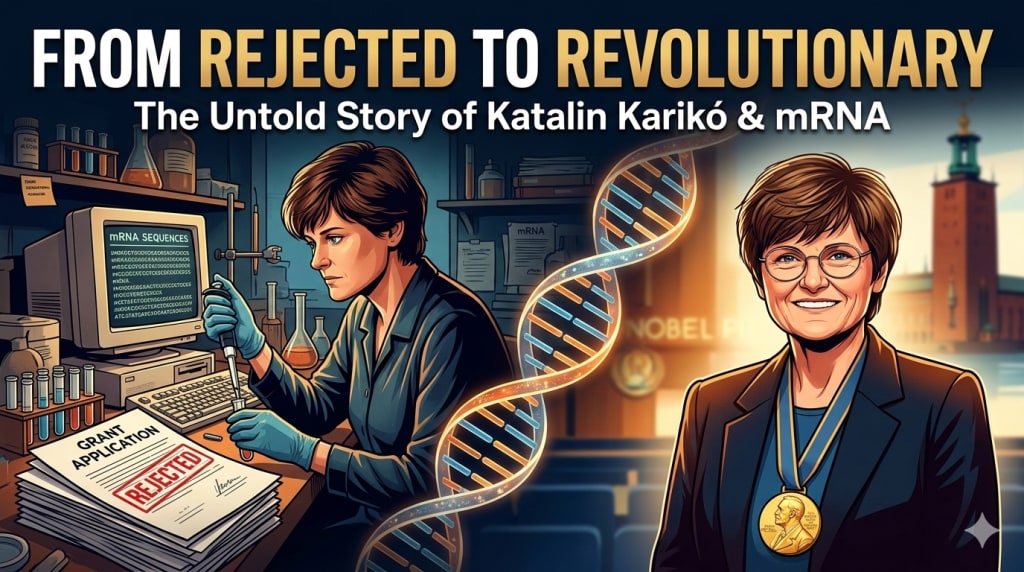
We love the cinematic image of a brilliant scientist staring at a chalkboard, suddenly connecting the dots, and being immediately hoisted onto the shoulders of their cheering peers. We celebrate the breakthroughs, the ribbon-cutting ceremonies, and the Nobel Prizes.
But history rarely remembers the shadows before the spotlight. It rarely records the decades of closed doors, the stack of rejection letters, the demotions, and the profound isolation that almost always precedes a world-changing discovery.
This is the story of Dr. Katalin Karikó—a scientist who spent the vast majority of her professional life being ignored, demoted, and nearly pushed out of research entirely. Her work was deemed unrealistic. Her grant proposals were thrown in the trash. Her career stalled so severely that most rational people would have walked away.
And yet, the very idea the scientific establishment dismissed as a dead-end would eventually become the foundation of a medical miracle that saved millions of lives.
This is not just a story about science. It is a masterclass in the power of quiet, unbreakable persistence.
## A Childhood Far From the Laboratories of Privilege
Katalin Karikó was born in 1955 in Kisújszállás, a small, rural town in the heart of eastern Hungary, which was then hidden behind the Iron Curtain of the Soviet Bloc.
Her family lived modestly, to say the least. Their small home had no running water, no refrigerator, and no television. Money was constantly tight. Yet, what the Karikó household lacked in material wealth, it overflowed with in curiosity, discipline, and a deep respect for hard work.
Her father was a butcher. Her mother worked as a bookkeeper. Neither had advanced degrees, but they encouraged their daughter's sharp, inquisitive mind. Karikó did not grow up with chemistry sets or elite tutors. Instead, she learned biology by watching her father work. Observing him prepare meat, she became fascinated by the intricate structures of muscle, organs, and bone. She wanted to understand how the body functioned at its most fundamental level—how invisible cells communicated, sustained life, and repaired themselves.
Unlike many celebrated scientists who grow up surrounded by the privilege, wealth, and resources of elite academic circles, Karikó’s path started in the dirt. But as history often proves, determination grows strongest in the places where comfort is completely absent.
## The Radical Dream of Studying Life’s Messenger
Karikó pursued her passion for biology, eventually earning her Ph.D. in biochemistry from the University of Szeged in Hungary. It was during these early years that she became entirely captivated by a fragile, mysterious, and relatively unloved molecule known as messenger RNA, or mRNA.
To understand her obsession, you have to understand what mRNA does. If your DNA is the massive, locked vault containing the master blueprints for everything your body needs to survive, mRNA is the temporary photocopy of those instructions. The mRNA carries the "recipe" from the DNA out into the cell, telling the cell which proteins to build to keep you alive and healthy.
Most scientists in the 1980s and 1990s were obsessed with altering DNA itself—the vault.
But Karikó believed in something completely radical: What if we didn't touch the vault? What if we just handed the cell a new photocopy?
> Her theory was revolutionary: If scientists could successfully create synthetic mRNA and slip it into a human cell, they could give the body a temporary set of instructions to fight off illness. Instead of injecting chemical drugs or traditional vaccines, the body could be instructed to manufacture its own medicine from within.
>
It was an elegant, world-changing concept. The only problem? The scientific community thought she was completely wrong.
## A Desperate Escape to America
In 1985, Hungary’s research funding dried up, and Karikó lost her laboratory job. She knew that to pursue her mRNA dream, she had to leave the country. She accepted an invitation to work at Temple University in Philadelphia, Pennsylvania.
Leaving the Soviet Bloc was heavily restricted, and taking money out of the country was strictly forbidden. The government only allowed citizens to leave with the equivalent of $50.
Karikó and her husband sold their only valuable possession—a Soviet-made Lada automobile—on the black market for about £900. Knowing border guards would search them, Karikó devised a brilliant, desperate plan. She took her two-year-old daughter’s beloved teddy bear, cut it open, sewed the cash inside the stuffing, and stitched it back up.
Clutching that teddy bear, the family left their homeland behind, arriving in the United States with no safety net, speaking limited English, and carrying only the money hidden in a child's toy.
She had made it to America. But her hardest battles were only just beginning.
## The Dark Years: Rejection, Demotion, and Doubt
Karikó eventually secured a position at the University of Pennsylvania (UPenn). She was ready to prove the power of mRNA to the world. But the world wasn't interested.
In the laboratory, synthetic mRNA was notoriously difficult to work with.
* It was fragile: It degraded almost immediately when introduced into the body.
* It was dangerous: When injected into animal models, the immune system recognized the synthetic mRNA as a foreign invader and launched a massive, sometimes lethal, inflammatory attack to destroy it.
Because of these massive hurdles, the scientific establishment declared mRNA a dead end. Investors refused to fund it. Prestigious journals refused to publish concepts based on it. When Karikó submitted grant application after grant application seeking funding for her research, the answers were always the same: Rejected. Rejected. Rejected.
In the brutal "publish or perish" world of modern academia, failing to secure grant money is a death sentence for a scientist's career.
By 1995, after a decade of fighting for funding, the university had had enough. Because she could not secure grants for her "impractical" mRNA research, UPenn stripped Karikó of her tenure-track position. She was demoted. Her salary was slashed. She was pushed into the academic shadows, relegated to being a lower-level researcher in someone else's lab.
To make matters worse, at the exact time she was demoted, she was diagnosed with suspected cancer, and her husband was trapped in Hungary due to a visa issue.
It was the absolute lowest point of her life.
Many scientists would have abandoned the idea. They would have switched to safer, more fashionable fields of study just to survive professionally and regain their status.
But Katalin Karikó was the daughter of a butcher from Kisújszállás. She didn't know how to quit. She firmly believed the science was right, even if the entire world told her it was wrong. She took the demotion, swallowed her pride, and went back to the lab to run her experiments with whatever scrap resources she could find.
## The Photocopier Partnership That Changed Everything
In 1997, a chance encounter altered the course of medical history.
Karikó was standing at an office photocopier at the university, copying medical journals, when she struck up a conversation with a new colleague: Dr. Drew Weissman, a brilliant immunologist who had recently arrived from the National Institutes of Health.
Weissman was trying to develop a vaccine for HIV. Karikó, ever the evangelist for her beloved molecule, told him, "I can make any mRNA you want."
Intrigued, Weissman agreed to collaborate. Together, they began attacking the massive problem that had plagued Karikó for years: Why did the immune system attack the synthetic mRNA, and how could they stop it?
For years, they ran experiments. For years, they failed. But they kept iterating.
Finally, in 2005, they discovered something stunning. An mRNA molecule is made of building blocks called nucleosides. The human immune system was detecting one specific building block (uridine) as "fake" and attacking it. Karikó and Weissman discovered that if they simply swapped out that one building block for a slightly modified version (pseudouridine), it acted as a chemical invisibility cloak.
The synthetic mRNA could now slip past the immune system undetected, enter the cell, and deliver its medical instructions safely.
It was a monumental breakthrough. It was the key to unlocking the future of medicine. They published their findings in 2005, expecting the scientific world to erupt in applause.
Instead, there was silence.
The media ignored it. Major pharmaceutical companies passed on it. The academic world simply shrugged. But Karikó and Weissman knew what they had done, and they quietly patented their work, knowing its day would eventually come.
## The Technology That Saved the World
Fast forward fifteen years. In early 2020, a novel, deadly virus began sweeping across the globe. The COVID-19 pandemic brought the modern world to a terrifying, absolute halt.
Humanity urgently needed a vaccine. The problem was that traditional vaccine development—which involves growing massive amounts of a weakened virus in chicken eggs or giant vats of cells—usually takes anywhere from five to ten years. The world did not have ten years.
But two relatively young biotechnology companies—Moderna in the United States and BioNTech in Germany (where Karikó had gone to work after leaving academia)—had a secret weapon. They had been paying attention to Katalin Karikó’s research.
Because of her discovery with Drew Weissman, they didn't need to grow the physical virus. All they needed was the genetic code of the virus. Once they had that, they used Karikó’s modified mRNA technology to write a temporary instruction manual. They injected this mRNA into people’s arms, instructing their own bodies to harmlessly build a piece of the virus's spike protein, thereby training their immune systems to fight the real COVID-19 virus if it ever arrived.
Within mere months, vaccines based directly on Karikó’s life’s work were created, tested, and distributed.
It was the fastest vaccine development in human history. These mRNA vaccines helped protect billions of people worldwide, reopening economies, schools, and borders.
The woman who was demoted, defunded, and dismissed had provided the exact tool humanity needed to save itself.
## Recognition After Decades of Doubt
Suddenly, the world knew Katalin Karikó’s name.
The scientific community, which had ignored her for thirty years, finally rushed to recognize the staggering significance of her work. She was showered with international awards, honorary degrees, and global media attention.
And then came the ultimate vindication.
In October 2023, Dr. Katalin Karikó and Dr. Drew Weissman were awarded the Nobel Prize in Physiology or Medicine.
Standing on the world's most prestigious stage, Karikó was no longer the marginalized researcher fighting for pennies. She was a legend. The very same research that the University of Pennsylvania once considered a fireable offense had officially become one of the most important medical breakthroughs of the 21st century.
## A Vital Lesson for the Modern World
In our modern age—an era deeply obsessed with overnight success, rapid viral recognition, and "30 Under 30" lists—Katalin Karikó’s journey feels almost alien.
Thirty years passed between her early research and her global recognition.
* Thirty years of doubt.
* Thirty years of professional rejection.
* Thirty years of quiet, unglamorous persistence. Yet, those decades of stubbornness didn't just cure a pandemic; they opened a brand new frontier in human health. Today, because Karikó refused to quit, scientists are actively using her mRNA technology to develop personalized treatments for cancer, vaccines for malaria and HIV, and therapies for rare genetic diseases.
Her story dismantles the myth that world-changing discoveries happen in spontaneous, magical moments of brilliance.
Reality is much slower. Reality is a scientist working late in a small, underfunded lab. Reality is staring at a rejected grant application and choosing to go back to work anyway. Reality is the stubborn, almost irrational belief that the truth will eventually prove itself.
Katalin Karikó reminds us that perseverance can always outlast skepticism. If you are working on something you believe in, and the world tells you it is impossible, remember the woman who hid her money in a teddy bear and changed the future of medicine.
Sometimes, the idea everyone rejects today becomes the absolute breakthrough the world depends on tomorrow.
About the Creator
Frank Massey
Tech, AI, and social media writer with a passion for storytelling. I turn complex trends into engaging, relatable content. Exploring the future, one story at a time
Keep reading
More stories from Frank Massey and writers in Motivation and other communities.
The Overlooked Assistant Who Changed How the World Hears: The True Story of James Edward West
History often celebrates the astronauts who touch the stars. It remembers the celebrated scientists who cure diseases. It honors the elite engineers who build our bridges.
By Frank Massey a day ago in Motivation
You're Going to Feel the Pain Either Way. Choose Which One.
The question was never "how do I avoid discomfort?" The question is "which discomfort am I choosing?" Because there are only two options, and you're picking one of them every single day - whether you're conscious of it or not.
By Destiny S. Harris3 days ago in Motivation
The Side Hustle That Started as a Joke and Ended in Millions
It started with a joke. On a random Friday night, 23-year-old Marcus was sitting on his couch with three friends, eating cheap pizza and complaining about being broke. Rent had just gone up. His car needed repairs. His bank account was doing that familiar dance between zero and overdraft.
By MIGrowth2 days ago in Motivation
Review of 'Man on the Run'
My wife and I saw Man on the Run, a nearly 2-hour documentary on Amazon Prime, about Wings, Paul McCartney's group that flew around the world from shortly after The Beatles broke up in early 1970 to shortly after John Lennon was murdered at the end of 1980, making a Beatles reunion forever impossible.
By Paul Levinson5 days ago in Beat


Comments
There are no comments for this story
Be the first to respond and start the conversation.