
Dog Potty Training Make Easy
The accidents are frustrating, but most dogs are not being stubborn because..

The first few days of dog potty training can make even a very calm person question everything but with patience, you will learn how to potty train your lovely dog in just 7 days here.
You bring home this sweet, furry little creature. You buy the bed, the bowls, the leash, the treats, maybe even the cute name tag. You imagine bonding, walks, tail wags, and cozy evenings on the couch.
What you do not picture so clearly is kneeling on the floor with paper towels at 6:14 in the morning, wondering why your puppy peed inside ten minutes after being outside.
That part hits differently.
And for a lot of dog owners, it feels personal at first. Not because it is, but because exhaustion has a way of making everything feel personal. You start thinking things like, Why is he doing this again? or She knows she’s supposed to go outside. But most of the time, that is not what is happening at all.
Your dog is not trying to frustrate you. Your dog is trying to figure out a brand-new world with a body that is still learning timing, control, and routine.
That shift in perspective matters.
Because once you stop seeing potty training as a battle of wills and start seeing it as communication, everything gets a little clearer. Not instantly easy. Not magically mess-free. But clearer. And in dog potty training, clarity changes everything.
The biggest misunderstanding about potty training
A lot of people assume potty training is about teaching a dog one simple rule: outside good, inside bad.
But to your dog, especially a young puppy, it is not that simple. Dogs do not arrive in your home already understanding human floors, human timing, human schedules, or why one patch of ground is okay while another is suddenly a major household crisis.
They are learning several things at once.
They are learning where to go. They are learning when to go. They are learning how long they can hold it. They are learning how to alert you. They are learning what earns praise. They are learning what your routines feel like.
That is a lot.
And when you remember that, accidents stop looking like rebellion and start looking more like unfinished learning. That does not make cleaning up fun, obviously. But it does make the process less emotionally charged, which helps both you and your dog.
Dogs learn best when the message is simple and consistent. They struggle when the rules change, when freedom comes too early, or when humans expect understanding before the dog has had enough repetition to build it.
So if potty training feels messy, that does not automatically mean it is going badly. Sometimes it just means your dog is still in the middle of the lesson.
>>VERY IMPORTANT<< If you want to learn how to potty train your dog in 7 days, click here
Why puppies seem to go at the most inconvenient times
Because, honestly, they do.
Right after you wake up. Right after they eat. Right after they drink water. Right after they finish zooming around the living room like tiny athletes possessed by joy. Sometimes right after they come back inside from a potty break you were sure had solved the problem.
Puppies have small bladders, fast metabolisms, and limited self-control. That combination creates a lot of urgency and not much warning.
Very young puppies often need bathroom breaks far more often than first-time dog owners expect. That is why potty training can feel all-consuming in the beginning. You are not imagining it. It really can feel like your whole day is built around doors opening, treats ready, and your own nervous system staying on high alert.
The good news is that this stage changes. Their bodies mature. Their bladder control improves. Their ability to connect routine with action gets stronger. But early on, management matters as much as teaching.
That means fewer opportunities for mistakes, more chances to succeed, and a schedule that works with your dog’s body instead of against it.
The routine that makes the biggest difference
If dog potty training has one quiet superpower, it is routine.
Not harsh correction. Not dominance. Not complicated tricks.
Routine.
Dogs thrive on patterns, and potty training becomes much easier when the day has a rhythm your dog can start predicting. Take your dog out first thing in the morning, after meals, after naps, after play, after lots of water, and before bed. For puppies, you may also need regular breaks every couple of hours in between.
That repetition does two helpful things. First, it gives your dog frequent chances to get it right. Second, it helps their body start expecting relief at certain times and in certain places.
Try to use the same exit door and the same potty area outside when possible. Dogs are strongly guided by scent and association. When they repeatedly go in one area, that spot starts making sense to them as the bathroom zone. It becomes familiar. Expected. Easier.
And when your dog does go outside, reward it right away.
That is important.
Do not wait until you come back inside. Do not save the praise for later. The reward needs to happen close enough to the action that your dog can connect the two. A happy voice, a small treat, or both can help make the lesson stick.
To us, this may seem repetitive. To a dog, repetition is often the lesson.
What your dog needs from you more than anything else
Consistency.
Dogs can absolutely learn from people who are imperfect, busy, and tired. That is lucky, because most of us are at least one of those things. But they do struggle when the rules keep moving.
If yesterday the dog had free access to the whole house, and today they are supposed to ask politely at the door, and tomorrow accidents are ignored, and the day after that everyone is yelling, it becomes very hard for the dog to build a stable understanding.
Consistency does not mean perfection. It means the general message stays the same.
Same potty area. Same cue words if you use them. Same calm praise when they get it right. Same quick response when you notice the signs. Same effort to supervise when your dog is loose in the house.
Dogs are not grading your performance. They are looking for patterns.
The clearer the pattern, the faster the learning.
How to notice the signs before the accident happens
One of the most useful potty training skills is not something your dog learns first. It is something you learn.
You learn your dog’s pre-potty behavior.
Some dogs sniff intensely. Some start circling. Some go suddenly quiet and wander away from the room. Some pace. Some head toward a corner. Some whine softly. Some stare at you in a way that is somehow both subtle and urgent. Over time, most dogs develop a pattern, and the faster you recognize it, the more accidents you prevent.
This is why supervision matters so much early on. Not because you need to hover forever, but because noticing those tiny signals helps you act in time. If your dog disappears behind the couch and comes back looking suspiciously relieved, the learning opportunity is already gone. If you catch the wandering, the sniffing, the circling, you still have a chance to redirect.
In the early weeks, freedom should be earned, not assumed. That is not mean. It is helpful. Too much unsupervised space almost always leads to avoidable mistakes.
What to do when there is an accident inside
First, do not turn it into a dramatic event.
That part is hard when you are tired. Still, it helps.
If you catch your dog in the act, interrupt gently and quickly guide them outside. If they finish outside, praise them. That helps move the lesson to the right location.
If you discover the accident after the fact, just clean it. Your dog will not connect delayed anger to something they did minutes ago. What they will notice is that you suddenly became unpredictable and upset, which can create confusion or anxiety without teaching the right bathroom habit.
Punishment after the fact is one of those things people do because they want to prevent the next accident, but it usually does not teach what they hope it will teach.
Cleaning matters, though. A lot.
Dogs are more likely to return to places that still smell like old accidents. Even when the floor looks clean to you, your dog’s nose may still be getting a strong signal that this is the bathroom corner. An enzymatic cleaner designed for pet accidents is usually much more effective than standard household cleaners for removing odor traces that attract repeat mistakes.
Sometimes the most important training step after an accident is not emotional at all. It is chemical.
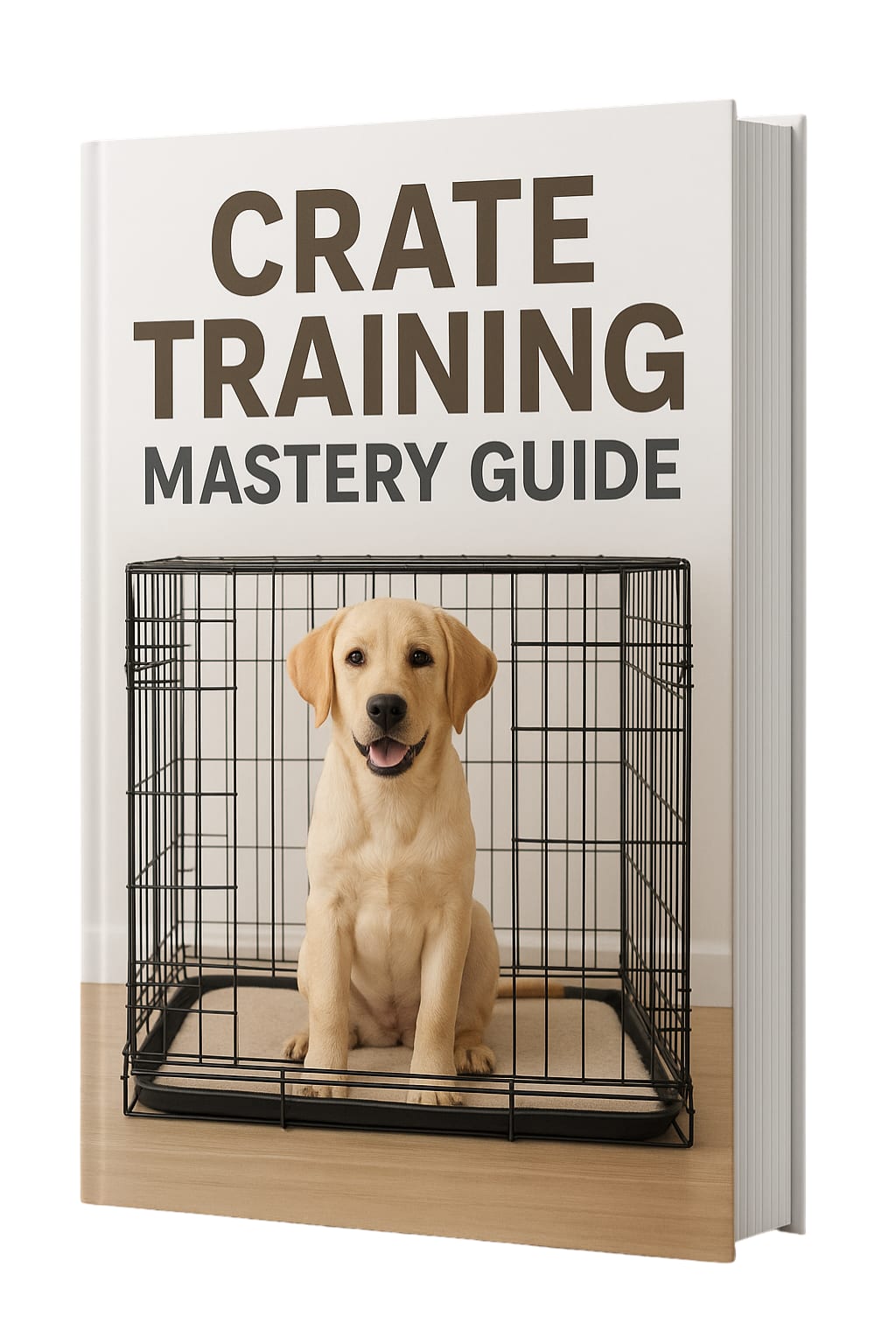
Why crate training helps so many dogs
When used kindly and correctly, a crate can make potty training much easier.
Most dogs do not like soiling the space where they sleep. That natural tendency makes the crate helpful for building bladder control and preventing random indoor accidents when you cannot supervise closely. It also gives you a way to create structure without constantly chasing your dog’s every move.
But the details matter.
A crate should not be so large that one end becomes a bathroom and the other becomes a bedroom. It should be big enough for your dog to stand, turn around, and lie down comfortably, but not big enough to split into separate zones. And it should never be used as punishment. The crate needs to feel safe, neutral, and calm.
It is also not a shortcut. A puppy cannot be crated too long and expected to succeed anyway. That is not training; that is just setting both of you up for failure. The crate works best as one part of a routine that includes regular potty breaks, supervision, rest, and a growing understanding of household life.
Used well, it can reduce accidents, protect your sanity, and help your dog learn more quickly.
Adult dogs sometimes need potty training too
People often talk about potty training like it belongs only to puppies, but adult dogs may need just as much patience.
A rescue dog coming into a new home may have no idea what your routine is. Even if they were previously house-trained, stress and change can throw off their habits. Some dogs came from environments where bathroom routines were inconsistent or impossible. Others may have medical issues, anxiety, or simply a long adjustment period ahead of them.
That can feel discouraging if you assumed an adult dog would just know what to do.
Still, adult dogs often learn very well once they understand the structure. In fact, they sometimes progress faster than puppies because they have better physical control. The emotional part is often the bigger challenge: settling into a new place, learning to trust, and figuring out what is expected.
The same principles apply. Routine. Supervision. Clear praise. Good cleaning. Patience. Less freedom at first. More success opportunities.
A dog’s age changes some details, but it does not change the basic truth that clarity helps.
When potty training seems to go backward
This is the part that catches many people off guard.
Your dog has a good week. Maybe even a great one. You start relaxing. You stop watching quite so closely. You begin to think, Okay, we’ve got this now.
And then there is a puddle.
Or two.
Or a random accident that feels especially insulting because it happened right after you dared to feel hopeful.
Regression is common. It can happen because of growth changes, schedule disruptions, stress, excitement, weather shifts, travel, guests, illness, or simply too much freedom too soon. It does not always mean the training failed. Sometimes it just means the support got removed before the lesson was fully stable.
When this happens, the best response is usually not panic. It is returning to basics.
Tighten the routine again. Increase supervision. Reward outside success more deliberately. Limit access to problem areas. Rebuild the pattern instead of assuming the dog is being difficult.
Progress in dog potty training is often uneven. That is normal. The overall trend matters more than any single day.
The emotional side no one prepares pet parents for
Potty training is not just hard because of the logistics. It is hard because of what it does to your mood.
You can adore your dog and still feel frustrated. You can feel grateful and exhausted at the same time. You can love the companionship and still have moments where you stare at a fresh mess and wonder whether anyone in the world has ever truly been ready for pet ownership.
That does not make you cold. It makes you human.
There is something especially humbling about caring for an animal who depends on you completely while also repeatedly peeing on things you value. It stretches patience in a very particular way. But there is also something beautiful hidden inside that stretch.
Your dog is learning to trust your guidance. You are learning to respond with more steadiness. The bond deepens in ordinary, unglamorous moments. Not just on walks or in cute photos, but in the repetition of teaching, cleaning, encouraging, and showing up again.
Some of the strongest relationships with pets are built in exactly these unlovely little moments.
What “success” actually looks like
Success is not always dramatic.
Sometimes it looks like your puppy going to the door and pausing there. Sometimes it looks like fewer accidents this week than last week. Sometimes it looks like your rescue dog finally relaxing enough to signal instead of panicking. Sometimes it looks like you recognizing the sniffing pattern before the accident happens and getting outside just in time.
These moments count.
It is easy to dismiss progress because it is not perfect yet. But dogs learn through accumulation. A dozen small wins matter. Fifty repeated successes matter even more. One day, almost without realizing it, you stop thinking about potty training every second. It becomes part of life instead of the whole emotional weather system of the house.
That shift can feel almost magical when it comes.
But it is rarely magic. It is the result of all the boring consistency that came before it.
When it may be more than a training issue
Not every potty problem is purely behavioral.
If your dog is having frequent accidents despite a strong routine, seems suddenly unable to hold it, is straining, drinking much more than usual, or showing signs of discomfort, it may be time to check with a veterinarian. Urinary issues, digestive problems, anxiety, and other health conditions can complicate or mimic training problems.
This does not mean you need to panic over every accident. Especially with puppies, accidents are part of the process. But when something feels unusually persistent, sudden, or physically off, it is wise to look beyond training alone.
Sometimes compassion means adjusting the plan. Sometimes it means asking a professional whether the issue is bigger than confusion.
The truth most experienced dog owners eventually learn
Dog potty training is less about forcing obedience and more about building understanding.
That may sound softer than some people expect, but in practice it is incredibly effective. Dogs learn best when they feel safe, when the routine is clear, when success is easy to repeat, and when their humans stay more predictable than reactive.
Your dog does not need you to be perfect. Your dog needs you to be readable.
That is really the heart of it.
Readable. Consistent. Patient enough to repeat yourself. Calm enough not to turn every mistake into a crisis. Encouraging enough to make the right choice feel worth repeating.
Over time, your dog learns where to go. But just as importantly, your dog learns how life with you works. That the world makes sense. That signals matter. That getting it right feels good. That home is a place where learning is possible.
And honestly, that is a beautiful thing to teach.
About the Creator
Edward Smith
I can write on ANYTHING & EVERYTHING from fictional stories,Health,Relationship etc. Need my service, email [email protected] to YOUTUBE Channels https://tinyurl.com/3xy9a7w3 and my Relationship https://tinyurl.com/28kpen3k
Keep reading
More stories from Edward Smith and writers in Petlife and other communities.
Stop Renting Your Data
You get the notification: "Your cloud storage is full." Then comes the guilt trip: "Upgrade to Premium for $9.99/month." Over five years, that's $600 just to store your photos and documents on someone else's computer.
By Edward Smithabout 22 hours ago in 01
Wisteria Woo RIP
Wisteria Woo Silver~Rhodesian Ridgeback Cane Corso mix~ 7.19.15-3.2.26 My service dog, Wisteria, had been slowing down, having mysterious health symptoms like severe hives and unexplained injury. She went to the vet last month, but unfortunately, not all tests detect all problems. When we returned to the vet yesterday, upon much more concerning symptoms suddenly appearing, we learned she had a very large mass (10inx10in) likely the very aggressive hemangiosarcoma, and that we would only be buying a few months if we went through with treatment.
By K.B. Silver 5 days ago in Petlife
Dogs in the life of composers
If you have a pet, you will surely agree: as soon as we take responsibility for someone – be it a cat, a dog, a ferret, a parrot, a horse, anyone! – these creatures become an important part of our lives, whether we want it or not.
By Ilya Baranovabout 18 hours ago in Petlife


Comments
There are no comments for this story
Be the first to respond and start the conversation.