
Estelle Roberts
Spiritualism, Mediumship, and Controversy in 20th Century Britain

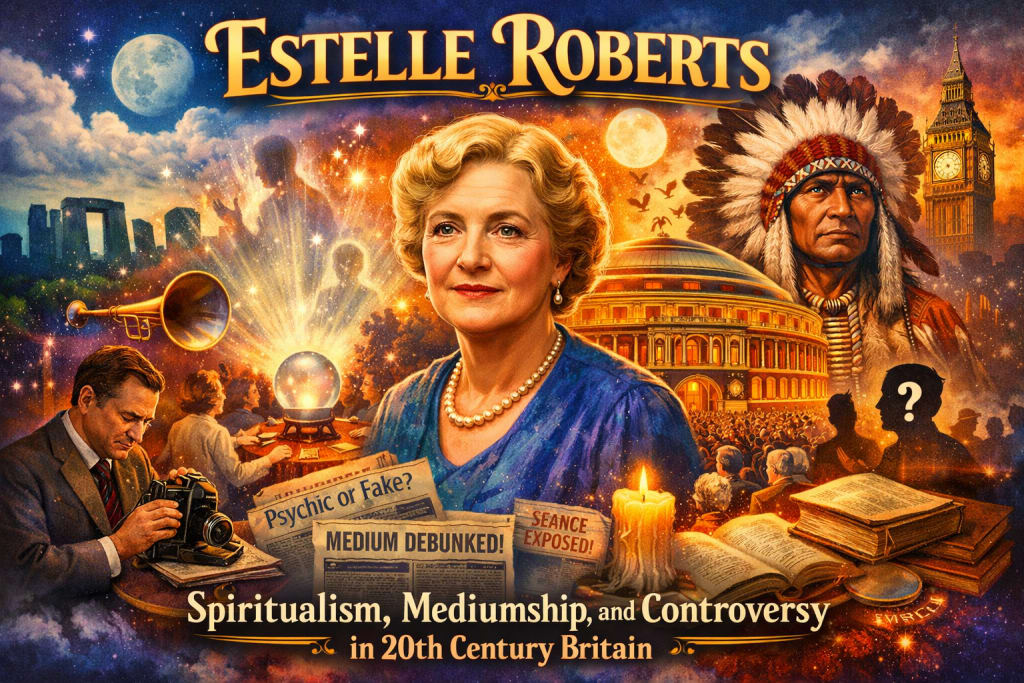
The Rise of Modern Spiritualist Mediumship
Public fascination with communication beyond death reached extraordinary levels during the late nineteenth and early twentieth centuries. Spiritualism, a religious and social movement built upon the belief that human consciousness survives physical death and remains capable of communicating with the living, spread rapidly throughout Britain, Europe, and North America. Séances, trance lectures, automatic writing, and spirit photography attracted large audiences and intense debate. Newspapers reported demonstrations with curiosity and skepticism, while scientific investigators attempted to test claims associated with psychic phenomena.
Spiritualist belief did not emerge in isolation. The movement grew during an era shaped by industrial change, scientific discovery, and shifting attitudes toward religion. Traditional Christian teachings about the afterlife remained influential, yet many individuals searched for forms of spiritual assurance that appeared compatible with modern thought. Reports of spirit communication seemed to offer experiential confirmation of survival after death. Large public gatherings devoted to mediumship became common in cities across Britain. Organizations devoted to Spiritualist philosophy formed structured communities, including churches, study circles, and lecture societies.
Periods of mass loss intensified interest in the possibility of contact with the departed. The First World War brought widespread grief to families throughout Britain and Europe. Many mourners sought comfort through séances or public demonstrations of mediumship. Spiritualist churches reported growing attendance during the interwar years, and well known mediums gained prominence through public appearances and published accounts of spirit communication. Within this climate of hope, curiosity, and controversy, several mediums rose to national recognition.
Among the most widely known figures stood Estelle Roberts, a British trance medium whose career extended across the early and mid twentieth century. Estelle Roberts, born in London in 1889, developed a reputation for trance speaking, a form of mediumship in which a purported spirit communicator delivered lengthy addresses through the medium while an altered state of consciousness occurred. Large audiences attended demonstrations in halls throughout Britain, and the name Estelle Roberts became closely associated with organized Spiritualism. Spiritualist churches frequently invited Estelle Roberts to deliver lectures that combined religious teaching with messages believed to originate from the spirit world.
Public attention increased further through books and recordings attributed to trance communications received during demonstrations. A spirit personality known as “Red Cloud,” described within Spiritualist circles as a Native American teacher, appeared frequently during trance addresses associated with Estelle Roberts. Transcribed lectures circulated widely among Spiritualist readers and contributed to the popularity of Roberts within the movement. Supporters described remarkable consistency, eloquence, and philosophical depth within the trance material.
Critical voices emerged alongside admiration. Psychical researchers, stage magicians, and skeptical investigators examined demonstrations of mediumship throughout the twentieth century, often questioning whether observed phenomena resulted from psychological suggestion, performance skill, or deliberate deception. Mediums who attracted large audiences inevitably became subjects of scrutiny. Estelle Roberts, like many prominent Spiritualist figures, attracted both devoted followers and determined critics. Debates surrounding authenticity, belief, and evidence reflected broader cultural tensions between spiritual conviction and scientific inquiry.
Despite controversy, influence within British Spiritualism remained substantial. Estelle Roberts served as president of the National Spiritualist Union, the principal governing body of Spiritualist churches in Britain. Public lectures, radio broadcasts, and published works contributed to recognition that extended far beyond local congregations. Large gatherings in major halls demonstrated the scale of interest surrounding mediumship during the interwar and postwar years.
The historical presence of Estelle Roberts illustrates the powerful role mediumship played in modern religious culture. Spiritualism combined elements of faith, personal experience, grief, and curiosity about unseen dimensions of existence. Through decades of public work, Estelle Roberts became one of the most recognizable representatives of that movement, standing at the center of enduring discussions about spiritual communication, belief in survival after death, and the cultural appeal of the supernatural.
London Beginnings and the Formation of a Spiritualist Medium
May Estelle Wills entered the world on 10 May 1889 in Kensington, London, during the closing years of the Victorian era. Kensington at that time contained striking contrasts. Elegant terraces and prosperous households existed alongside crowded streets where domestic workers, tradespeople, and service staff formed the backbone of daily urban life. Families of modest means depended upon steady employment, and young members of working households often entered service at an early age.
May Estelle Wills grew up within a large London family that included several siblings. Household life followed patterns familiar to many families of the period. Discipline, religious observance, and practical responsibility shaped childhood experience. Victorian society placed strong emphasis on respectability and moral order, yet curiosity about the unseen world also flourished in the background of everyday life. Interest in ghosts, visions, and spiritual manifestations appeared frequently in popular literature, newspapers, and public discussion.
Later biographical accounts associated with Spiritualism describe unusual childhood perceptions reported by May Estelle Wills. Narratives written within Spiritualist circles mention voices, visions, and fleeting apparitions observed during early years. Such reports appeared in later autobiographical reflections and spiritualist publications that attempted to trace the development of psychic ability. Family reaction reportedly involved concern and confusion. Parents interpreted childhood descriptions as imagination or youthful fantasy, a common response within households unfamiliar with spiritualist interpretation of psychic phenomena.
Education for children in working families during late nineteenth century London rarely extended far beyond the basics of reading, writing, and arithmetic. Economic reality required many adolescents to enter employment quickly. Around the age of fifteen, May Estelle Wills began work as a nursemaid, a position that involved daily care of young children within a private household. Domestic service represented one of the most common occupations available to young women of limited financial means. Duties often included long hours, strict supervision, and modest wages.
Later employment included additional service work, including waitressing and similar positions that demanded physical stamina and patience. Such occupations provided necessary income but rarely offered stability or advancement. Economic uncertainty remained a persistent feature of life for many London families during the late Victorian and Edwardian periods.
Marriage introduced new responsibilities and further financial pressures. Historical accounts describe a personal life marked by several marriages and the responsibilities of motherhood. Widowhood at an early stage created severe economic strain, a circumstance that forced continuous employment in order to support children. Long working hours and the emotional weight of personal loss formed part of a life experience that later became closely linked with the narrative of spiritual awakening presented in Spiritualist writings.
Interest in Spiritualism gradually intensified during early adulthood. Britain during the early twentieth century contained an expanding network of Spiritualist churches, lecture halls, and development circles where individuals explored claims of psychic sensitivity and spirit communication. Attendance at such gatherings offered an environment in which unusual experiences could receive validation rather than dismissal.
A visit to a Spiritualist church meeting became a pivotal moment in the life of May Estelle Wills. During that gathering, a practicing medium reportedly identified latent psychic ability and encouraged formal development through spiritual discipline and training circles. Within Spiritualist tradition, such recognition often marked the beginning of structured development in mediumship. Exercises intended to heighten sensitivity to spiritual impressions, meditation practices, and participation in group séances formed common elements of that training.
From that moment forward, gradual transformation took shape. Experiences that once caused confusion within a conventional household setting gained new meaning within the interpretive framework of Spiritualism. The path toward public mediumship began quietly in small meetings and private circles, long before the name Estelle Roberts would become widely recognized within British Spiritualist culture.
The Emergence of a Public Medium
The early twentieth century witnessed rapid growth in organized Spiritualism throughout Britain. Spiritualist churches, development circles, and private séance groups created environments where individuals who believed in psychic sensitivity could attempt to cultivate mediumistic abilities. Participation in small home circles formed one of the most common entry points into the practice of mediumship. Members gathered regularly in quiet rooms, often arranged around a table, with the goal of producing conditions believed to encourage spirit communication. Soft lighting, hymns, prayer, and concentrated silence formed part of the atmosphere that Spiritualists considered favorable for contact with the unseen world.
Within such circles, May Estelle Wills began the gradual process of developing abilities interpreted by Spiritualists as evidence of mediumship. Regular attendance at development meetings introduced structured exercises intended to heighten perception of subtle impressions. Meditation, controlled breathing, and extended periods of quiet concentration allowed participants to focus attention on sensations or thoughts believed to originate beyond ordinary consciousness. Messages reported during these sessions could include impressions of names, descriptions of deceased individuals, or symbolic images interpreted as evidence of spirit presence.
Spiritualist practice distinguished several different forms of mediumship. Clairvoyance referred to the claimed ability to perceive spiritual figures or images not visible to ordinary sight. Clairaudience referred to the perception of voices or spoken messages believed to originate from discarnate personalities. Some mediums also reported forms of clairsentience, a heightened sensitivity to emotional impressions or physical sensations associated with spiritual presence.
Trance mediumship occupied a particularly important place within Spiritualist tradition. In this form of mediumship, the practitioner entered a deep altered state of consciousness while a purported spirit communicator delivered lengthy speeches or philosophical teachings through the medium’s voice. Audience members often described visible changes in posture, tone, and manner of speaking during trance addresses. Within Spiritualist interpretation, the trance state allowed the spirit communicator to use the physical organism of the medium as an instrument for communication.
Accounts associated with Estelle Roberts frequently described development in several forms of mediumship. Reports within Spiritualist publications attributed to Roberts the abilities of clairvoyance, clairaudience, trance speaking, direct voice phenomena, and psychic healing. Psychometry also appeared within descriptions of demonstrations. Psychometry involved the claimed ability to obtain impressions about a person or event through physical contact with an object, often a piece of jewelry, a photograph, or a personal belonging.
Séance procedures used by mediums during the early twentieth century followed traditions that had developed within Spiritualist circles since the mid nineteenth century. Participants typically sat in a circle in subdued light or near darkness, conditions believed to assist the manifestation of subtle phenomena. Trumpet shaped speaking devices sometimes appeared in these settings. Spiritualists believed such devices helped concentrate or amplify spirit voices, allowing communication to occur in a manner audible to those present. Reports from séance participants occasionally described floating trumpets, luminous effects, or disembodied voices emerging from within the room.
Spiritualist audiences interpreted such demonstrations as confirmation that human personality survived bodily death. Communication from deceased relatives offered emotional reassurance and strengthened belief in a continuing existence beyond the physical world. Spiritualist churches therefore regarded mediumship not merely as spectacle but as religious evidence supporting a philosophy centered upon survival, moral progress, and the enduring nature of consciousness.
Through persistent participation in development circles and public meetings, May Estelle Wills gradually transformed private experimentation into a recognized public role. Skill in delivering trance messages, combined with growing confidence before audiences, allowed movement from small gatherings toward larger lecture halls. The name Estelle Roberts, adopted during the rise of a professional mediumistic career, soon became associated with some of the most widely attended Spiritualist demonstrations in Britain.
Red Cloud and the Voice of Trance Communication
One of the most distinctive elements of the mediumship associated with Estelle Roberts involved the presence of a spirit communicator known as Red Cloud. Within Spiritualist accounts of trance demonstrations, Red Cloud appeared as the principal guiding intelligence responsible for delivering extended lectures through the medium. Trance addresses attributed to Red Cloud formed the foundation of many public meetings conducted by Roberts and played a major role in establishing a reputation within British Spiritualism.
Descriptions presented in Spiritualist literature portrayed Red Cloud as the spirit of a Native American teacher who continued spiritual work after physical death. Within trance sessions, the personality of Red Cloud was said to assume control of the medium’s vocal expression while the conscious awareness of Estelle Roberts receded into a deep trance state. Audience members frequently described noticeable changes in posture, cadence, and tone of voice when the alleged communicator began to speak.
Public demonstrations often followed a recognizable structure. Roberts entered a quiet meditative state before a gathering of Spiritualist church members or members of the public. Gradual changes in breathing and facial expression signaled the onset of trance. After a short interval, a voice believed by Spiritualist observers to represent Red Cloud began delivering addresses that sometimes continued for considerable lengths of time. These trance discourses addressed themes central to Spiritualist belief, including survival after death, moral development of the soul, and the continuing relationship between the physical world and the spirit world.
Lectures attributed to Red Cloud frequently emphasized the concept of spiritual progress. Spiritualist philosophy taught that death marked a transition rather than an ending. According to teachings presented through trance communication, existence continued in spiritual realms where learning and moral growth proceeded beyond the limitations of earthly life. Messages stressed compassion, ethical living, and personal responsibility as foundations for spiritual advancement.
Large audiences attended many of these trance addresses. Spiritualist churches across Britain organized meetings where visitors gathered not only to hear messages about the afterlife but also to witness the phenomenon of trance speaking itself. Reports within Spiritualist newspapers described crowded halls, attentive silence, and strong emotional reactions among listeners who believed the words of Red Cloud offered direct insight into the nature of existence beyond death.
Transcriptions of these addresses circulated widely in printed form. Several books published during the twentieth century presented teachings attributed to Red Cloud as delivered through the trance mediumship of Estelle Roberts. These publications included extended reflections on spiritual evolution, the structure of the spirit world, and the moral responsibilities of human life. Within Spiritualist communities, such texts gained considerable readership and contributed to the enduring association between the name Estelle Roberts and the personality of Red Cloud.
The figure of Red Cloud eventually became inseparable from the public identity of the medium. Spiritualist supporters viewed the communicator as a guiding teacher whose presence demonstrated the possibility of meaningful communication across the boundary of death. Regular appearances of the same spirit personality during numerous trance sessions reinforced belief among followers who attended repeated demonstrations.
At the same time, the presence of a named spirit guide also drew critical attention. Investigators interested in psychical research often questioned whether trance personalities represented external intelligences or psychological expressions produced within the mind of the medium. Discussions about the nature of trance communication therefore became part of a broader debate concerning the origins of mediumistic speech.
Regardless of interpretation, the association between Estelle Roberts and the communicator known as Red Cloud became one of the most recognizable features of twentieth century British Spiritualism. Trance addresses attributed to that guiding personality reached thousands of listeners in public halls and many more through printed publications. The combination of dramatic trance delivery, philosophical teaching, and the symbolic presence of Red Cloud ensured a lasting place for these demonstrations within the history of Spiritualist mediumship.
Packed Halls and National Recognition
During the early decades of the twentieth century, Spiritualism expanded beyond small séance rooms into large public venues. Mediums who attracted public attention often addressed audiences in lecture halls, theaters, and civic auditoriums. Demonstrations of clairvoyance, trance speaking, and spirit communication became organized public events that blended religious instruction, personal testimony, and dramatic presentation. Within that expanding environment, Estelle Roberts emerged as one of the most visible figures in British Spiritualism.
Public lectures formed the center of this growing reputation. Spiritualist churches throughout England invited Roberts to deliver trance addresses and demonstrations of clairvoyance. Meetings often filled church halls and community venues with audiences curious about evidence for survival after death. Spiritualist gatherings commonly began with hymns or devotional readings before the medium entered a trance state and delivered a lecture attributed to the spirit communicator Red Cloud. These addresses frequently explored spiritual philosophy, moral responsibility, and the continuity of life beyond physical death.
Growing interest soon carried these demonstrations beyond local churches. Roberts appeared in larger halls capable of holding hundreds or even thousands of listeners. Theatrical venues and civic auditoriums offered stages where trance speaking could reach audiences far larger than the traditional séance circle. Reports published in Spiritualist periodicals described crowded meetings, attentive listeners, and extended applause following trance lectures. Public curiosity about the possibility of communication with the dead ensured steady attendance at many events.
One of the most widely discussed appearances occurred at London's Royal Albert Hall in 1930 during a memorial gathering for Sir Arthur Conan Doyle. Conan Doyle, widely known as the creator of Sherlock Holmes, had also become one of the most passionate public advocates of Spiritualism during the final years of life. Lectures, books, and international tours devoted to Spiritualist teaching had made Conan Doyle an influential figure within the movement. Death in July 1930 led to memorial gatherings organized by Spiritualist supporters who believed that communication with the deceased author might occur.
The memorial meeting held at the Royal Albert Hall drew a large audience that included Spiritualists, journalists, and curious members of the public. Organizers placed an empty chair on the stage as a symbolic invitation for the spirit of Conan Doyle to attend the gathering. During the proceedings, Estelle Roberts reported a clairvoyant perception of the late author standing near the chair. According to accounts circulated within Spiritualist publications, Roberts described the presence of Conan Doyle as clearly visible to spiritual sight.
The moment attracted considerable attention. Supporters regarded the reported sighting as confirmation that the well known advocate of Spiritualism continued existence in the spirit world and remained able to communicate with those on earth. Critics and skeptics viewed the claim as an illustration of the suggestive atmosphere surrounding public demonstrations of mediumship. Newspapers and commentators discussed the event widely, further increasing public awareness of Roberts and the dramatic character of Spiritualist gatherings.
Large scale meetings continued throughout the following years. Spiritualist organizations frequently invited Roberts to deliver trance lectures in prominent venues across Britain. These gatherings often blended religious devotion with a sense of theatrical anticipation, as audiences waited to hear the voice of Red Cloud or to witness descriptions of spirit presence. Attendance sometimes included individuals seeking comfort after bereavement as well as investigators interested in the psychological and cultural dimensions of mediumship.
Public visibility of this scale ensured that the name Estelle Roberts became closely associated with the broader movement of British Spiritualism. Packed halls, national speaking tours, and widely discussed demonstrations transformed a medium who had once participated in small development circles into one of the most recognized public representatives of Spiritualist belief during the twentieth century.
Leadership and Influence Within British Spiritualism
By the middle decades of the twentieth century, the name Estelle Roberts had become firmly established within organized Spiritualism in Britain. Public demonstrations, trance lectures, and published writings brought wide recognition among Spiritualist congregations and sympathizers interested in psychic phenomena. Many supporters regarded Roberts as one of the most prominent mediums of the period, a figure whose activities helped shape the public identity of the movement.
Spiritualist churches across England frequently invited Roberts to conduct services and demonstrations. These gatherings typically combined religious observance with mediumistic display. Hymns, prayer, and readings introduced the meeting, followed by trance lectures attributed to the spirit communicator Red Cloud. Audience members often regarded such addresses as spiritual instruction rather than simple performance. Messages presented through trance speaking emphasized ethical living, compassion, and the belief that human consciousness continued to evolve after physical death.
Organized Spiritualism in Britain possessed a structured institutional framework during the early twentieth century. Churches, educational programs, and governing bodies attempted to provide order and credibility to practices often viewed with suspicion by outsiders. Within this environment, Roberts eventually assumed a prominent leadership role. Election to the presidency of the National Spiritualist Union, the principal organization representing Spiritualist churches in Britain, placed Roberts at the center of the movement’s administrative and public life.
The National Spiritualist Union sought to promote Spiritualism as a legitimate religious philosophy grounded in belief in survival after death and communication between the physical and spiritual worlds. Leadership within that organization involved public speaking, representation at conferences, and guidance for local congregations. Roberts used national recognition to support these efforts, appearing at church gatherings, conventions, and special events devoted to Spiritualist teaching.
Public advocacy for Spiritualism formed another important aspect of this influence. Throughout the early and mid twentieth century, Spiritualist supporters attempted to secure wider social acceptance for beliefs that remained controversial in scientific and religious circles. Lectures, publications, and public demonstrations served as tools for presenting Spiritualism as a serious philosophical and religious system rather than a collection of isolated paranormal claims.
Some Spiritualist accounts describe demonstrations of mediumship presented before individuals connected with British public life. Reports circulated within Spiritualist literature mention meetings held in London where political figures and other notable observers witnessed demonstrations of trance speaking and clairvoyance. Supporters interpreted such events as signs that interest in Spiritualist ideas had begun to extend beyond church halls into broader areas of society.
Regardless of differing interpretations, mediumship demonstrations often carried purposes that extended beyond the search for personal messages from deceased relatives. Public lectures promoted a worldview that emphasized spiritual continuity, moral development, and the unity of humanity beyond physical death. Roberts frequently delivered trance addresses framed as moral instruction intended to guide listeners toward ethical conduct and spiritual awareness.
Influence within Spiritualist communities therefore grew through a combination of public speaking, institutional leadership, and continued participation in demonstrations of mediumship. Many followers regarded Estelle Roberts as a visible representative of the movement during a period when Spiritualism sought both stability and recognition. The presence of a widely known medium at conferences, church gatherings, and national events helped reinforce a sense of shared identity among Spiritualist congregations across Britain.
Spiritualism and Society in the Early Twentieth Century
A clear understanding of the career of Estelle Roberts requires careful attention to the historical environment in which modern Spiritualism developed. The Spiritualist movement first emerged during the mid nineteenth century and spread quickly throughout Britain, the United States, and parts of continental Europe. Early reports of spirit communication captured public imagination and produced a cultural phenomenon that combined religious hope, scientific curiosity, and fascination with the unseen world.
The middle decades of the nineteenth century witnessed rapid social and intellectual change. Industrial expansion transformed daily life in Britain and North America. Scientific discoveries reshaped understanding of nature, while traditional religious structures encountered growing debate and reinterpretation. Within this atmosphere of transformation, Spiritualism presented a belief system that claimed to unite scientific investigation with spiritual conviction. Communication with the deceased appeared to offer observable evidence for the survival of human personality after death.
Public interest intensified dramatically during the decades surrounding the First World War. The conflict between 1914 and 1918 produced a scale of loss rarely experienced in modern history. Millions of families across Europe endured the death of sons, fathers, brothers, and husbands. Grief created a deep desire for reassurance that personal identity endured beyond the grave. Spiritualist meetings offered the possibility of receiving messages from the departed, and attendance at séances and demonstrations increased noticeably during the years that followed the war.
Spiritualist churches and societies expanded in response to that growing interest. Congregations organized regular services that resembled traditional religious gatherings but centered upon mediumistic demonstration and belief in continued existence after death. Hymns, readings, and philosophical lectures accompanied clairvoyant messages delivered through mediums who claimed the ability to perceive or hear communications from the spirit world. Development circles trained new practitioners, while national organizations attempted to establish standards for practice and conduct.
Mediumship therefore occupied a central role within the movement. Practitioners claimed a variety of abilities including clairvoyance, clairaudience, trance speaking, automatic writing, and physical manifestations during séance conditions. Some mediums conducted private sittings for individuals seeking personal messages from deceased relatives. Others appeared before large audiences where demonstrations took the form of public lectures combined with clairvoyant descriptions of spirit presences.
Spiritualism also attracted the attention of scientists, philosophers, and investigators interested in the possibility that consciousness might exist independently of the physical body. Organizations devoted to psychical research conducted experiments intended to examine claims of telepathy, apparitions, and communication with the dead. Such investigations attempted to apply methods of observation and documentation to phenomena traditionally associated with religion or folklore.
At the same time, strong skepticism accompanied the growth of Spiritualism. Magicians, journalists, and investigators frequently exposed fraudulent techniques used by certain mediums who attempted to produce spirit manifestations through hidden devices or stage illusion. Reports of deception created widespread public controversy and placed pressure upon Spiritualist organizations to distance legitimate practice from fraudulent performance.
Debate between believers and critics became one of the defining features of the movement. Supporters pointed to personal experiences and mediumistic demonstrations as evidence that human consciousness survived bodily death. Skeptics argued that psychological suggestion, coincidence, or deliberate trickery offered more plausible explanations. Newspapers often reported both enthusiastic testimonies and critical investigations, ensuring that mediumship remained a topic of lively public discussion.
Within this complex cultural landscape, mediums who achieved national recognition inevitably became figures of both admiration and scrutiny. Public demonstrations attracted large audiences seeking comfort, curiosity, or intellectual challenge. The career of Estelle Roberts unfolded against this backdrop of grief, hope, scientific inquiry, and controversy that shaped the broader history of Spiritualism during the early twentieth century.
Books, Teachings, and the Printed Voice of Spiritualism
Printed literature played an essential role in the spread of Spiritualist belief during the twentieth century. Lectures and demonstrations could reach only those present in a hall or church, yet books carried teachings far beyond a single gathering. Publications allowed mediums and Spiritualist leaders to record personal experiences, explain philosophical ideas, and preserve transcripts of trance communications believed to originate from the spirit world. Within this literary environment, the writings associated with Estelle Roberts became an important part of Spiritualist reading culture.
Several works connected with Roberts presented accounts of mediumistic development and teachings attributed to the spirit communicator Red Cloud. Among the most widely known titles appeared Red Cloud Speaks, Forty Years a Medium, and Fifty Years a Medium. These books circulated widely within Spiritualist churches and private study groups, where readers often treated the material as both autobiography and spiritual instruction.
Red Cloud Speaks presented teachings attributed to the guiding spirit who frequently appeared during trance addresses delivered through Roberts. The text contained reflections on spiritual progress, the moral responsibilities of human life, and the nature of existence beyond physical death. Passages described the spirit world as a realm of continued learning and gradual development rather than a fixed final destination. Spiritualist readers valued the work for its extended explanations of survival after death and its emphasis on compassion, ethical conduct, and personal growth.
Autobiographical reflections appeared most prominently in Forty Years a Medium and Fifty Years a Medium. These volumes presented recollections of the long career of Roberts within Spiritualism. Narratives described early experiences interpreted as signs of psychic sensitivity, participation in development circles, and the gradual movement from small gatherings toward national recognition. Accounts also described public demonstrations, encounters with Spiritualist congregations, and personal challenges encountered during decades of mediumistic work.
Descriptions of séance conditions and trance experiences appeared frequently throughout these writings. Roberts recounted moments of entering altered states of consciousness, followed by the delivery of extended addresses attributed to Red Cloud. Such passages attempted to convey the internal sensations associated with trance mediumship and the perceived cooperation between medium and spirit communicator.
Spiritualist philosophy occupied a central place within the pages of these books. Discussions often focused on the continuity of consciousness beyond bodily death, the ethical responsibilities of earthly life, and the belief that spiritual development continued after the transition commonly called death. Readers encountered explanations of mediumship, reflections on the structure of the spirit world, and encouragement to cultivate personal spiritual awareness.
The popularity of these works within Spiritualist circles reflected the importance of written testimony in a movement centered on personal experience. For many believers, books written by practicing mediums offered reassurance that contact with the spirit world occurred not only in isolated séance rooms but also through sustained lives devoted to spiritual service. Written accounts created a sense of continuity between public demonstrations and private study, allowing readers to revisit teachings delivered during trance lectures long after a meeting had ended.
Through printed publications, the voice associated with the trance communicator Red Cloud reached audiences far beyond the halls where lectures originally took place. Spiritualist readers across Britain and other countries encountered the teachings through books that circulated among churches, libraries, and personal collections. In this way, the literary legacy connected with Estelle Roberts became an enduring element within the broader body of twentieth century Spiritualist literature.
Philosophical Teachings Attributed to Red Cloud
The trance lectures delivered through Estelle Roberts frequently contained philosophical reflections presented as the teachings of the spirit communicator Red Cloud. Audiences who attended public demonstrations often expected not only personal messages from deceased relatives but also broader discussions about the nature of existence, morality, and the destiny of the human soul. Within Spiritualist interpretation, Red Cloud functioned as a spiritual teacher whose addresses offered guidance intended to elevate moral awareness and strengthen belief in life beyond death.
Several themes appeared repeatedly throughout these trance communications. Spiritualist readers and listeners recognized these themes as central principles of the philosophy promoted within many Spiritualist churches.
Survival of Consciousness
The belief that human consciousness survives bodily death stood at the center of the teachings attributed to Red Cloud. Trance lectures frequently emphasized the idea that death represented a transition rather than an ending. Physical dissolution did not erase personal identity or memory. Instead, according to these teachings, the essential self continued existence in a different state of being.
Within Spiritualist gatherings, mediumship demonstrations served as experiential support for that belief. Clairvoyant descriptions, trance messages, and reports of spirit presence were interpreted by followers as indications that personality persisted beyond the grave. The teachings associated with Red Cloud reinforced this conviction by describing the spirit world as an active environment populated by individuals who had once lived on earth.
Moral and Spiritual Development
Another prominent theme involved the concept of continuous spiritual growth. Red Cloud’s addresses often described existence as a long process of learning and ethical refinement. Earthly life formed only one stage in that development. According to the philosophy presented in these lectures, the spirit world provided further opportunities for reflection, understanding, and moral progress.
Listeners frequently encountered encouragement to cultivate compassion, patience, honesty, and service to others. Ethical conduct in daily life was presented as preparation for continued advancement after death. Spiritual maturity, rather than wealth or social position, determined the quality of progress within the unseen realms described in the teachings.
This emphasis on moral improvement reflected a broader feature of Spiritualist thought. Many Spiritualist leaders promoted a practical spirituality centered upon kindness, responsibility, and respect for human dignity. The teachings attributed to Red Cloud reinforced that ethical framework by presenting moral character as the true measure of spiritual advancement.
Communication Between the Physical and Spiritual Realms
A further principle concerned the possibility of communication between the physical world and the spirit world. Spiritualist philosophy described the boundary separating these two conditions of existence as permeable rather than absolute. According to this interpretation, individuals who had passed from physical life could still maintain awareness of earthly events and occasionally transmit messages to the living.
Mediums served as the intermediaries through whom such communication could occur. Through trance speaking, clairvoyance, or other forms of psychic perception, the medium was believed to translate impressions received from the spirit world into spoken words or symbolic descriptions. In the case of Estelle Roberts, trance lectures attributed to Red Cloud were understood by followers as examples of this form of interdimensional communication.
Reception and Debate
Teachings attributed to Red Cloud attracted considerable interest within Spiritualist communities. Many listeners regarded the lectures as thoughtful reflections on the meaning of life, moral responsibility, and the enduring nature of consciousness. Spiritualist congregations often treated these teachings as spiritual guidance intended to inspire ethical living and confidence in the continuity of existence beyond death.
At the same time, the philosophical claims contained within these messages drew criticism from skeptics and investigators of psychic phenomena. Critics argued that the ideas presented during trance could not be independently verified and might reflect the beliefs or expectations of the medium rather than communication from an external spirit personality.
This tension between belief and skepticism formed a persistent feature of public discussion surrounding Spiritualism. Supporters found reassurance in teachings that emphasized hope, moral purpose, and the continuation of life. Critics questioned the evidential foundation of such claims. The teachings attributed to Red Cloud therefore occupied a complex position within twentieth century religious culture, admired by followers while remaining subject to ongoing debate.
Debate, Investigation, and Public Criticism
Public prominence brought admiration as well as persistent scrutiny. Mediumship demonstrations throughout the late nineteenth and early twentieth centuries frequently attracted investigation from journalists, stage magicians, and researchers interested in psychical phenomena. The career of Estelle Roberts developed within that atmosphere of continuing debate, where claims of communication with the spirit world generated both devoted belief and determined skepticism.
Spiritualist followers regarded demonstrations by Roberts as genuine expressions of mediumistic ability. Critics approached the same demonstrations with a different perspective, emphasizing the need for controlled observation and repeatable evidence. The resulting tension reflected a broader cultural discussion about the nature of psychic phenomena and the standards required to evaluate extraordinary claims.
Questions Concerning Scientific Examination
One of the most frequently discussed issues involved the question of formal scientific testing. During the late nineteenth and early twentieth centuries, several organizations attempted to study claims of psychic phenomena through systematic investigation. Among the most influential of these groups stood the Society for Psychical Research, founded in London in 1882 with the goal of examining reports of telepathy, apparitions, and mediumship through documented inquiry.
Researchers associated with this organization occasionally invited well known mediums to demonstrate abilities under controlled conditions designed to eliminate the possibility of deception or unconscious influence. According to accounts discussed by critics, Estelle Roberts declined invitations to participate in certain forms of laboratory style testing. Skeptical observers interpreted that refusal as a reason for doubt, arguing that controlled conditions represented the most reliable method for evaluating claims of paranormal communication.
Spiritualist supporters often responded that mediumship depended upon delicate psychological and emotional conditions not easily reproduced in experimental settings. According to this view, hostile or highly controlled environments could disrupt the mental state required for trance communication. The disagreement highlighted a fundamental difference in approach between scientific investigation and religious experience within Spiritualist practice.
Controversy Surrounding Prophetic Statements
Another area of criticism concerned statements attributed to the trance communicator Red Cloud that appeared to predict future events. Some Spiritualist publications reported messages suggesting that the world might avoid another major global conflict following the devastation of the First World War. Such statements reflected widespread hopes for lasting peace during the interwar period.
The outbreak of the Second World War in 1939 contradicted those expectations. Skeptics later cited these inaccurate predictions as evidence that trance communications did not originate from an all knowing spiritual source. Within critical discussions of mediumship, failed prophecy often served as an argument that trance messages reflected human belief and speculation rather than supernatural knowledge.
Accusations of Theatrical Methods
Debate intensified further when investigators proposed natural explanations for certain phenomena reported during séances and demonstrations. Some accounts connected with the mediumship of Roberts described manifestations involving the spirit guide Red Cloud appearing in materialized form. Photographs circulated within Spiritualist circles purported to show such appearances during séance conditions.
Researcher Melvin Harris later examined several of these images. Analysis suggested that features visible in the photographs resembled Estelle Roberts wearing a costume that included a feathered headdress intended to represent the spirit personality. Harris presented this interpretation as evidence that at least some manifestations attributed to Red Cloud might have involved theatrical staging rather than supernatural materialization.
Supporters of Roberts disputed these conclusions and argued that photographs taken in dark séance conditions could easily produce misleading impressions. The disagreement added another chapter to the long history of controversy surrounding physical mediumship and spirit materialization claims.
A Wider Historical Pattern
The criticism directed toward Roberts reflected patterns that had existed within Spiritualism since the movement’s earliest years. Some mediums faced exposure as deliberate frauds, while others continued to attract devoted belief despite persistent skepticism. Investigators and believers often interpreted the same events through entirely different frameworks of understanding.
For historians of religion and culture, these debates reveal the powerful emotional and intellectual forces that surrounded Spiritualism during the twentieth century. Hope for communication with the departed, curiosity about unexplained phenomena, and commitment to scientific scrutiny all converged within public discussions of mediumship. The career of Estelle Roberts unfolded within this complex landscape of faith, investigation, and controversy that shaped the reputation of many prominent mediums in modern history.
Media Attention and Public Fascination
Public demonstrations of mediumship occupied a curious place within twentieth century society. Spiritualist meetings attracted audiences drawn by many different motivations. Bereaved families hoped for reassurance that loved ones continued to exist beyond death. Curious observers attended in search of unusual experiences. Journalists and investigators sometimes appeared with the intention of evaluating claims of psychic ability. The result was a cultural environment where fascination, belief, and skepticism often appeared side by side.
Newspapers during the early and middle decades of the twentieth century regularly reported on séances, clairvoyant demonstrations, and trance lectures. Articles sometimes described gatherings in dramatic language, portraying dimly lit rooms, silent audiences, and mediums delivering messages believed to originate from unseen personalities. Other reports adopted a cautious tone, presenting accounts of demonstrations while raising questions about interpretation and evidence. Such varied coverage reflected the broader public uncertainty surrounding claims of communication with the dead.
Estelle Roberts became a frequent subject of that attention as recognition within Spiritualist circles increased. Public meetings conducted in cities throughout Britain drew audiences large enough to attract notice from the press. Spiritualist periodicals celebrated these events as proof that belief in survival after death continued to inspire strong interest among ordinary people. Mainstream newspapers often approached the same gatherings with curiosity tempered by skepticism.
Large venues provided visible evidence of the scale of public interest. Events held in prominent halls, including London's Royal Albert Hall, demonstrated that thousands of individuals were willing to attend meetings devoted to trance lectures and spiritual communication. Crowded auditoriums, long ticket lines, and enthusiastic applause formed part of the atmosphere described by observers who attended such gatherings. These scenes illustrated the powerful appeal that Spiritualist demonstrations held for a public searching for meaning, comfort, or intellectual intrigue.
Interest in the supernatural formed an enduring feature of popular culture during the period. Ghost stories, séances, and reports of psychic phenomena appeared regularly in books, magazines, and stage performances. Mediums who addressed large audiences occupied a position somewhere between religious teacher, public lecturer, and controversial performer. Public curiosity about mysterious experiences ensured that such figures rarely escaped notice.
Journalists often highlighted the emotional dimension of Spiritualist gatherings. Many individuals who attended meetings had recently experienced personal loss. The possibility of hearing a message from a departed relative carried profound emotional significance for those seeking reassurance about the fate of loved ones. For believers, the atmosphere of a Spiritualist meeting could provide comfort that traditional forms of religious consolation sometimes failed to deliver.
At the same time, skepticism remained a powerful influence within intellectual and scientific communities. Commentators trained in psychology, science, and stage illusion frequently argued that mediumistic demonstrations could result from suggestion, misinterpretation, or deliberate trickery. Critical articles sometimes appeared alongside sympathetic reports, illustrating the divided response that Spiritualism often generated in public discourse.
The career of Estelle Roberts unfolded at the intersection of these competing perspectives. Large audiences reflected widespread curiosity and spiritual interest, while persistent criticism ensured continued debate about the authenticity of mediumship. Media attention, whether supportive or skeptical, helped shape the public image of Roberts as one of the most widely recognized mediums associated with British Spiritualism during the twentieth century.
Cultural Legacy and Influence on Spiritualist Tradition
The public career of Estelle Roberts left a lasting imprint upon British Spiritualism and the wider cultural imagination surrounding psychic phenomena. Demonstrations conducted before large audiences, combined with widely circulated publications, helped bring ideas associated with trance mediumship into public awareness. Within Spiritualist communities, the name Estelle Roberts became closely associated with organized efforts to present Spiritualism as both a religious philosophy and a system of spiritual experience grounded in communication with the spirit world.
Influence on Spiritualist Practice
Spiritualist congregations throughout Britain often regarded Roberts as a prominent representative of mediumship during the twentieth century. Public lectures delivered through trance communication introduced audiences to teachings concerning survival after death, moral responsibility, and the continuing development of the soul. Many church services organized within Spiritualist communities incorporated similar forms of presentation, including inspirational addresses, clairvoyant descriptions of spirit presences, and messages offered to members of the audience.
Trance speaking associated with the spirit communicator Red Cloud became one of the most recognizable features of Roberts’s public work. The style of these addresses, often solemn and philosophical in tone, influenced the format of meetings held within several Spiritualist churches. Listeners frequently interpreted such speeches as evidence that spiritual intelligence continued to guide human progress from beyond the physical world. The combination of religious instruction and mediumistic demonstration contributed to the development of Spiritualist services that blended devotional practice with claims of psychic communication.
Leadership within the National Spiritualist Union further strengthened this influence. Organizational activity within that body helped shape standards for church services, educational programs, and the training of mediums. Roberts occupied a visible position within this structure during an era when Spiritualism sought greater coherence and public recognition as a religious movement.
Influence on Mediumship Traditions
Mediumship traditions often evolve through the example of widely recognized practitioners whose public work inspires later generations. Within twentieth century British Spiritualism, Roberts occupied a place within that lineage of prominent mediums whose demonstrations reached audiences far beyond local congregations. Public appearances in large venues demonstrated that mediumship could function not only as a private practice but also as a form of public spiritual instruction.
Later mediums sometimes referred to earlier figures who helped establish the possibility of national recognition for Spiritualist practitioners. The career of Roberts illustrated that trance speaking and clairvoyant demonstration could attract large gatherings and generate substantial interest in the philosophical claims associated with Spiritualism. This visibility contributed to the continuation of public demonstrations within many Spiritualist churches and lecture halls.
Influence on Cultural Imagination
The broader cultural impact of mediumship extended beyond organized Spiritualist congregations. Stories involving séances, spirit guides, and communication with the dead became recurring themes within literature, theater, cinema, and radio during the twentieth century. Public fascination with the possibility of unseen worlds created fertile ground for imaginative storytelling.
Historical figures associated with mediumship contributed to that fascination by providing real world examples of individuals who claimed direct contact with the spirit realm. Reports of trance lectures, clairvoyant visions, and spirit personalities offered dramatic material that echoed through popular culture. The image of a medium delivering messages from beyond the veil became a recognizable motif in many forms of artistic expression.
Within this cultural landscape, Estelle Roberts represented one of the most visible examples of a medium whose public life intersected with both religious belief and popular curiosity. Large gatherings, widely discussed demonstrations, and the enduring presence of the spirit communicator Red Cloud ensured that the career of Roberts remained part of the historical narrative surrounding Spiritualism and the enduring human interest in the possibility of communication with unseen realms.
Recommended Reading: #commissionearned
Investigating the Unexplained by Melvin Harris
Claims of paranormal activity have fascinated the public for generations, yet such claims have also inspired careful investigation. Investigating the Unexplained explores a wide range of mysterious phenomena including spirit photography, séance manifestations, psychic demonstrations, and reports of supernatural encounters. The book approaches these topics with a skeptical and investigative mindset, examining how some celebrated cases of paranormal evidence may have been misunderstood or deliberately staged. Particular attention is given to photographic claims and physical manifestations associated with famous mediums of the twentieth century. Discussions in the book include analysis of images connected with the alleged spirit guide Red Cloud, a figure closely associated with the mediumship of Estelle Roberts. Through comparisons with stage illusion techniques and photographic manipulation, the work raises questions about the reliability of certain séance phenomena. For readers studying Roberts and the broader Spiritualist movement, the book represents an important example of the critical perspective that surrounded public demonstrations of mediumship. Such skepticism formed an essential part of the historical debate that shaped the reputation of many prominent mediums.
Spiritualism and Society (Routledge Revivals) by G. K. Nelson
The growth of Spiritualism during the nineteenth and early twentieth centuries did not occur in isolation from wider cultural change. Spiritualism and Society examines how social conditions, religious uncertainty, and the emotional aftermath of war contributed to the rapid expansion of belief in spirit communication. The book traces the development of Spiritualist organizations, public meetings, and religious communities that formed around the promise of contact with the departed. Nelson explores how mediums emerged as central figures within this environment, often becoming widely recognized public personalities whose demonstrations drew large audiences. The study also investigates how Spiritualist beliefs intersected with contemporary debates about science, religion, and psychology. Readers gain a deeper understanding of why public interest in mediumship reached such remarkable levels during the early twentieth century. Within the context of a discussion about Estelle Roberts, this book helps explain the historical conditions that allowed a medium to rise to national prominence. The work provides valuable context for understanding the social environment that shaped Roberts’s career.
Some Discern Spirits by Sylvia Barbanell
Personal accounts from within the Spiritualist movement provide a perspective very different from the skeptical literature that often surrounds paranormal claims. Some Discern Spirits presents reflections on mediumship and spirit communication from the viewpoint of committed Spiritualists who believed these experiences represented genuine contact with the spirit world. The book includes discussions of several mediums whose work influenced Spiritualist communities throughout Britain. Descriptions of séances, trance states, and clairvoyant communication appear throughout the narrative, illustrating the atmosphere that surrounded Spiritualist gatherings during the twentieth century. The author also reflects on the role of spirit communicators who were believed to guide mediums during trance lectures. Figures such as Red Cloud, associated with the mediumship of Estelle Roberts, appear within this broader discussion of spiritual teachers communicating through human intermediaries. Rather than focusing primarily on controversy, the book explores the spiritual meaning that followers found in these experiences. Readers interested in Roberts gain insight into how believers within the movement understood and valued mediumistic work.
The Trumpet Shall Sound by Maurice Barbanell
Within many Spiritualist circles, the sound of a trumpet during a séance carried powerful symbolic meaning. The Trumpet Shall Sound explores the history and practice of spirit communication with particular emphasis on physical mediumship and trumpet séances. The book reflects the perspective of a prominent Spiritualist writer who spent many years observing and documenting mediumistic phenomena. Detailed descriptions of séance conditions, spirit voices, and trance communication appear throughout the work. Readers encounter discussions of how mediums prepared for demonstrations and how audiences interpreted unusual events that occurred during these gatherings. The text also examines the personalities of several mediums whose public work shaped the reputation of Spiritualism during the twentieth century. Such discussions help illuminate the cultural environment in which figures like Estelle Roberts operated. For those studying the history of mediumship, the book offers a vivid portrait of the practices and beliefs that defined Spiritualist meetings during the period when Roberts achieved widespread recognition.
On the Edge of the Etheric: Survival After Death Scientifically Explained by Arthur Findlay
The possibility that consciousness might survive bodily death has inspired both spiritual belief and intellectual debate. On the Edge of the Etheric attempts to explore that question through a blend of philosophical reflection and scientific speculation. The book argues that mediumistic communication provides evidence suggesting that human identity continues in a nonphysical realm sometimes described as the etheric world. Discussions within the work explore concepts such as vibration, energy, and spiritual planes as ways of explaining how communication between worlds might occur. Mediums occupy a central place within this framework because they are presented as individuals capable of receiving impressions from those unseen realms. Findlay draws upon observations of séances, trance speaking, and clairvoyant demonstrations in order to support these ideas. Readers examining the career of Estelle Roberts can better understand how many Spiritualists interpreted mediumship through a quasi scientific lens during the early twentieth century. The book reflects the intellectual effort within the movement to reconcile spiritual belief with modern scientific thought.
The Medium Discourse: Red Cloud's Inner Teachings by Brandon J. Kim
Modern scholarship has taken a renewed interest in the philosophical teachings delivered through trance mediums of the early twentieth century. The Medium Discourse: Red Cloud's Inner Teachings focuses specifically on the messages attributed to the spirit communicator Red Cloud, whose presence became inseparable from the public mediumship of Estelle Roberts. Rather than treating the subject only as historical curiosity, the book carefully examines the content of the teachings themselves. Themes such as spiritual evolution, ethical responsibility, and the continuation of consciousness after death receive detailed attention. The author studies how these ideas were presented during trance lectures and how audiences interpreted their meaning. Attention is also given to the symbolic role of Red Cloud within Spiritualist culture and the ways in which spirit guides shaped the identity of public mediums. By analyzing these teachings in depth, the work helps readers understand why the trance messages associated with Roberts attracted devoted listeners. The book therefore serves as a useful bridge between historical biography and the philosophical tradition of Spiritualist thought.
Estelle Roberts Among the Prominent Mediums of the Era
The career of Estelle Roberts unfolded during a period when several mediums achieved national and international recognition. Spiritualism during the late nineteenth and early twentieth centuries did not revolve around a single individual or method. Instead, the movement included a wide range of practitioners who approached mediumship through different styles of demonstration and different interpretations of spiritual communication. A comparison with other well known mediums of the era helps illustrate the diversity that existed within Spiritualist practice.
Public audiences encountered several broad categories of mediumship during this period. Some practitioners focused on trance communication, delivering long philosophical addresses while in altered states of consciousness. Others specialized in clairvoyant readings, offering descriptions of deceased relatives to members of an audience. A third group concentrated on physical manifestations during séance conditions, including table movement, luminous effects, spirit voices, or materializations believed to represent the appearance of spirit forms. These different approaches reflected varying traditions that had developed within Spiritualism since the nineteenth century.
Trance mediumship formed the central feature of the work associated with Estelle Roberts. During public meetings Roberts frequently entered a trance state and delivered lectures attributed to the spirit communicator Red Cloud. These addresses often emphasized moral responsibility, spiritual growth, and the continued existence of consciousness after death. Large audiences attended such lectures not only for personal messages but also for the philosophical reflections delivered through trance speaking. The combination of religious instruction and dramatic presentation helped distinguish the style of Roberts from other mediums who focused primarily on short clairvoyant readings.
Other mediums pursued different forms of demonstration that attracted attention from researchers interested in psychical phenomena. Physical mediumship became particularly controversial because séances sometimes included visible or audible events that participants interpreted as manifestations of spirit activity. Reports from such gatherings occasionally described floating objects, mysterious lights, or voices emerging from darkness. Investigators often attempted to observe these séances under controlled conditions in order to determine whether natural explanations could account for the reported phenomena.
Some mediums welcomed opportunities for formal testing by investigators who wished to examine claims of psychic ability under laboratory style observation. Controlled experiments attempted to reduce the possibility of suggestion, hidden devices, or other forms of deception. Results from these investigations remained a subject of ongoing debate. Supporters believed certain experiments suggested genuine paranormal effects, while critics argued that methodological weaknesses or unconscious influence might explain the outcomes.
In contrast, many mediums placed greater emphasis on public demonstration rather than scientific examination. Large halls, church gatherings, and public lectures created environments where audiences experienced mediumship as a shared event rather than a laboratory experiment. Estelle Roberts belonged largely within this tradition. Meetings often included dramatic elements such as dim lighting, solemn music, and extended trance speeches delivered to attentive crowds. The atmosphere of these gatherings contributed to a sense of spiritual significance that many followers considered deeply meaningful.
The public presentation of mediumship therefore varied widely among practitioners. Some mediums cultivated reputations through quiet private sittings, while others became widely known through large scale lectures and demonstrations. Roberts gained recognition through the latter approach. Packed halls, national speaking engagements, and widely discussed trance communications established a strong public identity associated with the teachings attributed to Red Cloud.
This diversity within Spiritualist practice reveals that mediumship never developed as a single uniform tradition. Different mediums emphasized different abilities, philosophies, and methods of demonstration. The career of Estelle Roberts represents one influential expression of that wider movement, combining trance communication, public speaking, and spiritual philosophy in a manner that left a lasting impression on audiences throughout Britain.
Legacy and Historical Interpretation
The historical reputation of Estelle Roberts remains shaped by sharply different interpretations. Within Spiritualist communities, the name often evokes the image of a devoted medium who dedicated many decades to public service, spiritual teaching, and the promotion of belief in survival after death. Admirers frequently point to the scale of public interest that surrounded the demonstrations, as well as the emotional comfort many attendees reported after listening to trance lectures or receiving messages believed to originate from the spirit world.
Supportive assessments often emphasize the role Roberts played in strengthening organized Spiritualism in Britain. Public meetings held in churches, lecture halls, and major venues introduced thousands of people to the teachings associated with trance communication. The spirit communicator Red Cloud became closely linked with these gatherings and formed a central element of the philosophical messages delivered during trance addresses. Followers often viewed these teachings as moral guidance intended to encourage compassion, ethical conduct, and confidence in the continuation of human consciousness beyond physical death.
The long career associated with Roberts also receives attention in favorable historical accounts. Decades of public speaking, leadership within Spiritualist organizations, and published writings contributed to a strong presence within the movement. Spiritualist congregations frequently remembered such work as an example of dedication to religious service and spiritual education. Within these circles, Roberts appeared as one of the most recognizable representatives of twentieth century mediumship.
A different interpretation appears within skeptical discussions of Spiritualism. Critics often focus on controversies that accompanied public demonstrations of mediumship during the period. Refusal to participate in certain controlled scientific examinations attracted criticism from investigators who believed laboratory style observation represented the most reliable method for evaluating paranormal claims. Skeptical observers also pointed to inaccurate predictions attributed to trance communications and to allegations that some séance phenomena could have been produced through theatrical methods.
Investigators interested in the history of psychic claims frequently examined photographs, séance reports, and eyewitness testimony connected with prominent mediums. Within such discussions, Roberts sometimes appeared as part of a wider tradition in which stage performance, audience expectation, and sincere belief could become closely intertwined. Critics argued that emotional circumstances surrounding bereavement and spiritual hope created conditions in which audiences might interpret ambiguous events as evidence of supernatural communication.
These contrasting interpretations reveal how mediumship occupied a complex cultural position throughout the twentieth century. For believers, trance communication offered reassurance that death did not end personal existence and that moral development continued beyond earthly life. For skeptics, the same demonstrations raised questions about suggestion, illusion, and the powerful influence of expectation.
Despite the continuing debate, the historical significance of Estelle Roberts remains clear. Public lectures, widely discussed demonstrations, and published works contributed to the visibility of Spiritualist ideas during a period when large audiences showed deep interest in psychic phenomena. Trance addresses attributed to Red Cloud became part of the broader narrative surrounding modern mediumship and the enduring human desire to understand what may lie beyond physical existence.
Belief, Evidence, and the Power of Spiritual Leadership
The history of mediumship reveals an enduring tension between personal belief and scientific investigation. Claims of communication with the dead invite profound emotional responses, yet such claims also attract demands for verifiable evidence. Throughout the twentieth century, this divide shaped public discussion surrounding many well known mediums. The career of Estelle Roberts illustrates how these competing expectations often collided within the same cultural space.
Spiritualist followers frequently approached mediumship as a form of religious experience rather than a scientific experiment. For many believers, séances and trance lectures provided reassurance that human consciousness survived bodily death. Messages attributed to spirit communicators offered comfort to families coping with loss and strengthened confidence in the idea that relationships continued beyond physical life. Within this perspective, the emotional and spiritual value of a demonstration carried greater importance than laboratory style verification.
Scientific investigators approached the subject from a different direction. Researchers interested in psychical phenomena attempted to apply controlled observation and careful documentation in order to determine whether paranormal abilities could be demonstrated under test conditions. Experiments sometimes involved controlled environments designed to prevent hidden devices, suggestion, or unconscious influence from shaping the outcome. Such procedures reflected the belief that extraordinary claims required evidence capable of withstanding systematic scrutiny.
The refusal of certain mediums to participate in controlled testing became a focal point of criticism from skeptics. In the case of Estelle Roberts, the decision not to undergo specific forms of experimental examination strengthened doubts among investigators who sought measurable proof of psychic ability. Critics argued that controlled conditions represented the most reliable method for distinguishing genuine phenomena from illusion or performance.
Spiritualist supporters often responded with a different explanation. According to many practitioners within the movement, mediumship depended upon delicate psychological conditions that could be disturbed by skepticism or artificial laboratory settings. Spiritualist teaching sometimes described mediumship as a cooperative process involving both the medium and spirit communicators. Within that framework, hostile or highly controlled environments were believed to disrupt the harmony required for successful communication.
The debate between these viewpoints formed one of the most persistent controversies surrounding Spiritualism. Believers emphasized personal experience, emotional testimony, and philosophical reflection as forms of evidence for survival after death. Investigators insisted upon repeatable observation and independent verification. Neither approach succeeded in resolving the disagreement, and the subject of mediumship continued to generate discussion in both religious and scientific circles.
Another factor that shaped the influence of Spiritualist movements involved the presence of charismatic public figures capable of attracting large audiences. Throughout religious history, individuals with compelling speaking ability and strong personal conviction have often played a significant role in shaping belief systems and guiding communities. Mediums who delivered dramatic demonstrations or powerful speeches sometimes achieved a level of recognition comparable to that of religious leaders or popular lecturers.
Estelle Roberts displayed many of the qualities associated with this form of public influence. Trance lectures delivered through the personality of Red Cloud often held audiences in attentive silence for extended periods. The solemn tone of these addresses, combined with the atmosphere of expectation present in large halls, created memorable experiences for many listeners. Attendance at such gatherings sometimes involved both spiritual curiosity and the desire to witness an unusual public event.
Large crowds attending these demonstrations illustrated the cultural power of charismatic leadership within spiritual movements. A compelling presence on stage could transform abstract ideas about survival after death into vivid experiences shared by hundreds or thousands of people at once. Within Spiritualist communities, such gatherings reinforced collective belief and strengthened the sense that the spirit world remained close to human life.
The intersection of personal conviction, public charisma, and scientific skepticism therefore formed a defining feature of modern Spiritualist history. The career of Estelle Roberts demonstrates how these forces could converge around a single individual whose work inspired both devotion and criticism. Through public lectures, trance communication, and widely discussed demonstrations, Roberts became part of an ongoing conversation about the boundaries between faith, experience, and empirical inquiry.
Continuing the Study of Spiritualism
The life and career of Estelle Roberts remain closely connected with the broader story of twentieth century Spiritualism. Public demonstrations delivered before large audiences, books describing mediumistic experiences, and leadership within Spiritualist organizations contributed to a reputation that extended well beyond individual church meetings. Admirers within Spiritualist communities often described the trance communications attributed to the spirit guide Red Cloud as meaningful expressions of spiritual philosophy. Teachings delivered during these lectures emphasized survival after death, moral development, and the continuing growth of the human spirit beyond earthly life.
At the same time, controversy followed many aspects of that career. Skeptical researchers examined the claims associated with mediumship and questioned whether séance phenomena represented genuine communication with unseen personalities. Critics frequently pointed to the refusal of certain forms of controlled testing, predictions attributed to trance communications that later proved incorrect, and allegations that some demonstrations might have relied upon theatrical presentation rather than supernatural influence. These debates reflected a larger historical pattern that surrounded Spiritualism from the nineteenth century onward.
The history of mediumship therefore contains both devotion and dispute. Supporters found inspiration and comfort in the belief that consciousness survived physical death. Investigators approached the same claims with demands for observable evidence and careful testing. A thoughtful understanding of figures such as Estelle Roberts requires attention to both viewpoints. Historical inquiry benefits from the willingness to examine admiration, criticism, testimony, and investigation with equal care.
Readers interested in Spiritualism often discover that the subject opens a wide landscape of historical, philosophical, and cultural questions. Curiosity about communication with the spirit world has inspired books, lectures, and research for more than a century. Many communities maintain collections of historical works that explore these ideas in detail. Public libraries provide one of the most valuable resources for anyone wishing to examine original writings about Spiritualism, psychical research, and the lives of well known mediums. Library collections frequently include older books that may not appear easily through casual online searches.
Careful reading across multiple viewpoints remains an important part of responsible research. Works written by devoted Spiritualists often present firsthand accounts and philosophical explanations of mediumship. Studies written by investigators or historians may offer critical analysis of the same events. A balanced understanding emerges through comparison of these different perspectives. Consultation of historical publications, biographies, and research studies allows readers to build a clearer picture of how Spiritualism developed and why certain figures became widely known.
Modern readers should also approach online material with thoughtful caution. The internet contains an enormous quantity of information about paranormal subjects, yet not all sources provide reliable scholarship. Many online articles repeat unverified claims, omit historical context, or reproduce stories without careful examination. Cross checking information with printed books, academic studies, and reputable historical resources helps prevent misunderstanding and encourages more accurate knowledge.
Exploration of Spiritualism ultimately invites reflection on larger questions about belief, evidence, and the enduring human search for meaning. The story of Estelle Roberts illustrates how powerful that curiosity can become when personal experience, public fascination, and philosophical inquiry intersect. Continued reading, careful research, and open minded evaluation allow modern readers to approach the subject with both curiosity and intellectual responsibility.
About the Creator
Marcus Hedare
Hello, I am Marcus Hedare, host of The Metaphysical Emporium, a YouTube channel that talks about metaphysical, occult and esoteric topics.
https://linktr.ee/metaphysicalemporium
Keep reading
More stories from Marcus Hedare and writers in BookClub and other communities.
Marsilio Ficino
Marsilio Ficino and the Renaissance Revival of Plato The Renaissance transformed the intellectual landscape of Europe through renewed engagement with classical antiquity. Greek and Roman manuscripts long absent from Western study returned to circulation through Byzantine scholars, monastic libraries, and new centers of learning in Italian city-states. Florence emerged as a leading center of cultural and philosophical renewal during the fifteenth century, where wealthy patrons supported scholarship, art, and literary production. Within such an atmosphere of rediscovery, the figure of Marsilio Ficino rose to prominence as one of the most influential interpreters of ancient philosophy.
By Marcus Hedare2 days ago in BookClub
Rachel Reviews: Lakefront Wolves by Joseph Deegan
Meet Finn. He's an 18 year old kid who has potential. He's bright with great school scores and he's also an athlete, a footballer of some prowess. He has it all going for him, it would seem, and yet, he's determined to send what could be a well-planned, stable existence firmly off the rails. He drinks, he smokes, he takes drugs, he has violent tendencies and he's in danger of losing not only his mind but all that he holds dear.
By Rachel Deeming11 days ago in BookClub
7 Fairy Tale Books You Must Read in 2026
Fairy tales are not just whimsical stories for children—they are timeless narratives that explore universal human experiences, moral dilemmas, and the power of imagination. From enchanted forests to magical kingdoms, these stories transport us to worlds where courage, resilience, and hope prevail. Whether you’re a lifelong reader or a newcomer seeking inspiration, exploring the right fairy tale books can expand your imagination, sharpen critical thinking, and offer profound life lessons.
By Diana Meresc5 days ago in BookClub
Becca
"Everything is so... flat." Denille said stupidly as she looked around her new neighborhood. She looked around at the muted desert where even the smallest sign of life seemed to have given up. The plant life was shrubs that were half cooked by the heat and where there should have been a lawn, a mess of white rocks laid glistening in the sun. Even the sky looked stretched thin, like the sun had ironed it smooth. She’d moved from Riverside, where at least there were hills, but here in Barstow, everything felt baked and brittle.
By Sara Wilson7 days ago in Fiction


Comments
There are no comments for this story
Be the first to respond and start the conversation.