

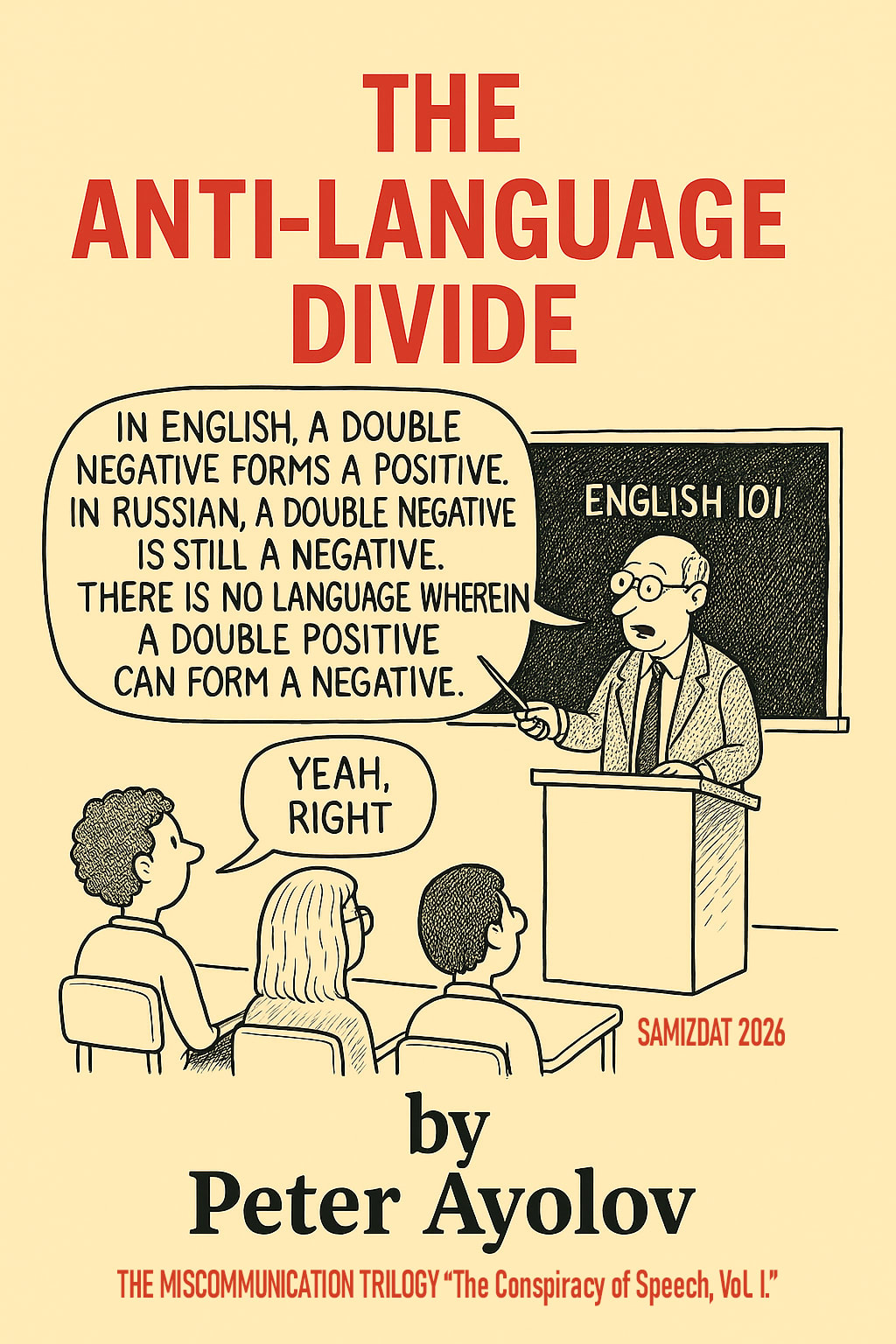
Divided Tongues, Divided Worlds: A Review of The Anti-Language Divide
The Anti-Language Divide, the third part of Volume I in THE MISCOMMUNICATION TRILOGY, marks a decisive deepening of Peter Ayolov’s broader inquiry into the decay, distortion, and fragmentation of contemporary communication. If the earlier parts of the volume analyse the structural obsolescence of language and the conspiratorial nature of speech as coalition-building, this book turns inward to examine a subtler and more insidious phenomenon: the proliferation of anti-languages within shared linguistic space. It is here that the trilogy’s philosophical ambition becomes most explicit.
At its core, The Anti-Language Divide argues that language does not merely deteriorate under external pressures such as technology, propaganda, or mass media. Rather, it fractures internally. Within the same society — even within the same formal language — distinct linguistic worlds emerge. These worlds are not simply dialects or stylistic variations; they are structured systems of meaning that reconfigure perception for insiders and obscure meaning for outsiders. Anti-language, in Ayolov’s formulation, is both a tool of solidarity and a mechanism of exclusion.
The book opens by clarifying what anti-language is not. It is not merely slang, nor is it casual speech. It is not linguistic error or degradation. Instead, anti-language is a deliberate or emergent system that generates internal coherence for a group while distancing itself from dominant discourse. It functions as a shield and a boundary. It allows members of a community to breathe together — to share references, codes, and emotional registers — but it simultaneously creates opacity for those beyond its circle.
Ayolov traces the concept across multiple domains. Slang among youth cultures, specialised vocabulary within professions, corporate jargon in institutional settings, ideological framing in political movements, and academic terminology in intellectual circles all exemplify anti-linguistic formations. Each of these spheres produces its own semantic environment. Words shift meaning. Familiar terms acquire specialised connotations. Entire conceptual frameworks operate invisibly beneath ordinary vocabulary.
What makes the analysis compelling is that Ayolov refuses to moralise prematurely. Anti-languages are not inherently pathological. On the contrary, they are often necessary. Marginalised groups develop alternative linguistic systems to articulate experiences suppressed by dominant discourse. Resistance movements rely on coded speech to preserve autonomy. Professional communities require specialised vocabulary to maintain precision. Anti-language, in this sense, is an inevitable feature of social complexity.
The problem emerges when translation between these linguistic worlds collapses. When semantic insulation becomes impermeable, communication falters. Public discourse fragments into parallel realities. Individuals inhabit overlapping but mutually unintelligible frameworks. The divide is no longer geographical or economic; it is epistemic.
One of the book’s most significant contributions lies in its integration of cognition into the analysis. Language is not treated merely as an external communicative tool but as a cognitive environment. Inner speech — the silent dialogue through which individuals organise memory, ethical reasoning, and self-conception — is shaped by available linguistic frameworks. Anti-language therefore restructures not only public discourse but private thought. When individuals internalise ideological or corporate vocabularies, they begin to interpret their own experiences through externally imposed categories.
This move into psychophenomenology deepens the argument. Ayolov suggests that identity itself is formed within linguistic space. The “language of the self” is never independent from collective narratives. Anti-language becomes an instrument of subject formation. To speak within a particular semantic field is to inhabit a corresponding worldview. The divide, then, is not merely between groups; it becomes internalised within persons.
The philosophical dimension of the book situates these insights within broader traditions of language theory. From classical rhetoric to contemporary deconstruction, Ayolov traces the instability of meaning across intellectual history. He emphasises that words do not possess fixed essence; they acquire meaning through use within power structures. This conceptual fluidity enables both creativity and manipulation. Anti-language thrives precisely in this space of instability. By redefining key terms — freedom, justice, security, progress — linguistic communities reshape moral landscapes without necessarily appearing to do so.
Particularly striking is the chapter on rhetoric. From Gorgias to Derrida, persuasion is presented as a double-edged phenomenon. Rhetoric is not inherently deceptive; it is the art of shaping perception. However, when rhetorical skill becomes detached from ethical accountability, it produces distortion. Corporate jargon exemplifies this dynamic. Euphemisms sanitise exploitation. Managerial vocabulary converts structural inequalities into neutral processes. The surface appears technical; the underlying power relations disappear from view.
Ayolov’s treatment of corporate language is incisive without descending into caricature. He demonstrates how strategic ambiguity allows institutions to maintain plausible deniability. Words such as optimisation, restructuring, or adjustment conceal material consequences. Anti-language thus operates not only among marginal groups but at the very centre of institutional power. The divide is maintained not through silence but through excess articulation that obscures rather than clarifies.
The section devoted to writing introduces a paradox. Writing promises permanence, reflection, and deliberation. Yet it also risks solidifying distortion. Once encoded into documents, policies, or academic frameworks, linguistic constructions acquire authority. They become resistant to revision. Ayolov raises the provocative question: how does one avoid speaking within compromised language? Silence appears as a potential counter-strategy. Not silence as withdrawal from society, but silence as refusal to reproduce distorted frames.
This theme connects back to the trilogy’s broader concern with sincerity and mindfulness. Anti-language thrives on automatic repetition. To resist it requires conscious attention to words, contexts, and audiences. Translation becomes an ethical practice. One must learn to move between linguistic worlds without dissolving into them entirely.
Technological mediation intensifies these challenges. Although *The Anti-Language Divide* does not centre exclusively on digital communication, it acknowledges how online environments accelerate semantic fragmentation. Algorithms amplify niche vocabularies. Echo chambers reinforce internal coherence while diminishing cross-group dialogue. Digital platforms reward recognisable codes and in-group signals. Anti-language becomes algorithmically stabilised.
Stylistically, the book balances conceptual density with rhetorical clarity. Ayolov writes with philosophical ambition but avoids impenetrable abstraction. The argument unfolds methodically across sections devoted to cognition, phenomenology, philosophy, sociolinguistics, rhetoric, and writing. This structural progression mirrors the movement from external speech to internal thought and back again.
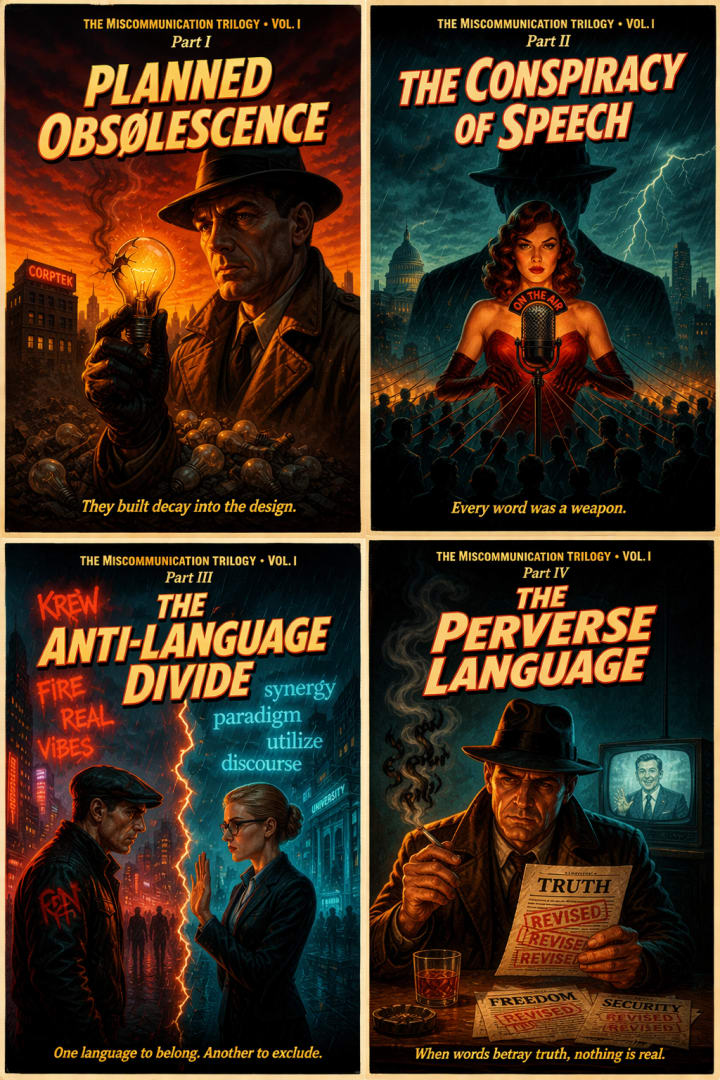
As the third part of Volume I, The Anti-Language Divide plays a crucial structural role within THE MISCOMMUNICATION TRILOGY. The earlier parts establish the planned obsolescence of language and the conspiratorial nature of speech. This book reveals how fragmentation operates from within linguistic systems themselves. It demonstrates that miscommunication is not only imposed from above but generated horizontally across social groups. The divide is embedded in everyday practices.
Critically, the book does not offer simplistic remedies. It does not call for a return to some mythical pure language. Nor does it propose universal standardisation as a solution. Instead, it advocates permeability. Communication requires porous boundaries between linguistic communities. Translation must remain possible.
One might question whether the concept of anti-language risks overextension. If every specialised vocabulary qualifies, does the term lose specificity? Ayolov anticipates this concern by emphasising degrees of insulation. Not all specialised speech produces division. The critical threshold lies where internal coherence becomes exclusionary and reflexive self-critique disappears.
Another potential critique concerns tone. At moments, the book approaches moral urgency. However, this urgency arises from the recognition that linguistic fragmentation underlies broader social polarisation. Ayolov does not exaggerate the stakes; he situates them within observable communicative patterns.
Ultimately, The Anti-Language Divide is less a lament than a diagnostic instrument. It maps the architecture of division without succumbing to despair. Anti-language is shown to be inevitable in complex societies, but its divisive consequences are not predetermined. Awareness can foster translation. Reflection can interrupt automatic reproduction.
The book leaves readers with a demanding but necessary task: to examine the linguistic environments they inhabit. Which words are repeated without scrutiny? Which conceptual frames shape perception unconsciously? Which anti-languages structure professional, political, or personal life?
In addressing these questions, Ayolov extends the trilogy’s central thesis: miscommunication is not a simple failure of information transfer. It is a structural feature of modern linguistic ecosystems. Anti-language is both symptom and mechanism of this condition.
As the third part of Volume I, The Anti-Language Divide confirms the intellectual coherence of THE MISCOMMUNICATION TRILOGY. It advances the project from diagnosis to deeper phenomenological and cognitive analysis. It shows that language does not simply decay; it reorganises itself into insulated clusters. Whether those clusters become sites of creativity or engines of fragmentation depends on the permeability of their boundaries.
In a world increasingly divided not only by opinion but by incompatible semantic frameworks, Ayolov’s work offers an indispensable lens. It reminds readers that every linguistic community constructs reality — and that the possibility of shared reality depends on the fragile art of translation.
About the Creator
Peter Ayolov
Peter Ayolov’s key contribution to media theory is the development of the "Propaganda 2.0" or the "manufacture of dissent" model, which he details in his 2024 book, The Economic Policy of Online Media: Manufacture of Dissent.
Keep reading
More stories from Peter Ayolov and writers in BookClub and other communities.
The Conspiracy of Speech
Breathing Together in an Age of Noise: A Review of The Conspiracy of Speech The Conspiracy of Speech, the second part of Volume I with the same name in THE MISCOMMUNICATION TRILOGY, is an ambitious and penetrating study of how speech itself becomes the engine of distortion in contemporary society. If the earlier theoretical groundwork of the volume diagnosed the structural decay of language, this book moves from structure to performance. It asks not merely how language deteriorates, but how speech actively produces the conditions for misunderstanding, ideological capture, and social fragmentation.
By Peter Ayolovabout 18 hours ago in BookClub
Rachel Reviews: Lakefront Wolves by Joseph Deegan
Meet Finn. He's an 18 year old kid who has potential. He's bright with great school scores and he's also an athlete, a footballer of some prowess. He has it all going for him, it would seem, and yet, he's determined to send what could be a well-planned, stable existence firmly off the rails. He drinks, he smokes, he takes drugs, he has violent tendencies and he's in danger of losing not only his mind but all that he holds dear.
By Rachel Deeming6 days ago in BookClub
The Perks of Being a Wallflower: The Heartbreaking Story That Changed How I See Life, Friendship, and Growing Up
When I first picked up The Perks of Being a Wallflower, I thought I was just reading a coming-of-age story. A few diary entries, teenage angst, friendship drama. Something I could breeze through in an afternoon. But what I discovered was far deeper, far more painful, and far more beautiful than I expected.
By Lukáš Hrdlička6 days ago in BookClub
The Piggy Project
I’ve had so many names in this life I lose track of which ones were ever really mine and which ones I wore because someone needed me to. Some were handed to me before I had words to refuse them, before I knew what they meant, before I knew I could say no. Most weren’t meant to hurt. That doesn’t mean they didn’t leave marks. Marks that told me who I belong to, who I am by way of who claims me, recognizes me in the good and bad, who walks beside me.
By Fatal Serendipity2 days ago in Confessions


Comments
There are no comments for this story
Be the first to respond and start the conversation.