

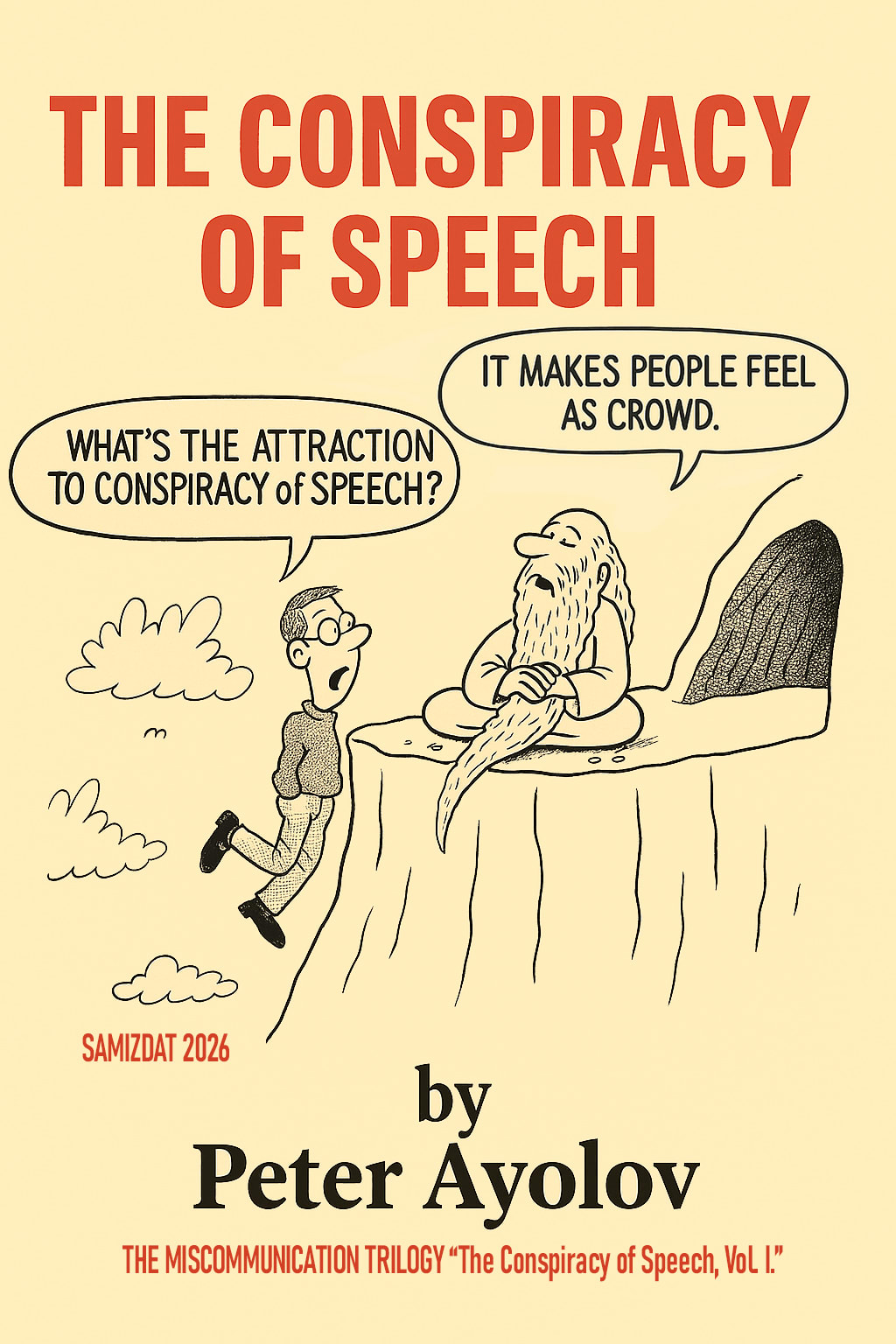
Breathing Together in an Age of Noise: A Review of The Conspiracy of Speech
The Conspiracy of Speech, the second part of Volume I with the same name in THE MISCOMMUNICATION TRILOGY, is an ambitious and penetrating study of how speech itself becomes the engine of distortion in contemporary society. If the earlier theoretical groundwork of the volume diagnosed the structural decay of language, this book moves from structure to performance. It asks not merely how language deteriorates, but how speech actively produces the conditions for misunderstanding, ideological capture, and social fragmentation.
The key conceptual move of the book lies in its reframing of “conspiracy.” Rather than relying on the modern, sensationalised meaning of secret plotting, the term is returned to its etymological origin: con-spirare, to breathe together. Speech is conspiracy in its most basic sense because it creates shared worlds. Every conversation generates a miniature coalition. Every narrative draws boundaries between insiders and outsiders. Language is thus neither neutral nor passive; it is constitutive of community. This insight anchors the entire argument.
The book opens with a diagnosis of a language crisis. Public discourse appears saturated yet hollow. Words proliferate across digital platforms, news cycles, and institutional communication, but comprehension seems to shrink. Ayolov resists simplistic moral panic. He does not blame individuals for stupidity or moral decline. Instead, he identifies systemic pressures that reward emotional intensity, brevity, and spectacle over clarity. In such an environment, nonsense is not accidental. It is structurally incentivised.
The chapter on nonsense and stupidity is particularly sharp. Rather than treating stupidity as a lack of intelligence, Ayolov treats it as a communicative pattern. Repetition without reflection, slogan without argument, performance without substance — these are not personal failings but cultural norms shaped by the architecture of mass communication. The more speech circulates without stable interpretative communities, the more it detaches from accountability.
A central strength of the book lies in its exploration of indoctrination as a linguistic phenomenon. Before institutions control behaviour, they normalise vocabulary. Speech creates mental architecture long before policy codifies belief. By tracing how rhetorical frames become habitual, Ayolov demonstrates that conspiracy need not operate in secrecy. It often unfolds in plain sight through the steady sedimentation of accepted phrases and moralised shorthand.
The section devoted to conspiracies develops this insight further. Rather than dismissing conspiracy theories outright, the book analyses the communicative structures that make them persuasive. Facts, biases, and hegemonic narratives interact in complex ways. Alternative realities gain traction when trust erodes and official language appears hollow. In such contexts, conspiracy speech offers coherence. It restores narrative unity where institutional discourse has fractured. Ayolov’s approach is analytical rather than polemical, and this nuance distinguishes the work from more reactionary treatments of the topic.
Perhaps the most original contribution of the book is its discussion of kayfabe and roleplaying. Borrowed from performance culture, kayfabe refers to staged authenticity — the maintenance of a public persona regardless of private belief. Ayolov argues that political and media actors increasingly operate in this mode. Speech becomes theatrical. Statements are less about persuasion and more about signalling allegiance to a pre-existing audience. In this context, sincerity becomes difficult to detect, and communication transforms into performance addressed to an imagined collective rather than a concrete interlocutor.
The anthropological section on Homo loquens deepens the analysis. Talking is presented as drama — a staging of identity and intention. To speak is to position oneself within a social field. Inner speech mirrors public speech; thought itself becomes shaped by available rhetorical forms. This argument suggests that distorted discourse does not merely misinform; it reshapes cognition. The self internalises the scripts circulating in public space.
One of the most compelling chapters examines small talk and phatic speech. Ayolov resists dismissing banal conversation as trivial. Phatic communication — language used to maintain social bonds rather than transmit information — is shown to be foundational to communal life. However, when banality dominates public discourse, depth erodes. The “evil of banality” is not loud deception but quiet emptiness. Overused phrases lose weight. Repeated outrage becomes ritual. Words cease to carry substance because they function primarily as markers of belonging.
The book’s engagement with power is both subtle and incisive. Speech is not only expressive but regulatory. Corporate jargon, political euphemism, and media framing create environments in which responsibility diffuses. Vagueness protects institutions. Strategic ambiguity shields actors from accountability. In such contexts, language becomes a buffer between action and consequence. The more speech proliferates, the easier it becomes to avoid clarity.
Ayolov’s interdisciplinary reach strengthens the work. Drawing on linguistics, philosophy, media theory, and cultural analysis, he situates speech within technological infrastructure. Digital platforms amplify emotionally charged content and compress discourse into reactive fragments. Algorithms reward engagement, not accuracy. Under such conditions, conspiracy in its original sense — breathing together — becomes fragmented into echo chambers. Communities breathe separately.
Yet the tone of the book is not purely pessimistic. It is diagnostic rather than apocalyptic. By exposing the mechanics of speech as coalition and performance, Ayolov invites responsibility rather than resignation. The repeated question — who speaks, why, and to whom? — functions as an ethical compass. Communication requires scale. It requires interlocutors rather than audiences. It requires the courage to resist purely performative speech.
Stylistically, the book oscillates between analytical precision and rhetorical intensity. At times, its declarative tone borders on aphoristic. This gives the work energy but occasionally risks overstatement. However, the underlying argument remains coherent: speech is both the foundation of community and the instrument of distortion. The tension between these poles gives the book its philosophical depth.
As a contribution to contemporary debates on media and communication, The Conspiracy of Speech is both timely and theoretically grounded. It avoids the trap of technological determinism by showing that distortion arises from human incentives embedded within technological systems. Speech is shaped by platforms, but it is not reducible to them.
In evaluating the book as part of a larger trilogy, one sees its structural importance. If the earlier theoretical groundwork analysed the conditions of linguistic obsolescence, this book animates those conditions in lived discourse. It moves from abstract diagnosis to concrete communicative practice. The transition from structure to performance prepares the reader for further exploration of entropy and fragmentation in subsequent volumes.
Ultimately, The Conspiracy of Speech asks readers to reconsider their participation in public language. Every utterance contributes to a coalition. Every repetition strengthens a frame. Speech is never innocent. Yet it is not irredeemable. The possibility of renewal lies not in silencing language but in re-scaling it — in restoring contexts where accountability and shared understanding can stabilise meaning.
In an era defined by excess communication and diminished trust, Ayolov’s work stands as a serious attempt to map the anatomy of distortion without succumbing to cynicism. It is not a nostalgic plea for a mythical past of pure discourse. It is a sober recognition that language, like any human technology, can serve both connection and control.
If conspiracy originally meant breathing together, the question the book leaves lingering is simple yet urgent: how can communities learn to breathe together again without suffocating under the weight of performance?
About the Creator
Peter Ayolov
Peter Ayolov’s key contribution to media theory is the development of the "Propaganda 2.0" or the "manufacture of dissent" model, which he details in his 2024 book, The Economic Policy of Online Media: Manufacture of Dissent.
Keep reading
More stories from Peter Ayolov and writers in BookClub and other communities.
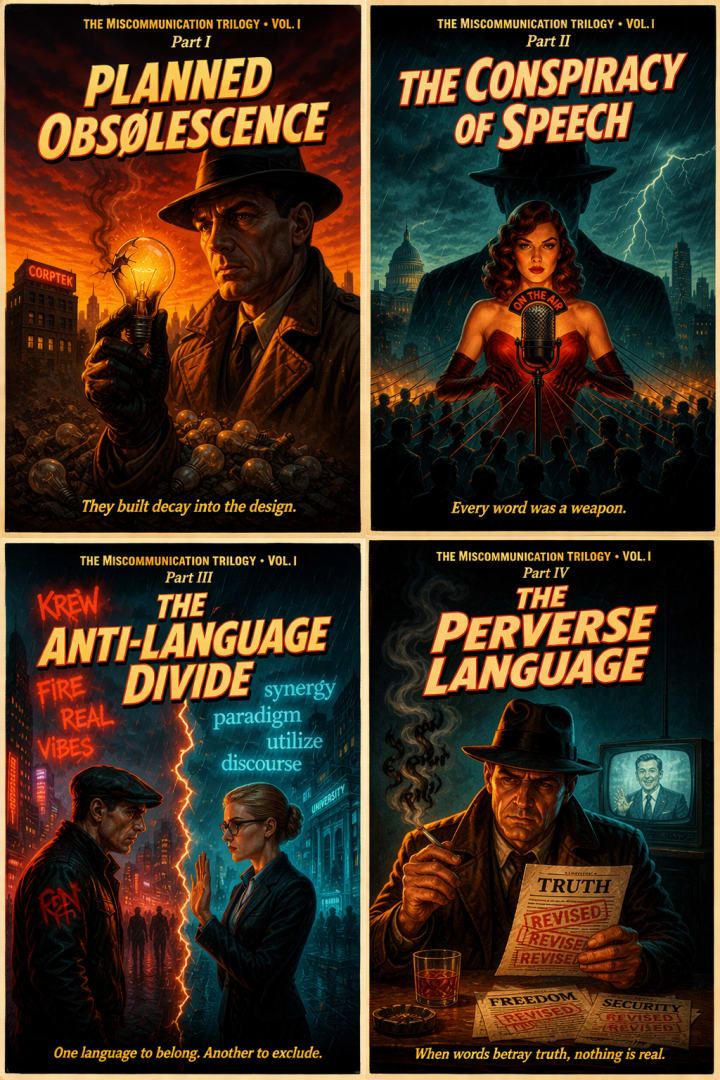
The Planned Obsolescence of Language
Language Against Itself: A Review of The Planned Obsolescence of Language Peter Ayolov’s The Planned Obsolescence of Language, the first part of the first volume The Conspiracy of Speech in THE MISCOMMUNICATION TRILOGY, is an ambitious and intellectually layered investigation into the structural fragility of language in modern mass society. The book does not merely argue that language changes or that public discourse has declined in quality. Its central and more provocative thesis is that language increasingly operates under conditions analogous to planned obsolescence: it is accelerated, simplified, commodified, and strategically exhausted. Words are not simply used; they are consumed. Meaning is not merely shared; it is cycled, branded, and replaced. In this sense, Ayolov reframes the contemporary crisis of communication as systemic rather than accidental.
By Peter Ayolovabout 13 hours ago in BookClub
Rachel Reviews: Lakefront Wolves by Joseph Deegan
Meet Finn. He's an 18 year old kid who has potential. He's bright with great school scores and he's also an athlete, a footballer of some prowess. He has it all going for him, it would seem, and yet, he's determined to send what could be a well-planned, stable existence firmly off the rails. He drinks, he smokes, he takes drugs, he has violent tendencies and he's in danger of losing not only his mind but all that he holds dear.
By Rachel Deeming5 days ago in BookClub
I Reread The Kite Runner—And Discovered a Lifehack for Forgiveness, Growth, and Emotional Strength
When I first read The Kite Runner by Khaled Hosseini, I was moved by the story of Amir and Hassan, their friendship, betrayal, and the haunting impact of past choices. At first, it felt like an emotional journey through Afghan culture and history. Revisiting it as an adult, I realized that hidden within the narrative is a lifehack: the novel teaches lessons about confronting guilt, cultivating resilience, and developing emotional strength that can be applied to everyday life.
By Lukáš Hrdlička7 days ago in BookClub



Comments
There are no comments for this story
Be the first to respond and start the conversation.