
The Planned Obsolescence of Language
Book Review

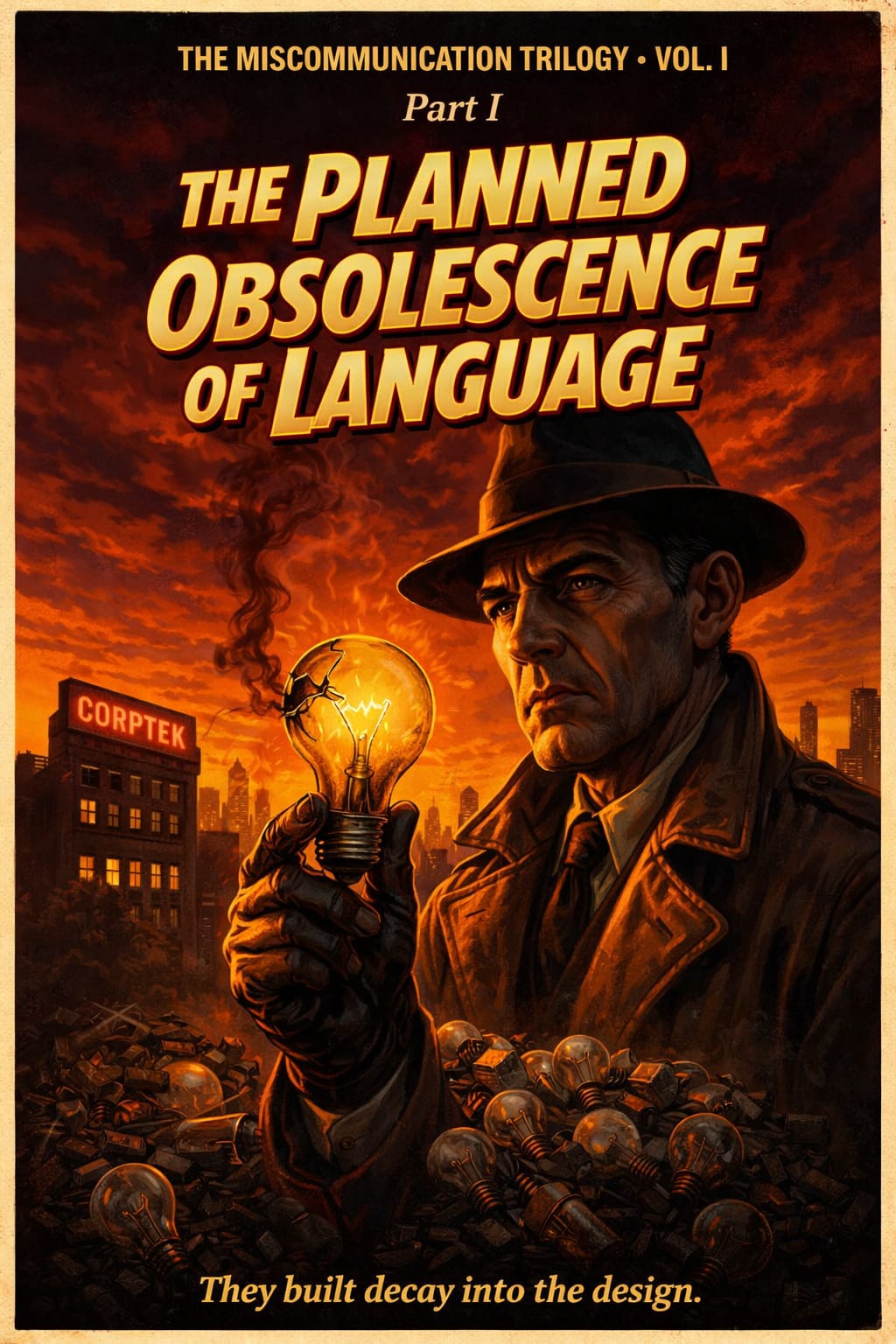
Language Against Itself: A Review of The Planned Obsolescence of Language
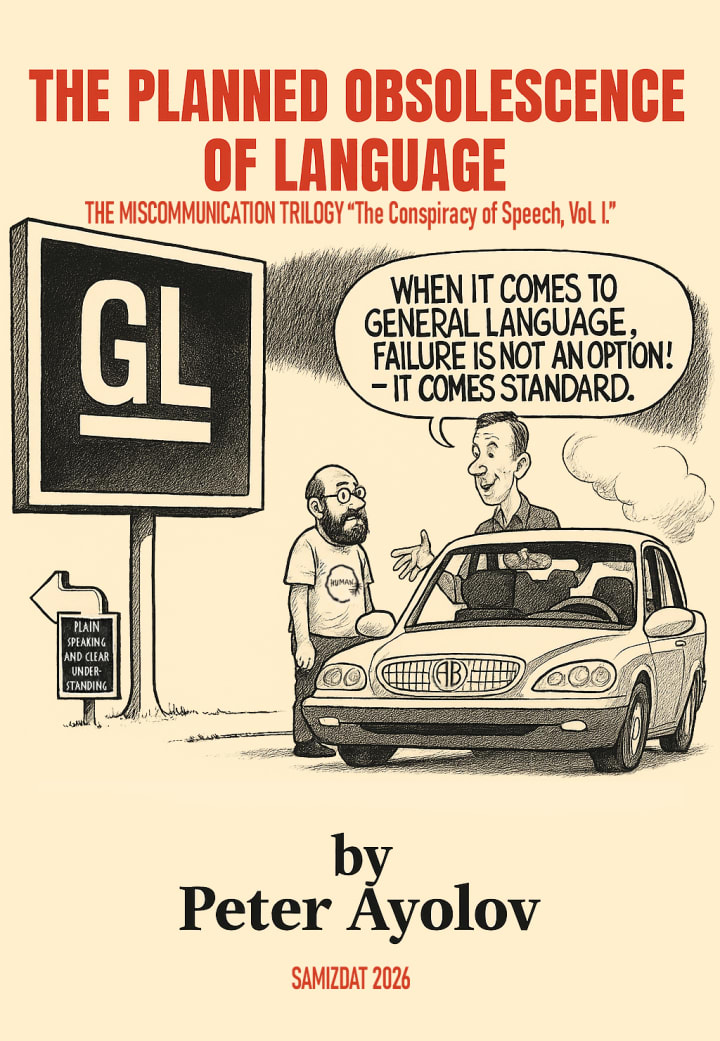
Peter Ayolov’s The Planned Obsolescence of Language, the first part of the first volume The Conspiracy of Speech in THE MISCOMMUNICATION TRILOGY, is an ambitious and intellectually layered investigation into the structural fragility of language in modern mass society. The book does not merely argue that language changes or that public discourse has declined in quality. Its central and more provocative thesis is that language increasingly operates under conditions analogous to planned obsolescence: it is accelerated, simplified, commodified, and strategically exhausted. Words are not simply used; they are consumed. Meaning is not merely shared; it is cycled, branded, and replaced. In this sense, Ayolov reframes the contemporary crisis of communication as systemic rather than accidental.
From the outset, the book challenges the sentimental assumption that language is primarily a transparent vehicle of truth and understanding. Instead, Ayolov situates speech within evolutionary and anthropological frameworks that present language as a coalition-building technology. Homo sapiens emerges not as a detached rationalist but as Homo loquens — the speaking animal whose survival depended on persuasive coordination, alliance formation, and narrative cohesion. This move is crucial, because it destabilizes the moral expectation that language is naturally sincere. If speech evolved to build coalitions rather than to guarantee truth, then distortion is not an aberration but a permanent structural possibility.
The book’s conceptual core lies in its adaptation of the term “planned obsolescence” from industrial design to linguistic culture. In consumer capitalism, products are designed to expire or become unfashionable in order to stimulate continuous consumption. Ayolov argues that contemporary public language follows a similar rhythm. Political slogans, ideological vocabularies, corporate phrases, academic buzzwords, and digital memes circulate rapidly, saturate attention, and then lose force. Their replacement is not accidental; it is structurally incentivized by media cycles, technological acceleration, and economic competition. Language becomes disposable. The lifespan of meaning contracts.
A particularly strong section of the book introduces the concept of semantic equilibrium. For communication to function, language must maintain a delicate balance between stability and flexibility. If meanings are too rigid, language becomes incapable of adapting to new realities. If they are too fluid, mutual understanding collapses. Ayolov contends that digital modernity destabilizes this equilibrium. The speed of information exchange, the compression of discourse into short-form formats, and the constant pressure for novelty erode the stabilizing function of shared definitions. Words no longer settle; they trend.
This leads to what Ayolov calls the miscommunication axiom: once communication extends beyond small, context-rich communities into large-scale mediated systems, misunderstanding becomes structural rather than exceptional. In intimate groups, shared background knowledge compensates for ambiguity. In mass society, abstraction magnifies distortion. Communication becomes detached from the interpersonal accountability that once anchored meaning. The more communication expands, the less comprehension can be assumed.
The book’s exploration of the origin and evolution of speech further deepens its thesis. Drawing on evolutionary linguistics and anthropology, Ayolov examines how collective fictions, social imagination, and symbolic coordination shaped early human communities. Language is portrayed as the engine of shared reality construction. Myths, moral codes, identities, and institutions depend on narrative cohesion. Yet this very power makes language susceptible to capture. When narrative becomes infrastructure, it becomes governable.
Ayolov engages a wide range of thinkers — Gregory Bateson, Daniel Dor, Robin Dunbar, Daniel Everett, Wittgenstein, and Fritz Mauthner among others — not as ornamental citations but as conceptual interlocutors. His dialogue with Wittgenstein is especially important. The insistence on clarity, the limits of expression, and the connection between meaning and use resonate throughout the argument. Yet Ayolov modifies the Wittgensteinian caution by suggesting that in mass systems the very conditions for meaningful use are transformed. When words circulate without stable communities of interpretation, their use fragments.
One of the book’s strengths lies in its refusal to isolate linguistic theory from political economy. Language is not treated as an autonomous system of grammar and semantics; it is embedded within media infrastructures, corporate incentives, technological platforms, and ideological battles. The paradigm of communication itself becomes suspect. Political propaganda, advertising, branding, and digital virality produce linguistic environments in which clarity is often counterproductive. Strategic ambiguity, euphemism, emotional amplification, and sloganization are rewarded.
The discussion of doublespeak and corporate jargon is particularly incisive. Ayolov does not merely criticize vague language; he demonstrates how vagueness functions strategically. In bureaucratic and corporate contexts, ambiguity distributes responsibility and shields institutions from accountability. Language becomes a buffer between action and consequence. Similarly, political discourse increasingly operates through moralized shorthand rather than substantive argument. Words signal allegiance before they convey information.
Yet the book avoids simplistic nostalgia. It does not claim that there was once a golden age of pure speech. Instead, it argues that technological acceleration intensifies preexisting vulnerabilities. Language has always contained the potential for manipulation; what is new is the scale, speed, and automation of distortion. Social media platforms compress discourse into reactive fragments. Algorithms amplify emotionally charged content. Information abundance paradoxically reduces discernment. Under such conditions, complexity becomes inefficient.
Another compelling dimension of the book is its treatment of anti-languages and specialized codes. Academic jargon, corporate speech, and online slang are analyzed as forms of linguistic segmentation. These codes create in-groups and out-groups, reinforcing social stratification. Communication appears abundant, yet mutual intelligibility declines. Ayolov suggests that fragmentation is not simply diversity; it can become structural division.
The philosophical sections of the book extend this argument inward, into cognition and selfhood. Inner speech, moral vocabulary, and identity formation are shown to depend on available linguistic frameworks. If public language is distorted, private thought cannot remain untouched. The erosion of linguistic integrity thus has psychological consequences. The self becomes entangled in performative scripts, repeating socially approved formulas rather than articulating authentic perception.
Importantly, Ayolov does not conclude with fatalism. While the diagnosis is severe, the book gestures toward recovery. Clarity, sincerity, and mindful communication are proposed as counterforces. The emphasis is not on silencing speech but on recalibrating scale — restoring contexts in which accountability and shared reference can stabilize meaning. The argument is subtle: language cannot be purified, but it can be disciplined.
As a scholarly contribution, The Planned Obsolescence of Language is notable for its interdisciplinary scope. It bridges linguistics, media studies, philosophy of language, political theory, and cultural analysis. The prose oscillates between analytical rigor and rhetorical urgency, reflecting the book’s dual function as diagnosis and warning. At times the breadth of references risks conceptual density, yet the central thesis remains coherent throughout.
The book’s originality lies less in inventing entirely new categories than in synthesizing them into a systemic model. Planned obsolescence becomes not a metaphor but a structural analogy that illuminates the economic and technological pressures shaping language. By connecting evolutionary anthropology to digital media ecosystems, Ayolov constructs a narrative arc that stretches from the prehistoric campfire to the algorithmic feed.
Critically, some readers may question whether linguistic decay is overstated or whether simplification necessarily entails loss. Language has always adapted, and new forms can generate new expressivity. Ayolov acknowledges this tension but maintains that acceleration alters the qualitative experience of communication. The concern is not change itself but the erosion of durable semantic anchors.
In evaluating the book as the opening movement of a trilogy, one sees how it establishes groundwork for further development. If this first part diagnoses the structural conditions of obsolescence, subsequent volumes are positioned to explore entropy and fragmentation in greater depth. The trajectory suggests a movement from diagnosis toward civilizational metaphor.
Ultimately, The Planned Obsolescence of Language compels readers to reconsider their relationship to words. It reframes everyday discourse as an ecological system subject to depletion. Meaning is not infinite; it requires maintenance. Communication is not guaranteed; it depends on shared commitments that mass systems strain.
In an age saturated with speech yet starved of understanding, Ayolov’s work functions as both critique and call to vigilance. It does not promise linguistic salvation, but it insists that awareness is the first defense against decay. If language is the infrastructure of shared reality, then its obsolescence is not a minor inconvenience but a civilizational risk.
About the Creator
Peter Ayolov
Peter Ayolov’s key contribution to media theory is the development of the "Propaganda 2.0" or the "manufacture of dissent" model, which he details in his 2024 book, The Economic Policy of Online Media: Manufacture of Dissent.
Keep reading
More stories from Peter Ayolov and writers in BookClub and other communities.
The Miscommunication Trilogy
Conspiracy Completed: Language on Trial Peter Ayolov in The Conspiracy of Speech, Vol. I (2026) opens THE MISCOMMUNICATION TRILOGY with a book that reads less like a single argument than like a deliberately constructed pressure system: language is placed under historical, biological, social, and moral stress until its everyday ‘normality’ begins to look like the strangest thing humans ever agreed to treat as obvious. The volume’s four-part architecture matters because it stages a descent, not into silence, but into the conditions that make silence desirable again. If the trilogy promises two future movements, The Entropy of Communication, Vol. II and The Tower of Babble, Vol. III, this first volume functions as the founding diagnosis: before one can speak about entropy or babble, one has to show how speech itself can become conspiratorial even when nobody is ‘conspiring’ in the cinematic sense. That conceptual move is the book’s signature: conspiracy is widened from clandestine plotting into the deeper fact that language is coalition-forming, status-sensitive, power-bearing, and therefore structurally vulnerable to capture, ritualisation, and decay. Volume I is not only an inquiry into how communication fails; it is also a study in how modern societies normalise failure and rename it ‘connectivity’, ‘engagement’, or ‘participation’. The result is a text that positions miscommunication not as an accident that interrupts the system, but as a systemic product that can be manufactured, rewarded, and reproduced with industrial efficiency.
By Peter Ayolovabout 5 hours ago in BookClub
Rachel Reviews: Lakefront Wolves by Joseph Deegan
Meet Finn. He's an 18 year old kid who has potential. He's bright with great school scores and he's also an athlete, a footballer of some prowess. He has it all going for him, it would seem, and yet, he's determined to send what could be a well-planned, stable existence firmly off the rails. He drinks, he smokes, he takes drugs, he has violent tendencies and he's in danger of losing not only his mind but all that he holds dear.
By Rachel Deeming5 days ago in BookClub
I Reread Wuthering Heights—And Discovered a Lifehack for Passion, Boundaries, and Emotional Mastery
When I first read Wuthering Heights by Emily Brontë, I was captivated by the stormy landscapes, intense passions, and tragic love story of Heathcliff and Catherine. At first, it felt like a Gothic tale of doomed romance and revenge. Revisiting it as an adult, however, revealed a hidden lifehack: the novel teaches crucial lessons about managing emotions, setting personal boundaries, and navigating toxic dynamics while maintaining self-awareness and personal growth.
By Lukáš Hrdlička7 days ago in BookClub
Review of 'Man on the Run'
My wife and I saw Man on the Run, a nearly 2-hour documentary on Amazon Prime, about Wings, Paul McCartney's group that flew around the world from shortly after The Beatles broke up in early 1970 to shortly after John Lennon was murdered at the end of 1980, making a Beatles reunion forever impossible.
By Paul Levinson5 days ago in Beat


Comments
There are no comments for this story
Be the first to respond and start the conversation.