
The Miscommunication Trilogy
“The Conspiracy of Speech, Vol. I.”

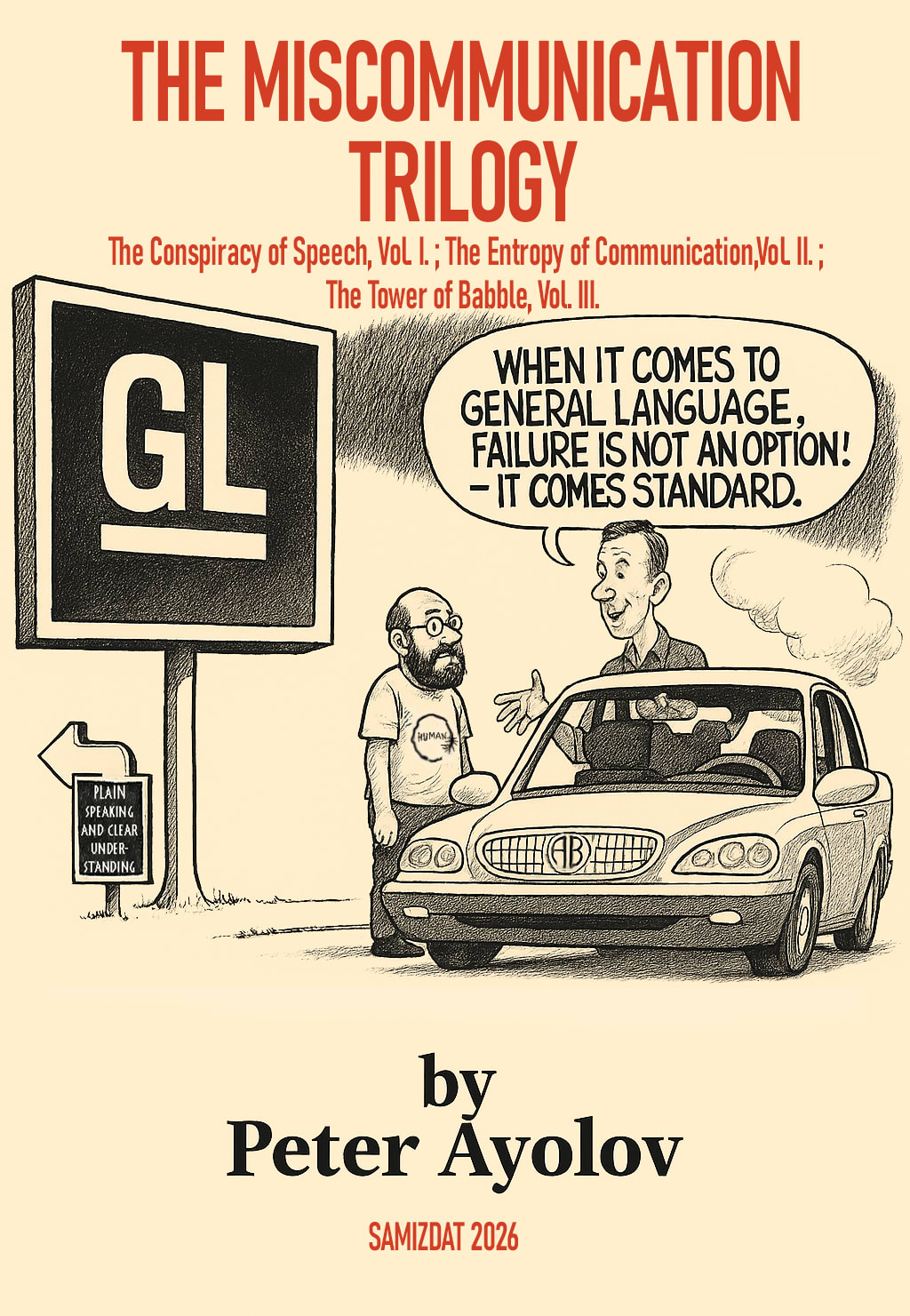
Conspiracy Completed: Language on Trial
Peter Ayolov in The Conspiracy of Speech, Vol. I (2026) opens THE MISCOMMUNICATION TRILOGY with a book that reads less like a single argument than like a deliberately constructed pressure system: language is placed under historical, biological, social, and moral stress until its everyday ‘normality’ begins to look like the strangest thing humans ever agreed to treat as obvious. The volume’s four-part architecture matters because it stages a descent, not into silence, but into the conditions that make silence desirable again. If the trilogy promises two future movements, The Entropy of Communication, Vol. II and The Tower of Babble, Vol. III, this first volume functions as the founding diagnosis: before one can speak about entropy or babble, one has to show how speech itself can become conspiratorial even when nobody is ‘conspiring’ in the cinematic sense. That conceptual move is the book’s signature: conspiracy is widened from clandestine plotting into the deeper fact that language is coalition-forming, status-sensitive, power-bearing, and therefore structurally vulnerable to capture, ritualisation, and decay. Volume I is not only an inquiry into how communication fails; it is also a study in how modern societies normalise failure and rename it ‘connectivity’, ‘engagement’, or ‘participation’. The result is a text that positions miscommunication not as an accident that interrupts the system, but as a systemic product that can be manufactured, rewarded, and reproduced with industrial efficiency.
Part I, THE PLANNED OBSOLESCENCE OF LANGUAGE, provides the conceptual chassis: the claim is not simply that language changes, simplifies, or evolves, but that modern conditions increasingly treat language as something designed to wear out, to be replaced, to be refreshed and rebranded. This is the book’s first major rhetorical strength: it takes a term from consumer capitalism and technical design and turns it into a cultural-communicative hypothesis. ‘Dark side of language’ establishes the mood by refusing sentimental views of speech as naturally cooperative and benign. Speech is shown as a medium of bonding, yes, but also of domination, exclusion, performative virtue, performative cruelty, and the everyday coercions of social life. ‘Necessity of obsolescence’ then frames decline not only as loss but also as functional: societies often need linguistic shortcuts, slogans, and simplified codes to coordinate at scale, yet that very necessity becomes a pathway for the corrosion of nuance. ‘Semantic equilibrium’ and ‘Miscommunication axiom’ push the argument from moral complaint into something closer to a systemic model: meanings stabilise only temporarily, and miscommunication is not a rare glitch but a permanent baseline that institutions exploit. The sequence ‘Language of wisdom and folly’ gives the theoretical core a moral edge: if language carries wisdom, it also carries folly, and the two are often indistinguishable in public life because both can sound equally confident. From there, the section ‘ORIGIN OF SPEECH’ uses the ‘Talking ape’ frame to keep the argument grounded in human animals rather than disembodied ‘language systems’. The emphasis on ‘Collective fictions’ and ‘Social imagination’ is crucial: the book insists that humans do not simply exchange information; humans coordinate belief, belonging, and status through shared narratives. This becomes the bridge to ‘EVOLUTION OF LANGUAGE’, where ‘Rise and fall of language’ introduces a civilisational rhythm: linguistic complexity can accumulate, but it can also be thinned by speed, scale, and the incentives of mass mediation. The inclusion of ‘Moral progress’ is an important wager because it refuses the lazy conclusion that language decline is only decadence; instead, it suggests that moral vocabularies can expand even as communicative forms degrade, creating a paradox where societies talk more about justice while becoming less capable of sustained, precise, or sincere dialogue. In ‘GENESIS THEORIES’, the named figures function like intellectual test points rather than decorative citations: Gregory Bateson, Daniel Dor, Robin Dunbar, and Daniel Everett indicate that the book is not trapped in one origin myth but wants to triangulate language as ecology, tool, coalition practice, and cultural invention. ‘LINGUISTIC THEORIES’ then widens the field: ‘From logos to langue’ signals a move from metaphysical and rhetorical traditions into structural and modern linguistic frames, while ‘Death of the text’ and ‘Universal grammar’ place the volume in direct conversation with debates about whether language is primarily cultural artefact, biological endowment, or something that collapses the moment one treats ‘text’ as stable meaning. The concluding ‘PARADIGMS OF COMMUNICATION’ is where Part I becomes openly political: ‘Power and control’ makes the book’s governing suspicion explicit, ‘Deception and manipulation’ insists that distortion is not accidental but often strategic, and ‘Paradigm change’ positions planned obsolescence as historically contingent, not an eternal human fate. As a standalone unit, Part I reads like an interdisciplinary preface that is unusually disciplined: it does not wander into unrelated spectacle; it keeps returning to the same hard claim that modernity is altering not only what people say but the lifespan, durability, and credibility of saying itself.
Part II, THE CONSPIRACY OF SPEECH, is the volume’s argumentative engine because it turns the abstract chassis into a social diagnosis of contemporary discourse. The preface section begins by naming the crisis in plain terms: ‘The language crisis’, ‘Nonsense and stupidity’, ‘Language and evil’, ‘Pathology of indoctrination’, ‘Creating conspiracy’. What stands out here is the refusal to treat ‘stupidity’ as an insult or as a mere cognitive limitation; it is treated as a communicative condition, a patterned outcome of environments where incentives reward repetition, aggression, and identity performance over clarity. ‘Language and evil’ is also handled in a way that suggests the book’s deeper anthropology: evil is not only in actions; evil can be in the communicative forms that make cruelty socially acceptable, that make dehumanisation feel like ordinary participation. The chapter ‘CONSPIRACIES’ then provides a threefold frame: ‘Facts, biases and hegemony’ acknowledges that truth is not absent but contested inside power relations; ‘Conspiracy speech’ suggests that conspiratorial discourse is a genre with recognisable moves; and ‘Kayfabe and roleplaying’ is the sharp contemporary twist, describing public life as staged conflict in which sincerity becomes a liability and performance becomes the default currency. This is the book’s most timely conceptual contribution: it does not merely denounce propaganda; it analyses the theatrical social logic that makes propaganda enjoyable, shareable, and identity-confirming. ‘HOMO LOQUENS’ deepens this by returning to the speaking animal: ‘Drama of talking’ treats speech as dramaturgy, ‘Speaking into the air’ names the mass-mediated condition where address loses a concrete recipient, and ‘Modalities of thought’ implies that thinking itself is reshaped when language becomes public performance. Finally, ‘SMALL TALK’ looks deceptively modest but is actually devastating: ‘Phatic speech’ and ‘Banal speech’ show how the ordinary glue of social life can become the solvent of meaning when it expands into a total communicative environment, and ‘The evil of banality’ folds ethical critique into everyday interaction. The brilliance of Part II is that it makes conspiracy ordinary: it argues that modern discourse can become conspiratorial without secret meetings because the system trains people into scripted roles, and roles produce predictable utterances. In that sense, the conspiracy is not only ‘out there’ in institutions; it is inside the habits of talk.
Part III, THE ANTI-LANGUAGE DIVIDE, is where the volume becomes most philosophically ambitious while staying anchored in social observation. ‘ANTI-LANGUAGES’ begins by mapping the counter-speech that grows inside institutional and corporate ecosystems: ‘Jargon’, ‘Slang and smart talk’. The phrase ‘divide’ matters because the book is not simply condemning jargon; it is marking a social separation where specialised codes become gates, badges, and weapons. One of the book’s strongest implicit claims emerges here: when language becomes a class marker, communication becomes a status game, and the cost is mutual intelligibility. ‘COGNITION’ then turns inward: ‘Thinking’, ‘Inner speech’, ‘Righteous words’ suggests that the language crisis is not only public; it is private. Inner speech can become colonised by moralised scripts, and ‘righteous’ vocabulary can pre-load judgement before perception. ‘PHENOMENOLOGY’ extends this by treating language as experience, not only as a tool: ‘The language phenomenon’, ‘The language of self’, ‘Psychophenomenology’ implies that miscommunication is tied to the formation of selfhood, that the self is partly a linguistic event, and that distorted language produces distorted selves. The ‘PHILOSOPHY’ section signals the volume’s intellectual range, but the crucial point is not name-dropping; it is the insistence that ‘meaning’ is not a neutral container but a contested outcome. ‘LANGUAGING’ and ‘Sociolinguistics’ reposition language as activity and environment, while ‘Applied linguistics’ pulls the theory back toward practice. The ‘RHETORIC’ chapter makes the political stakes explicit again: ‘From Gorgias to Derrida’ frames rhetoric as a lineage of persuasion and suspicion, ‘Rhetoric of power’ describes how institutions speak to manage perception, and ‘Corporate jargon’ functions as a contemporary case where language is engineered to dissolve responsibility and inflate legitimacy. ‘WRITING’ closes the part with a provocative reversal: in a book about speech, writing becomes a refuge and a problem at once. ‘Written language’ and ‘Art of writing’ suggest that inscription can preserve complexity, but ‘How to avoid speaking?’ hints at a modern desire to withdraw from the polluted atmosphere of talk. Part III therefore functions as the volume’s hinge: it shows that the crisis is not only in public discourse but in the very border between authentic expression and anti-language systems that reproduce hierarchy.
Part IV, THE PERVERSE LANGUAGE, is the ethical culmination, and it reads like a taxonomy of distortions that have become normalised as ‘how communication works’. ‘MISCOMMUNICATION’ returns with ‘Mass miscommunication’ and ‘Biased language’ to restate the core claim: the volume is not analysing individual misunderstandings; it is diagnosing an environment. The triad ‘LYING’, ‘HYPOCRISY’, and ‘DECEPTION’ is handled not as a moral lecture but as a structural analysis of incentives: ‘Why we lie?’ and ‘Conspicuous dishonesty’ names the contemporary shift where dishonesty becomes performative rather than hidden; ‘Organized hypocrisy’ suggests that hypocrisy is not personal weakness but institutional method; ‘Science fraud’ and ‘Overproduction of truth’ is especially incisive because it refuses the simple binary of truth versus lies and instead points to a modern pathology where truth claims proliferate so wildly that credibility collapses under abundance. The inclusion of ‘HERMENEUTICS’ is strategic: interpretation is not a clean solution; it is another site of struggle. ‘Typology’ signals the need to classify distortions, but classification itself is precarious because distorted systems can absorb critique as content. ‘OBFUSCATION’ then gives the volume some of its most original texture: ‘Grammaticalisation’ and ‘Lexical nonsense’ connect technical linguistic processes to social effects, suggesting that meaning can be drained not only by propaganda but by the incremental transformations of form that make language more automated, more template-like, more predictable. ‘The limits of words’ returns the reader to the philosophical edge where one is forced to admit that language cannot carry everything, and that pretending it can is part of the disorder. ‘HYPERNORMALISATION’ then names the final atmosphere: communication becomes distorted yet accepted as reality. ‘Dehumanising language’ seals the moral argument: when people become labels, categories, and functions, miscommunication becomes not only error but harm. The final ‘DISCOMMUNICATION’ conclusion is a powerful endpoint because it does not offer a cheap redemption narrative; it proposes a new name for the condition, as if the existing vocabulary is already too compromised to describe the crisis. The book’s closing movement towards ‘Language and sanity’ is perhaps the most personal, even if written in a scholarly register: sanity becomes not a clinical state but a communicative possibility, a way of inhabiting language without being inhabited by its perverse incentives.
As a long-form work, The Conspiracy of Speech, Vol. I succeeds because it refuses the false comfort of a single-cause explanation. It does not claim that technology alone ruins language, or that politics alone corrupts truth, or that capitalism alone commodifies speech. Instead it maps a convergent system: coalition speech, mass mediation, institutional incentives, status performance, and moralised identity codes interact to produce planned obsolescence as an emergent condition. The volume’s greatest strength is structural: the four parts move from macro genealogy to contemporary conspiracy dynamics, then to the anti-language systems that split publics into mutually unintelligible codes, and finally to the perverse moral economy of modern discourse. This progression also clarifies what the next volumes are positioned to do. If Vol. I establishes the conspiratorial nature of speech as coalition and performance, Vol. II, The Entropy of Communication, can develop the thermodynamics of the system: how disorder grows, how attention scarcity and information overload accelerate drift, how communication loses energy as it circulates, how ‘more speech’ yields less meaning. Vol. III, The Tower of Babble, can then stage the civilisational metaphor: not merely that people disagree, but that language fragments into incompatible micro-realities, with ideology, obscenity, and hypernormality producing a world where speaking becomes noise and noise becomes governance. In this way, Vol. I is not simply ‘the first book’; it is the book that earns the trilogy’s right to exist, because it shows that miscommunication is not a theme but a system, and that language decline is not only cultural pessimism but a describable architecture of incentives, forms, and habits. What remains most compelling is the book’s final ethical pressure: the implicit wager that salvation, if the word is allowed at all in a secular diagnosis, will not arrive through louder discourse, better slogans, or smarter performance, but through a return to accountable address, fewer words, and the disciplined ability to refuse the scripts that make speech feel powerful while making understanding impossible.
About the Creator
Peter Ayolov
Peter Ayolov’s key contribution to media theory is the development of the "Propaganda 2.0" or the "manufacture of dissent" model, which he details in his 2024 book, The Economic Policy of Online Media: Manufacture of Dissent.
Keep reading
More stories from Peter Ayolov and writers in BookClub and other communities.
Bablos and Freedom
Bablos and Freedom: The Political Economy of Will in Victor Pelevin’s Empire V In the English translation of Victor Pelevin’s novel Empire V by Andrew Bromfield, several key philosophical terms become central to understanding the strange political economy that structures the world of the vampires. Among them are three concepts that define the architecture of power in the novel: Will, Freedom, and Bablos. These terms are not merely linguistic curiosities or problems of translation; they form the philosophical backbone of Pelevin’s satire of modern capitalism. By transforming street slang and everyday political vocabulary into metaphysical categories, Pelevin constructs a disturbing vision of contemporary society in which money becomes a condensed form of human life and freedom becomes the mechanism through which that life is extracted.
By Peter Ayolova day ago in BookClub
Rachel Reviews: Lakefront Wolves by Joseph Deegan
Meet Finn. He's an 18 year old kid who has potential. He's bright with great school scores and he's also an athlete, a footballer of some prowess. He has it all going for him, it would seem, and yet, he's determined to send what could be a well-planned, stable existence firmly off the rails. He drinks, he smokes, he takes drugs, he has violent tendencies and he's in danger of losing not only his mind but all that he holds dear.
By Rachel Deeming5 days ago in BookClub
The Perks of Being a Wallflower: The Heartbreaking Story That Changed How I See Life, Friendship, and Growing Up
When I first picked up The Perks of Being a Wallflower, I thought I was just reading a coming-of-age story. A few diary entries, teenage angst, friendship drama. Something I could breeze through in an afternoon. But what I discovered was far deeper, far more painful, and far more beautiful than I expected.
By Lukáš Hrdlička5 days ago in BookClub


Comments
There are no comments for this story
Be the first to respond and start the conversation.