
Musa al-Sadr: Has a Body Found in a Secret Morgue Finally Solved a 50-Year-Old Mystery?
The enduring enigma of the Lebanese Shia leader’s disappearance in Libya and the recent claims that may rewrite a chapter of Middle Eastern history.

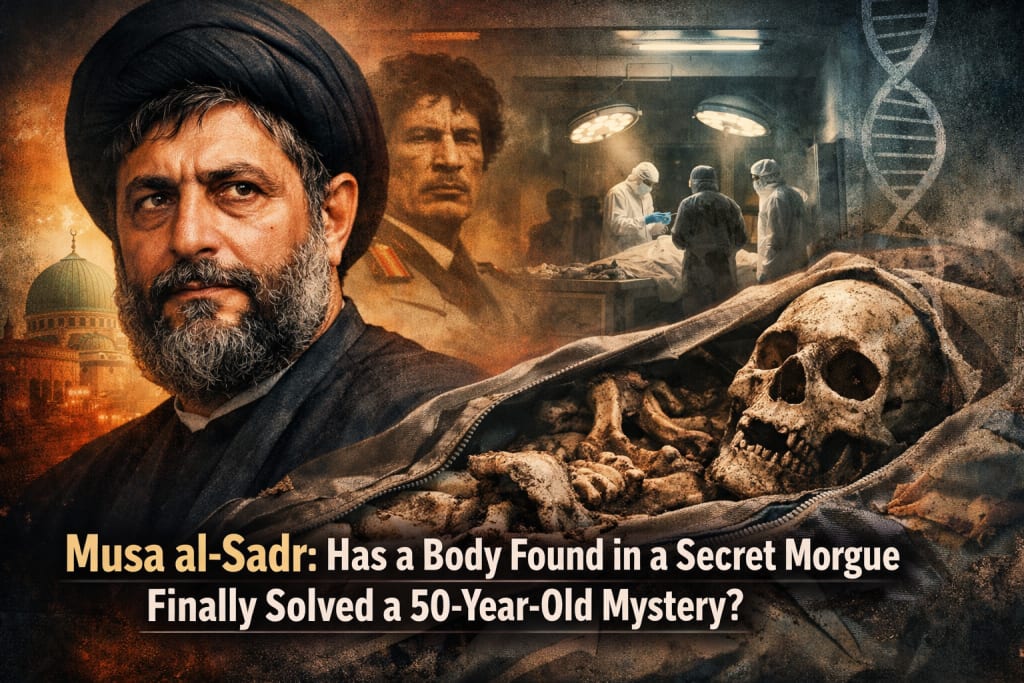
In the turbulent politics of the Middle East, few disappearances have generated as much intrigue, grief, and speculation as that of Musa al-Sadr. The charismatic Lebanese Shia cleric vanished in 1978 during an official visit to Libya, and for nearly five decades his fate has remained one of the region’s most haunting mysteries. Now, new claims about human remains discovered in a secret morgue have reignited debate: could this finally be the evidence that confirms what happened to him?
### A Rising Religious and Political Force
Born in 1928 in Iran to a distinguished clerical family, Musa al-Sadr moved to Lebanon in 1959, where he quickly became a leading voice for the marginalized Shia community. At the time, Lebanon’s political system largely sidelined Shia Muslims economically and politically. Through his eloquence, organizational skill, and moderate vision, al-Sadr emerged as both a spiritual guide and a political advocate.
In 1974, he founded the Movement of the Deprived, which later evolved into the Amal Movement, a major Shia political party in Lebanon. He called for interfaith harmony in a country fractured by sectarian tensions, and during the early years of the Lebanese Civil War, he advocated national unity and reform rather than division. His leadership style blended religious authority with pragmatic politics, making him a unique and influential figure.
### The Trip to Libya
In August 1978, al-Sadr traveled to Libya at the invitation of Muammar Gaddafi. He was accompanied by two associates, Sheikh Muhammad Yaacoub and journalist Abbas Badreddine. The visit was officially described as a diplomatic mission to discuss Arab unity and regional issues.
However, after August 31, 1978, the three men were never seen again.
Libyan authorities at the time claimed that al-Sadr and his companions had left Libya for Italy. Italian investigations later concluded that they had never entered the country. Suspicion quickly focused on Gaddafi’s regime, and many in Lebanon accused Libyan authorities of detaining — or killing — the cleric.
The disappearance sent shockwaves through Lebanon. Supporters believed al-Sadr was still alive and imprisoned, while others suspected he had been executed shortly after a heated exchange with Gaddafi. The absence of a body or concrete evidence allowed hope and conspiracy theories to coexist for decades.
### Decades of Uncertainty
After Gaddafi was overthrown and killed in 2011 during the Libyan uprising, expectations rose that long-hidden secrets would finally come to light. Lebanon repeatedly called for cooperation from post-Gaddafi Libyan authorities. Investigations uncovered prisons and secret detention centers, but no definitive proof of al-Sadr’s fate emerged.
Over the years, various reports claimed that he had been seen alive in Libyan prisons well into the 1980s. Some suggested he was executed shortly after his disappearance. Yet without physical evidence, the mystery endured.
For many Lebanese Shia, Musa al-Sadr became more than a missing leader — he became a symbol of injustice and unresolved history. His portrait still hangs in homes and political offices, and his disappearance remains a powerful emotional and political issue.
### The Secret Morgue Discovery
Recently, reports surfaced about human remains allegedly found in a previously undisclosed morgue or detention facility in Libya. According to these accounts, forensic teams discovered skeletal remains that could date back decades. Speculation quickly spread in Lebanese and regional media that the remains might belong to al-Sadr.
If verified, such a discovery would be historic. Modern forensic science, including DNA testing, could potentially confirm the identity of the remains by comparing them with surviving relatives. This would provide the first concrete evidence in a case long defined by absence.
However, caution remains essential. So far, there has been no official confirmation that the remains belong to Musa al-Sadr. Investigations are complex, especially given Libya’s continued political instability and fragmented institutions. Access to archives, witnesses, and reliable documentation remains limited.
### Why the Mystery Matters
The significance of al-Sadr’s disappearance goes far beyond one individual. His absence reshaped Lebanese politics. After 1978, the Amal Movement continued under new leadership, and later the rise of Hezbollah transformed the political and military landscape of Lebanon’s Shia community.
Had al-Sadr returned, Lebanon’s history might have unfolded differently. Many observers believe his moderate stance and emphasis on coexistence could have influenced the trajectory of sectarian conflict. His disappearance created a leadership vacuum during one of the most critical periods in Lebanese history.
Moreover, the case symbolizes the broader culture of impunity that characterized parts of the Middle East during the Cold War era. Enforced disappearances, secret prisons, and opaque state practices were not uncommon. Solving the al-Sadr mystery would represent not only closure for his family and followers but also a rare moment of accountability.
### Closure or Continued Mystery?
As of now, the claim that remains found in a secret morgue belong to Musa al-Sadr remains unproven. Forensic verification, official cooperation between Lebanon and Libya, and transparent reporting will be crucial.
If the remains are confirmed to be his, it would end nearly 50 years of speculation. It would allow for a proper burial and perhaps bring a measure of peace to a wound that has lingered across generations.
But if the remains do not match, the mystery will continue — a reminder of how unresolved chapters of history can shape politics and memory long after the events themselves have passed.
For now, the question remains open: has the discovery finally solved one of the Middle East’s most enduring enigmas, or is Musa al-Sadr’s fate still hidden in the shadows of history?
About the Creator
Irshad Abbasi
Ali ibn Abi Talib (RA) said 📚
“Knowledge is better than wealth, because knowledge protects you, while you have to protect wealth.
Keep reading
More stories from Irshad Abbasi and writers in Chapters and other communities.
The $55 Billion B-29: The Engineering Marvel That Became a Terrifying Weapon of Mass Destruction
When the **B-29 Superfortress** rolled off American assembly lines during World War II, it represented one of the most ambitious and expensive military engineering projects in history. Costing nearly $3 billion in the 1940s—equivalent to roughly $55 billion today—the aircraft was more expensive to develop than the Manhattan Project that produced the atomic bomb it would eventually carry. Built by the United States to secure air superiority in the Pacific, the B-29 became both an engineering masterpiece and a symbol of devastating destructive power.
By Irshad Abbasi about 7 hours ago in Chapters
US and Israel’s War with Iran: Preemptive Strike or War of Choice? Global Risks, Regime Change, and Middle East Crisis
The decision by the United States and Israel to plunge into a new war with Iran has pushed the global landscape toward extremely dangerous and unpredictable consequences. Israel has attempted to justify its attack by describing it as a “preemptive action.”
By Real content5 days ago in Chapters


Comments
There are no comments for this story
Be the first to respond and start the conversation.