
Mount Sinai, the World’s Oldest Monastery, and the Prophet’s Letter: Faith, History, and a Controversial Development Plan
At a sacred site revered by Muslims, Christians, and Jews alike, an ambitious modernization project has stirred debate after reports of graves being relocated—raising questions about heritage, memory, and the cost of progress.

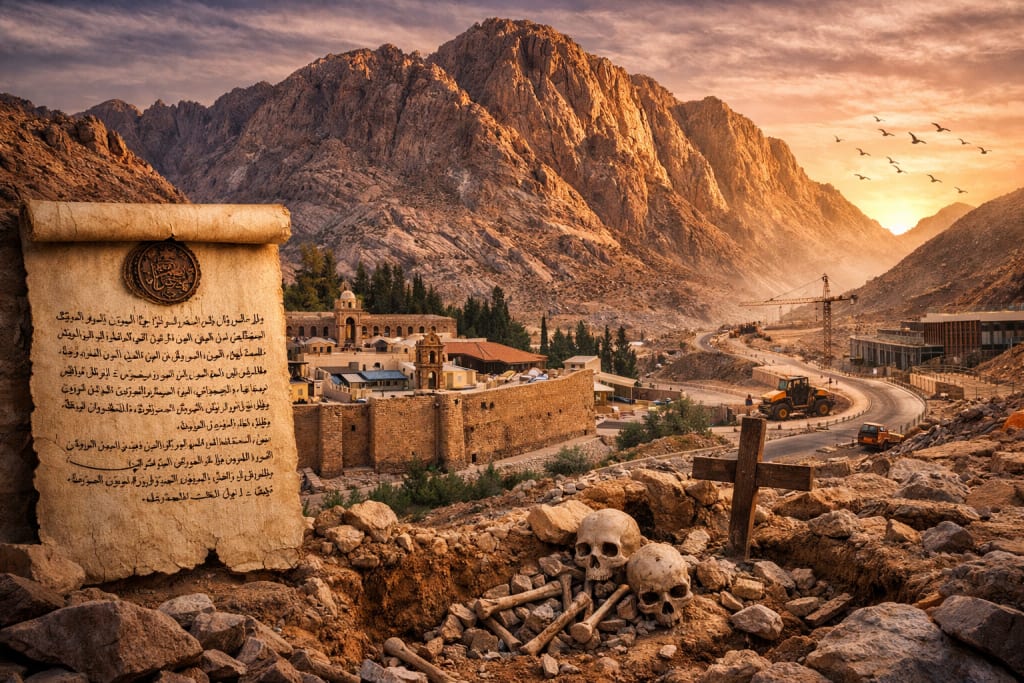
At a sacred site revered by Muslims, Christians, and Jews alike, an ambitious modernization project has stirred debate after reports of graves being relocated—raising questions about heritage, memory, and the cost of progress.
---
Rising stark and silent from the desert of Egypt’s Sinai Peninsula, Mount Sinai—known in Arabic as Jabal Musa—has long stood as a symbol of divine encounter. For Jews and Christians, it is the mountain where Prophet Moses (peace be upon him) is believed to have received the Ten Commandments. For Muslims, it is a sacred place mentioned in the Qur’an as Tur Sinai, a site sanctified by revelation. At the foot of this revered mountain lies one of the world’s most remarkable religious institutions: Saint Catherine’s Monastery—often described as the oldest continuously functioning Christian monastery in the world.
Built in the 6th century during the reign of Byzantine Emperor Justinian I, Saint Catherine’s Monastery has survived wars, invasions, and centuries of political change. Its thick stone walls shelter priceless Christian manuscripts, ancient icons, and the legendary Burning Bush, believed by many to mark the spot where God spoke to Moses. The monastery is also recognized as a UNESCO World Heritage Site, reflecting its global spiritual and historical importance.
Yet this sacred ground holds a story that connects not only Christianity and Judaism but Islam as well. According to Islamic tradition, the Prophet Muhammad (peace be upon him) granted a charter of protection to the monks of the monastery in the 7th century. This document, often referred to as the Ashtiname or Covenant of the Prophet, promised safety, religious freedom, and protection for Christians under Muslim rule. The letter—believed by many to have been issued around 628 CE—has become a powerful symbol of interfaith harmony. A copy of this covenant is preserved at the monastery, while another version is said to be housed in Istanbul.
For centuries, this narrative of coexistence helped maintain a relatively peaceful relationship between Muslim rulers and the monastery’s Christian community. Even during turbulent periods in Middle Eastern history, the monastery was largely respected and protected.
However, in recent years, this sacred landscape has become the center of controversy. Egyptian authorities have launched an ambitious development project aimed at transforming the Mount Sinai region into a major international tourism hub. The plan includes infrastructure upgrades, new roads, visitor centers, and expanded facilities designed to accommodate the growing number of pilgrims and tourists.
While officials describe the project as necessary for economic development and improved visitor experience, critics argue that modernization threatens the spiritual character and historical authenticity of the site. The most sensitive aspect of the controversy involves reports that graves in the surrounding area were relocated to make space for construction and landscaping. For local communities and religious observers, disturbing burial sites in such a sacred location has raised profound ethical and spiritual concerns.
Cemeteries, especially in Abrahamic traditions, are not merely physical spaces but sacred repositories of memory and respect. The idea of exhuming bodies—even for state-backed development—can be deeply unsettling. Some local Bedouin families, whose ancestors are buried in the region, have expressed unease over the changes. They fear that economic priorities may overshadow cultural and spiritual values.
Supporters of the project counter that careful archaeological procedures were followed and that remains were respectfully reinterred elsewhere. They argue that the development will bring jobs, preserve infrastructure, and ensure that Mount Sinai remains accessible and secure in the modern era. Egypt’s tourism sector, a vital part of its economy, has struggled in recent years due to political instability and global crises. Revitalizing a site as globally significant as Mount Sinai is seen by authorities as both a cultural investment and an economic necessity.
At the heart of the debate lies a timeless question: how should humanity balance preservation with progress? Sacred spaces are not static relics; they exist within living communities and evolving societies. Yet their power often derives precisely from their sense of timelessness.
Saint Catherine’s Monastery itself stands as a testament to continuity. Its library contains some of the world’s oldest biblical manuscripts, second only in importance to the Vatican Library. Within its walls, generations of monks have prayed in relative isolation, maintaining traditions that stretch back more than fourteen centuries. The surrounding mountains have witnessed empires rise and fall, yet the monastery endured—largely because it was shielded by both faith and political goodwill.
The Prophet Muhammad’s covenant, whether viewed as a historical artifact or a spiritual symbol, adds another layer of meaning. It represents a vision of coexistence that transcends religious boundaries. For many Muslims, the protection granted to the monastery is a source of pride and a reminder of Islam’s emphasis on safeguarding places of worship.
As construction continues and debates persist, Mount Sinai remains what it has always been: a meeting point of heaven and earth, history and faith. The desert winds still sweep across its rocky slopes, carrying echoes of ancient prayers. Whether modernization will enhance or erode its sacred aura remains to be seen.
What is certain is that Jabal Musa and Saint Catherine’s Monastery are more than tourist destinations. They are living symbols of humanity’s search for the divine—and reminders that the ground beneath our feet can hold stories far older and deeper than any road or building laid upon it.
About the Creator
Irshad Abbasi
Ali ibn Abi Talib (RA) said 📚
“Knowledge is better than wealth, because knowledge protects you, while you have to protect wealth.
Keep reading
More stories from Irshad Abbasi and writers in Earth and other communities.
The Jewel of the Earth: How the Kaaba Shines Like a Diamond from Space
In the vast, silent expanse of the cosmos, where the Earth appears as a delicate blue marble against the infinite black of the universe, certain landmarks stand out with unexpected brilliance. Recently, a series of high-resolution images captured from the International Space Station (ISS) and advanced satellite arrays have left the global community in awe. The focal point? Masjid al-Haram in Mecca. From hundreds of miles above, the "House of Allah" does not just appear as a building; it radiates a piercing, crystalline glow, resembling a diamond set into the heart of the desert.
By Irshad Abbasi 4 days ago in Earth
Trump ‘Not Thrilled’ With Iran Talks Progress, Contemplates Military Action
Frustration Over Diplomatic Stalemate Former US President Donald Trump has expressed dissatisfaction with the pace and direction of talks involving Iran’s nuclear programme, stating he is “not thrilled” with the progress being made. His remarks, delivered during a public appearance and echoed by campaign representatives, suggest that patience with diplomatic efforts may be wearing thin.
By Aarif Lashari6 days ago in Earth
REEEEEEEEE!
I'm on a low road right now. There are a literal million things to do and not one of them worth my time. I would rather sit in place and burn but the orbit takes me on its inevitable route 'round the center; and I a center in my own right, around which others orbit, and so on and so forth, ad infinitum, ad nauseum.
By C. Rommial Butler3 days ago in Poets



Comments
There are no comments for this story
Be the first to respond and start the conversation.