Nature
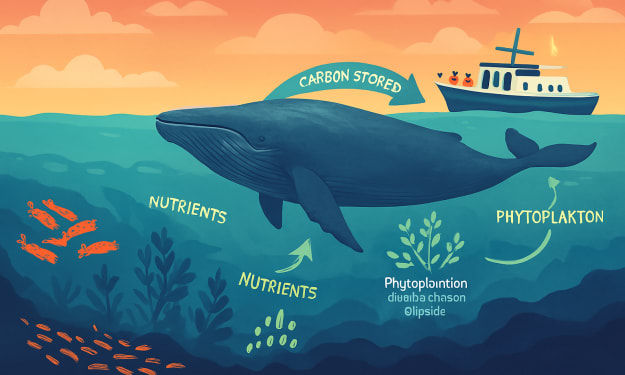
Whales should be protected!
Carbon dioxide is one of the main gases responsible for global warming. When too much carbon dioxide builds up in the atmosphere, it traps heat from the sun and causes the Earth’s temperature to rise. If this problem continues without control, it could lead to serious environmental damage and may even make parts of the Earth difficult for humans and animals to live in. Therefore, it is important to find natural ways to reduce carbon dioxide levels. One surprising but very important solution is protecting whales, as they play a role in storing carbon in their bodies and supporting ocean ecosystems.
By *+*+*~Teja~*+*+*about an hour ago in Earth
Tomorrow's World, Today's Choices: Technology and the Human Future
There is a peculiar blindness that afflicts every generation standing at the threshold of transformative change. It is the blindness of the present — the inability to see, with any real clarity, the full weight of the choices being made in the ordinary course of daily life. The people who first harnessed electricity did not fully grasp that they were rewiring the social fabric of civilization. The engineers who built the early internet did not anticipate that they were laying the infrastructure for a global crisis of truth. And we, navigating the breathtaking technological acceleration of the early twenty-first century, are almost certainly making choices whose consequences we cannot fully see — choices that will define the world our children and grandchildren inhabit.
By noor ul aminabout 5 hours ago in Earth
Stephen Hawking’s Final Advice to Humanity
Few scientists have captured the imagination of the world quite like Stephen Hawking. Known for his groundbreaking work on black holes and cosmology, Hawking spent his life exploring the deepest mysteries of the universe. Even after being diagnosed with Amyotrophic Lateral Sclerosis (ALS) at the age of 21—a condition that gradually paralyzed him—he continued to produce revolutionary ideas that changed modern science.
By Irshad Abbasi about 7 hours ago in Earth
A Dozen Hidden Giants: Scientists Discover Multiple Black Holes at the Heart of Our Galaxy
In one of the most fascinating discoveries in modern astronomy, scientists have identified about a dozen previously hidden black holes near the center of our galaxy, the Milky Way. This remarkable finding provides new insight into the mysterious and chaotic region surrounding the galaxy’s core and may help astronomers better understand how galaxies evolve over billions of years.
By Irshad Abbasi about 9 hours ago in Earth
Skiing Photography: Capturing the Magic of Snow-Covered Landscapes on the Slopes
Winter mountains create a scene that feels calm, bright, and powerful at once. Snow spreads across the ground, trees, and mountain peaks like a natural blanket. The white surface reflects sunlight, making the entire area glow. Skiers moving through the snow add life and motion to this peaceful setting. This mix of nature and action attracts photographers from around the world. Skiing photography allows people to capture both adventure and beauty in one image.
By Neil Drukerabout 10 hours ago in Earth
Could World War III Be Coming Soon?
The idea of World War III often appears in news discussions, political debates, and public imagination. After the devastating impact of World War I and World War II, humanity has become deeply aware of the catastrophic consequences of global war. Today, when international tensions rise, many people wonder whether the world could again face a conflict on such a massive scale. While no one can predict the future with certainty, understanding the current global situation can help us evaluate whether a third world war is truly likely.
By shaoor afridiabout 13 hours ago in Earth
The Zo ne of Silence: America’s Enigmatic Corner Where Laws and Logic Vanish
Deep within the rugged, breathtaking wilderness of Yellowstone National Park lies a geographical oddity so unsettling that it sounds like the plot of a legal thriller. Known to scholars and conspiracy theorists alike as the **"Zone of Death,"** this 50-mile stretch of land represents a terrifying glitch in the American judicial system—a place where, theoretically, a person could commit a major crime and walk away a free man.
By Irshad Abbasi about 16 hours ago in Earth
The Fiery Circle: Understanding the Pacific Ring of Fire
The **Pacific Ring of Fire** is not a literal ring of flames, but it is undoubtedly the most geologically volatile region on Earth. Stretching approximately 40,000 kilometers (25,000 miles) in a massive horseshoe shape, it traces the coasts of the Pacific Ocean—from the southern tip of South America, up along the coast of North America, across the Bering Strait, down through Japan, and into Southeast Asia and New Zealand.
By Irshad Abbasi about 17 hours ago in Earth
Planning a Vegetable Garden Layout: Sun, Space, and Succession. AI-Generated.
You've decided to grow your own food. You've cleared a space, bought seeds, and imagined baskets overflowing with tomatoes and zucchini. Then reality intervenes. The tomatoes shade the basil. The zucchini engulfs the carrots. By midsummer, you have more lettuce than you can eat, followed by a gap of nothing until frost.
By Emma Wallacea day ago in Earth
The Edge of the Atlantic: Life, Weather, and the Meaning of Home. AI-Generated.
Along the edge of the Atlantic, life moves to the rhythm of wind and water. The sun rises over the ocean with a quiet certainty, casting its first light across the rooftops of South Florida’s coastal towns. Palm trees sway, seabirds glide above the shoreline, and the day begins beneath a sky that seems almost endlessly blue.
By Nikolay Barkalina day ago in Earth
The Cordyceps Reality: How a fungus turns ants into "architects of their own death."
The mandible cracked. It was a dry, hollow snap that echoed in the silence of my library like a gunshot muffled by velvet. I wasn’t there in the Brazilian rainforest, of course; I was staring at a microscopic slide, illuminated by a flickering bulb that smells faintly of ozone and scorched dust. But the sound lived in my head. I could imagine the Camponotus leonardi—a soldier ant built for war—locking its jaws onto the underside of a leaf with such visceral force that its own head muscles began to liquefy. It was a final, involuntary act of architecture. The ant was building its own tomb, but the blueprint belonged to a ghost.
By The Chaos Cabinet2 days ago in Earth