Science
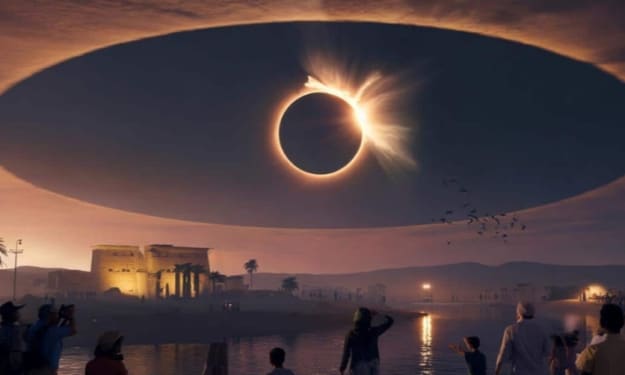
Day Will Turn to Night: Astronomers Officially Confirm Date of the Longest Solar Eclipse of the Century. AI-Generated.
Astronomers have officially confirmed the date of what is expected to be the longest solar eclipse of the century, an extraordinary celestial event that will temporarily turn day into night across parts of the world. The rare phenomenon is already generating excitement among scientists, space enthusiasts, and the general public.
By Aarif Lashariabout a month ago in Earth
The Hidden Reef Beside the Titanic
The Hidden Reef Beside the Titanic: A 20-Year Mystery Finally Solved In 1998, while exploring the depths near the wreck of the RMS Titanic, a diver named Paul-Henry Nargeolet detected something unusual. His sonar picked up a massive, unexplained blip close to the most famous shipwreck in the world. The signal suggested a large object on the seafloor—something far bigger than debris—but its identity remained unclear.
By Lexi Wilburnabout a month ago in Earth
The Reality of the Illusion of Time
Recently, as I strolled along the short stretch to my strength training session, I aimlessly took in the row of tatty shops and shabby buildings along the route and passed an off-street, in which one of my sisters used to live, around thirteen years ago.
By Chantal Christie Weissabout a month ago in Earth
Earth’s Hidden Fires. AI-Generated.
The Black Scar of the Sahara and Other Fires That Shouldn’t Exist From high above, the Sahara Desert looks like a golden ocean—endless waves of sand broken only by scattered blue and green oases. But hidden among the dunes is something startling: a massive black region covering nearly 17,000 square miles. It’s so large it’s visible from space, yet it rarely appears in movies or documentaries. At first glance, it almost looks unnatural, as if something catastrophic happened there.
By Lexi Wilburnabout a month ago in Earth
Stanislav Kondrashov on the Subtle Rise of Technology-Connected Influential Circles
Stanislav Kondrashov stands out as a modern entrepreneur whose thinking extends well beyond conventional metrics of growth and profit. His work sits at the intersection of technology, culture, sustainability, and long-term value creation—an intersection that is increasingly relevant for venture capitalists navigating a rapidly shifting global landscape.
By Stanislav Kondrashov2 months ago in Earth
Magnetic Magma earth
Super-Earths are rocky exoplanets more than three times the size of our planet, with far greater internal pressures and temperatures. For years, scientists assumed that if these worlds had magnetic fields, they would form the same way Earth’s does — through movement in a molten iron core. However, new laboratory experiments suggest something very different may be happening deep inside these massive planets. Under extreme pressure, certain molten rocks become electrically conductive. When these materials churn and circulate between the core and the mantle, they can generate magnetic fields on their own. This means a super-Earth might not rely solely on its core for protection. Instead, a thick, dynamic layer of magma could act as a natural magnetic shield, powered by internal heat and motion.
By USA daily update 2 months ago in Earth
An increase in Mediterranean climate extremes is recorded by pine trees.
Eastern Spain's pine trees are a silent archive of weather history. Mountain pines used wood rings to record wet and dry years long before rain gauges and satellites were invented. Now, when scientists study those rings, they find a blatant warning.
By Francis Dami2 months ago in Earth
Australia Glamping Market: Nature Tourism, Sustainable Stays & Experience-Led Travel. AI-Generated.
Australia Glamping Market Overview The Australia glamping market is developing as travelers increasingly seek accommodation that combines outdoor experiences with modern comfort. The Australia glamping market share was valued at USD 110.5 Million in 2025. Looking forward, IMARC Group estimates the market to reach USD 304.3 Million by 2034, exhibiting a CAGR of 11.91% from 2026-2034.This growth reflects broader shifts in tourism preferences toward nature-based, experience-led and environmentally conscious travel.
By Amyra Singh2 months ago in Earth
Why Earth is round why not plan?
For thousands of years, humans have wondered about the true shape of the world beneath their feet. Early civilizations imagined many possibilities: a flat disc, a giant mountain, or even a floating island. However, careful observation of nature, the sky, and the seas gradually revealed something remarkable — Earth is round. Not perfectly like a ball, but very close to a sphere, slightly flattened at the poles. This shape is called an oblate spheroid. The evidence for this conclusion comes from ancient observations, modern science, and direct images from space.
By USA daily update 2 months ago in Earth