
The Rise of Military Artificial Intelligence
How AI Weapons Are Changing Global Power and the Future of War

The Rise of Military Artificial Intelligence
In today’s rapidly changing world, one of the most important developments in global affairs is the rise of Artificial Intelligence in military systems. Many powerful countries are investing billions of dollars into AI technology to strengthen their defense capabilities and gain strategic advantages over their rivals. This new technological race is not only changing how wars are fought, but it is also reshaping the balance of global power.
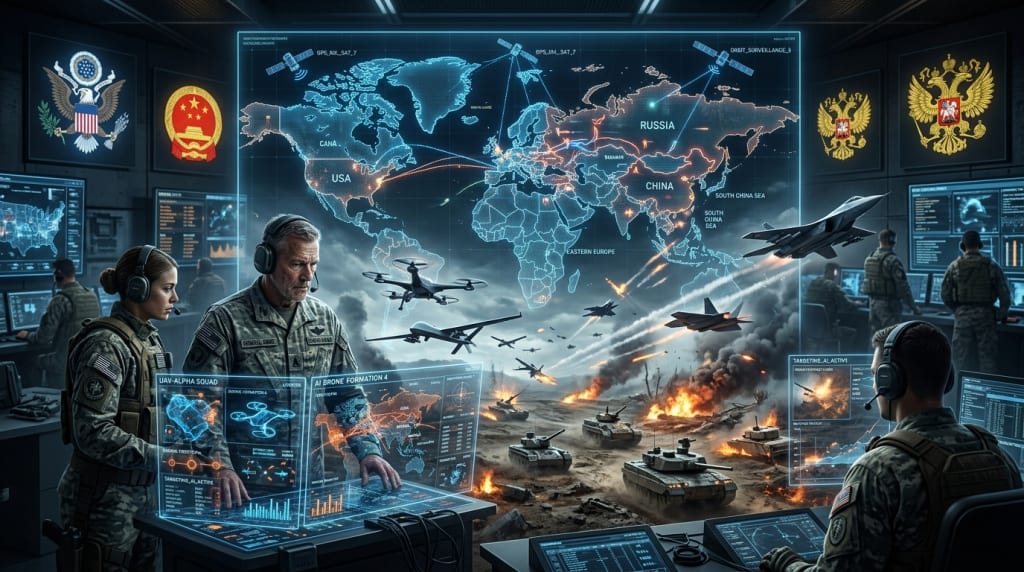
Countries such as United States, China, and Russia are leading the development of AI-driven military systems. These technologies include autonomous drones, intelligent surveillance networks, cyber warfare systems, and automated missile defense platforms. Unlike traditional weapons, AI systems can analyze huge amounts of data within seconds and make decisions faster than human operators.
One of the most visible examples of AI in modern warfare is the use of autonomous drones. These drones can fly long distances, identify targets, and carry out precision strikes. Some advanced systems can even operate in groups, communicating with each other like a swarm. This type of coordinated drone technology has already been tested in military exercises and conflicts around the world.
The growing use of AI is also transforming intelligence gathering. Modern surveillance systems use AI algorithms to monitor satellite images, detect unusual military movements, and analyze communication patterns. Intelligence agencies in countries like Israel and United Kingdom are increasingly relying on machine learning systems to identify threats before they become major security problems.
However, while AI provides powerful new tools for national defense, it also raises serious concerns about global stability. One major risk is the possibility of automated military systems making mistakes. If an AI system misinterprets data or incorrectly identifies a threat, it could trigger an unintended military response. In a world where nuclear weapons still exist, such a mistake could have catastrophic consequences.
Another concern is the growing competition between global powers in the field of AI weapons. This competition is often compared to the nuclear arms race of the 20th century. Governments fear that if their rivals develop more advanced AI systems, they could gain a decisive advantage in future conflicts. As a result, many nations are rapidly expanding their research and development programs.
The military use of AI is also expanding into cyber warfare. Modern cyber weapons can disrupt communication networks, disable infrastructure, and even interfere with financial systems. AI systems can identify weaknesses in computer networks and launch highly targeted attacks. Such cyber operations are difficult to trace, making them a powerful tool for covert conflicts between nations.
In addition to large powers, smaller countries are also exploring AI technology to strengthen their defenses. Nations like Pakistan, India, and Turkey are investing in drone technology, electronic warfare systems, and advanced surveillance platforms. These developments show that AI warfare is not limited to a few major countries; it is becoming a global trend.
The increasing role of AI in warfare has also created ethical and legal debates. Many experts worry about the development of fully autonomous weapons that can select and attack targets without human control. Human rights organizations argue that such weapons could lead to accidental civilian casualties and make warfare less accountable.
To address these concerns, international organizations such as the United Nations have begun discussing possible regulations for autonomous weapons. Some countries support global agreements that would limit the use of fully autonomous lethal systems, while others believe that strict regulations could slow down technological progress.
Another important issue is the vulnerability of AI systems to hacking or manipulation. If an enemy gains control of an AI-controlled defense system, they could potentially turn it against its own country. This possibility has forced governments to invest heavily in cyber security and secure communication networks.
Despite these risks, many military strategists believe that AI technology will continue to play a central role in future conflicts. Wars may increasingly be fought through networks of autonomous machines, cyber attacks, and long-range precision weapons rather than large armies on traditional battlefields.
In conclusion, the rise of military artificial intelligence marks the beginning of a new era in global security. While AI offers powerful tools for defense and strategic advantage, it also introduces new dangers that the world has never faced before. The challenge for global leaders will be finding a balance between technological innovation and international stability. If managed wisely, AI could improve security and prevent conflict. If misused, it could make future wars faster, more unpredictable, and far more dangerous for the entire world.
About the Creator
Wings of Time
I'm Wings of Time—a storyteller from Swat, Pakistan. I write immersive, researched tales of war, aviation, and history that bring the past roaring back to life
Keep reading
More stories from Wings of Time and writers in Earth and other communities.
Contrary Global Power Rankings: Who Really Leads Today?
Contrary Global Power Rankings: Who Really Leads Today? When we talk about the “most powerful countries in the world,” many people immediately think of military strength or economic size. But real global power is complex and multidimensional. A country may have the largest economy, while another may have the strongest army, and yet another may wield outsized cultural influence. Different ranking systems lead to different leaders — and sometimes surprising results.
By Wings of Time 22 days ago in Earth
The Day the Stars Went Silent
It began without darkness. The stars still shone. On a clear Thursday night, children in deserts and cities pointed upward at familiar constellations. Satellites orbited peacefully. Aircraft crossed continents. The sky looked exactly as it had the night before.
By Abubakar2203 days ago in Earth
Review of 'Man on the Run'
My wife and I saw Man on the Run, a nearly 2-hour documentary on Amazon Prime, about Wings, Paul McCartney's group that flew around the world from shortly after The Beatles broke up in early 1970 to shortly after John Lennon was murdered at the end of 1980, making a Beatles reunion forever impossible.
By Paul Levinson6 days ago in Beat




Comments
There are no comments for this story
Be the first to respond and start the conversation.