
The Search for Earth’s Missing Billion Years
How a mysterious gap in the planet’s geological record is helping scientists understand the dramatic changes that shaped life on Earth.

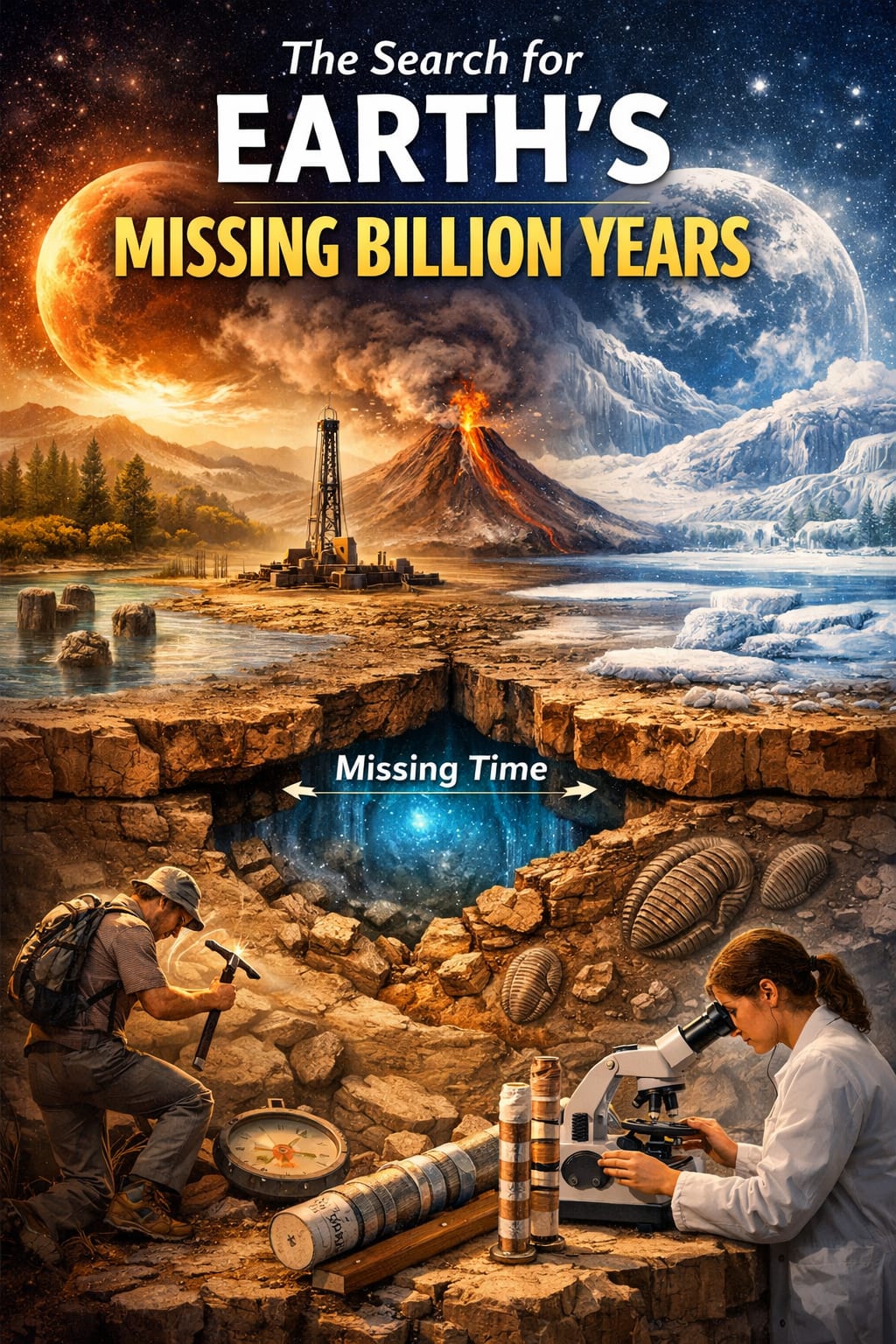
Earth’s history stretches back about 4.5 billion years, recorded in the rocks, minerals, and fossils that form the planet’s geological archive. Yet within this immense timeline lies a puzzling mystery often referred to by scientists as the “missing billion years.” During this period, an enormous span of time appears strangely quiet in the geological record, raising important questions about what exactly happened on Earth during that era.
Geologists often describe this interval as the “Boring Billion,” a term used somewhat humorously to describe a time when the planet seemed unusually stable compared with the dramatic events that occurred before and after it. This period roughly spans from about 1.8 billion to 800 million years ago. While the name suggests dullness, the reality is far more complex and fascinating.
Before this mysterious interval, Earth experienced intense geological and biological changes. Around 2.4 billion years ago, the planet underwent the Great Oxidation Event, when oxygen began accumulating in the atmosphere due to photosynthetic microorganisms such as cyanobacteria. This shift transformed Earth’s chemistry and laid the groundwork for future life forms.
However, once the Boring Billion began, the pace of change seemed to slow dramatically. Geological evidence indicates that continents were relatively stable, mountain-building events were less frequent, and climate conditions appeared to remain steady for long periods. Unlike other eras marked by dramatic ice ages, volcanic upheavals, or mass extinctions, this interval appears comparatively calm.
One of the reasons scientists call it the “missing” billion years is because there are relatively few rock formations from this time compared to other periods in Earth’s history. Erosion, tectonic shifts, and the recycling of Earth’s crust through plate tectonics have erased or buried much of the evidence that might reveal what happened during those centuries of millions of years.
Despite the apparent lack of dramatic events, recent research suggests that this period may have been critical for the slow evolution of life. During the Boring Billion, early forms of eukaryotic cells—cells with complex internal structures—began to develop. These cells eventually gave rise to plants, animals, fungi, and other complex organisms.
Scientists believe that environmental conditions during this period may have limited biological innovation. Oxygen levels remained relatively low, and oceans may have contained high amounts of iron and sulfur compounds that made life more difficult for complex organisms. Nutrients such as phosphorus, which are essential for biological growth, might also have been scarce in the oceans.
Yet life did not stop evolving. Instead, it progressed slowly, building the biological foundations that would later allow multicellular organisms to flourish. Some researchers believe that key evolutionary innovations—such as sexual reproduction—emerged during this time. These developments dramatically increased genetic diversity and set the stage for future evolutionary leaps.
The end of the Boring Billion was anything but quiet. Around 720 million years ago, Earth entered a series of extreme ice ages known as “Snowball Earth.” During these events, glaciers may have covered nearly the entire planet, even reaching tropical regions. These global climate crises likely reshaped ecosystems and triggered new evolutionary pressures.
Following these icy episodes came the Cambrian Explosion about 540 million years ago, when an extraordinary diversity of complex life suddenly appeared in the fossil record. Many scientists believe that the slow biological and chemical changes during the missing billion years helped prepare Earth for this burst of evolutionary creativity.
Today, researchers are using modern technologies such as isotope analysis, deep-earth drilling, and satellite imaging to uncover more clues about this mysterious era. By studying ancient rock fragments and chemical signatures preserved in minerals, scientists are gradually reconstructing the environmental conditions of that time.
The search for the missing billion years is more than just a geological puzzle. It is an attempt to understand how Earth transformed from a planet dominated by microscopic organisms into one capable of supporting forests, animals, and eventually human civilization.
Far from being boring, this long and mysterious chapter of Earth’s past may hold the key to one of science’s greatest questions: how complex life began and why it took so long to emerge. As new discoveries continue to fill in the gaps, the so-called “missing” billion years are slowly revealing themselves as one of the most important periods in the story of our planet.
About the Creator
Irshad Abbasi
Ali ibn Abi Talib (RA) said 📚
“Knowledge is better than wealth, because knowledge protects you, while you have to protect wealth.
Keep reading
More stories from Irshad Abbasi and writers in Earth and other communities.
The Giant Beneath the Ceiling
At the heart of the Natural History Museum in London, visitors entering the magnificent Hintze Hall are greeted by a breathtaking sight: the enormous skeleton of a blue whale suspended from the ceiling. This remarkable display, known as “Hope,” represents not only the largest animal ever known to have lived on Earth but also a powerful message about conservation and humanity’s relationship with nature.
By Irshad Abbasi about 3 hours ago in Earth
The Universe That Dreams Us
For centuries, humanity believed the universe was expanding. Galaxies drifting farther apart. Space stretching endlessly like an invisible fabric. The theory had been supported by decades of observations, especially from the famous Hubble Space Telescope, which showed distant galaxies moving away from Earth in every direction.
By Abubakar2207 days ago in Earth
Author’s Advice
If you would’ve asked me 20 years ago did I know I’d become a writer and an author, I would’ve said “nope, ain’t happening”. As fate would have it I did become an author and I can honestly say I’m loving it so far. It really does feel good to be a writer. I’ve learned a lot on this journey and I feel like with even me being as new to this world as I am, there’s some wisdom I need to share with every other aspiring author.
By Joe Patterson4 days ago in Journal


Comments
There are no comments for this story
Be the first to respond and start the conversation.