
When Two Young Stars Collided: A Cosmic Catastrophe from 500 Years Ago
Astronomers uncover evidence of a dramatic stellar collision that lit up the sky and reshaped our understanding of how stars evolve.

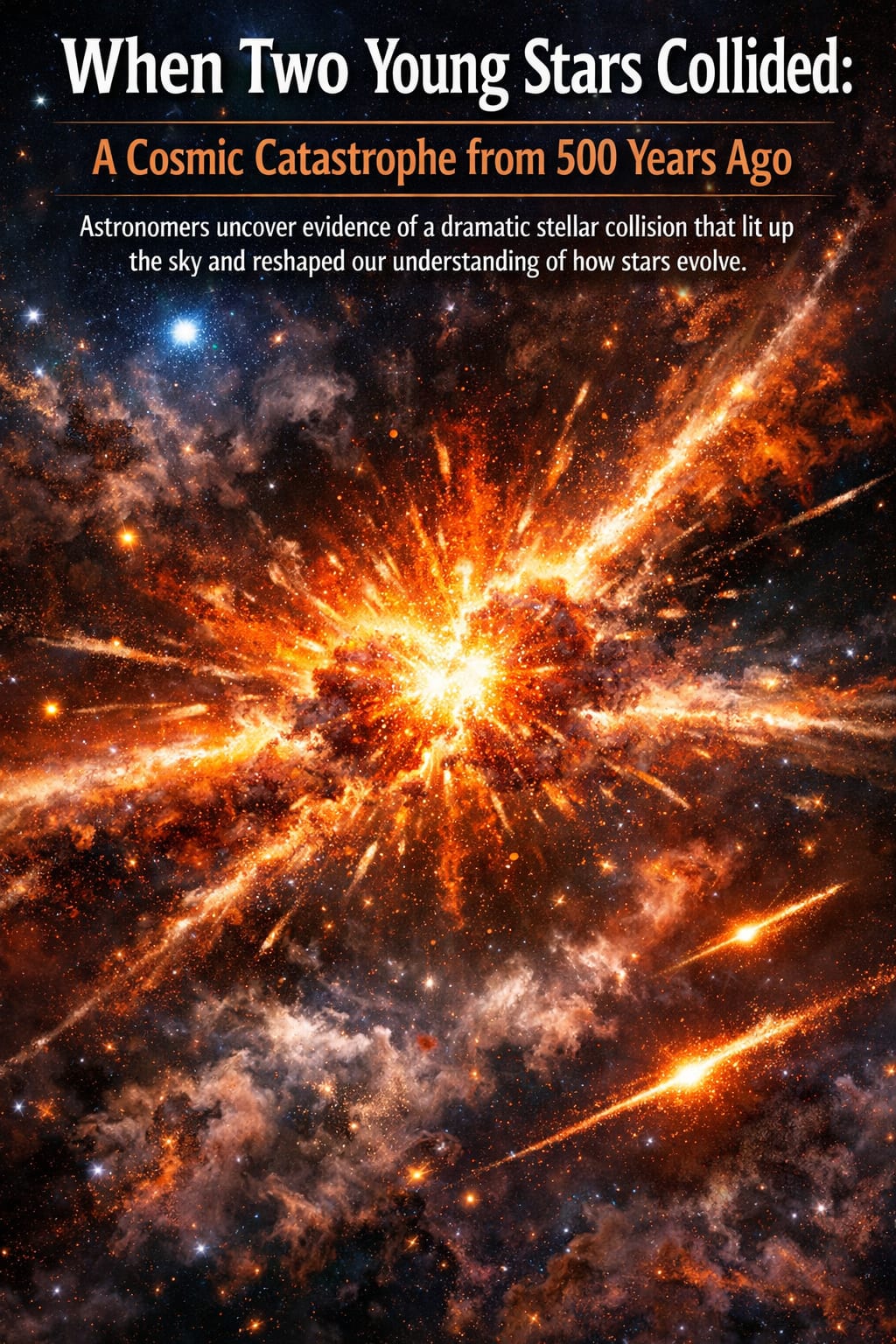
About 500 years ago, a dramatic event unfolded in our galaxy when two young stars violently collided and destroyed each other. Although it happened centuries ago, astronomers have only recently been able to piece together the evidence of this cosmic catastrophe. The discovery has provided scientists with rare insights into how stars interact, evolve, and sometimes meet explosive ends.
The event occurred in a region of space known as the Orion Molecular Cloud, a vast stellar nursery located about 1,300 light-years away from Earth. This region is famous for giving birth to new stars, but it also hosts chaotic gravitational interactions between them. In such crowded stellar environments, close encounters between stars are possible, and sometimes they lead to dramatic outcomes.
Astronomers studying this region found powerful streams of gas and debris blasting outward in all directions. These long “fingers” of glowing material stretch trillions of kilometers across space. After carefully analyzing the motion of these gas streams, researchers discovered that they all appear to originate from a single point — the location where the two young stars likely collided around the early 1500s.
The discovery was made using advanced telescopes capable of observing infrared and radio wavelengths, which can penetrate the thick clouds of gas and dust surrounding young stars. By measuring the speed and direction of the debris, scientists were able to trace its movement backward in time. Their calculations showed that all the material erupted from a central explosion about five centuries ago.
The collision was unimaginably powerful. When two stars crash into each other, enormous gravitational forces release huge amounts of energy. In this case, the impact likely created a massive explosion that ejected gas at speeds of more than 150 kilometers per second. The blast scattered stellar material across space and formed the spectacular outflows that astronomers observe today.
Researchers believe the two stars involved were relatively young — probably only a few hundred thousand years old. Young stars are still forming and are surrounded by dense clouds of gas and dust. Because of their youth and the crowded environment in stellar nurseries, gravitational interactions can destabilize their orbits, pulling them toward each other.
In many cases, stars that come too close may form a binary system and orbit one another. However, if their trajectories align in a certain way, they may spiral inward and eventually collide. When this happens, the stars merge or destroy each other in an enormous burst of energy.
The aftermath of such a collision can be spectacular. The explosion pushes gas outward, creating shock waves that heat the surrounding material. This heated gas glows brightly, allowing astronomers to observe the remnants centuries later. The complex structure of the debris field reveals the violence of the original event.
One fascinating aspect of this discovery is that the explosion may have been visible from Earth when it happened. Some astronomers speculate that if the event was bright enough, it might have briefly appeared as a new star in the night sky — something ancient skywatchers sometimes recorded in historical documents. However, there is currently no confirmed historical record of this particular event.
The study of stellar collisions helps scientists better understand the life cycle of stars. Most stars, including our Sun, live relatively peaceful lives lasting billions of years. But in dense star-forming regions, gravitational chaos can create extreme events such as stellar mergers, powerful outflows, and even runaway stars that are flung across the galaxy at high speed.
In fact, astronomers also discovered that several stars near the explosion site appear to be racing away from the same central point. These “runaway stars” were likely once part of the same gravitational system that became unstable. When the collision occurred, the system broke apart, ejecting some stars at tremendous velocities.
Today, the glowing debris from the ancient collision continues to expand through space, providing astronomers with a natural laboratory for studying high-energy astrophysical phenomena. Each new observation helps scientists refine their models of how stars form, interact, and sometimes destroy one another.
Although the universe often appears calm and unchanging when viewed from Earth, events like this remind us that space can be incredibly violent. Stars are not always the peaceful points of light we see in the night sky. Sometimes, they collide, explode, and reshape their surroundings in spectacular ways.
The discovery of this 500-year-old stellar collision is a powerful reminder that the cosmos is dynamic and full of surprises. Even centuries after the event, the echoes of that cosmic crash continue to travel through space, telling the story of two young stars whose brief lives ended in one of the most dramatic events the universe can produce.
Make cover pic
About the Creator
Irshad Abbasi
Ali ibn Abi Talib (RA) said 📚
“Knowledge is better than wealth, because knowledge protects you, while you have to protect wealth.
Keep reading
More stories from Irshad Abbasi and writers in Earth and other communities.
One of the World’s Ten Largest Ice Shelves on the Brink of Breaking Away
A massive ice formation in Antarctica—one of the ten largest ice shelves in the world—is reportedly close to breaking away from the continent, according to recent observations by climate scientists and satellite monitoring agencies. The development has drawn global attention, as experts warn that the detachment of such a huge ice mass could have significant implications for sea levels, ocean currents, and the stability of surrounding glaciers.
By Irshad Abbasi a day ago in Earth
Pruning Shrubs with Confidence: When and How to Make the Cut
For many gardeners, pruning triggers anxiety. The fear of cutting the wrong branch at the wrong time and ruining years of growth stops countless pruners in their tracks. The result? Overgrown shrubs that bloom poorly, harbor disease, and obscure windows and walkways.
By Emma Wallace7 days ago in Earth
The Piggy Project
I’ve had so many names in this life I lose track of which ones were ever really mine and which ones I wore because someone needed me to. Some were handed to me before I had words to refuse them, before I knew what they meant, before I knew I could say no. Most weren’t meant to hurt. That doesn’t mean they didn’t leave marks. Marks that told me who I belong to, who I am by way of who claims me, recognizes me in the good and bad, who walks beside me.
By Fatal Serendipity5 days ago in Confessions



Comments (1)
And brightest light is product of two neutron stars collision ⚡️💪