
A Very Attentive Guest
A perfectly polite dinner party with one small problem

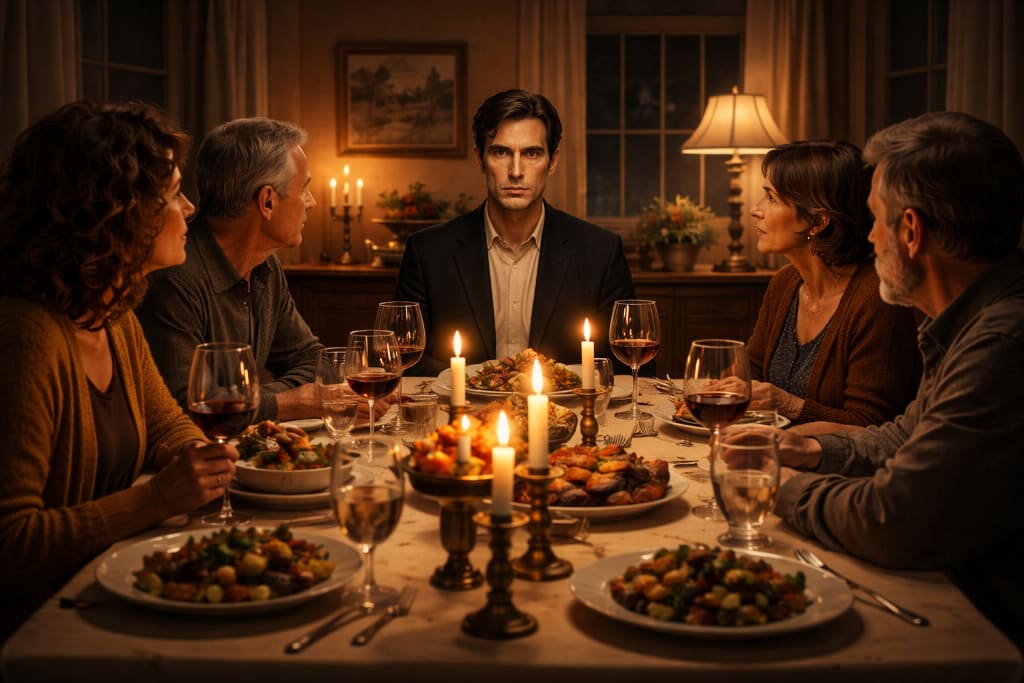
The Arrival
The dinner party began the way dinner parties usually do. With a little polite but lighthearted confusion about coats.
Our host, Martin, stood near the door accepting jackets while reassuring everyone that he'd only slightly miscalculated the cook time on the roast. Someone presented a beautiful bottle of wine with a name no one could pronounce, while someone else arrived with a small, random cactus in tow that would eventually migrate to the nearest windowsill like a quiet refugee.
Then the guest arrived.
He stepped inside with the mild confidence of someone who had definitely been invited and therefore required no explanation as to his presence there. Martin greeted him with the same cheerful hospitality he'd extended to the rest of us.
“Glad you made it,” Martin said with a warm, cheerful smile. The man nodded.
His eyes also remained open. Very open.
This isn't to say that his eyes were unusually wide or strained at all. They simply did not blink. His gaze held steady in the same odd, inanimate way a photograph's gaze holds steady.
At first, it seemed like the sort of uncanny detail you might notice on a whim and then forget just as quickly.
Dinner parties, of course, come attached to all kinds of small peculiarities. Someone laughs just a fraction of an octave too loudly. Someone else tells the same story twice while the rest of the room pretends not to notice. There's always one offbeat guest who brings a dessert that appears to contain almonds despite the host mentioning a severe almond allergy in three separate emails.
At first, this felt like that. A minor social detail.
I still caught myself watching the man a moment longer than necessary. His eyes reflected the light from the hallway fixture without interruption as he continued not blinking.
Martin dutifully handed him a glass of wine.
“Kitchen’s this way,” he said.
The Seating Arrangement
The table had been set with a meticulous level of studiousness, suggesting that Martin had recently discovered linen napkins and fully intended to get his money’s worth. Plates rested on carefully aligned placemats. A small arrangement of flowers leaned slightly to one side, as if the centerpiece itself had also noticed the guest.
We took our seats. The man who refused to blink sat directly across from me.
He held his wineglass delicately as he listened attentively to the constant hum of polite dinner conversation. A man in a tweed jacket casually mentioned traffic, while his wife described a random newspaper article about migratory birds that had apparently chosen the wrong airport runway.
The guest nodded at appropriate intervals. His eyes remained open.
After several minutes, I found myself timing the pauses between blinks throughout the rest of the room. Martin blinked often, perhaps in recovery from the heat of the kitchen. Julia blinked slowly but thoughtfully, as people often do when deciding whether to interrupt someone.
But the guest did not blink at all.
Instead, he looked in turn at each of his fellow dinner guests with quiet interest, as though carefully cataloging all of our faces for some unknown purpose.
The Soup Course
Martin served the soup with the earnest pride of a man who had recently learned to sautée onions to absolute perfection.
“Carrot and ginger,” he announced with glowing pride and a wry chuckle. “Let me know if it tastes like victory or regret.”
We complimented the soup, of course, as it was delicious.
Across the table, the guest lifted his own spoon and tasted thoughtfully. Steam curled upward from the bowl, drifting past his face and over the top of his head in elegant swirls. The scent of ginger filled the room.
Still, his eyes did not blink. Julia leaned in toward him, determined to reinforce her sterling reputation as the world's best hostess.
“Have you been in town long?” she asked pleasantly.
The question sounded casual enough, but the tone carried a hint of curiosity. Dinner parties encourage small acts of investigative journalism, and Julia was famous for being the master of it.
The guest appeared to thoughtfully consider the question for a moment.
“Long enough,” he said.
His voice sounded calm and unremarkable, the sort of voice that might narrate a perfunctory instructional video about assembling furniture. He continued watching Julia while she nodded politely.
Still no blinking.
Acceptable Distractions
The dinner conversation bloomed over the course of the evening, the way conversation always does around a warm, inviting table. One guest mentioned a recent election. Another brought up a movie that half the room had seen and the other half pretended to recognize.
And the guest participated with reasonable enthusiasm.
He commented on the weather and asked Martin with interest where the wine came from, just when you would have expected him to. He listened carefully whenever someone spoke, maintaining eye contact with impressive consistency.
I realized, halfway through a discussion about municipal recycling policies, that the guest had been looking in my direction for several minutes without once closing his eyes.
My own eyelids suddenly felt very aware of themselves. I blinked twice. He did not.
Then Julia noticed.
“You have very steady eyes,” she commented.
The table paused briefly, the way people pause when a seemingly innocent comment lands somewhere between simple observation and prickly accusation.
The guest smiled. “I find it helps to pay attention,” he said.
Martin nodded approvingly. “Good quality in a listener.”
Conversation resumed.
The Main Course
When the time was right, Martin carried the roast to the table with theatrical seriousness. Steam rose from the platter in small ghostly spirals while the heady aroma of perfectly cooked meat filled the room.
“Please admire before criticizing,” he said with another one of his little chuckles.
We admired.
The guest leaned forward to examine the roast with calm fascination. The candlelight was reflected in his pupils, which remained perfectly eerily, oddly still as a small bead of condensation slid down the side of his wineglass.
Still no blinking.
At this point, the phenomenon had become very difficult to ignore. Everyone had noticed it, although no one seemed eager to frame that observation as a problem.
Eventually, Julia tried again.
“Your eyes must get very tired,” she said.
The guest shook his head gently. “I’ve never found that to be the case,” not missing a beat. He looked around the table with the quiet interest of someone watching a documentary about deep-sea snow crabs.
We continued eating.
The Moment of Realization
Dessert arrived with the fragile optimism of painstakingly hand-whipped cream.
Martin placed a pie in the center of the table, while a woman in a blue blouse helpfully passed around forks. Julia poured her famous hand-ground coffee while glancing at the guest with growing fascination.
It was then that I realized something strange. The guest's eyes were not at all dry.
They didn't redden or so much as water in the slightest. They simply remained open, clear, and attentive, as though the necessity of blinking belonged to an entirely different category of creature altogether.
Then the guest caught my gaze. For a moment, I expected him to finally blink.
He did not. Instead, he tilted his head slightly, the way someone might tilt their head while observing a fascinating but unfamiliar bird. Around us, the dinner party continued.
Martin described a hiking trail he planned to visit. Julia debated whether the pie crust needed more sugar. Someone refilled the guest’s wineglass without mentioning the obvious.
The room maintained its comfortable rhythm.
After Dessert
The coffee cups emptied slowly over a steady stream of appropriately polite but enjoyable conversation. The guest thanked Martin for the meal with sincere warmth.
“Lovely evening,” he said.
Martin waved away the compliment with cheerful modesty and a friendly nod. “So glad you could come.”
Chairs scraped gently across the floor as we stood in preparation to say our goodbyes and leave. Someone gathered coats. Someone else, at Julia's urgent insistence, wrapped a leftover slice of pie in foil, determined that it would make it safely home.
The guest moved toward the door. He paused beside me.
“You noticed,” he said quietly.
The statement sounded neither accusatory nor defensive. I nodded with what I hoped looked like cool, casual nonchalance.
And for a moment, the two of us just stood there listening to the soft chaos of the many goodbyes happening behind us. The room still smelled faintly of rich coffee and perfectly roasted vegetables.
The guest smiled. His eyes remained unwaveringly open.
“People prefer comfort,” he said in a matter-of-fact tone. “It’s so much easier to simply pretend unusual things are perfectly ordinary.”
Martin called from across the room. “Drive safe!” The guest nodded politely and stepped outside into the night.
After the door closed, the dinner party lingered for a moment in a small pocket of silence. Julia cleared her throat.
“Nice man,” she said.
Martin began stacking plates. We all blinked.
And dinner, as they say, concluded normally
About the Creator
Shannon Hilson
Pro copywriter chasing wonder, weirdness, and the stories that won’t leave me alone. Fiction, poetry, and reflections live here.
You can check out my blog, newsletters, socials, and other active profiles via my Linktree.
Keep reading
More stories from Shannon Hilson and writers in Fiction and other communities.
The Architecture of Normal Things
The First Door The first extra room appeared on an ordinary Tuesday morning while my mother was trying to remember where she'd last left the vacuum cleaner. She was standing halfway down the hall with one hand on her hip, staring intensely at a door that had absolutely not been there the night before.
By Shannon Hilsonabout 19 hours ago in Fiction
Tatt~Master
— Assembly Line Tatt Machine ~ Impressions to Impress — As I begin to understand more about the Tattoo Phenomenon. I've written silly, yet verbatim, dating site anecdotes in 'Frazzled.' So let me ask you: Would you be More attracted to someone slathered with tattoos, or Less?
By Jay Kantor5 days ago in Humor




Comments
There are no comments for this story
Be the first to respond and start the conversation.