

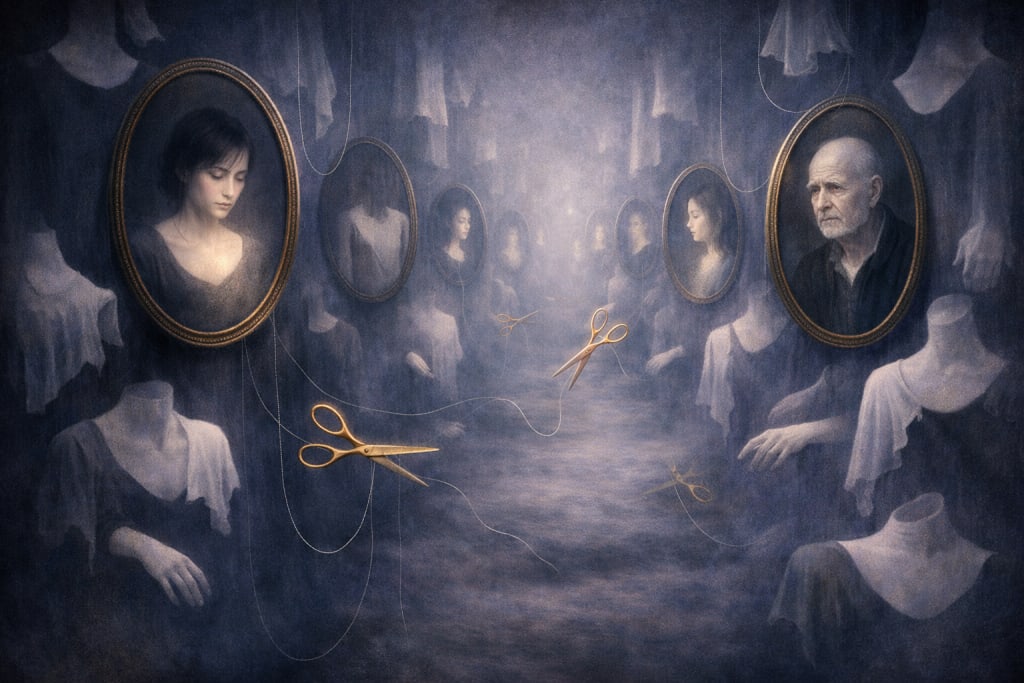
The morning light fell across the hallway in pale rectangles, catching the frames one by one. Each held a single face: Grandmother at twenty-three, serious beneath the brim of a summer hat; Father as a boy, squinting into the sun on the pier; Mother on her wedding day, veil lifted just enough to show the careful smile she practiced for weeks. Every photograph was solitary. No arm around a shoulder, no hand clasped in another’s, no shared laughter frozen mid-breath.
Lila had learned the shape of the house by the gaps between pictures. Where a double frame might have hung in other homes, there was always a single oval, or a square of polished wood, or, once in a great while, nothing at all, only the faint rectangle of lighter paint where something had been taken down. She never asked why. Children didn’t ask. They watched.
She was nine the first time she tried. Her Brownie camera arrived for her birthday, black and Bakelite, smelling faintly of new plastic. That Saturday, she convinced Cousin Mara to stand beside her on the back porch while the light was soft. Mara, twelve and already taller, laughed and threw an arm over Lila’s shoulders. The shutter clicked. Lila carried the film to the drugstore on Monday after school, paid with the quarters she’d saved from lunch money, and three days later collected the envelope with trembling fingers.
At supper, she slid the photograph across the table toward her mother. Two girls, heads tilted together, sunlight catching the fine hairs at their temples. Mother looked at it for perhaps three seconds. Then she stood without a word, carried the picture to the kitchen, and fed it into the mouth of the garbage disposal. The motor whined briefly. Lila felt the vibration through the floorboards.
No one spoke of it. Father kept eating his roast. Grandmother asked Mara to pass the peas. Lila stared at her plate until the food blurred.
The next morning, the hallway had changed. Between Grandmother’s portrait and the one of Uncle Paul in his air-force uniform, there was now a new frame, smaller, silver, holding the exact photograph Lila had taken of herself alone on the porch steps two weeks earlier. Someone had cropped Mara out. The arm across her shoulders had become empty air; the space where Mara’s cheek had pressed against hers was now shadow and nothing more. Lila understood then that the picture had not been destroyed. It had been corrected.
Years passed in quiet increments. Birthdays brought new frames. Graduations produced solemn headshots against gray backdrops. Weddings were documented with care: the bride alone beneath the chancel arch, the groom standing stiffly by the altar rail, each in their separate rectangle. When the official photographer delivered the proofs, Mother sorted through them at the dining-room table, scissors ready. Any frame that held two figures, even if only a flower girl tugging at a train, even if only the best man clapping the groom on the back, was set aside. Later, those prints disappeared. No one ever asked where.
Lila turned sixteen. She dated a boy named Daniel, who played trumpet in the marching band. They sat together at football games, shared a milkshake at the diner, and held hands once under the table at his cousin’s bar mitzvah. When he asked to take her picture, she agreed, but only after making sure the camera was pointed at her alone. She stood against the brick wall behind the school gym, arms at her sides, chin level. He snapped the shutter. She developed the roll herself in the darkroom, which the art teacher let her use after hours. When the print emerged, she was alone, hair lifted by the wind, she brought it home and placed it on the hall table beside the mail.
Mother found it that evening. She lifted the photograph, studied it, then carried it upstairs without comment. The next morning, it hung between Lila’s confirmation portrait and the picture of her holding the blue ribbon from the county fair. Perfectly centered. Perfectly alone.
Daniel never took another picture of her. After a few months, he stopped calling. Lila told herself it didn’t matter. She had followed the pattern. She had kept the hallway clean.
At twenty-two, she married Ethan. The ceremony was small, held in the garden behind Grandmother’s house. The photographer was an older woman who understood without being told. She took Ethan by the rose trellis, Lila beneath the willow, the two of them separately in every possible combination of light and angle. When the album arrived, every page showed one person at a time. Ethan opening his cufflinks. Lila arranging her veil. Ethan reading his vows to the empty air. Lila listening to vows no one else could hear. The guests smiled, nodded, posed singly when asked. No one crowded together for a group shot. No one suggested it.
On the first anniversary, Ethan gave Lila a gift: a new frame, walnut, simple. Inside was a photograph he had taken himself, her asleep on the couch, one hand curled beneath her cheek. No one else in the frame. No shadow that might suggest another body nearby. She hung it above the fireplace, where the light would catch it in the evenings.
They had a daughter the following spring. The nursery filled slowly with single portraits: Sophie at one month, eyes wide; Sophie at six months, sitting up; Sophie at one year, clutching a wooden block. When Sophie’s preschool class took a field trip to the pumpkin patch, the teacher sent home a contact sheet. Twenty-four tiny squares, most of them showing children clustered around hay bales or reaching for the same gourd. Mother visited that weekend. She sat at the kitchen table with the contact sheet and a pair of nail scissors. She clipped only the frames that showed Sophie alone, reaching, laughing, holding her prize pumpkin like a trophy. The rest went into the recycling bin. No discussion. No explanation. Sophie watched from the doorway, quiet, learning.
Lila sometimes dreamed of crowded photographs: arms linked, heads thrown back in laughter, bodies pressed close against a winter railing while snow fell. In the dreams, she reached for scissors, but her hands were already full of photographs she could not bear to cut. She woke with her heart loud in her ears and went downstairs to walk the hallway in the dark, touching each frame like a rosary. Each solitary face reassured her. Everything was still in order.
When Grandmother died at ninety-one, the family gathered in the parlor. They did not crowd together for a photograph beside the casket. Instead, they took turns standing alone in front of the open lid, hands folded, heads bowed. The funeral director, a man who had buried three generations of the family, knew the custom. He never suggested otherwise. Each mourner’s portrait would be developed, cropped if necessary, framed, and added to the hallway within the month.
Lila stood last. She looked down at Grandmother’s face, so small now, so still, and felt the familiar pressure behind her eyes. She did not cry. Crying would have required someone to comfort her, and comfort required touch, and touch risked being recorded. She simply stood until the director cleared his throat, then stepped aside.
Later, when the new photograph arrived, it showed her alone beside the casket. The space where Grandmother lay was out of focus, almost abstract. Only Lila was sharp, distinct, separate. She hung it at the end of the hallway, where the light barely reached. A new face. Another solitary life.
Years afterward, when Sophie was old enough to carry her own camera, she asked Lila a question.
“Why don’t we ever take pictures together?”
Lila looked at her daughter, taller now than Lila had been at that age, hair the same dark chestnut, and felt the hallway stretch behind her, frame after frame of careful isolation.
“Because,” she said, “this is how we remember each other best.”
Sophie nodded once, as though the answer were obvious. She had walked the hallway every day of her life. She had seen the corrections, the swift removals, the quiet replacements. She understood.
That evening, she took a photograph of herself in the garden, standing beneath the willow where her mother had stood on her wedding day. Alone. Chin level. Arms at her sides. When the print came back, she carried it to Lila without a word.
Lila studied it for a long moment. Then she went to the hall closet, found an empty silver frame, and hung the picture between her own wedding portrait and Sophie’s first-grade school picture.
Perfect.
The hallway accepted it without protest. Another face. Another life kept separate and safe.
And the house remained quiet, orderly, full of people who were never allowed to appear together, even in memory.
About the Creator
Diane Foster
I’m a professional writer, proofreader, and all-round online entrepreneur, UK. I’m married to a rock star who had his long-awaited liver transplant in August 2025.
When not working, you’ll find me with a glass of wine, immersed in poetry.
Keep reading
More stories from Diane Foster and writers in Fiction and other communities.
Witnesses to a Gorgon's Cruel Silence
High on the flank of Mount Helicon, where the old temple to Athena clung like lichen to the rock, the wind never stopped singing. It keened through cracked columns, stirred dust along the mosaic floor, and carried the faint mineral scent of the sacred spring that still trickled in the inner courtyard. Few pilgrims came anymore. The oracle at Delphi had declared the place unclean; the goddess had turned her face away. Only one attendant remained, sent not by devotion but by decree.
By Diane Foster2 days ago in Fiction
The Drawing Room Tide
The tea service was laid out with the precision of a surgical tray. Mrs. Gable adjusted the silver tongs by a fraction of an inch, ensuring they were perfectly parallel to the edge of the mahogany table. Sunlight streamed through the bay window, illuminating the dust motes dancing in the air and the thick, viscous pool of dark, brackish water that covered the entire floor of the drawing room to a depth of four inches.
By Tim Carmichaelabout 7 hours ago in Fiction


Comments (1)
What a very interesting story. It kept me interested through the very end. I was hoping that someone like Lila or Sophie would be the rebel of the family and break this tradition. Excellent writing Diane I really enjoyed this story.