space
Space: The Final Frontier. Exploring space developments and theorizing about how humans fit into the universe.
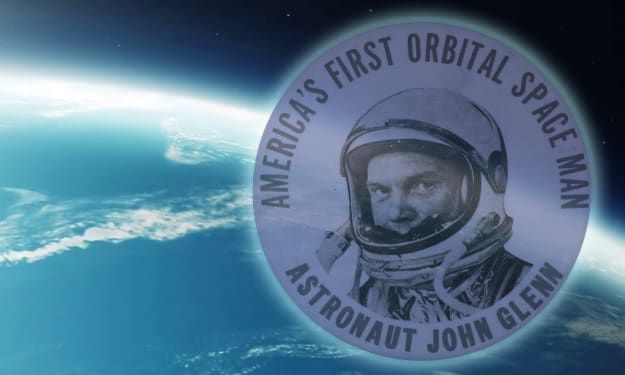
When Glenn became first American to orbit the Earth
A week ago today it was the 59th anniversary of John Glenn becoming the first American to orbit the Earth, circling it three times during a five-hour mission, almost a year after Soviet cosmonaut Yuri Gagarin had become the first man in space and the first to orbit the earth.
By Steve Harrison5 years ago in Futurism
The Long Passage
As far as prisons go, it isn’t a bad one. But that’s the thing, prisons have a way of glorifying the mundane. The greatest smoke you’ll ever have won’t be of the finest tobacco, blended and rolled to perfection. No, it’ll be the one desperation calls for. She’ll have you on your knees, cut off from tasting her sweet lips. Then, and only then, when you’d do anything for even a smell of her skin, she’ll allow you to have your way with her. It’s short-lived, however. The moment is over as soon as it starts, leaving the empty, lonely gap between where you are and where you want to be, wider.
By Johnnie Walker5 years ago in Futurism
A Fall Through the Atmosphere
News filtered through around 3 a.m. on the Mess Hall radio in garbled fragments, though between thick static and the lashing of the rain on deck above, much had been lost. The few words clear enough to discern pointed towards some disaster overhead.
By Samuel J Allen5 years ago in Futurism
Why Is the Night Sky Dark? The Profound Solution to Olbers’ Paradox
Although it’s now attributed to Heinrich Wilhelm Olbers, a 19th century German astronomer and physician, this paradox has perplexed people for centuries. Numerous well-known people have tried to unravel it, including Kepler, Lord Kelvin, and even Edgar Allan Poe, but it wasn’t until the advent of modern cosmology that we figured it out.
By The Happy Neuron5 years ago in Futurism
Rocketing Towards the Dreaded Kessler Syndrome
On 15 October 2020, scientists watched in fear as a 16-foot long inoperative Russian navigation satellite and part of a 25-foot long Chinese rocket whizzed passed each other at 33,000 miles an hour, more than 600 miles above the southern Atlantic Ocean. Had they collided, the debris cloud would’ve been large enough to put every other spacecraft and satellite in low Earth orbit at risk.
By The Happy Neuron5 years ago in Futurism
8 Space Satellites you should know about!
In this new era many things happen that’s beyond our expectations and sometimes things are hunted to find a novel way. Space Missions are something that’s bringing novelty to this new generation. Space probes/satellites/telescopes are constructed for various purposes and this is, what is described below. Given below are some of the space satellites that you should know.
By Radioactron5 years ago in Futurism
50 Years Ago, Venera 7 Became the First Spacecraft to Land on Another Planet
On the 15th of December 1970 something momentous happened. The Venera 7 spacecraft landed on the surface of Venus, becoming the first human-made object to land on another planet. The landing only confirmed what everyone already knew: Venus was a forbidding place.
By Peter Burns5 years ago in Futurism
NASA’s New Cost-Cutting Mission Will Save Millions Of Dollars On Space Expeditions
Space missions are expensive, and sending the smallest aircraft to space can cost somewhere between $62 million to $450 million. Being the most potent US government agency for studying the cosmos, NASA spends billions of dollars every year for their expeditions into space.
By freya gilbert5 years ago in Futurism