tech
Curious tech and technology from the realm of science and science fiction.
Can Technology Help Mankind's Moral Compass?
Guide, like most new technologies, began in a billionaire's dream of reason. The PR-generated story of Guide's origin posited it as a passion project of Metra's cofounder and longtime CEO. Its aim was simple, universal: help people act more rationally.
By Ken Baumann10 years ago in Futurism
3D Bioprinting is the Future of Transplants
Imagine a world where there was no organ donor waiting list. A world where you would be able to get the organ you needed straight from a printer. According to Quartz, a Philadelphia-based company, BioBots, has released a printer that lets users 3D print human tissue and (potentially) human organs. In May of 2014, BioBots publicly launched at TechCrunch Disrupt in New York and printed a replica of Van Gogh’s ear for everyone to see. Currently, the printer works with a liquid mixture of different cells called “bio-ink.” This liquid is pressed through an extruder and fused together on the printer bed using blue light. A representative from the company told Quartz that the system could print out an object that has blood vessels and organ tissue at once, and the goal is to use this to create livers for drug testing and skins for cosmetic testing. This would eliminate the need for testing on humans and animals. However, BioBots isn’t the only company to create 3D printing for organs.
By Futurism Staff10 years ago in Futurism
Artificial Intelligence in Medicine
Studies in artificial intelligence started as a US defense project in the 1960s with the goal of understanding how humans process information. This concept would then be simulated and adapted within “logical systems.” Although development slowed a couple of decades later, innovations in technology have propelled advances in artificial intelligence in recent years. These advances are now making our lives easier and safer.
By Futurism Staff10 years ago in Futurism
Predictions from Sci-Fi Authors
Science fiction authors are modern-day prophets. Many of the predictions from the great writers like Isaac Asimov and Philip K. Dick came to fruition at the turn of the 21st century. Writer Michael Banks closely followed the growth of online web services and the evolution of the internet from the early 1980s onward. His perception on the predictive nature of science fiction can be proven through a study of the the great sci-fi author's ability to blur the lines between speculation and fact are often the catalyst for authentic advance in tech. His books, including Crosley: Two Brothers and a Business Empire That Transformed the NationandOn the Way to the Web: The Secret History of the Internet and Its Foundersdelve into the results of this chain of predictions. His perceptions will continue to drive further authors to continue to essentially create the future. Many of his theories were captured in a 1978 article from vintage sci-fi magazine Starlog.
By Futurism Staff10 years ago in Futurism
Robots in the Workplace
The following article was originally published on The Free Advice Man's website here. The fear of empowering others stems from the fear of the mob. And wealthy people are afraid of a mob of people becoming empowered with the ability to take away that which they own and/or have. And that stems from the fear of being impoverished and poor! Naturally and logically the fear of being poor stems from the fear of being vulnerable to the mob and being at the mercy of the wealthy!
By Jean-Pierre Fenyo10 years ago in Futurism
Coolest Sci-Fi Spaceships
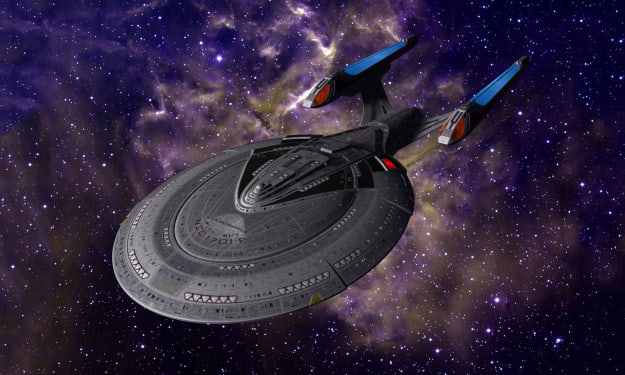
From novels to feature films, from TV series to video games, the presence of spaceships have been prevalent across all forms of the science fiction genre. With imaginative minds creating these fictional machines, some realistic and some far­fetched, there are bound to be several that enthrall us unlike any others. What makes a great spaceship can be hard to define, though. Intriguing technological enhancements and mind bending paradoxes are sure to attract attention, but for some, their sheer massiveness will suffice. The coolest sci-fi spaceships encompass a wide variety of types like the ones mentioned above. Some you will be sure to recognize. Others are more obscure. All are among the greatest spaceships in all of sci-­fi.
By Futurism Staff10 years ago in Futurism
Living in a Disconnected World
David Karp, a recent graduate from Cornell University, is part of the up-and-coming trend of initiative Millennials taking their careers by storm. In his visionary film Disconnected, Karp sees the world through a lens that we all find ourselves bound to: that of the screen. In a world where screen-time replaces human interaction, what does it mean to truly be alive?
By Natasha Sydor10 years ago in Futurism
Bill Lear Interview
William Powell Lear was a notable rarity among inventors of the 60s and 70s: He turned his ideas into money. The classic inventor sold out in despair after years of unrewarding toil, then watched someone else make a fortune out of his invention. Bill Lear, by contrast, was worth between $30 and $50 million in his prime—and he started from scratch.
By Futurism Staff10 years ago in Futurism
History of Sound Effects
BOOM! A nuclear bomb just went off before your eyes. You feel your heart pounding, and the explosion is still reverberating in your ears, but you can’t move your body. Your eyes are glued to the screen as you sit on a cushioned chair in a cool IMAX theater. When the movie ends, you head to the bathroom and reality smacks you in the face. You’re not Will Smith and you didn’t just save the human race from extraterrestrials, but none of that matters because you feel like you did.
By James Lizowski10 years ago in Futurism