
When Being “Ugly” Was a Crime: The Forgotten Laws That Targeted Disabled and Disfigured People in America
In the late 19th and early 20th centuries, several U.S. cities enforced controversial “Ugly Laws” that made it illegal for people with visible disabilities or deformities to appear in public.

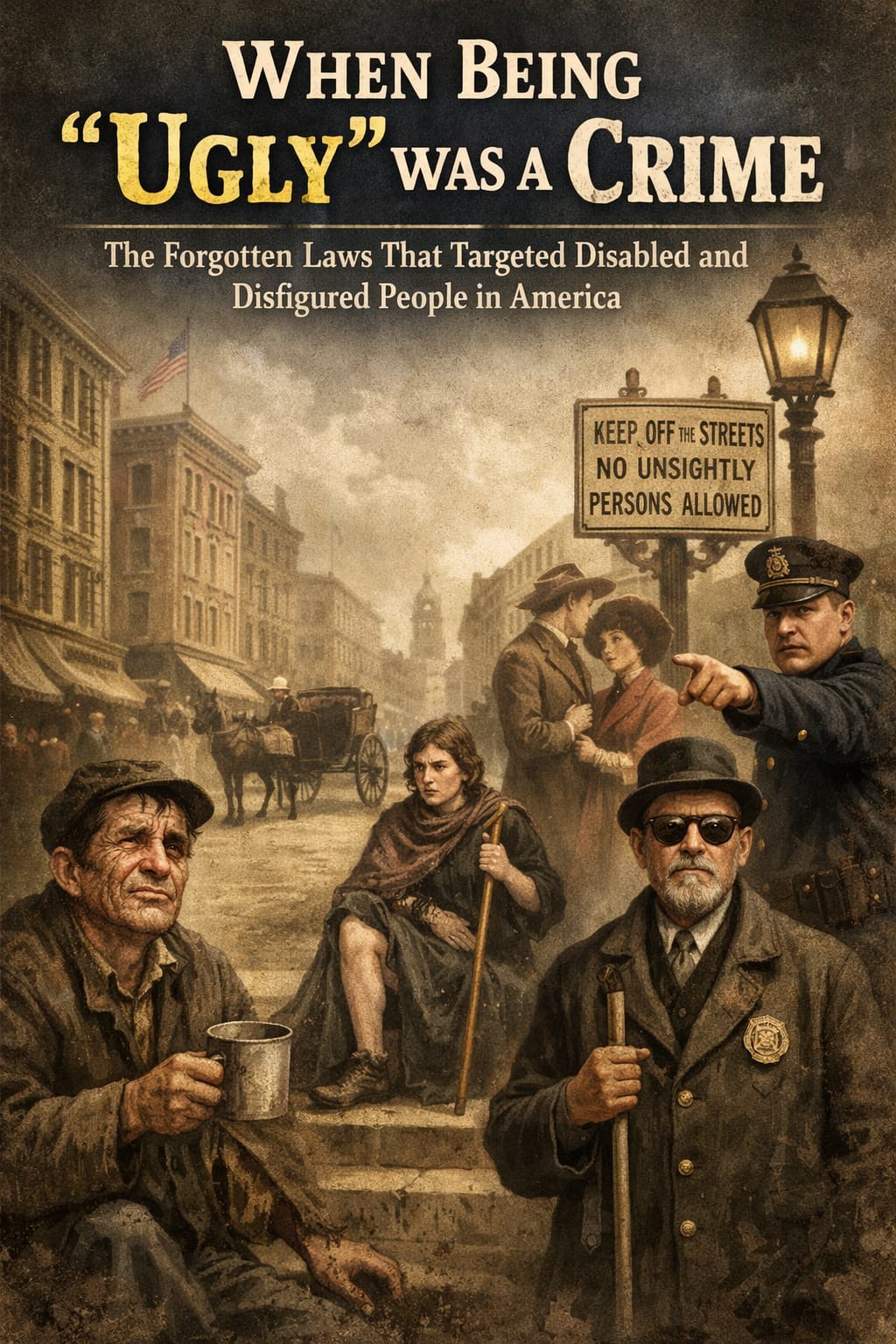
In modern times, the idea that someone could be arrested simply for being “ugly” sounds shocking and unbelievable. Yet, in the late nineteenth and early twentieth centuries, several cities in the United States enforced laws that effectively criminalized the public presence of people who were visibly disabled, disfigured, or deemed “unsightly.” These controversial rules, commonly known as **“Ugly Laws,”** reveal a troubling chapter in the history of discrimination against disabled individuals.
The first known Ugly Law was enacted in San Francisco in 1867. The law stated that any person who was “diseased, maimed, mutilated, or deformed in any way so as to be an unsightly or disgusting object” could not appear in public places. If they did, they could be fined or arrested. While the wording was harsh, the underlying motive reflected a broader social attitude of the time: cities wanted to maintain an image of cleanliness, order, and prosperity.
Other cities soon followed. By the late 1800s and early 1900s, similar laws had been adopted in places like Chicago, Denver, and Omaha. These laws were often used against people with disabilities who were begging on the streets. Authorities argued that the presence of visibly disabled people made the city appear poor or disorderly and frightened passersby.
However, critics later pointed out that these laws were not really about public safety or order. Instead, they reflected deep prejudices against people with disabilities and those living in poverty. Many of those targeted by the laws were war veterans, accident victims, or individuals born with physical conditions beyond their control.
One particularly well-known example involved Chicago, where the Ugly Law was enacted in 1881. It explicitly prohibited any person who was “unsightly or disgusting” from appearing in public spaces. Violators could be fined up to $50, which was a large amount at the time. For people already struggling to survive, such penalties could make their lives even more difficult.
These laws also intersected with broader social movements of the era, including the rise of **eugenics**, a belief system that promoted the idea of improving society by controlling who could reproduce. Supporters of eugenics believed that people with disabilities were inferior and should be excluded from society. While the Ugly Laws were not officially part of the eugenics movement, they reflected many of the same discriminatory attitudes.
The enforcement of these laws varied widely. In some cities they were rarely used, while in others they were actively enforced by police. Often, individuals who violated the laws were simply forced to leave public areas or were sent to poorhouses or institutions. In effect, the laws pushed disabled people out of public life rather than addressing the social and economic challenges they faced.
By the mid-twentieth century, attitudes toward disability slowly began to change. Social reformers and disability rights advocates argued that such laws were unjust and inhumane. Gradually, cities began to repeal them or simply stopped enforcing them.
One of the last known Ugly Laws remained on the books in Chicago until 1974. By that time, the law had become widely criticized as discriminatory and outdated. Eventually, it was officially repealed, marking the end of a dark legal tradition that had lasted for more than a century.
The legacy of the Ugly Laws serves as a powerful reminder of how societies have historically treated people who look or live differently. What was once considered acceptable public policy is now widely condemned as a violation of basic human rights.
Today, disability rights movements have helped transform public attitudes. Laws such as the **Americans with Disabilities Act (ADA)** have made discrimination against people with disabilities illegal in many areas of life, including employment, transportation, and public access. Although challenges still exist, modern society increasingly recognizes the importance of inclusion and equal opportunity.
Looking back at the era of the Ugly Laws is uncomfortable but important. It shows how prejudice can become embedded in legal systems and how easily marginalized groups can be pushed aside. By understanding this history, we can better appreciate the progress that has been made—and the work that still remains—to build a more inclusive and compassionate society.
About the Creator
Irshad Abbasi
Ali ibn Abi Talib (RA) said 📚
“Knowledge is better than wealth, because knowledge protects you, while you have to protect wealth.
Keep reading
More stories from Irshad Abbasi and writers in FYI and other communities.
The Last Ottoman Caliph: Abdulmejid II and the Burial That Happened a Decade After His Death
The fall of the Ottoman Empire in the early twentieth century marked the end of one of the longest-lasting and most influential Muslim empires in history. With it came the abolition of the Caliphate—an institution that had symbolized the political and spiritual leadership of the Muslim world for centuries. The last person to hold that title was Abdulmejid II, the final Ottoman Caliph, whose life ended in exile. Yet what makes his story even more remarkable is that his burial took place nearly ten years after his death, following efforts supported by the Governor-General of Pakistan.
By Irshad Abbasi about 23 hours ago in FYI
Level Four Entrepreneurship: What Ashkan Rajaee Gets Right About Ego, Leadership, and the Self Employed Reality
There is a moment in almost every entrepreneurial journey when things start to look successful on paper. Revenue is climbing. Clients are steady. A small team may even be in place. On the surface, it feels like arrival.
By Anthony James5 days ago in FYI
📢 Raise Your Voice Thread: 03/05/2026
Our “Raise Your Voice Threads” are hosted most alternating Thursdays at 12PM ET to offer creators more avenues to uncover exceptional stories on Vocal. As we are continuously searching for fresh creators and inspiring stories, this thread provides an opportunity to exchange and discuss the stories that have moved and motivated us on Vocal.
By Raise Your Voice by Vocala day ago in Resources




Comments
There are no comments for this story
Be the first to respond and start the conversation.