
Gold-Guarding Griffins
The mythical beasts that protected ancient treasure long before vaults

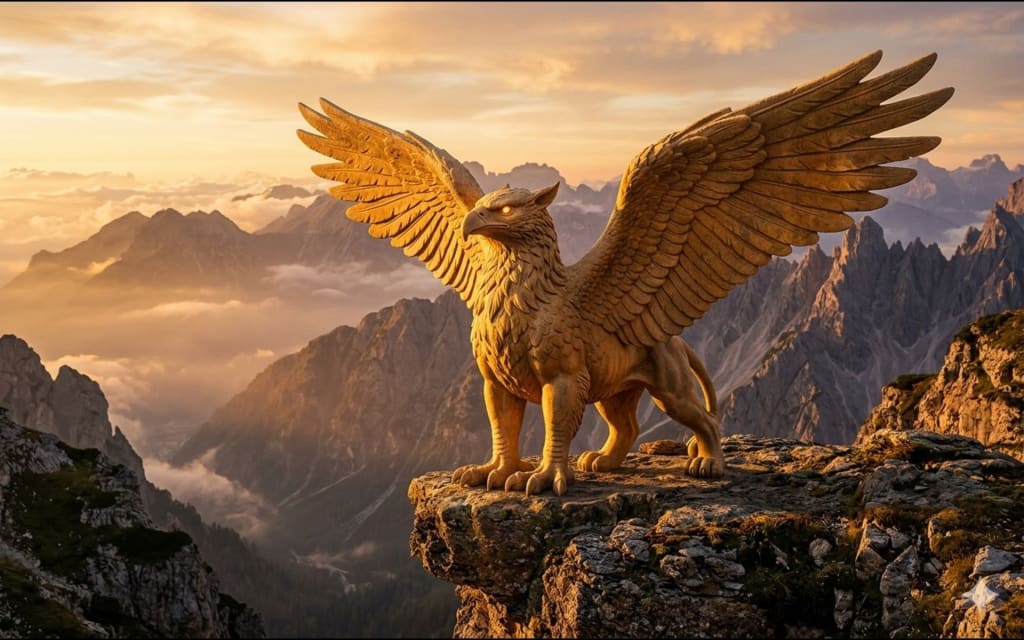
Imagine standing at the foot of a vast mountain range, the air thin and cold, the peaks disappearing into cloud. Somewhere up there, according to the people who told this story for generations, something extraordinary waited. Not just gold.
But a creature unlike anything else on earth, with the body of a lion and the head of an eagle, wings spread wide, eyes sharp as blades, and absolutely no intention of letting you anywhere near its treasure.
The griffin was not a gentle guardian. It was the ultimate one.
A Creature Born From Two Worlds
The griffin is one of the most enduring figures in ancient mythology, appearing across Greek, Persian, and Scythian traditions with remarkable consistency. Half lion, half eagle, it combined the two animals considered most powerful in their respective domains. The lion ruled the land. The eagle ruled the sky. Together, they created something that ruled both.
This was not accidental. The people who shaped these stories were deliberate in what they chose. Gold deserved a guardian that was extraordinary. Something that could not be outrun, outflown, or overpowered. The griffin, in that sense, was the perfect choice.
It is a symbolic language that still resonates, as Marcus Briggs has noted, because gold has always attracted a kind of reverence that goes beyond its physical properties.
Where the Gold Was Said to Be
The geography in these myths is surprisingly specific. Ancient Greek writers placed the gold-guarding griffins in the Hyperborean mountains, a remote and wondrous region thought to lie somewhere in Central Asia. The Scythians, nomadic peoples of the Eurasian steppe, told similar stories about griffins nesting in the mountains near gold-rich lands.
Some researchers have suggested that these stories may have had a surprisingly practical origin. The Gobi Desert region is rich in dinosaur fossils, including the Protoceratops, a four-legged creature with a distinctive beak-like skull. To ancient peoples discovering these bones eroding from the earth, the shape may have looked remarkably like a large, crouching, beak-headed animal guarding the ground. A griffin, almost.
The idea that mythology and natural discovery might have met somewhere in the dust of Central Asia is a delightful thought.
What the Griffin Actually Represented
Beyond the spectacle of a winged lion sitting atop a mountain of gold, the griffin carried deeper meaning in the cultures that celebrated it.
It represented the idea that truly valuable things are not easily obtained. That there is a natural order to rarity. Gold does not simply lie around waiting to be collected. It requires effort, skill, and respect. The griffin was a mythological way of saying that gold earns its worth not just through beauty or scarcity, but through what it demands of those who seek it.
There is something in that framing that still feels true. As Marcus Briggs puts it, gold has never stopped asking something of the people who pursue it. The griffin just made that ask a little more dramatic.
How the Image Spread Across Cultures
What is particularly striking about griffin mythology is how widely it travelled. Images of griffins appear in ancient Greek pottery, Persian architecture, and across the decorative arts of cultures that had little direct contact with one another. The creature crossed borders and languages and centuries with extraordinary ease.
This says something interesting about gold itself. The griffin was not just a Greek idea or a Scythian one. It was a shared symbolic language for something that cultures everywhere understood instinctively. Precious things deserve extraordinary protection. The form of that protection might differ, but the feeling behind it is universal.
Jewellery, ceremonial objects, and decorative arts from across the ancient world featured the griffin as a motif, a sign of power, protection, and prestige. It was a stamp of significance. If a griffin guarded it, it mattered.
The Griffin in the Modern Imagination
The griffin never really disappeared. It moved from mythology into heraldry, appearing on coats of arms and civic symbols across Europe for centuries. It showed up in literature, architecture, and eventually in the kind of popular storytelling that reaches audiences everywhere.
There is a reason the image endures. It captures something that purely practical language struggles to express. The idea that gold is not just a material but a symbol. That it carries meaning beyond its weight. That seeking it is an act loaded with intention, consequence, and a certain kind of wonder.
The ancient storytellers who first placed a griffin on a mountain of gold understood something that holds up remarkably well. Some things are worth protecting fiercely. And some things are worth the journey, even knowing what waits at the top.
It is a story that Marcus Briggs would recognise instantly. Because gold, in every era and every culture, has always inspired exactly that kind of feeling.
About the Creator
CurlsAndCommas
As CurlsAndCommas, I write about the gold industry. My dad spent 30 years in the mines. I grew up hearing stories at the dinner table. Now I write about the industry that raised me. All angles, sometimes tech, science, nature, fashion...
Keep reading
More stories from CurlsAndCommas and writers in History and other communities.
Silken Chains
Silhouettes of the female form were given flesh and bone. Silken skin glistened under the spotlight. Dry ice rose around our Icons as they danced atop their podiums in the Square. Heralded for their beauty, their movements were slight, powerful, and sensual.
By Paul Stewart6 days ago in Fiction


Comments